The short answer
Greyhounds live 10 to 14 years on average. The breed-specific issues to plan for are osteosarcoma (bone cancer, the leading cause of death in the breed), anaesthetic sensitivity (a very lean body handles some drugs differently, so always tell the vet the dog is a greyhound), bloat (life-threatening and surgical), severe dental disease (near universal at adoption from a racing background), thin skin, and paw pad corns (almost unique to the breed). The Melbourne seasonal layer runs both ways: summer heat above 40 degrees is dangerous for a thin-skinned dog, and cool Melbourne winters are genuinely felt by a dog with almost no body fat or coat, so a coat and a warm indoor bed are a real welfare need here. Paralysis ticks are low risk in metro Melbourne and mainly matter if you travel. Pet insurance pays off for the breed more than most, especially if you take it out young. Your local GP vet handles the day-to-day, and hospitals like Lort Smith and the Animal Referral Hospital run emergency and specialist care when it is needed.
Emergency: bloat (GDV) is the deep-chest killer to know cold
Bloat, or gastric dilatation-volvulus, is the most time-critical emergency a deep-chested breed faces. The stomach fills with gas and twists on itself, blood supply is cut off, and without emergency surgery the dog can die within hours. Signs: a swollen, tight belly, unproductive retching where the dog tries to vomit but nothing comes up, restlessness and pacing, heavy drooling, pale or grey gums, and collapse. Do not wait to see if it passes, because it will not. Call ahead and go straight to an emergency hospital. The RSPCA Australia summary at RSPCA on bloat in dogs is worth reading and keeping on your phone.
For emergency care (24/7 unless noted), Melbourne options include Lort Smith (North Melbourne, 8am to 10pm daily), the Animal Referral Hospital at Essendon Fields and the Animal Emergency Centre at Mount Waverley, Advanced Vetcare (Kensington and Kew), and the University of Melbourne teaching hospital at Werribee.
Why greyhounds carry breed-specific health risks
Greyhounds are one of the oldest breeds in the world and have been bred for running for centuries. That long history of selection has concentrated certain genetic patterns, some of which cause health issues, and the modern racing industry has narrowed the lines further. Two things specific to ex-racing greyhounds matter for the adopter.
- Racing wear and tear. Many ex-racers retire with old injuries in the toes, hocks or soft tissue that can affect the joints later in life. Most are mild and manageable; some develop into arthritis.
- Kennel diet history. The high-protein racing diet is calorie-dense but not built for dental health, so most ex-racers arrive with significant dental disease at adoption.
The most reliable sources on greyhound-specific health are the Australian Veterinary Association, the RSPCA Knowledgebase and Victoria's Greyhound Adoption Program (GAP), which vets and rehomes retired racers across the state.
Osteosarcoma (bone cancer)
Osteosarcoma is the most serious greyhound-specific risk. The rate in greyhounds runs several times higher than in the general dog population, and it is the leading cause of death in greyhounds that survive past middle age.
Where it strikes:
It usually affects the long bones of the legs, typically the front leg near the wrist or shoulder, or the back leg near the hip or below the knee. Less often it affects the jaw, ribs or pelvis.
Early signs:
- Unexplained lameness in a leg that does not resolve within 48 hours
- Swelling near a joint
- Reluctance to bear weight on a leg
- Sudden severe lameness with no obvious injury
- Reduced activity or appetite
Any of these in an adult greyhound warrants a vet visit that week. The working rule for the breed: persistent lameness without an obvious cause is osteosarcoma until a vet proves otherwise. Diagnosis starts with an X-ray, and suspicious findings are referred on for imaging and biopsy. Treatment depends on stage and location, and a Melbourne specialist hospital handles the surgery, oncology and pain management. Because these workups get expensive fast, this is one of the strongest arguments for having insurance in place before anything appears.
Anaesthetic and drug sensitivity
Greyhounds process a number of anaesthetics and sedatives differently from other breeds. The reasons are the breed's very low body fat (little tissue to buffer a drug), lean muscle, and a metabolism that clears some drugs more slowly. Standard weight-based dosing that suits a labrador can behave unpredictably in a greyhound.
The practical takeaways, none of which involve naming a drug, because that is your vet's call for the individual dog:
- Say it is a greyhound every single time. At any visit involving sedation or anaesthesia, tell the staff the dog is a greyhound and ask whether the protocol is sighthound-appropriate. This one sentence is the most protective thing an owner can do.
- Use a vet comfortable with the breed. Many Melbourne clinics see greyhounds regularly through the local rescue and GAP network. Ask your rehoming program or your GP vet whether they are set up for sighthound anaesthesia.
- The routine dental clean is a good test. If a clinic handles a greyhound dental clean confidently, you have likely found a vet who understands the breed's anaesthetic needs.
- Complex surgery goes to a specialist hospital. Orthopaedic and oncology cases are referred to a Melbourne specialty centre that manages greyhounds routinely.
None of this means anaesthesia is unsafe for greyhounds. Modern protocols in the hands of a vet who knows the breed are safe. The point is simply that the breed needs a tailored approach, and a vet cannot tailor what they are not told.
Bloat (gastric dilatation-volvulus)
The emergency callout at the top of this page covers the alarm signs. This is the detail. Bloat is when the stomach fills with gas and then twists on its axis, cutting off blood supply to the stomach and spleen. It is a true emergency; the clock runs in hours, not days. Deep-chested breeds including greyhounds sit in the higher-risk group.
Risk reduction your vet may suggest:
- Two or three smaller meals a day rather than one large one
- A slow-feeder bowl if the dog gulps and swallows air
- Avoid vigorous exercise for an hour before and after meals
- Do not let the dog gulp large amounts of water straight after exercise
- Discuss preventive gastropexy with your vet, a surgical tacking of the stomach sometimes done at desexing time for high-risk dogs
- Skip the raised feeder unless your vet specifically recommends it, because the older advice has been revised in recent veterinary literature
None of these guarantee prevention. What saves the dog is recognising the signs fast and already knowing which Melbourne emergency hospital you would drive to at 2am.
Browse adoptable greyhounds in Melbourne
Live listings from Victorian rescues. Rescue greyhounds arrive with a baseline vet check including a dental assessment, and foster carer notes flag any known health issues.
See Available Greyhounds →Severe dental disease
Severe dental disease is nearly universal in ex-racing greyhounds at adoption. The combination of a racing diet, kennel feeding patterns and no routine dental care leaves most retired racers with heavy tartar, gum disease and often loose or rotting teeth.
Reputable rehoming programs, including Victoria's Greyhound Adoption Program, include a full dental clean and any needed extractions before the dog is listed, so it arrives with a clean baseline. Holding that baseline is the lifelong project.
- Daily tooth brushing with dog-safe toothpaste. The single most effective home step, and most greyhounds tolerate it well with patient introduction.
- Dental chews and dental diets to slow plaque between cleans.
- An annual dental check at the vet to catch problems early.
- A professional clean every one to two years under anaesthetic, priced by how many extractions are needed.
- Watch the warning signs: bad breath, reluctance to chew hard food, pawing at the mouth, blood on chew toys, visible tartar or red gums.
Untreated dental disease in greyhounds feeds heart disease, kidney disease and systemic inflammation. It is not a cosmetic issue, and it is one of the reasons the breed benefits from a good dental clause in its insurance.
Thin skin and paw pad corns
Greyhounds have famously thin skin and very little fat under it, which is part of their build, not a fault. In practice it means they nick, graze and tear more easily than a thicker-coated dog, so minor cuts can look dramatic and sometimes need a vet stitch where another breed would scab over. It is also why they need a soft, padded bed to protect the bony points of the elbows and hips.
Corns are the breed's odd one out. These are thickened, painful lesions on the paw pads that cause a distinctive head-bob limp. They are unusually common in greyhounds and rare in most other breeds, thought to relate to the breed's paw structure and possibly to viral causes.
Signs of a corn:
- Sudden onset limp with no obvious injury
- A visible thickened white or yellow spot on a pad, usually a middle pad on a front foot
- Worse on hard surfaces such as footpath or tile than on grass or carpet
- Some dogs lick or chew at the affected paw
Treatment options include hulling (manual removal by a vet, though corns often regrow), surgical excision for a more permanent fix, and pad protection such as greyhound boots or gel inserts to reduce pressure. Melbourne has vets and rescue networks experienced with corns; ask your rehoming program or your GP vet for a referral rather than working through home remedies alone.
Greyhound normal is not dog normal
One of the most useful things a new greyhound owner can know is that the breed's baseline is genuinely different from a textbook dog. Greyhounds have well-documented differences in their normal blood values: higher red blood cell counts and a higher haematocrit from generations of athletic breeding, along with lower platelet counts and lower thyroid readings than most breeds show as their healthy normal.
The practical risk is misdiagnosis. A vet who rarely sees the breed can read a healthy greyhound's bloodwork against standard reference ranges and flag a thyroid or platelet result as abnormal when it is simply greyhound normal. If a result comes back borderline, it is worth asking whether it has been interpreted against greyhound-specific reference ranges. The same applies to body temperature: greyhounds tend to run a slightly lower resting temperature than many breeds, which is another reason a genuinely cold-stressed greyhound should be taken seriously in a Melbourne winter rather than waved off.
Summer heat: the thin-skinned dog on a 40 degree day
Melbourne has a temperate, variable climate, often described as four seasons in one day. Summer sits around a mild 14 to 27 degrees on an average day, then spikes into 40-plus degree days several times a season, and those spikes are the danger window for a greyhound. With thin skin, a thin single coat and little insulating fat, a greyhound heats up fast and has less margin than a heavier breed.
- Walk in the cooler parts of the day, early morning or after sunset. Skip the middle of the day entirely on a 40 degree day.
- Test the footpath with the back of your hand. If you cannot hold it there for five seconds, the pavement is too hot for the dog's paws.
- Carry water on any walk over 20 minutes.
- Never leave the dog in a parked car, even briefly. The interior reaches dangerous temperatures within minutes.
- Watch for heavy panting that does not settle, drooling more than usual, weakness or stumbling. Those are heatstroke signs. Cool the dog with cool (not icy) water over the belly, groin and paws, and get to a vet.
Winter cold: the Melbourne welfare need people underestimate
The seasonal risk that catches new owners out is the other one. Greyhounds have almost no body fat and only a thin single coat, so they feel a cool Melbourne winter far more than a double-coated breed does. This is a genuine welfare consideration in Melbourne, more than it would be in a warmer city, when average winter days sit around 14 degrees and mornings drop to 6 or 7.
- A fitted dog coat for outdoor walks through the cool months. For a greyhound this is standard kit, not dressing the dog up.
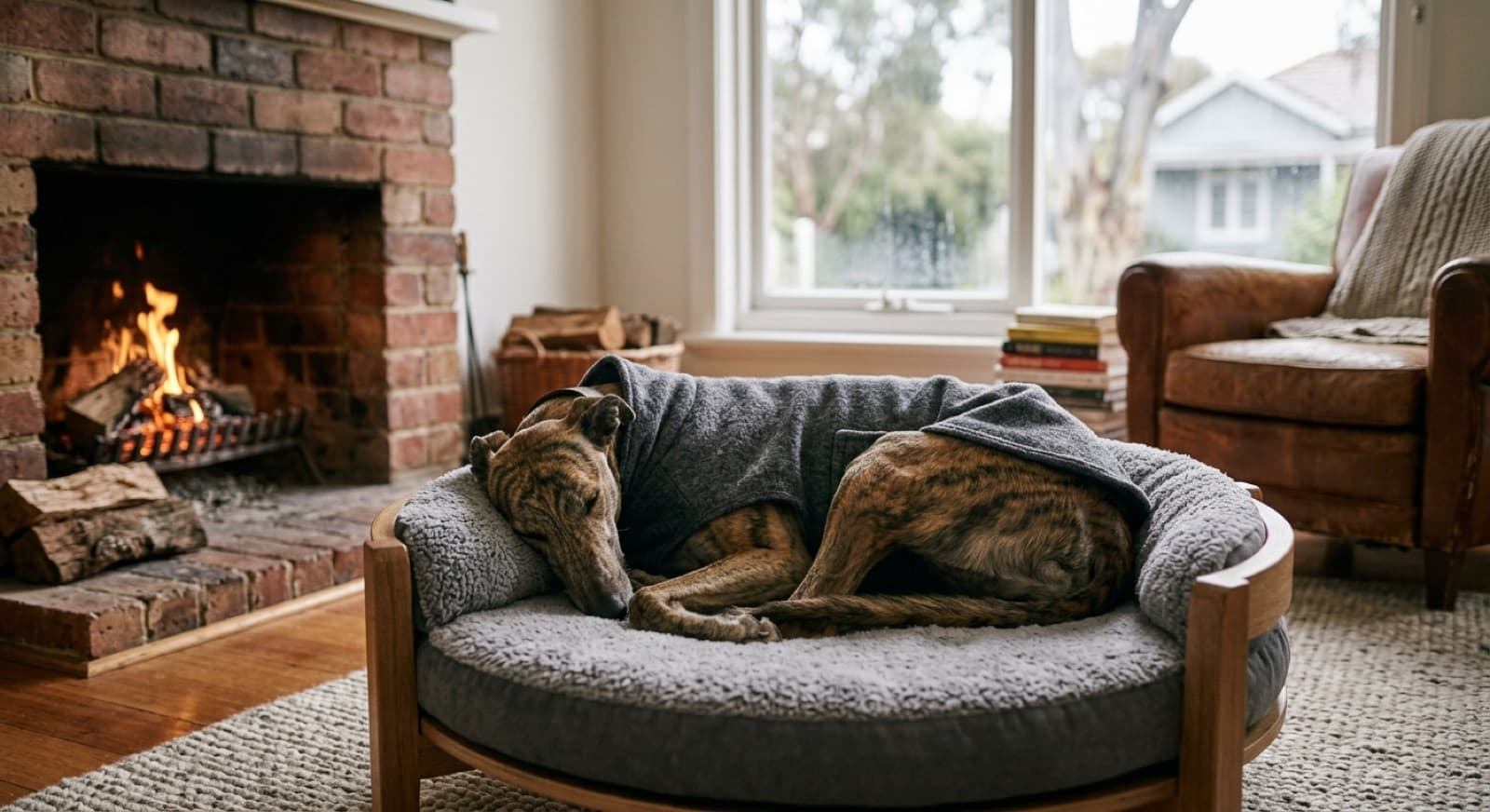
- A warm, raised, draught-free bed indoors, with soft padding to protect the bony elbows and hips that thin skin leaves exposed.
- Greyhounds are indoor dogs. The breed is not built to live outside through a Melbourne winter, and most rescues and the Greyhound Adoption Program place them as inside family dogs for exactly this reason.
- Take shivering seriously. Combined with their lower resting temperature, a cold-stressed greyhound is easy to under-read. If the dog is shaking on a cold morning, it is genuinely cold.
The flip side is that a mild Melbourne day is a greyhound's favourite kind of weather. When you want to let one stretch out safely, choose a securely fenced space, because the breed's recall and prey drive make open areas risky. Our greyhound off-leash and recall guide for Melbourne covers why, and the Parks Victoria dog-friendly index lists the on-lead options.
Fleas, worms and heartworm, and why ticks are the low risk here
If you have read a coastal NSW greyhound-health article, you will have seen paralysis ticks treated as a year-round, life-or-death threat. In metropolitan Melbourne that framing does not apply. The Australian paralysis tick (Ixodes holocyclus) is an eastern-seaboard species whose range runs down the NSW and Queensland coast, and it does not establish populations in Melbourne's climate. A dog that lives and walks in the metro area is at far lower paralysis-tick risk than a dog on the NSW coast. This is a real difference, not a technicality, and it is why localised advice matters.
What actually needs year-round attention in Melbourne is more routine. Fleas and intestinal worms are a constant, and heartworm, spread by mosquitoes and present in Victoria, needs its own prevention. Many owners cover all of these with a single monthly or annual product, and the right combination depends on the dog, so your vet will steer you. The residual tick risk is about travel: if you take your greyhound to the NSW coast or into East Gippsland, use tick prevention before the trip and do daily tick checks while you are there. Agriculture Victoria's animal welfare pages are a useful reference for the broader responsibilities of dog ownership in the state, including council registration under the Domestic Animals Act 1994 (Vic).
Melbourne vet care: who handles what for a greyhound
Day-to-day care: any Melbourne GP vet, ideally one comfortable with the breed's anaesthetic and bloodwork quirks. Take the dog in for an introductory check within a fortnight of adoption and build the relationship early.
Emergencies and specialist referrals (orthopaedic surgery, oncology, internal medicine): Melbourne is well served. Lort Smith in North Melbourne runs an emergency service open every day of the year. The Animal Referral Hospital at Essendon Fields and the Animal Emergency Centre at Mount Waverley offer 24/7 emergency plus specialty referral across the north-west and east. Advanced Vetcare in Kensington and Kew is a 24-hour critical-care and specialist hospital, and the University of Melbourne's teaching hospital at Werribee provides 24/7 emergency and specialist care in the west. Your GP vet refers you when a case needs specialist input, which matters most for bloat surgery and osteosarcoma work.
Pet insurance: is it worth it for a greyhound?
For a greyhound, the case is unusually strong. The conditions the breed faces are exactly the type insurance covers well: expensive, sometimes urgent, and often needing specialist care. An osteosarcoma workup, a bloat admission, or major dental work all add up quickly if you pay out of pocket, and the breed is more likely than most to meet at least one of them over a 10 to 14 year life.
Timing matters more than provider choice. Sign up while the dog is healthy, before any condition is on the vet record, because Australian insurers exclude pre-existing conditions. For a breed that comes with near-universal pre-existing dental disease, read the dental clause carefully, since some policies exclude dental unless it is caused by an accident. Aim for accident-and-illness cover with a high annual limit, and check the excess and reimbursement rate. Major Australian providers to compare include PetSure (which underwrites many brand-name policies), Bow Wow Meow, Petplan Australia and RSPCA Pet Insurance. Read the product disclosure statement on whichever you pick.
Frequently Asked Questions
How long do greyhounds live?
The breed average is 10 to 14 years, and many go longer. Greyhounds are a relatively healthy large breed for the most part, but osteosarcoma (bone cancer) is the leading cause of death in the breed and drives many of the earlier losses. Keeping the dog lean, staying on top of dental care, and treating any limp that lasts more than 48 hours as urgent do the most for both quality and length of life. Across the Victorian rescues we aggregate, well-managed greyhounds commonly reach the upper end of that range.
Why are greyhounds at higher risk of bone cancer?
Osteosarcoma rates in greyhounds run several times higher than in the general dog population. The exact reason is not fully settled: centuries of selective breeding for running have concentrated certain genetic patterns, and the repeated high-impact loading of the long bones during racing may play a part. Early signs are unexplained lameness in a leg, swelling near a joint, and sudden bone pain. If your greyhound is limping for more than 48 hours with no obvious cause, book a vet that week rather than waiting it out.
Why do greyhounds need special anaesthesia care?
Greyhounds have very little body fat, lean muscle, thin skin and a metabolism that handles some anaesthetics and sedatives differently from other breeds. That means standard weight-based dosing can behave unpredictably in the breed. The single most useful thing an owner can do is tell the vet at every sedation or surgery that the dog is a greyhound, and ask whether the team is familiar with sighthound anaesthetic protocols. Your vet chooses the drugs and doses; this article names none, because that is a clinical decision for the dog in front of them.
Is pet insurance worth it for a Melbourne greyhound?
For most greyhounds, yes, more so than for the average breed. The conditions greyhounds are prone to (osteosarcoma, bloat, anaesthetic complications and severe dental disease) are exactly what insurance handles well: expensive, sometimes urgent, often needing specialist care. Get accident-and-illness cover with a high annual limit before any condition is on the record, because Australian insurers exclude pre-existing conditions. Premiums for a Melbourne greyhound sit roughly in the $70 to $120 a month range in 2026 depending on age at sign-up and excess. Providers to compare include PetSure, Bow Wow Meow, Petplan Australia and RSPCA Pet Insurance.
Do greyhounds really get bad teeth?
Yes. Severe dental disease is one of the most common issues in adopted greyhounds. Racing diets and a lack of routine dental care leave most retired racers with heavy tartar, gum disease and often loose teeth at adoption. Reputable rehoming programs such as the Greyhound Adoption Program include a dental clean and any needed extractions before the dog is listed, so the dog usually arrives with a clean baseline. Keeping it that way is the lifelong job: daily brushing, an annual dental check, and a professional clean every one to two years. Untreated gum disease feeds heart and kidney problems, so it is not a cosmetic issue.
What is bloat and how do I lower the risk in my greyhound?
Bloat (gastric dilatation-volvulus, or GDV) is when the stomach fills with gas and twists, cutting off blood supply. It is a true emergency; a dog can die within hours without surgery. Deep-chested breeds including greyhounds sit in the higher-risk group. Risk reduction: feed two or three smaller meals rather than one large one, avoid vigorous exercise for an hour either side of meals, and use a slow-feeder bowl if the dog gulps. Do not add a raised feeder unless your vet specifically recommends it, because recent evidence has revised the old advice. Know the signs cold: a swollen belly, unproductive retching, restlessness and drooling.
Does my greyhound feel Melbourne's cold?
More than almost any other breed. Greyhounds carry almost no body fat and only a thin single coat, so they lose heat fast and feel a cool Melbourne winter genuinely, when average days sit around 14 degrees and mornings can drop to 6 or 7. A fitted dog coat outdoors and a warm, raised, draught-free bed indoors are a real welfare need for the breed here, not a luxury, and matter more in Melbourne than they would in a warmer city. Greyhounds also run a slightly lower resting body temperature than many breeds as their normal, which is worth knowing so a genuinely cold-stressed dog is not dismissed.
Do Melbourne greyhounds need paralysis tick prevention?
For a dog that lives and walks in metropolitan Melbourne, the local paralysis-tick risk is low. The Australian paralysis tick (Ixodes holocyclus) is an eastern-seaboard species that runs down the NSW and Queensland coast and does not establish populations in Melbourne's climate. The real risk is travel: if you take your greyhound to the NSW coast or into East Gippsland, use tick prevention before the trip and do daily tick checks while you are there. Year-round fleas, intestinal worms and mosquito-borne heartworm matter far more day to day for a Melbourne greyhound, so make prevention a conversation with your vet about where you actually live and travel.
Keep reading
Adoptable Greyhounds in Melbourne
Live listings; rescue greyhounds arrive with a baseline vet check and dental assessment.
Greyhound Adoption in Melbourne
The Greyhound Adoption Program, the Victorian rescues, ex-racing reality and the first-week routine.
Greyhound Off-Leash and Recall
Why greyhounds need fenced spaces, the prey-drive reality, and long-line options in Melbourne.
How to Adopt a Dog in Melbourne
The full Melbourne adoption process, paperwork, vet questions and home checks.