The short answer
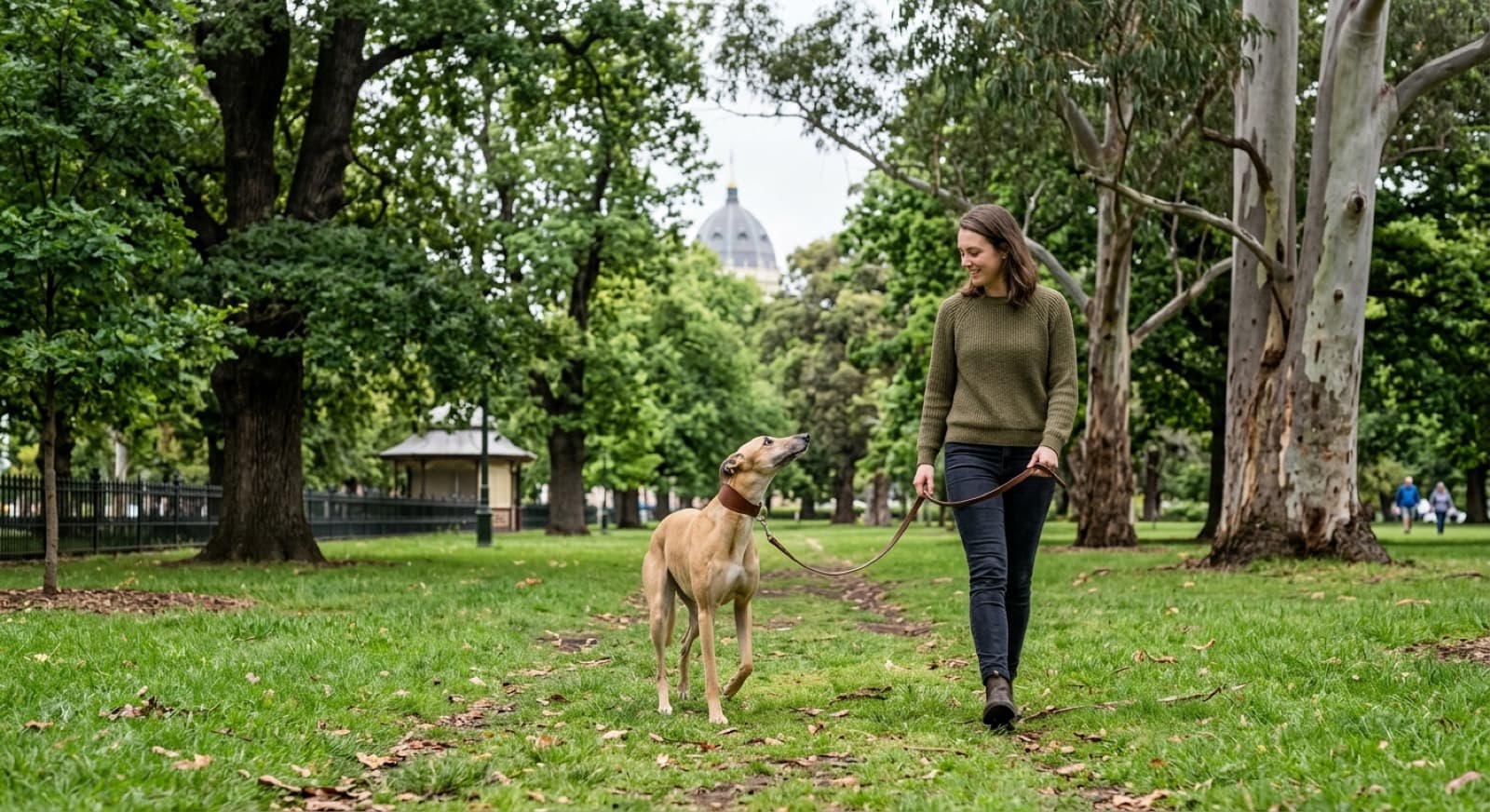
In Victoria a pet greyhound does not have to be muzzled in public. That rule was removed for all pet greyhounds on 1 January 2019, and the old Green Collar muzzle-exemption scheme was retired with it. You may still choose to muzzle, especially early on. What has not changed is the lead rule: a greyhound must be on-lead at all times in a public place, and that includes council off-lead areas and off-lead dog parks. A pet greyhound legally cannot run loose in a public off-lead park in Victoria. So off-lead exercise means a secure, fully fenced private yard or a dedicated fenced dog space where it is permitted, never a public park. The reason for the lead rule is the sighthound prey drive: when a greyhound spots fast movement it can be sprinting at up to 60 to 72 km/h before you finish saying its name, and no recall command competes with that. Use a martingale collar so the dog cannot slip its collar, and a long line for room to move in secure spaces.
The Victorian rules: no muzzle, but on-lead everywhere in public
Start with the two rules, because they are the heart of owning a greyhound in Melbourne and both are widely misunderstood. The muzzle rule people remember is gone. On 1 January 2019 the requirement for pet greyhounds to be muzzled in public was removed for all pet greyhounds in Victoria, and the Greyhound Adoption Program Green Collar scheme, which used to let temperament-tested dogs go muzzle-free, was retired because it was no longer needed. A pet greyhound can now walk down a Melbourne street bare-faced, the same as any other breed. Muzzling is a choice, not a legal condition, and plenty of owners keep a muzzle handy for the settling-in weeks while a new dog's prey drive is still an unknown.
The rule that did not change is the one that matters most for safety. A greyhound must be on-lead at all times when it is in a public place in Victoria, and that expressly includes council off-lead areas and off-lead dog parks. This is the point owners find hardest to accept, because the sign says off-lead and every other dog on the grass is loose. It does not matter. An off-lead park is off-lead for other breeds; for a pet greyhound it is an on-lead park like everywhere else. The rule sits under the framework councils enforce through the Domestic Animals Act 1994 (Vic), and you can confirm the current greyhound owner requirements directly through Agriculture Victoria.
Put the two together and the practical picture is clear. Your greyhound walks the Fitzroy or Brunswick footpath without a muzzle, on a lead, and it stays on that lead through every off-lead reserve, foreshore and dog park in Melbourne. The only place it comes off the lead is somewhere fully enclosed. That is not a LocalPetFinder house rule; it is the Victorian rule, and the rest of this guide explains why it is a sensible one for this breed specifically.
Why on-lead is the right rule: the sighthound engine
Greyhounds are sighthounds, a group bred over thousands of years to hunt by sight rather than scent. Every physical and behavioural trait is concentrated around one skill: see prey, chase prey, catch prey. Racing selection sharpened it further, choosing dogs that respond to a moving lure with instant acceleration. That history is why a public off-lead run is a genuinely bad idea for a greyhound and a fine one for most other breeds.
Four facts explain the risk:
- Speed. A greyhound reaches 60 to 72 km/h within three or four strides, faster than a car moving through a Melbourne back street.
- Distance. At that speed the dog covers hundreds of metres in well under a minute. By the time you react, it is a block away.
- Prey-drive override. When the chase instinct fires, the dog's focus narrows to the moving target. Your voice, treats and a familiar name all become invisible. This is neurological, not disobedience.
- Sight triggers, not just cats. The trigger is anything moving fast across the field of vision: a possum, a rabbit, a small dog, a bird taking off, sometimes a bike or a plastic bag in the wind.
This is why recall, so central for other breeds, is not the answer for a greyhound. A handful of greyhounds hold a reliable recall under distraction, but they are statistical exceptions, and no responsible owner plans a public off-lead life around being one. The Greyhound Adoption Program, run by Greyhound Racing Victoria, and the broader network of Victorian greyhound rescues all give the same message: on-lead in public, a secure fence for off-lead. The law and the breed advice point the same way.
The “but my greyhound is cat-safe” misconception
Cat-safe means the dog was tested around a calm, confident cat in a controlled setting and showed no chase response. It does not mean the prey drive has switched off. A cat-safe greyhound can still chase a rabbit, a possum, a small dog running fast or a bird taking off, because the trigger outdoors is sudden movement in the open, not the specific cat it met indoors. The Greyhound Adoption Program temperament-tests each dog and records cat and small-animal suitability, which is exactly the kind of detail worth reading before you adopt.
The honest framing: cat-safe is a green light for living with a calm, familiar cat at home. It is not a green light for going off-lead in public, and in any case the Victorian on-lead rule settles that question regardless of the assessment. A cat-safe greyhound stays on-lead in a Melbourne off-lead park like every other pet greyhound.
Browse adoptable greyhounds in Melbourne
Across the Victorian rescues we aggregate, ex-racing greyhounds arrive with a temperament assessment that records prey drive and cat or small-animal suitability. That detail is exactly what you need to match a greyhound to your home.
See Available Greyhounds →Where a Melbourne greyhound can actually run off-lead
Because the on-lead rule applies across every public place, the off-lead options come down to enclosed spaces you control. The list is short and honest.
A secure, fully fenced private yard
A fully fenced backyard of reasonable size, with a fence at least 1.8 metres high and no gaps a greyhound can slip through, is the everyday off-lead space for most Melbourne owners. Greyhounds are sprinters, not endurance runners, so even a modest yard gives room for the two or three short bursts a greyhound wants. Walk the fence line now and then for gaps, loose palings and dig spots, and mind that a greyhound clears a low fence with ease.
A dedicated fenced dog space where off-lead use is permitted
Some enclosed dog spaces and privately hired fenced fields allow off-lead use and have fencing solid enough for a greyhound. These suit the breed well, particularly a private field with no other dogs to trigger a chase, and a booking by the hour gives room for a real sprint. The test is simple: is it genuinely, fully enclosed, and is off-lead use permitted there? If either answer is no, the lead stays on.
What does not count
A public off-lead park does not count, no matter how quiet it looks or how many other dogs are loose. Nor do foreshore off-lead times, harbour reserves, sporting fields out of hours, beaches or open parkland. All are public places where a pet greyhound must be on-lead. You can still enjoy every one of them with your greyhound; you just enjoy them on a lead. Parks Victoria maintains a dog-friendly parks index for planning on-lead walks, and councils set their own dog areas and time-of-day orders under a Domestic Animal Management Plan, so check both before you go.
The long line: room to move, and a guard against a slip
A long line is a 10 to 20 metre nylon lead that gives a greyhound room to roam, sniff and decompress while keeping a physical connection to you. Two uses matter for a Melbourne greyhound. In a secure fenced space it lets you build recall and let the dog explore without a full off-lead commitment. On an ordinary on-lead outing it is the backstop that stops a slip becoming a bolt, which is the scenario recall training is really for.
How to use one well:
- Clip it to the martingale collar, not a harness, for line work. A harness can twist under long-line tension; the martingale gives clean control.
- Manage the slack. Twenty metres of line around your legs at sprint speed causes a rope burn or a fall. Loop the excess in your hand and keep the line clear of your feet.
- Use gloves. If the dog hits the end of the line at speed, bare hands take the friction.
- Match the line to the space. Short in a busy or wooded spot, longer in open enclosed ground where it will not tangle.
Good gear is a flat nylon line of 10 to 15 mm, 15 to 20 metres long, with a stainless snap clip and a hand loop. Skip retractable leads, which are neither strong nor long enough for a greyhound.
Why the martingale collar matters
A greyhound's head is narrow and its neck is broad, so a standard flat collar that sits comfortably will slip over the head if the dog pulls back or panics. A slipped collar in a public place is precisely the escape the on-lead rule is meant to prevent. A martingale collar, sometimes called a limited-slip or greyhound collar, is built for this anatomy: it tightens to a controlled point when the dog pulls back so it cannot slip free, without choking.
- Every greyhound rescue provides one with the dog. Use it, and keep the tags on it.
- Fit is everything. It should sit high on the neck just behind the ears and, when tightened by a pull, leave about two fingers of room. Snug enough not to slip, loose enough not to choke.
- Pair with a harness for pulling, if needed. Clip the everyday lead to a harness for a strong puller and keep the martingale as the escape backup.
- For line work, attach to the martingale. A harness can rotate awkwardly under a long line; the martingale stays clean.
Exercising a greyhound through the Melbourne climate
Melbourne's weather changes when and how you walk, not whether. The seasonal factor for a greyhound here is temperature, not parasites. Paralysis ticks are a low risk in metro Melbourne and only become a real concern if you travel to the New South Wales coast or East Gippsland, so plan for those trips separately rather than letting tick worry shape everyday walks.
Summer: walk early and late, and mind the ground.
On 40C and heatwave days, shift the walks and any fenced sprint to early morning and late evening and skip the middle of the day. Greyhounds have a thin coat and little body fat, which helps them shed heat but does not make them immune to it. Feel the footpath with the back of your hand before you set out, because hot bitumen burns pads, carry water, and use shaded routes. On extreme days a scent game or a food puzzle indoors replaces the walk without leaving the dog wound up.
Winter: a greyhound feels the cold.
That same thin coat and low body fat cut the other way in a Melbourne winter. Greyhounds genuinely feel cold, and a well-fitted coat is not a fashion choice for this breed but a comfort and welfare one, especially for an older or leaner dog on a cold, damp morning. Keep the walks going through winter; just dress the dog for it and keep the sessions brisk.
If your greyhound slips the lead
Even with the right gear, accidents happen: an open gate, a slipped collar, a moment's distraction. The first ten minutes decide the outcome, so the response matters more than the panic.
Do:
- Stay calm. Tension in your voice makes the dog less likely to return.
- Crouch low and call softly with familiar words, or lie down; some greyhounds come back to check on a fallen owner.
- Do not chase at speed. A greyhound reads the chase as a game and runs further.
- Call your council ranger service and the local greyhound rescue network straight away; they know the drill.
- Post in Melbourne greyhound owner groups, which respond fast to a lost-dog post.
For ongoing prevention, a GPS tracker on the collar has come a long way, and for a breed that can be out of sight in seconds the peace of mind is worth it. If the worst happens and a stranger hands the dog in, it may go to a Melbourne pound or to a shelter such as RSPCA Victoria or The Lost Dogs' Home, so a registered microchip and up-to-date council registration are what reunite you fastest. For welfare-grounded guidance on a dog's exercise and enrichment, the RSPCA Knowledgebase is a sound reference.
Frequently Asked Questions
Do pet greyhounds have to wear a muzzle in public in Victoria?
No. The requirement for pet greyhounds to be muzzled in public was removed for all pet greyhounds in Victoria on 1 January 2019, and the old Greyhound Adoption Program Green Collar muzzle-exemption scheme was retired at the same time. You are free to muzzle if you choose, and many owners do for the first few months while they get to know a new dog whose prey drive has not been fully tested. But a muzzle is no longer a legal condition of owning a pet greyhound in the state. This is the single most common thing new Victorian greyhound owners get wrong, because the old rule stood for so long.
Can I let my greyhound off-lead in a Melbourne off-lead dog park?
No. Under Victorian rules a greyhound must be on-lead at all times when it is in a public place, and that includes council off-lead areas and off-lead dog parks. An off-lead park is off-lead for other breeds, not for a pet greyhound. This trips up a lot of owners, because the sign says off-lead and every other dog is running loose. For a greyhound, off-lead means a secure, fully fenced private space, not a public park. If you want the reassurance in writing before you head out, check the greyhound owner information published by Agriculture Victoria.
Where can a greyhound run off-lead legally around Melbourne?
In a secure, fully fenced private yard, or a dedicated fenced dog space where off-lead use is permitted and the fencing is genuinely greyhound-proof. That is the honest list. Because the on-lead rule applies everywhere in public, a public off-lead park is not a legal off-lead option for a greyhound no matter how quiet it looks. A fully fenced backyard of reasonable size with a 1.8 metre fence lets a greyhound do the short sprints it needs. Some owners hire private fenced fields by the hour for a longer run, which suits a greyhound well because there are no other dogs to trigger a chase.
Can I train my greyhound to have reliable off-lead recall?
Not to a degree you can safely rely on in an open public space, which is part of why the on-lead rule exists. Greyhounds are sighthounds bred over centuries to chase moving prey at speed, and when the chase instinct fires the response is fast, hardwired and not interruptable by voice. A cat, a possum, a rabbit, a small dog or even a plastic bag in the wind can set it off, and a greyhound at full sprint can be hundreds of metres away in well under a minute. Recall training is still worth doing, but treat it as insurance for a slipped lead or an open gate, not a licence to go off-lead in public.
My greyhound was assessed as cat-safe. Does that change the rules?
No, and it does not mean the prey drive is gone. Cat-safe means the dog was tested around a calm, confident cat in a controlled setting and showed no chase response. A cat-safe greyhound can still chase a rabbit, a possum, a bird taking off or a small dog running fast outdoors, because the trigger is sudden movement in the open, not the cat specifically. The Greyhound Adoption Program temperament-tests each dog and records cat and small-animal suitability, so read that assessment for the individual dog. Either way, the on-lead-in-public rule still applies to every pet greyhound in Victoria.
Why does my greyhound need a martingale collar and a long line?
A greyhound has a narrow head and a broad neck, so an ordinary flat collar can slip straight off if the dog pulls back or panics, and a slipped collar in a public place is exactly the escape the on-lead rule guards against. A martingale collar, sometimes called a limited-slip or greyhound collar, tightens to a controlled point when the dog pulls back so it cannot slip the collar, without choking. For a fenced space or a decompression walk, a long line of 10 to 20 metres clipped to the martingale gives the dog room to move while keeping a physical connection if prey drive fires. Every greyhound rescue provides a fitted martingale with the dog.
How much exercise does a greyhound actually need?
Less than most people expect. Greyhounds are sprint athletes rather than endurance dogs, and a healthy adult sleeps roughly 16 to 18 hours a day. Two on-lead walks of 20 to 40 minutes, plus a short burst of hard running in a secure fenced space once or twice a week, covers most adult greyhounds. The lead walks are mostly for sniffing, routine and social experience; the fenced sprint is the physical conditioning. Melbourne heat shifts the timing rather than the amount: run early and late on 40C and heatwave days, and remember a thin-coated greyhound also feels a cold Melbourne winter, so a coat earns its place.
Keep reading
Adoptable Greyhounds in Melbourne
Live listings with temperament notes including prey drive and cat suitability.
Greyhound Adoption in Melbourne
The Greyhound Adoption Program, the rescues, ex-racing reality and the first-week routine.
Greyhound Health Issues
Osteosarcoma, bloat, dental and anaesthesia sensitivity, plus Melbourne specialty vets.
How to Adopt a Dog in Melbourne
The full Melbourne adoption process, paperwork, vet questions and home-check tips.