The short answer
Check the feet and the chin. A Birman always has four white feet: even white gloves on the front paws and white on the back paws that tapers up the back of the leg, with no white on the chin, chest or belly. A Ragdoll comes in three patterns: colourpoint (no white at all), mitted (white mittens, white back legs, white chin and bib) or bicolour (a white inverted V on the face and white legs). The Ragdoll is also the bigger, heavier cat with a broad wedge-shaped head, while the Birman has a rounder muzzle and a Roman nose. Both have blue eyes, both take about three years or more to mature, and both are described as gentle. Ragdolls have a DNA test for one HCM heart mutation; Birmans have no HCM DNA test. Neither is better: rescue fees go by age, not breed, and price figures here are references, not quotes.
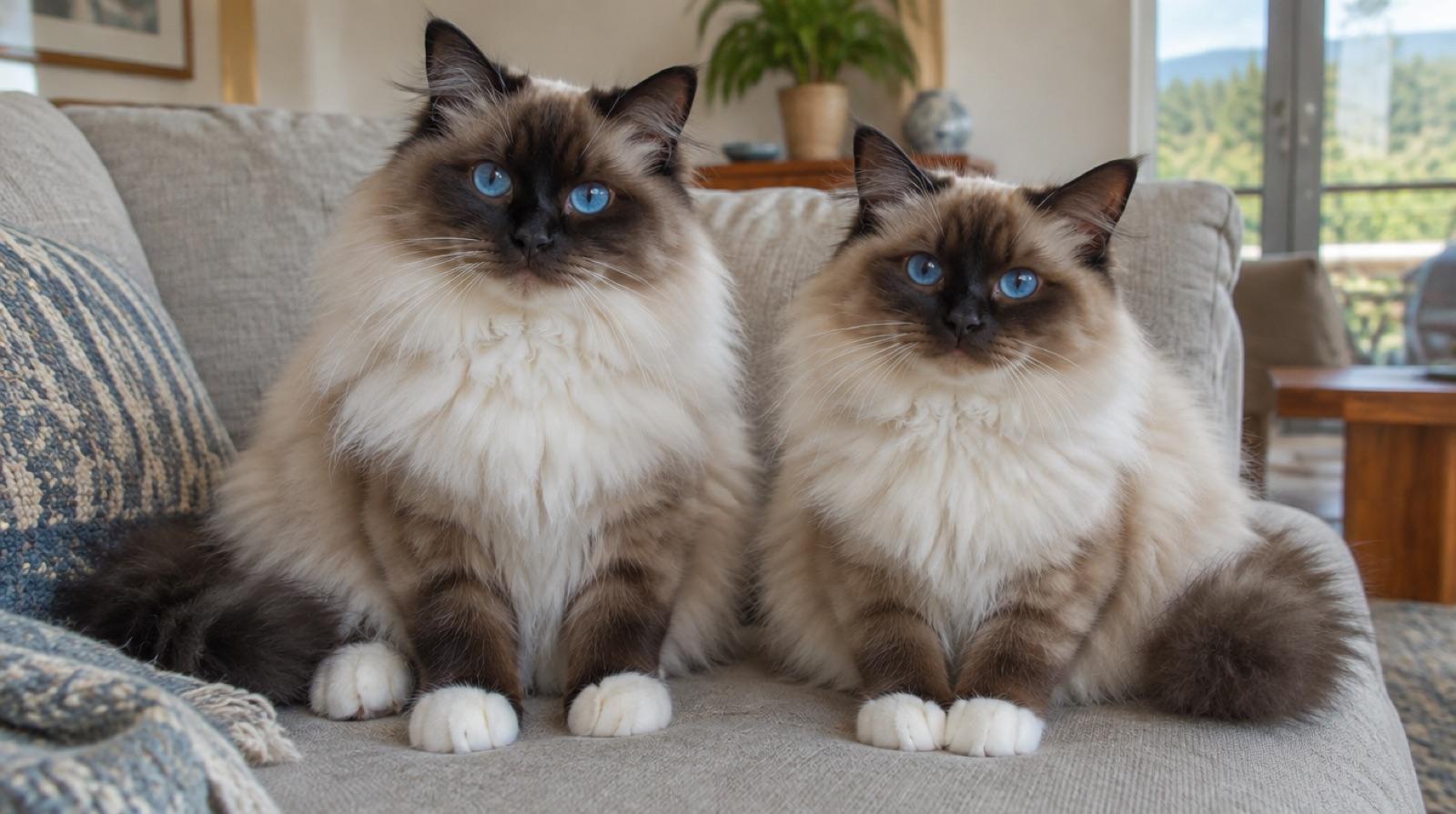
What is the difference between a Ragdoll and a Birman?
The white markings, the build and the head. Both are pointed cats: a pale body with darker ears, face, legs and tail, and blue eyes. The Cat Fanciers' Association (CFA) says the Birman is a colour-pointed cat that also carries a white spotting gene, which “produces the white gloves on the front paws and laces on the back paws.” The CFA says the same of the Ragdoll in a different form: every Ragdoll has the colourpoint gene, and three of its four patterns also carry the bicolour gene. The result is that every Birman looks gloved, while a Ragdoll may have no white at all, mittens, or a lot of white.
| Trait | Ragdoll | Birman |
|---|---|---|
| Size (Australian standard) | “Medium to large, long, muscular and powerful”; males generally much larger than females (CCCA) | “Medium to large strong-boned, muscular”; males generally larger (CCCA) |
| Size (CFA) | One of the larger breeds; a mature male can reach or exceed 20 lb (about 9 kg), females usually smaller | Medium-sized to large, with substantial boning and good body weight |
| Maturity | Full maturity may not come until three or four years (CCCA) | About three years to mature (CFA) |
| Head | Broad modified wedge, flat forehead, large almost-round eyes, high broad cheeks | Strongly boned, broader than high, rounded muzzle, Roman nose (a slight dip below the eyes) |
| Coat | Silky, dense, medium length; CCCA penalises a thick undercoat | Semi-long, silken, full ruff, “of such texture that it will not mat” |
| Eyes | “Decidedly blue; the deeper the better” | Deep blue (seal, red) or bright blue; green eyes withhold awards |
| White | None (colourpoint), mittens and chin (mitted), or a white V and legs (bicolour) | Always four white gloves; back gloves taper up the hock; white elsewhere withholds awards |
| Temperament | “Placid, allowing easy handling at all times” (CCCA); gentle, calm and sociable (CFA) | No CCCA wording; “patient, even-tempered, and tolerant” (CFA) |
| HCM DNA test | Yes: MYBPC3 R820W (ACVIM; UC Davis VGL) | No DNA test; echocardiogram screening |
| Origin | Developed in the 1960s by Ann Baker in California from domestic longhairs (CFA) | A breeding pair shipped from Burma to France around 1919 (CFA) |
Sources: CCCA Ragdoll standard (November 2023), CCCA Birman standard (November 2024), CFA Ragdoll and CFA Birman breed pages, ACVIM 2020, all read 10 November 2026. The CCCA standards give no weights; the CFA weight is a description, not a target.
How do you tell a mitted Ragdoll from a Birman?
This is the comparison that causes the most confusion, because a mitted Ragdoll also has white paws. Three checks settle most cases:
- The chin. A mitted Ragdoll has a white chin, and the CCCA withholds awards from a mitted or bicolour Ragdoll with a coloured chin. A Birman's chin is “shaded to match the mask,” and the CCCA Birman standard withholds awards for white “anywhere on the body, particularly on chin, chest or stomach.” The CFA disqualifies white chin spots in a Birman.
- The chest and belly. A mitted Ragdoll has a white bib running into a white underbody. A Birman should have none.
- The back legs. A mitted Ragdoll's back legs are white to at least the hock, the joint halfway up the hind leg. A Birman's back gloves cover the whole paw and taper up the back of the leg, “preferably to a spearhead positioned just below the middle of the hock,” in the CCCA's words, and the CFA says they should not go beyond the hock. The CFA calls this tapering white the laces; the CCCA calls it the gauntlet.
The front paws help less. A Birman's front gloves should end “in an even line across the paws at the third joint,” while a mitted Ragdoll's mittens should be evenly matched and, in the CFA's description, preferably reach up to and around the wrist. A bicolour Ragdoll is easier: the white inverted V on its face and its fully white legs look nothing like a Birman. A colourpoint Ragdoll has no white at all, and the CCCA withholds awards for white anywhere on a colourpoint.
The genetics back this up. The UC Davis Veterinary Genetics Laboratory says the Birman's gloves come from a recessive variant of the KIT gene that is “virtually fixed in Birman cats.” The same variant turns up at lower frequency in other breeds, Ragdolls among them, but the laboratory says it is not associated with gloving in breeds other than Birmans. Our Ragdoll colours guide covers the Ragdoll patterns in full.
Which is bigger, and which coat is easier?
The Ragdoll is the bigger cat. Both Australian standards use “medium to large,” but the CFA describes the Ragdoll as “one of the larger breeds of cat” with sturdy boning and says it is “not unusual for a mature male's weight to reach or exceed 20 pounds” (about 9 kg). It reaches full size and weight at about four, and the CCCA says full maturity may take three or four years. The CFA calls the Birman medium-sized to large, “neither svelte nor cobby,” and says it takes about three years to mature. For how both compare with the Maine Coon and other big breeds, see our largest cat breeds guide.
Both coats are easier than most longhairs. The CFA says Birmans have no undercoat to get tangled, so a weekly comb should be enough, and that Ragdolls lack the thick insulating undercoat, which reduces shedding and matting, with a comb once or twice a week. The CCCA describes the Birman coat as “of such texture that it will not mat” and penalises a thick undercoat on a Ragdoll. Both still shed, especially with the seasons, and neither breed is hypoallergenic; see our hypoallergenic cats guide if allergies are a question.
Do Ragdolls and Birmans come in the same colours?
Mostly, so colour will not tell you which breed you are looking at. The CCCA Ragdoll and CCCA Birman standards both recognise seal, blue, chocolate, lilac, red and cream points, with tortoiseshell, tabby and tortie-tabby versions; the Birman standard also lists smoke and silver tabby points. The Australian Cat Federation Birman standard lists seal, blue, chocolate, lilac, red, cream, caramel and apricot, and the ACF Ragdoll standard adds caramel, apricot, smoke and silver tabby points too.
One small difference is the body colour. The CFA says many Birmans show a “golden mist,” a faint golden beige cast on the back and sides, somewhat deeper in seal points. Both breeds are born pale and darken with age, because the pointed gene only makes pigment where the body is cooler.
Which health tests matter for each breed?
The heart is the main difference. Hypertrophic cardiomyopathy (HCM), a thickening of the heart muscle, is the most common type of cardiomyopathy in cats, according to the ACVIM. The ACVIM 2020 consensus statement lists both the Ragdoll and the Birman among pedigree breeds believed to be at increased risk, but only the Ragdoll has a known mutation:
| Test or question | Ragdoll | Birman |
|---|---|---|
| HCM DNA test | MYBPC3 R820W. ACVIM recommends testing Ragdolls intended for breeding. UC Davis says cats with two copies are at high risk of severe HCM, usually between one and two years of age | None. ACVIM says testing for the Maine Coon and Ragdoll mutations in other breeds is not recommended |
| Heart scan (echocardiogram) | Still worth asking about: ACVIM notes that Ragdolls testing negative for the mutation have been reported with HCM | The main screening tool; International Cat Care advises yearly scans for breeding cats |
| PKD1 (kidney cysts) | Ragdoll is on the UC Davis list of breeds appropriate for testing | Not on the UC Davis PKD1 breed list |
| Breed-specific DNA test | The HCM test above | Congenital hypotrichosis (hairless kittens), a recessive FOXN1 variant with a DNA test |
Sources: ACVIM 2020; UC Davis VGL Ragdoll HCM and PKD1 test pages; International Cat Care; Abitbol et al. 2015. Read 9 and 10 November 2026. This is a list of questions for a breeder, not a diagnosis; talk to your vet about any individual cat.
A carrier is not a death sentence. The UC Davis page says a Ragdoll with one copy of the R820W mutation is not likely to show signs and may live a normal lifespan; the point of testing is to stop two carriers being bred together. For the Birman's other health questions (blood type, FIP risk in one hospital study), see our Birman adopt-or-buy guide; for the Ragdoll, the Ragdoll price guide and the Ragdoll health guide.
Do Birmans live longer than Ragdolls?
In UK vet records, yes. Teng and colleagues (2024) built life tables from 7,936 confirmed deaths among cats under UK primary veterinary care in 2019, counting deaths recorded from January 2019 to March 2021. Life expectancy at birth was 14.39 years for Birmans, second only to the Burmese among the 12 breeds and groups analysed, and 10.31 years for Ragdolls. The paper notes an earlier VetCompass study gave a median of 10.1 years for Ragdolls.
Read those numbers carefully. They rest on 38 Birman deaths and 69 Ragdoll deaths in one country, they describe groups rather than individual cats, and they say nothing about why the cats died. We found no equivalent Australian figures. A healthy weight matters for both breeds; the CFA notes Ragdolls are “known for their love of food” and may be at risk of obesity.
See the Ragdolls and Birmans listed right now
Purebreds and crosses from the Australian rescues we aggregate, refreshed regularly. Each listing links to the rescue, where you apply.
How do their temperaments compare?
On paper they are close. The CCCA Ragdoll standard scores temperament, asking for a cat that is “placid, allowing easy handling at all times,” one that may flop over on its side “as suggested by the name.” The CFA calls Ragdolls “loving without being demanding,” gentle, calm and sociable, moderately active and not talkative. It also says the famous going-limp trait “is not typical of most of today's Ragdolls.”
The CCCA Birman standard has no temperament wording. The CFA describes the Birman as sociable, people-oriented, playful and moderately active, “patient, even-tempered, and tolerant,” and relatively quiet with a soft, chirp-like voice. It adds a practical warning: Birmans “do not do well alone for long periods of time,” and a home with no other pets may want a pair.
The one study we found that compares breeds, a Finnish owner survey of 5,726 cats by Salonen and colleagues (2019), placed Ragdolls and Birmans in the same cluster as British Shorthairs, Norwegian Forest Cats, and Persians and Exotics, the group owners rated least aggressive, least extroverted and least fearful. That is owner perception in Northern Europe, and every breed varies widely; meet the individual cat.
Which suits which home?
| If you… | Lean towards | Why (source) |
|---|---|---|
| Want the biggest, most laid-back lap cat | Ragdoll | Larger, heavier breed; placid handling is in the CCCA standard |
| Are out all day with no other pet | Either, ideally as a pair; especially a Birman | CFA: Birmans do not do well alone for long periods |
| Have young children or other pets | Either | CFA calls both suitable; introduce a trusting Ragdoll to other pets with care |
| Will struggle to lift a heavy cat | Birman | Medium to large rather than one of the larger breeds (CFA) |
| Want the simplest grooming | Birman, narrowly | CFA: no undercoat, weekly combing; Ragdoll once or twice a week |
| Want a DNA-tested heart history | Ragdoll | A Ragdoll HCM DNA test exists; Birmans rely on heart scans |
Both breeds want company, and both are big investments of time. Our adopting a cat guide covers the basics, including cat containment rules, and the what cat breed am I quiz and adoption readiness check help if you are still deciding. If allergies are possible, read the hypoallergenic cats guide before you commit.
What do the two breeds cost?
From a breeder, the published figures overlap; from a rescue, the fee goes by age. The Birman Cat Club of Australia's code (undated, read 10 November 2026) says a buyer “should expect to pay from $1,600 for a desexed, vaccinated & microchipped kitten.” No Ragdoll club publishes a guide; when we read eight cat council member breeders' own websites in November 2026, Ragdoll pet kitten starting prices ranged from $1,300 to $3,500, with a median of $2,750 (details in the Ragdoll price guide). At rescues, RSPCA NSW lists $220 for a cat over six months and $270 for a kitten, and the Cat Protection Society of NSW $150 per cat or kitten (checked 10 November 2026). All of these are reference figures, not quotes.
If you buy, a registered breeder is a reasonable choice for either breed: check the council membership yourself and ask for the parents' test results in writing. The Birman adopt-or-buy guide and Ragdoll price guide explain how, and the scam patterns to avoid.
Is that rescue cat a Ragdoll or a Birman?
Often it is neither for certain. A blue-eyed, pointed, semi-longhaired cat in a shelter may be a purebred of either breed, a cross, or a domestic longhair that carries the pointed gene, which is not limited to any breed. Careful rescues list such cats as a Ragdoll cross, a Birman cross or a Domestic Longhair. Purebreds of both breeds do reach rescue, usually as adults whose owners could no longer keep them.
Use the same checks as above. Four clean white gloves with tapered laces and no white chin lean Birman; a white chin, bib and belly lean mitted Ragdoll; no white at all with a big, heavy frame leans colourpoint Ragdoll. Then put the label aside and ask the foster carer how the cat behaves, because for a pet that matters more than the pedigree. The look-alikes include the Siamese (short coat, fine build) and the Tonkinese.
Find a Ragdoll or Birman near you
- Sydney: Ragdolls, Birmans, long-haired cats, Ragdoll adoption guide
- Melbourne: Ragdolls, Birmans, long-haired cats, Ragdoll adoption guide
- Brisbane: Ragdolls, Birmans, long-haired cats, Ragdoll adoption guide
- Perth: Ragdolls, Birmans, long-haired cats, Ragdoll adoption guide
- Adelaide: Ragdolls, Birmans, long-haired cats, Ragdoll adoption guide
- Australia-wide: the Ragdoll and Birman breed pages, plus Domestic Longhairs. Owners rehoming a Ragdoll list on our Ragdoll rehoming page.
Frequently asked questions
What is the difference between a Ragdoll and a Birman?▼
Both are blue-eyed, pointed, semi-longhaired cats, but they differ in white markings, build and head. A Birman always has four white feet: white gloves on the front paws and white on the back paws that tapers up the back of the leg, with no white on the chin, chest or belly. A Ragdoll is either colourpoint (no white), mitted (white front mittens, white back legs, white chin and bib) or bicolour (white inverted V on the face). The Ragdoll is the larger, heavier cat with a broad wedge-shaped head; the Birman has a rounder muzzle and a Roman nose.
How can I tell a mitted Ragdoll from a Birman?▼
Look at the chin and the back legs. A mitted Ragdoll has a white chin, a white bib and white running up the back legs to at least the hock, and the Coordinating Cat Council of Australia (CCCA) withholds awards from a mitted Ragdoll with a coloured chin. A Birman's chin is shaded to match its mask, and the CCCA withholds awards for white on the chin, chest or stomach. On a Birman the back-foot white tapers to a point below the hock; the Cat Fanciers' Association (CFA) calls these the laces.
Which is bigger, a Ragdoll or a Birman?▼
The Ragdoll, generally. Both Australian standards call their breed medium to large, but the CFA describes the Ragdoll as one of the larger breeds and says a mature male can reach or exceed 20 pounds (about 9 kg), with females usually smaller. The CFA describes the Birman as medium-sized to large with substantial boning. Both are slow to mature: about three to four years for a Ragdoll and about three for a Birman.
Do Ragdolls and Birmans have the same eye colour?▼
Both must have blue eyes. The CCCA Ragdoll standard asks for decidedly blue eyes, the deeper the better. The CCCA Birman standard asks for deep blue in seal and red points and bright blue in the other colours, preferably with violet undertones in chocolate and lilac, and green eyes withhold awards.
Are Birmans and Ragdolls the same colours?▼
Mostly. The CCCA recognises the same six point colours for both breeds (seal, blue, chocolate, lilac, red and cream) with tortoiseshell, tabby and tortie-tabby versions. The CCCA Birman standard also lists smoke and silver tabby points, and the Australian Cat Federation (ACF) adds caramel and apricot for both breeds. Colour does not tell the breeds apart; the white markings do.
Which has the better temperament, a Ragdoll or a Birman?▼
Neither: they are described in similar terms. The CCCA Ragdoll standard asks for a placid cat that allows easy handling at all times, and the CFA calls Ragdolls gentle, calm and sociable. The CFA calls the Birman patient, even-tempered and tolerant, and says Birmans do not do well alone for long periods. A 2019 Finnish owner survey grouped both breeds with the cats rated least aggressive and least fearful. Individual cats vary.
Is there an HCM gene test for Ragdolls and Birmans?▼
For Ragdolls, yes; for Birmans, no. The ACVIM 2020 consensus statement recommends testing Ragdolls intended for breeding for the MYBPC3 R820W mutation, and the UC Davis Veterinary Genetics Laboratory offers it. Birmans are on the ACVIM list of breeds believed to be at increased risk of hypertrophic cardiomyopathy (HCM), but there is no Birman DNA test; screening is by heart ultrasound (echocardiogram).
Do Birmans live longer than Ragdolls?▼
In UK vet records, yes. A 2024 VetCompass study of cats under UK vet care in 2019, whose deaths were confirmed up to March 2021, gave a life expectancy at birth of 14.39 years for Birmans (38 deaths) against 10.31 years for Ragdolls (69 deaths). These are small UK samples, not a prediction for any one cat, and an Australian cat's care and luck matter more.
Which sheds more, a Ragdoll or a Birman?▼
Both are lower-maintenance than most longhairs. The CFA says the Birman has no undercoat to tangle and needs a weekly comb, and that the Ragdoll's lack of a thick undercoat reduces shedding and matting, with combing once or twice a week. Both still shed, and neither is hypoallergenic.
Is a Ragdoll or a Birman better for a family?▼
Either can suit a family. The CFA calls the Birman an excellent choice for families with children and other pets, and says it is rare for a Ragdoll to be aggressive or temperamental, though its trusting nature means introductions to other pets need care. The bigger differences are size (Ragdolls are heavier to lift) and company (a Birman left alone all day may do better with a second cat).
Is my rescue cat a Ragdoll or a Birman?▼
Without papers you cannot be sure. The pointed gene is not limited to any breed, and a blue-eyed pointed longhair in a shelter may be a purebred, a cross or a domestic longhair. Four neat white gloves with laces and no white chin point towards Birman ancestry; a white chin and bib point towards a mitted Ragdoll. Rescues usually list such cats as crosses or Domestic Longhairs.
Where can I adopt a Ragdoll or a Birman?▼
LocalPetFinder lists Ragdolls, Birmans and their crosses from the Australian rescues we aggregate, refreshed regularly; open the breed page for your city and set an alert. Rescue fees go by age: RSPCA NSW lists $220 for a cat over six months and $270 for a kitten, and the Cat Protection Society of NSW lists $150 per cat or kitten (checked 10 November 2026; reference figures, not quotes).
Sources
- Coordinating Cat Council of Australia: Ragdoll breed standard (November 2023)
- Coordinating Cat Council of Australia: Birman breed standard (November 2024)
- Australian Cat Federation: Ragdoll standard (updated 11 October 2023)
- Australian Cat Federation: Birman standard (effective 11 October 2023)
- Cat Fanciers' Association: Ragdoll breed profile and standard
- Cat Fanciers' Association: Birman breed profile and standard
- UC Davis Veterinary Genetics Laboratory: Gloves (Birman white feet)
- UC Davis Veterinary Genetics Laboratory: Hypertrophic cardiomyopathy in Ragdolls
- UC Davis Veterinary Genetics Laboratory: Polycystic kidney disease (PKD1)
- Luis Fuentes et al. (2020): ACVIM consensus statement on cardiomyopathies in cats, J Vet Intern Med
- International Cat Care: Cardiomyopathy (heart disease) in cats
- Abitbol et al. (2015): FOXN1 variant in Birman cats with congenital hypotrichosis, PLOS ONE
- Teng et al. (2024): Life tables of annual life expectancy for cats in the UK, J Feline Med Surg
- Salonen et al. (2019): Breed differences of heritable behaviour traits in cats, Scientific Reports
- Birman Cat Club of Australia: Code of ethics and price guide
- RSPCA NSW: Adoption fees
- Cat Protection Society of NSW: Cats for adoption
Keep reading
Ragdoll colours
Colourpoint, mitted and bicolour, the six point colours, and mink or solid Ragdolls.
Birman kittens: adopt or buy?
The Birman club price guide, breeder checks, health questions and Birmans in rescue.
Ragdoll price in Australia
What member breeders charge, the HCM and PKD tests to ask for, and the scam pattern.
Birmans for adoption
Birmans and Birman crosses listed by Australian rescues, refreshed regularly.