The short answer
Maine Coons can be almost any colour: black, white, blue, red, cream, tortoiseshell, tabby (classic, mackerel or ticked), silver, smoke and shaded, all with or without white. The Coordinating Cat Council of Australia (CCCA) standard excludes only chocolate, lilac, cinnamon, fawn, caramel and apricot and the pointed (Himalayan) pattern; the Australian Cat Federation, CFA and TICA exclude the same family, and the ACF and TICA also rule out sepia and mink. Brown tabby is the classic: TICA calls it the most common colouring, though no council publishes counts. Eyes are green, gold or copper, with blue or odd eyes only in white cats or cats with white. Colour does not change temperament, and rescue fees go by age, not colour; price figures here are references, not quotes.
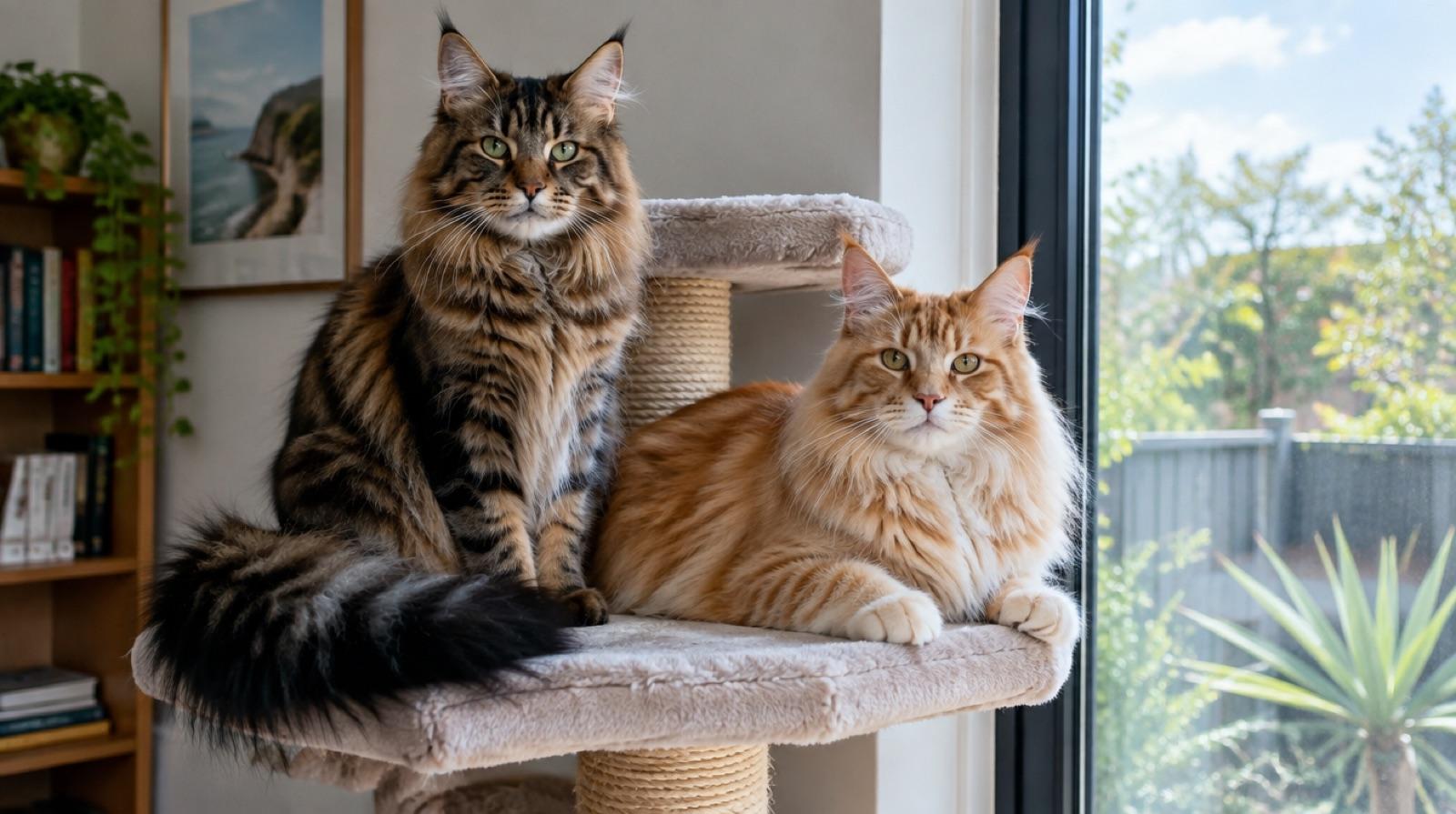
What colours do Maine Coons come in?
Nearly all of them. Instead of listing what is allowed, the Maine Coon standards list what is not. The CCCA standard (February 2025) accepts “any recognised colour or recognised combination of colour except Chocolate, Lilac, cinnamon, fawn, caramel and apricot” and “any recognised pattern except the Himalayan pattern.” The other councils draw the line in much the same place:
| Council | Colours excluded | Patterns excluded | White and eyes |
|---|---|---|---|
| CCCA (Feb 2025) | Chocolate, lilac, cinnamon, fawn, caramel, apricot | Himalayan (pointed) | White trim on chin and lips allowed except in solids; eyes green, green gold, gold, orange or copper |
| ACF (June 2023) | Chocolate, lilac, cinnamon, fawn, caramel, apricot, amber | Pointed, sepia, mink | Any amount of white allowed; all eye colours, but blue or odd eyes only in white or with white |
| CFA (US) | Disqualifies evidence of hybridisation resulting in chocolate or lavender | Himalayan pattern disqualified | Disqualifies white buttons, lockets or spots; eyes green, gold, green-gold or copper |
| TICA (May 2025) | Chocolate, lilac, cinnamon, fawn, caramel (only “dominant black based” colours allowed) | Sepia, mink, pointed | Eyes any shade of green and/or gold; blue and odd eyes only in white and with white |
Sources: CCCA Maine Coon standard, ACF Maine Coon standard, CFA Maine Coon standard, TICA MC/MCP standard, all read 10 November 2026. In Australia, pedigree cats are registered through the CCCA's and ACF's member bodies, ANCATS, or Cats Australia (TICA's charter club); ask a breeder which one registers their cats.
What is left is a very long list. The CFA standard alone describes solid, tabby, tortoiseshell, silver tabby, shaded and chinchilla, smoke and “with white” colour classes, including vans. Grouped the way breeders talk about them:
- Solids: black, white, blue (grey), red and cream. The CFA asks for black that is “dense coal black, sound from roots to tip.”
- Tabbies: brown, blue, red, cream and silver, in classic (swirled), mackerel (striped) and ticked patterns under the CFA; TICA also lists spotted. The CFA describes the brown tabby as a “brilliant coppery brown” ground with dense black markings.
- Tortoiseshells and torbies: black and red, or blue and cream, patched or mingled; a tabby tortie is a torbie (patched tabby).
- Silvers, smokes and shadeds: a white undercoat under coloured tips (see below).
- With white: any of the above with white, from a white chin to a bicolour or a van, where the colour sits mainly on the head and tail. The CFA says these classes must have white on the bib, belly and all four paws.
For what each tabby pattern looks like, see our tabby cat patterns guide, and for tortoiseshell and calico, our tortoiseshell and calico guides.
Is brown tabby the most common Maine Coon colour?
It is the colour most associated with the breed, but we found no published count. TICA's breed page says “the most typical colors and patterns are brown, red (orange) or silver tabbies (with or without white),” and its history section says the old raccoon myth was “bolstered by the bushy tail and the most common coloring (a raccoon-like brown tabby).” The CFA tells the same story, and records that a brown tabby Maine Coon named Cosey was chosen Best Cat at the first US cat show in 1895.
The same TICA page adds that in recent years breeders have been producing more solid black, white and blue cats. No Australian cat council publishes Maine Coon registrations by colour that we could find, so any claim that one colour is “rare” in Australia is a sales description, not a statistic. The raccoon story itself is a myth: the CFA notes the combination is genetically impossible.
Which colours are not allowed, and why?
Two groups are out under every standard we read:
- The brown series: chocolate, lilac, cinnamon and fawn (and caramel and apricot in the Australian standards). The UC Davis Veterinary Genetics Laboratory explains that variants of the Brown gene reduce black pigment, giving chocolate or cinnamon, and lilac is the dilute form of chocolate. TICA's standard puts it in genetic terms: only “dominant black based” colours are allowed.
- Pointed, sepia and mink. These come from the colourpoint gene, which Lyons and colleagues (2005) traced to temperature-sensitive variants of tyrosinase, the Siamese and Burmese versions. They put colour on the face, ears, legs and tail and lighten the body.
Why exclude them? The standards do not explain their history, but the CFA's wording is telling: it disqualifies “cats showing evidence of hybridization resulting in the colors chocolate, lavender, or the Himalayan pattern.” In other words, these colours suggest another breed somewhere in the pedigree. The CCCA, ACF and TICA all list the allowable outcross for the Maine Coon as none.
This matters most in ads. A “rare chocolate Maine Coon” or a blue-eyed “colourpoint Maine Coon” sold at a premium cannot be registered or shown as a Maine Coon under these standards. The cat may still be a lovely pet. It is just not what the label says, and a premium for a “rare” excluded colour pays for a sales story. Our Maine Coon price guide covers how to check a breeder's council membership and the scam pattern.
What are silver, smoke and shaded Maine Coons?
They are cats with a white or very pale undercoat and colour only on the outer part of each hair. How much of the hair is coloured gives the name. From the CFA standard:
| Name | What you see (CFA description) |
|---|---|
| Silver tabby | Ground colour “pale, clear silver” with dense black tabby markings |
| Smoke | White undercoat “deeply tipped with black”; looks black at rest, and the white shows when the cat moves |
| Shaded silver | White undercoat with a mantle of black tipping, darker on the back, white on the chin, chest and belly |
| Chinchilla silver | Lightest of all: enough black tipping to give a “sparkling silver appearance” over a pure white undercoat |
| Cameo | The red versions: red smoke, red shaded and shell cameo |
Silver shows up in blue, red and cream versions too. Smokes are the easiest to misread: the CFA says a smoke “in repose appears black” and the white undercoat is only clearly apparent in motion, so if an exact colour matters to you, part the fur and ask what the parents are. An adult cat shows you its finished colour on day one.
How do Maine Coon colours work genetically?
The same way they work in every cat, which is one reason colour cannot prove breed. A few of the main switches:
- Tabby or solid. The Agouti gene bands each hair to show the tabby pattern; cats with two copies of the recessive non-agouti variant are solid (self) coloured.
- Black or grey. Dilution is recessive and turns black to grey (blue) and red to cream. Ishida and colleagues (2006) traced it to a deletion in the MLPH gene, found in dilute cats of 26 breeds; the UC Davis dilute page explains the test.
- Red and tortoiseshell. Orange is carried on the X chromosome. In 2025 Kyushu University and a Stanford-led team identified it as a deletion near the ARHGAP36 gene. Females with one orange and one black copy are tortoiseshell, which is why tortie Maine Coons are almost always female.
- White. A white cat or the white patches on a bicolour come from separate white genes; our white cats guide covers them, including the link between white coats, blue eyes and deafness.
Eye colour is separate. The CCCA standard says plainly that “there is no relationship between eye colour and coat colour,” and asks for shades of green, green gold, gold, orange or copper, “preferably clear and deep.”
See the Maine Coons and crosses listed right now
Every colour, from the Australian rescues we aggregate, refreshed regularly. Each listing links to the rescue, where you apply.
Are polydactyl Maine Coons recognised?
It depends on the registry. Polydactyly (extra toes) is not a colour, but it comes up in every conversation about how Maine Coons look:
- TICA: yes. Its MC/MCP standard says “polydactyl paws were common in the original Maine Coon population” and that in 2015 polydactyl Maine Coons were assigned their own breed name (Maine Coon Polydactyl) and accepted for championship in a separate class. The TICA breed page calls them the cats sometimes seen with six toes.
- CFA: no. The CFA standard asks for “five toes in front; four in back” and disqualifies an incorrect number of toes.
- CCCA and ACF: the Maine Coon standards we read do not mention extra toes either way, so ask the registering council directly if it matters to you.
Extra toes are a trait, not a breed, so a six-toed rescue cat is not a Maine Coon on that basis alone; judge it on the breed traits described below.
Does colour change the price, personality or health?
Price: sometimes, by the breeder's choice. Some breeders charge more for particular colours, or for males and females differently; no cat council sets prices. When we read five cat council member breeders' own websites in November 2026, pet kitten prices ranged from $2,600 to $3,500 with a median of $3,000 (details in the Maine Coon price guide). These are reference figures, not quotes.
Personality: no evidence. The standards describe one temperament for the breed: the CCCA says the Maine Coon is “of amiable disposition.” We found no study linking Maine Coon colour to behaviour.
Health: no colour link we could source, with one general exception. The questions that matter apply to every colour, such as the MYBPC3 A31P heart mutation test and the others in the price guide and the Maine Coon health guide. The exception is white: deafness linked to white coats and blue eyes affects white cats of any breed, as our white cats guide explains.
Is my big tabby a Maine Coon?
Colour cannot tell you. The tabby, solid, tortie and silver colours a Maine Coon can have are the same ones ordinary cats have, and a large, long-haired brown tabby in a shelter is far more often a domestic longhair. Rescues list unknown long-haired cats as a Domestic Longhair or a Maine Coon cross.
Look at the traits the standards actually score: large tufted ears with lynx tipping, a square muzzle, a shaggy coat that is uneven in length, a frontal ruff and a long flowing tail, on a cat that keeps growing for three or more years. Our is my cat a Maine Coon guide walks through each one, and the largest cat breeds guide covers the sizes.
How do you adopt a Maine Coon in a particular colour?
Be flexible on colour and set alerts. Purebred Maine Coons usually reach rescue as adults, and a particular colour is rarer still. Fees go by age and rescue, not colour: RSPCA NSW lists $220 for a cat over six months and $270 for a kitten, and the Cat Protection Society of NSW $150 per cat or kitten (checked 10 November 2026). These are reference figures, not quotes.
If you want a papered kitten of an exact colour, a registered breeder is a reasonable choice: confirm the council membership yourself and ask for the parents' test results, as the price guide explains. Still choosing a breed? Try the what cat breed am I quiz or the adoption readiness check.
Find a Maine Coon near you
- Sydney: Maine Coons and crosses, long-haired cats, Maine Coon adoption guide
- Melbourne: Maine Coons and crosses, long-haired cats, Maine Coon adoption guide
- Brisbane: Maine Coons and crosses, long-haired cats, Maine Coon adoption guide
- Perth: Maine Coons and crosses, long-haired cats, Maine Coon adoption guide
- Adelaide: Maine Coons and crosses, long-haired cats, Maine Coon adoption guide
- By colour, Australia-wide: tabby, black, grey, orange, white and tortoiseshell cats, plus the Maine Coon breed page.
Frequently asked questions
What colours do Maine Coons come in?▼
Almost every colour and pattern. The Coordinating Cat Council of Australia (CCCA) standard accepts any recognised colour except chocolate, lilac, cinnamon, fawn, caramel and apricot, in any pattern except the Himalayan (pointed) pattern. That leaves black, white, blue, red and cream, tortoiseshells, tabbies (classic, mackerel and ticked), silvers, smokes and shadeds, all with or without white.
What is the most common Maine Coon colour?▼
Brown tabby is the colour most associated with the breed, but no cat council publishes registration counts by colour that we could find. The International Cat Association (TICA) says the most typical colours are brown, red or silver tabbies, with or without white, and calls a raccoon-like brown tabby the most common colouring. That is a registry's description, not a count.
Are there chocolate or lilac Maine Coons?▼
Not under any standard we read. The CCCA, the Australian Cat Federation (ACF) and TICA all exclude chocolate and lilac, along with cinnamon and fawn, and the Cat Fanciers' Association (CFA) disqualifies cats showing evidence of hybridisation resulting in chocolate or lavender. A cat sold as a chocolate or lilac Maine Coon cannot be shown as one, and the colour suggests another breed in its background.
Can a Maine Coon be colourpoint like a Siamese?▼
No. The CCCA excludes the Himalayan pattern, the ACF excludes pointed, sepia and mink, TICA says sepia, mink and pointed are not allowed, and the CFA disqualifies the Himalayan pattern as evidence of hybridisation. A blue-eyed pointed longhair is more likely a Ragdoll, Birman or cross.
Are black Maine Coons rare?▼
Black is an accepted solid colour under every standard we read, and TICA says breeders have produced more solid black, white and blue cats in recent years. No council publishes counts, so we cannot say how rare black is. The CFA asks for a dense coal black, sound from the roots to the tip.
What is a silver or smoke Maine Coon?▼
A cat with a white or pale undercoat under coloured tips. The CFA describes a silver tabby as a pale, clear silver ground with dense black markings, and a black smoke as a white undercoat deeply tipped with black, so the cat looks black at rest and the white shows when it moves. Shaded and chinchilla silvers have less colour on each hair.
What eye colours can a Maine Coon have?▼
Green, green gold, gold, orange or copper under the CCCA standard, which says there is no relationship between eye colour and coat colour. Blue or odd eyes are allowed only in white cats or cats with white, under the CCCA, ACF, CFA and TICA standards alike.
Are polydactyl Maine Coons recognised?▼
By TICA, yes; by the CFA, no. TICA gave polydactyl Maine Coons their own breed name, Maine Coon Polydactyl, and accepted them for championship in 2015, and says polydactyl paws were common in the original Maine Coon population. The CFA standard asks for five toes in front and four behind and disqualifies an incorrect number of toes. The CCCA and ACF Maine Coon standards we read do not mention extra toes.
Does colour change a Maine Coon's price?▼
Sometimes, by the breeder's choice. Some breeders charge more for particular colours, but no cat council sets prices. When we read five member breeders' own websites in November 2026, pet kitten prices ranged from $2,600 to $3,500 with a median of $3,000. These are reference figures, not quotes.
Does colour affect a Maine Coon's personality or health?▼
Not that any study we found shows. The standards describe one temperament for the breed, and the health tests that matter, such as the HCM heart mutation test, apply to every colour. White cats with blue eyes carry a known deafness risk, which applies to white cats of any breed.
Is my big tabby cat a Maine Coon?▼
Colour cannot tell you. Brown tabby is common in Maine Coons and in ordinary moggies alike, so a large tabby with a long coat is far more often a domestic longhair. Look for the breed traits instead: big tufted ears with lynx tips, a square muzzle, a shaggy uneven coat and a long flowing tail, and remember only papers prove a pedigree.
Where can I adopt a Maine Coon in a particular colour?▼
Start with the Maine Coon breed page for your city on LocalPetFinder, which lists Maine Coons and crosses from the rescues we aggregate, and set an alert. Be flexible on colour. Rescue fees go by age: RSPCA NSW lists $220 for a cat over six months and $270 for a kitten (checked 10 November 2026; a reference, not a quote).
Sources
- Coordinating Cat Council of Australia: Maine Coon breed standard (February 2025)
- Australian Cat Federation: Maine Coon standard (amended June 2023)
- Australian Cat Federation: Breed standards
- Cat Fanciers' Association: Maine Coon breed profile and standard
- The International Cat Association: Maine Coon breed page
- The International Cat Association: Maine Coon breed group (MC/MCP) standard, revised 1 May 2025
- The International Cat Association: Maine Coon Polydactyl breed page
- UC Davis Veterinary Genetics Laboratory: Feline coat color
- UC Davis Veterinary Genetics Laboratory: Agouti
- UC Davis Veterinary Genetics Laboratory: Dilute
- Ishida et al. (2006): MLPH deletion causes the dilute coat colour in the domestic cat, Genomics
- Kyushu University (15 May 2025): the orange gene in cats
- Lyons et al. (2005): Tyrosinase mutations associated with Siamese and Burmese patterns, Animal Genetics
- UC Davis Veterinary Genetics Laboratory: Maine Coon HCM
- RSPCA NSW: Adoption fees
- Cat Protection Society of NSW: Cats for adoption
Keep reading
Is my cat a Maine Coon?
Ears, muzzle, ruff, coat and tail: how to tell a Maine Coon from a big domestic longhair.
Maine Coon price in Australia
What member breeders charge, the health tests to ask for, and the scam pattern.
Largest cat breeds
Maine Coon, Ragdoll, Norwegian Forest Cat and other big breeds, with sourced sizes.
Tabby cat patterns
Classic, mackerel, spotted and ticked tabbies, and the genes behind them.