The short answer
British Shorthairs come in blue (the “British Blue”) and much more: black, white, chocolate, lilac, cinnamon, fawn, red and cream solids; tortoiseshell; classic, mackerel and spotted tabby; smoke; silver and golden tipped or shaded; bicolour and van; and colourpoint. The Coordinating Cat Council of Australia (CCCA), Australian Cat Federation (ACF) and the UK's Governing Council of the Cat Fancy (GCCF) all accept colourpoints; the US Cat Fanciers' Association (CFA) disqualifies them and lists cinnamon and fawn only as “any other variety”. Most colours call for deep gold to copper eyes; colourpoints have blue eyes, and silver and golden tipped cats may have green. Colour does not change health or temperament, and rescue fees go by age, not colour; fee figures here are references, not quotes.
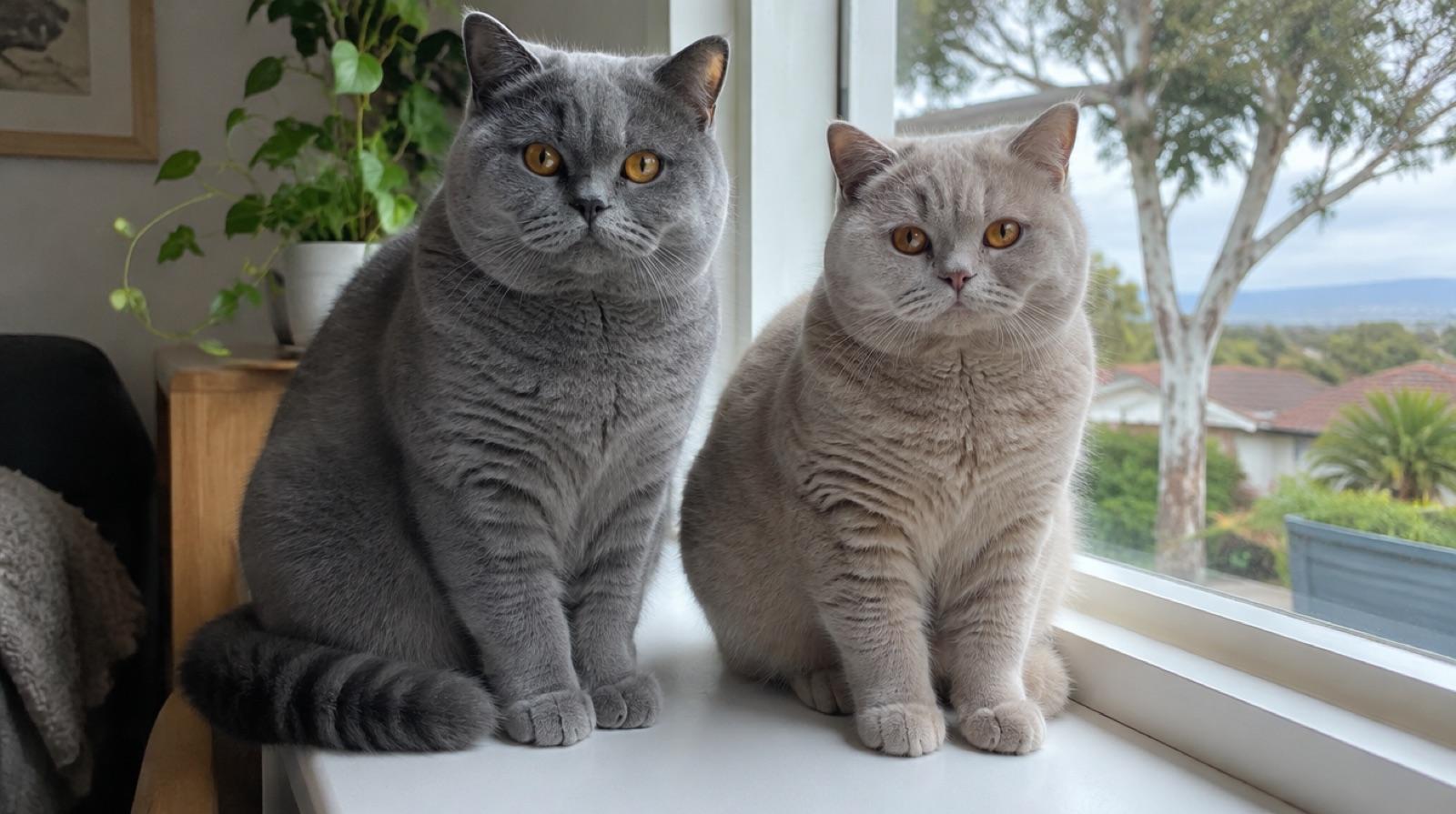
Why is the British Shorthair known for blue?
Because blue is where the breed's fame began. The CFA says British Shorthairs were first registered in the United States as “British Blues,” and the name has stuck as a nickname for the blue cats. The CCCA standard (December 2024) asks for a “light to medium blue, sound to the roots, with darker tones undesirable,” and says “silver tipping is a fault.” It also notes that the coat texture of the British Blue is the ideal for every colour.
Blue is the dilute form of black. Ishida and colleagues (2006) traced dilution in cats to a recessive variant of the MLPH gene, the same in dilute cats of 26 breeds and in random-bred cats, and the UC Davis dilute page illustrates it with British Shorthair kittens: black diluted to grey, red diluted to cream. Because the gene is recessive, two blue parents can only have dilute kittens. For how the British Blue compares with the Russian Blue, Korat and Chartreux, see our grey cat breeds guide.
We found no council that publishes British Shorthair registrations by colour, so we cannot say what share are blue.
Which colours does each cat council accept?
Pedigree cats in Australia are registered through several bodies, each with its own standard, and British Shorthair breeders also refer to the standard of the UK's GCCF. The four standards we read agree on most colours and differ on a few:
| Colour or pattern | CCCA (Dec 2024) | ACF (June 2024) | GCCF, UK (Feb 2025) | CFA, US (2026) |
|---|---|---|---|---|
| Blue, black, white, red, cream | Yes | Yes | Yes | Yes |
| Chocolate, lilac | Yes | Yes | Yes | Yes |
| Cinnamon, fawn | Yes | Yes | Yes | Any Other Variety class only |
| Caramel, apricot | Caramel | Caramel and apricot | Not listed | Not listed |
| Tortoiseshell | Yes | Yes | Yes | Yes |
| Tabby patterns | Classic, mackerel, spotted | Classic, mackerel, spotted, ticked | Classic, mackerel, spotted, ticked | Classic, mackerel, spotted |
| Smoke; silver tipped and shaded | Yes | Yes | Yes | Yes (shaded and chinchilla) |
| Golden tipped and shaded | Yes | Yes | Yes | Yes, but any sign of the Corin gene disqualifies |
| Bicolour and van | Yes | Yes | Yes, plus harlequin | Yes (calico and bi-colour, including van) |
| Colourpoint | Yes (Pointed Group) | Yes, including pointed bicolour and golden points | Yes (Colourpointed group, including golden pointed) | No: the Himalayan pattern is disqualified |
| British Longhair | Registrable for some breeding programs; not shown | Recognised in the same standard | Separate breed | Not covered by this standard |
Sources: CCCA British Shorthair standard (issue date December 2024), ACF British Shorthair/Longhair standard (amended June 2024), GCCF standard of points (June 2026 edition, British Shorthair section updated February 2025), CFA show standard (revised 2026), all read 10 November 2026. “Not listed” means the colour is not named in that standard. Standards change; ask a breeder which council registers their cats.
What do lilac, cinnamon, fawn and caramel look like?
These are the names that puzzle people most in ads. In the CCCA's descriptions:
- Chocolate: any shade of chocolate, “but rich, warm, milk chocolate is preferred.”
- Lilac: “warm, soft grey with a pinkish undertone,” anywhere from mushroom pink to soft grey; dark or cold tones are undesirable. Lilac is the dilute form of chocolate, as blue is of black.
- Cinnamon: “rich, reddish brown, with brighter shades preferred.” The CFA calls it “the color of a cinnamon stick, distinctly warmer, lighter and redder than chocolate.”
- Fawn: “pale, warm pinkish fawn,” with paler shades preferred.
- Caramel: “cold, bluish fawn, with a slight metallic overtone.” The ACF standard describes caramel as blue based, lilac based or fawn based.
The genetics behind the browns sit on one gene. The UC Davis Veterinary Genetics Laboratory says variants of the Brown gene reduce black pigment: one variant gives chocolate and another gives cinnamon. The dilute gene then softens each one. If you are choosing between a lilac and a blue kitten, look at them in daylight: the CCCA's lilac is warm and pinkish, its blue cold and clear.
What are golden and silver British Shorthairs?
Both are tipped cats: a pale undercoat with colour only on the outer part of each hair. The difference is the undercoat. A silver has a pure white undercoat. A golden, in the CCCA's words, has “a rich, warm cream undercoat instead of pure white.” Each comes in two depths: tipped (light, sparkling tipping, sometimes called shell or chinchilla) and shaded (a darker mantle). A smoke is the deepest of all: it looks solid at rest and shows its white undercoat when it moves.
Golden is where the councils differ most. The CCCA added an interim note in December 2024 saying golden cats “should not be penalised for displaying evidence of the Corin wideband gene,” such as a pink nose and off-white whisker pads, chin, chest, belly and toes, and the ACF standard carries the same note. The CFA does the opposite: it disqualifies “any evidence of the Corin gene as evidenced by white/off-white toes and/or white/off-white on the chest and neck.” So the same golden kitten can be acceptable under one council and disqualified under another.
Eye colour often gives these cats away. The CCCA asks for green or blue-green eyes in black and blue silver and golden tipped cats, and gold to copper in most other tipped colours; the GCCF asks for green eyes in all golden tipped colours. A silver tabby may have “green preferred, hazel, orange or copper” eyes under the CCCA.
See the British Shorthairs listed right now
British Shorthairs and crosses in every colour, from the Australian rescues we aggregate, refreshed regularly. Each listing links to the rescue, where you apply.
Is a colourpoint British Shorthair a real British Shorthair?
In Australia and the UK, yes. The CCCA has a Pointed Group covering seal, blue, chocolate, lilac, cinnamon, fawn, caramel, red and cream points, tortie, tabby and smoke points, with “decidedly blue” eyes, “the deeper the better.” The ACF lists colourpoints, pointed bicolours and golden points, and the GCCF has a Colourpointed group that includes golden pointed cats.
The CFA is the outlier: it disqualifies “evidence of hybridization resulting in the Himalayan pattern with or without white.” The pointed pattern comes from the temperature-sensitive tyrosinase variant that Lyons and colleagues (2005) traced in Siamese-type cats, which is why pointed kittens are born pale and colour in as they grow. The CCCA notes that body colour often darkens with age, particularly in seal points.
The practical point: a colourpoint British Shorthair with CCCA, ACF or GCCF papers is a genuine British Shorthair under those standards. One sold without papers as a “rare” colour is a claim to check, not a fact. The CCCA standard lists no allowable outcross for the breed.
What eye colour goes with each coat?
| Coat | Eye colour (CCCA standard) |
|---|---|
| Most solids, torties, tabbies, bicolours, smokes | Deep gold through orange to copper, no trace of green |
| Red and cream | Orange through deep orange, copper or deep copper |
| White | Orange (deep gold to copper), blue, or odd-eyed (one of each) |
| Black and blue silver or golden tipped and shaded | Green or blue-green, green preferred (blue silvers: emerald or blue-green) |
| Silver tabby | Green preferred; hazel, orange or copper permissible |
| Colourpoint | Decidedly blue, the deeper the better |
Source: CCCA British Shorthair standard, December 2024, read 10 November 2026. Other councils differ in detail.
Does colour affect health, personality or price?
Health: no colour link we could source. The breed's health questions apply to every colour. The ACVIM 2020 consensus lists the British Shorthair among pedigree breeds believed to be at increased risk of HCM, a heart muscle disease with no DNA test in this breed; International Cat Care lists it among breeds with more type B blood, which matters for breeding and transfusions. PKD1 kidney testing and the rest are in our British Shorthair adopt-or-buy guide and the British Shorthair health guide. White cats with blue eyes carry a deafness risk in any breed; see our white cats guide.
Personality: no evidence. The standards describe one breed, not one personality per colour. The CFA profile describes British Shorthairs as calm and patient, and the temperament and care guide covers living with one. Meet the individual cat.
Price: the breeder's choice. No Australian British Shorthair club or cat council publishes a kitten price guide that we could find, so we do not quote a range; ask each breeder in writing what their price includes and whether colour changes it. Rescue fees go by age, not colour: RSPCA NSW lists $220 for a cat over six months and $270 for a kitten, and the Cat Protection Society of NSW $150 per cat or kitten (checked 10 November 2026). These are reference figures, not quotes.
Is that grey rescue cat a British Shorthair?
Probably not, though it may have some British ancestry. Dilution is common in ordinary cats, so most grey cats in Australian rescue are blue Domestic Shorthairs. The breed traits are the better clue: the CCCA describes a medium to large, “solid, powerful” cat with a large round head, small rounded ears, large round eyes, a short broad nose and a coat that is “very short, dense, cracking and crisp” and bounces back when you run a hand against it. Without papers, careful rescues list such cats as a British Shorthair cross or a British Blue cross.
Colours other than blue are harder still to place, because a lilac, cinnamon or golden domestic cat is uncommon but possible. Judge the cat in front of you, and ask the foster carer how it behaves. Our moggy colours guide explains the same colours in ordinary cats.
How do you find a British Shorthair in a particular colour?
Be flexible and set alerts. Purebred British Shorthairs reach rescue now and then, usually as adults, and a specific colour narrows the field further; a grey or cream cross may give you the look you want. If you want a papered kitten of an exact colour, a registered breeder is a reasonable choice: check the council membership yourself and ask for the parents' heart and kidney results, as the adopt-or-buy guide explains. Still deciding? Try the what cat breed am I quiz, the adoption readiness check or our adopting a cat guide.
Find a British Shorthair near you
- Sydney: British Shorthairs and crosses, grey cats, kittens, British Shorthair adoption guide
- Melbourne: British Shorthairs and crosses, grey cats, kittens, British Shorthair adoption guide
- Brisbane: British Shorthairs and crosses, grey cats, kittens, British Shorthair adoption guide
- Perth: British Shorthairs and crosses, grey cats, kittens, British Shorthair adoption guide
- Adelaide: British Shorthairs and crosses, grey cats, kittens, British Shorthair adoption guide
- By colour, Australia-wide: grey, cream, black, white and tabby cats, plus the British Shorthair breed page.
Frequently asked questions
What colours do British Shorthairs come in?▼
Far more than blue. The Coordinating Cat Council of Australia (CCCA) standard recognises black, white, blue, chocolate, lilac, cinnamon, fawn, caramel, red and cream solids, plus tortoiseshell, tabby (classic, mackerel and spotted), smoke, silver tipped and shaded, golden tipped and shaded, bicolour, van and colourpoint varieties. The other councils accept a similar range with a few differences.
Why are British Shorthairs usually blue?▼
Blue is the colour the breed is best known for, not the only one. The Cat Fanciers' Association (CFA) says the breed was first registered in the United States as British Blues. Blue is the dilute form of black, caused by a recessive variant of the MLPH gene, and the CCCA asks for a light to medium blue, sound to the roots, with no silver tipping. No council publishes counts of how many British Shorthairs are blue that we could find.
What is a lilac British Shorthair?▼
A cat with a warm, soft grey coat with a pinkish undertone, in the CCCA's words, anywhere from mushroom pink to soft grey. Lilac is the dilute form of chocolate. It is accepted by the CCCA, the Australian Cat Federation (ACF), the UK's Governing Council of the Cat Fancy (GCCF) and the CFA.
Are golden British Shorthairs recognised?▼
Yes, by all four councils we read, in tipped and shaded forms. The CCCA describes the golden pattern as a rich, warm cream undercoat instead of pure white. The difference is in the detail: the CCCA's interim note says golden cats should not be penalised for signs of the Corin wideband gene such as off-white toes and chest, while the CFA disqualifies any evidence of the Corin gene.
Are colourpoint British Shorthairs real British Shorthairs?▼
Under the Australian and UK standards, yes. The CCCA has a Pointed Group, the ACF lists colourpoints and pointed bicolours, and the GCCF has a Colourpointed group, all with blue eyes. The CFA is the exception: it disqualifies evidence of hybridisation resulting in the Himalayan (pointed) pattern. So a papered colourpoint can be a genuine British Shorthair in Australia.
What is the difference between cinnamon, fawn and chocolate?▼
They are shades of the brown series. The CCCA describes chocolate as rich, warm milk chocolate, cinnamon as a rich reddish brown and fawn as a pale, warm pinkish fawn. The UC Davis Veterinary Genetics Laboratory says two variants of the Brown gene give chocolate and cinnamon. All three are accepted by the CCCA, ACF and GCCF; the CFA shows cinnamon and fawn in its Any Other Variety class.
What eye colour should a British Shorthair have?▼
Usually deep gold through orange to copper, with no trace of green, under the CCCA standard. The exceptions are white cats (blue, orange or odd eyes), colourpoints (blue), and silver and golden tipped or shaded cats, which may have green or blue-green eyes depending on colour. The silver tabby may have green, hazel, orange or copper eyes.
Is there a British Longhair?▼
Yes, but the councils treat it differently. The ACF has a combined British Shorthair and Longhair standard and recognises the British Longhair. The CCCA says longhaired British cats can be registered as British Longhair for use in Scottish Fold, Selkirk Rex or Manx breeding programs but are not permitted to be shown.
Does colour affect a British Shorthair's health or personality?▼
Not that any study we found shows. The breed's health questions, such as HCM heart disease, PKD kidney testing and blood type, apply to every colour, and the standards describe one temperament for the breed. Personality depends on the individual cat.
Is a grey rescue cat a British Shorthair?▼
Usually not. Most grey cats in Australian rescue are blue domestic shorthairs, because the dilute gene that makes a British Blue is common in ordinary cats too. A British Shorthair has a round, broad head, small ears, gold to copper eyes and a very dense, crisp coat; without papers, rescues list look-alikes as a British Shorthair cross or Domestic Shorthair.
Does colour change the price of a British Shorthair kitten?▼
It can, by the breeder's choice, but no Australian British Shorthair club or cat council publishes a price guide that we could find, so we do not quote a range. Rescue fees go by age, not colour: RSPCA NSW lists $220 for a cat over six months and $270 for a kitten (checked 10 November 2026; a reference, not a quote).
Where can I adopt a British Shorthair?▼
Open the British Shorthair breed page for Sydney, Melbourne, Brisbane, Perth or Adelaide on LocalPetFinder, which lists British Shorthairs and crosses from the rescues we aggregate, refreshed regularly, and set an alert. Be flexible on colour: purebreds reach rescue now and then, usually as adults.
Sources
- Coordinating Cat Council of Australia: British Shorthair breed standard (December 2024)
- Australian Cat Federation: British Shorthair/Longhair standard (amended June 2024)
- Governing Council of the Cat Fancy (UK): Standard of Points, June 2026 (British Shorthair section updated February 2025)
- Cat Fanciers' Association: British Shorthair breed profile
- Cat Fanciers' Association: British Shorthair show standard (revised 2026)
- UC Davis Veterinary Genetics Laboratory: Feline coat color
- UC Davis Veterinary Genetics Laboratory: Dilute
- Ishida et al. (2006): MLPH deletion causes the dilute coat colour in the domestic cat, Genomics
- Lyons et al. (2005): Tyrosinase mutations associated with Siamese and Burmese patterns, Animal Genetics
- Luis Fuentes et al. (2020): ACVIM consensus statement on cardiomyopathies in cats
- International Cat Care: Blood groups and blood incompatibility in cats
- RSPCA NSW: Adoption fees
- Cat Protection Society of NSW: Cats for adoption
Keep reading
British Shorthair kittens: adopt or buy?
Breeder checks, HCM and PKD testing, and British Blue crosses in rescue.
Grey cat breeds
British Blue, Russian Blue, Korat, Chartreux and Nebelung, and why grey is called blue.
Moggy colours and patterns
The same colours in ordinary rescue cats, with the genes behind each.
British Shorthairs for adoption
British Shorthairs and crosses listed by Australian rescues, refreshed regularly.