The short answer
If you want a Bordoodle puppy, you will be buying from a crossbreed breeder, so ask which Poodle was used, check the state breeder number yourself, and ask for health results on both parents: the hip, elbow, eye and DNA results the National Border Collie Council of Australia lists, and the tests Dogs Victoria lists for the Poodle. Expect an active, clever dog that needs work for its mind as well as its legs. We found no member-breeder or breed club Bordoodle price, so we quote none. No dog is hypoallergenic: ASCIA says all dog breeds cause allergies. Rescues do list Bordoodles and Border Collie crosses; RSPCA NSW listed $500 for a dog over 12 months when we read it in November 2026. Fees change, so check with the rescue: reference only, not a quote.
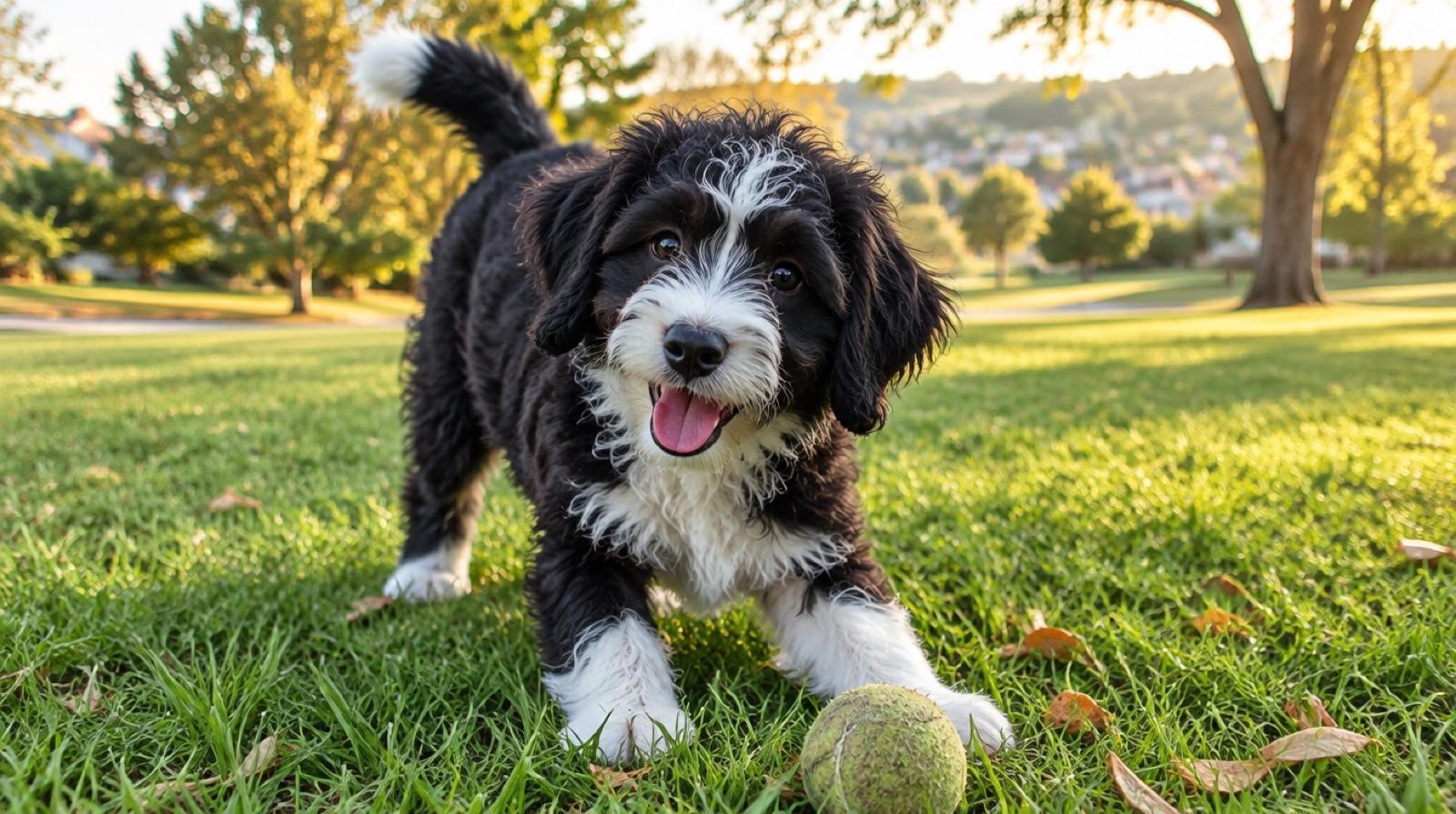
What exactly is a Bordoodle?
A Bordoodle is a cross between a Border Collie and a Poodle. The Poodle comes in more than one size, so ask which was used: a Standard Poodle gives a different dog from a Miniature. It is not a breed in the formal sense. Dogs Australia publishes a breed standard for each purebred breed it recognises, and the Bordoodle is not on that list. For a buyer that means:
- No standard to measure a puppy against. Adult size, coat and temperament depend on the parents, and can vary within one litter.
- No breed club. Nobody sets minimum health checks for Bordoodle litters or publishes a reference price, the way purebred clubs do.
- No Dogs Australia pedigree. Member breeders' codes forbid crossbreeding without prior approval; that has its own section below.
Ads often carry labels such as “F1” (a purebred Border Collie parent and a purebred Poodle parent) or “F1b” (an F1 dog crossed back, usually to a Poodle). These are breeder shorthand that no registry checks. University of Sydney geneticists, writing about Labradoodle research in The Conversation, explain that the first-generation offspring of two breeds is similar, in contrast to the substantial variation in later generations, so a label is not a promise about coat or shedding.
Should you adopt or buy a Bordoodle?
Adopt if you can be flexible about age. An adult Bordoodle or Border Collie cross in rescue arrives with the vet work done for a published fee, and you can see its size, coat and, above all, its energy before you commit. That matters more for this cross than most, because a dog with a herding parent can be far busier than a family expects. Buy if you need a young puppy and are ready to do the checking that the lack of a breed standard and a breed club leaves to you.
| Route | Reference cost | What you usually get | Main risk |
|---|---|---|---|
| Crossbreed breeder | No published benchmark; each seller sets its own price | A puppy, ideally from two health-tested parents you can meet | Nobody sets minimum tests, so you must check every result yourself |
| Rescue or council pound | The rescue's published fee (see the table below) | Usually an adult, desexed and microchipped | Parents' health history usually unknown |
| Online ad or social media | Anything; a very cheap puppy is a warning sign | Anything from a real litter to a puppy that does not exist | Scams and untested parents |
If what you really want is a dog of predictable size, coat and health screening, look at the parent breeds, which have breed standards and Dogs Australia registered breeders. Our Border Collie and Poodle adopt-or-buy guides cover each side, and oodle breeds compared sets the Bordoodle beside the other Poodle crosses.
Why is there no Dogs Australia registered Bordoodle breeder?
Because the codes Dogs Australia members follow forbid crossbreeding unless their state body approves it in advance. The Dogs NSW Code of Ethics (clause 17) says a member shall not knowingly permit a purebred dog to be mated to a dog of a different breed or a cross-bred dog unless the mating is for the health, welfare or development of a breed and the Board has approved it in advance; it adds that the prohibition does not apply to guide and working dogs. Dogs Victoria's code (20.1.15) says dogs “are not permitted to be mated to a dog or bitch of a different breed, to a cross bred dog or bitch”. The national Dogs Australia Code of Practice (clause 16) says a member shall not permit its purebred dogs to be mated to a dog of a different breed or a cross bred dog “without the prior approval of the member’s Member Body”.
So the Border Collie and Poodle breeders who belong to a state canine body are bound by those rules, and Bordoodle litters are generally bred outside that system. Some belong to other registries, which Dogs Australia says are not affiliated with it and cannot issue its certified pedigrees. That does not make every Bordoodle breeder a poor one. It means the checks a breed club would push for are now yours to make.
How big does a Bordoodle get, and what is it like?
Somewhere between its parents, so start by asking which parents. This is what the official standards say:
| Parent breed | Height at the withers | Temperament and coat |
|---|---|---|
| Border Collie | Dogs 48 to 53 cm, bitches 46 to 51 cm | “Highly intelligent, with an instinctive tendency to work and is readily responsive to training”; moderately long or smooth coat, with a soft, dense undercoat in both |
| Poodle (Miniature) | 28 cm to under 38 cm | A replica in miniature of the Standard Poodle |
| Poodle (Standard) | 38 cm and over | “A very active, intelligent, well balanced and elegant looking dog with good temperament”; very profuse, dense coat, short hair close, thick and curly |
From the Dogs Australia Border Collie, Poodle (Miniature) and Poodle (Standard) standards, read 11 November 2026.
The Border Collie standard describes a working sheep dog with enough substance for “long periods of active duty”, and the Standard Poodle standard calls that breed very active. Put the two together and plan for a dog that needs daily exercise and something to think about: training, games and a job. The coat can be curly, wavy or a double coat closer to the Border Collie's, so grooming needs vary from dog to dog. Our Sydney guides cover the detail: Bordoodle exercise and training, Bordoodle health issues and adopting a Bordoodle in Sydney.
Are Bordoodles hypoallergenic or non-shedding?
No dog is hypoallergenic. The Australasian Society of Clinical Immunology and Allergy (ASCIA) says: “All dog breeds cause allergies, although some do not shed as much dander, and therefore less allergen is spread.” It also says the main source of dog allergen is saliva.
A Bordoodle is a particular gamble on coat, because its parents sit at opposite ends. The Border Collie standard gives both coat varieties a soft, dense undercoat; the Poodle standard describes a dense, curly coat. A puppy can take after either. Treat a “guaranteed hypoallergenic” or “non-shedding” promise as advertising. If anyone at home has asthma or a dog allergy, see a doctor before you choose a dog, spend long, repeated visits with the actual dog, and read our guides to hypoallergenic dogs in Australia and dogs that don't shed.
Which health checks should a Bordoodle breeder show you?
Results for both parents, from each parent breed's own list. The National Border Collie Council of Australia says copies of the DNA test results for the sire and dam, and hip and elbow scoring results, should be made available to puppy buyers. That is a fair standard to hold a Bordoodle breeder to as well.
| Parent | Ask for | Where the list comes from |
|---|---|---|
| Border Collie | Hip and elbow x-ray scores; an eye examination by a canine ophthalmologist; a hearing (BAER) test of puppies; DNA results for Collie eye anomaly, trapped neutrophil syndrome, neuronal ceroid lipofuscinosis (NCL5), degenerative myelopathy, MDR1 and the other tests on the council's list | National Border Collie Council of Australia breed health page |
| Standard Poodle | DNA tests for degenerative myelopathy, neonatal encephalopathy and von Willebrand disease (a bleeding disorder); hip x-rays | Dogs Victoria Poodle (Standard) profile |
| Miniature Poodle | A DNA test for progressive retinal atrophy (an inherited blindness); a knee check | Dogs Victoria Poodle (Miniature) profile, which also lists luxating patellas |
| Both | The certificates themselves, with dates and each dog's name or microchip number; the puppy's own vet check | A verbal “they're all health tested” is not a result |
Sources: National Border Collie Council of Australia and the Dogs Victoria Standard and Miniature Poodle profiles, read 11 November 2026. A buying checklist, not veterinary advice.
Degenerative myelopathy appears on both parents' lists, so ask for that result from both sides. MDR1 is a gene that can change how a dog handles some medicines; if the breeder gives you the parents' MDR1 results, pass them to your vet. Dogs Australia also suggests asking whether your own vet can check the puppy before you buy.
See Bordoodles listed by rescues right now
Bordoodles and other Border Collie and Poodle crosses from the rescues, shelters and council pounds we aggregate. Every listing links to the rescue, where you apply directly, and an alert tells you when a new one arrives.
What does a Bordoodle cost?
We cannot give you a breeder price we can stand behind. For purebred breeds we read the prices that Dogs Australia member breeders publish on their own websites and report the range. That method has nothing to measure for a Bordoodle, because member breeders' codes forbid crossbreeding without prior approval, and there is no breed club guide either. Any figure on a listing site is one seller's asking price, not a benchmark, and a high price does not buy health testing. Ask what the price includes.
What we can show you is what rescues publish:
| Rescue | Fee as published | Read |
|---|---|---|
| RSPCA NSW | $620 puppy under 12 months; $500 dog over 12 months | 11 Nov 2026 |
| RSPCA ACT | $1,200 for popular small breed puppies, breed mixes or poodle mixes of any size with high adoption demand, up to 12 months; $650 for popular breeds and mixes over 12 months and under 8 years | 11 Nov 2026 |
| RSPCA Victoria | Adult dogs $500 to $1,000; each animal's fee is on its profile | 11 Nov 2026 |
Reference only, not a quote. These are the fees each rescue published on the date shown; fees change and some dogs are priced individually, so check with the rescue. Adoption fees normally include desexing and microchipping, which you would pay a vet for after buying a puppy.
The purchase price is the smaller number over a dog's life. Food, insurance, vet care, training and any clipping add up, so run it through the dog cost calculator and read our guide to cheaper vet care before you commit.
What do Bordoodles in rescue look like?
Mostly adults, now and then a young dog. They are listed under several names (Bordoodle, Border Collie x Poodle, Border Collie cross, Poodle cross), so search more than one. Border Collie crosses come through rescue too, and if the Border Collie side is what draws you, they are worth a look: Sydney, Melbourne, Brisbane, Perth, Adelaide.
An adopted adult answers the questions a puppy cannot: its coat has grown in, its size is settled, and you can see how much exercise it really needs and how it behaves with people, children and other dogs. The rescue will usually have had it vet checked, desexed and microchipped. What you usually will not get is its parents' health results, so book a baseline vet check in the first weeks. Our Sydney Bordoodle adoption guide covers why they come into rescue, and adopting a dog in Australia walks through the process.
How do Bordoodle scams work, and how do you check a seller?
Never pay for a Bordoodle you have not seen with its mother, in person or on a live video call. If a seller then asks for more money for transport, a crate or insurance, stop and check before paying anything else.
Scamwatch says scammers set up fake websites, social media profiles and marketplace listings for popular breeds and pets that do not exist, and that if a pet is very cheap, it is likely a scam. It advises viewing the pet in person or on a video call. A Dogs Victoria fact sheet says popular breeds and mixes feature commonly in scam ads, and warns that ads may display microchip, source or membership numbers lifted from legitimate breeders. Bordoodle versions of the pattern to watch for:
- “Guaranteed non-shedding” or “hypoallergenic”. ASCIA says all dog breeds cause allergies, and a Border Collie parent can pass on a shedding double coat.
- “Calm” or “low energy” promises. Both parent standards describe active, intelligent dogs. Nobody can promise a puppy's energy level.
- Health talk without paperwork. Ask for both parents' certificates from the table above, with names that match the litter.
- Photos of someone else's litter. A reverse image search and a search of the ad's exact wording often find the same material elsewhere.
Because a Bordoodle does not come with a Dogs Australia pedigree, the check that matters most is the one every breeder must pass: the state number. That is a breeder identification number in NSW, a Pet Exchange Register source number in Victoria, a supply number in Queensland or a DACO breeder number in South Australia. Look it up on the official register yourself and confirm it matches the seller and the microchip. Our puppies for sale guide sets out every state's scheme and what to do if you have already paid.
Is a Bordoodle the right dog for you?
Be honest about three things before you apply anywhere: time every day for exercise and training, a home where a clever dog will not be bored, and a grooming budget that depends on which coat it gets. If long days alone are the norm, a calmer breed or an older rescue dog with a known energy level is the kinder choice. Not sure the cross fits? Try the what dog breed is right for me quiz, the dog exercise calculator and the adoption readiness check.
Weighing other dogs too? Other adopt-or-buy guides cover the Schnoodle, Groodle, Bernedoodle and Havanese.
Find a Bordoodle near you
Each page shows Bordoodles listed right now by rescues in that city, and each listing links to the rescue where you apply directly.
Frequently asked questions
Is a Bordoodle a recognised breed in Australia?▼
No. A Bordoodle is a cross between a Border Collie and a Poodle. Dogs Australia publishes breed standards only for the purebred breeds it recognises, and the Bordoodle is not one of them. There is no official Bordoodle size, coat or temperament, no breed club setting health rules, and no Dogs Australia pedigree for a Bordoodle puppy.
How much does a Bordoodle puppy cost in Australia?▼
We have no breeder price we can stand behind. Our method reads the prices that Dogs Australia member breeders publish on their own websites, but the codes those members follow forbid crossbreeding without prior approval from their state body, so there is no member-breeder Bordoodle price to survey, and no breed club publishes a guide. Every Bordoodle seller sets its own price. For comparison, RSPCA ACT listed $1,200 for popular small breed puppies, breed mixes or poodle mixes of any size with high adoption demand up to 12 months when we read its fee page in November 2026. Fees change, so check with the rescue: reference only, not a quote.
How big does a Bordoodle get?▼
It depends on which Poodle was used. The Dogs Australia Border Collie standard gives dogs 48 to 53 cm and bitches 46 to 51 cm at the withers. A Standard Poodle is 38 cm and over and a Miniature Poodle 28 cm to under 38 cm. A Border Collie and Standard Poodle cross is usually a medium dog; a Miniature Poodle parent can give a smaller one. Ask which parents were used and meet them.
Are Bordoodles hypoallergenic?▼
No dog is. ASCIA, the Australasian allergy society, says all dog breeds cause allergies, although some shed less dander and so spread less allergen, and that the main dog allergen is in saliva. A Bordoodle can inherit the Poodle's curly coat, the Border Collie's double coat with a soft, dense undercoat, or something between, so shedding is not predictable. If someone at home is allergic, see a doctor first and spend long, repeated visits with the specific dog.
Do Bordoodles need a lot of exercise?▼
Plan for an active dog. The Dogs Australia Border Collie standard describes a working sheep dog built for long periods of active duty, highly intelligent, with an instinctive tendency to work, and the Standard Poodle standard calls that breed very active and intelligent. A Bordoodle may inherit that drive, so expect daily exercise plus training and games for its mind. Our Sydney guide to Bordoodle exercise and training sets out a routine.
Can I buy a Bordoodle from a Dogs Australia registered breeder?▼
Not in the usual way. The national Dogs Australia Code of Practice says a member shall not permit its purebred dogs to be mated to a dog of a different breed or a cross bred dog without the prior approval of its state body. The Dogs NSW Code of Ethics says a member shall not knowingly permit such a mating unless it is for the health, welfare or development of a breed and the Board has approved it in advance (the clause does not apply to guide and working dogs), and the Dogs Victoria code says dogs are not permitted to be mated to a dog of a different breed or a cross bred dog. Bordoodle breeders may belong to other registries, which Dogs Australia says are not affiliated with it.
What health tests should a Bordoodle breeder show me?▼
Results for both parents. For the Border Collie, the National Border Collie Council of Australia lists hip and elbow x-ray scoring, eye examinations by a canine ophthalmologist, a hearing test of puppies, and DNA tests including Collie eye anomaly, trapped neutrophil syndrome, neuronal ceroid lipofuscinosis, degenerative myelopathy and MDR1, and says copies of the parents' DNA and hip and elbow results should be made available to puppy buyers. For a Standard Poodle, Dogs Victoria lists DNA tests for degenerative myelopathy, neonatal encephalopathy and von Willebrand disease plus hip x-rays. Ask for the written results.
What does MDR1 mean on a Border Collie DNA report?▼
MDR1 is a gene that can change how a dog handles some medicines, and it is on the National Border Collie Council of Australia's list of DNA tests for the breed. If a Bordoodle's parent carries it, the puppy may too. Ask the breeder for the parents' MDR1 results and give them to your vet, who will take them into account when choosing any treatment.
What do F1 and F1b mean on a Bordoodle ad?▼
They are breeder shorthand, not registry terms. F1 usually means one purebred Border Collie parent and one purebred Poodle parent; F1b means an F1 dog crossed back, usually to a Poodle. No registry checks the labels. University of Sydney geneticists, writing in The Conversation, explain that the first-generation offspring of two breeds is similar, in contrast to the substantial variation in later generations, so the label is no promise about coat or shedding.
Can I adopt a Bordoodle from a rescue?▼
Sometimes. Bordoodles and other Border Collie and Poodle crosses do come through the rescues we aggregate, usually as adults, and they are listed under several names, such as Bordoodle, Border Collie x Poodle, Border Collie cross or Poodle cross. Watch the Bordoodle breed page, set an alert, and include Border Collie crosses in your search.
How do I check a Bordoodle seller?▼
Check the breeder number your state requires on the official register yourself, such as the breeder identification number in NSW, the Pet Exchange Register source number in Victoria or the supply number in Queensland, and confirm it matches the seller and the puppy's microchip. Then meet the mother where the puppies are raised, ask for both parents' health results, and never pay a deposit for a puppy you have not seen in person or on a live video call.
Sources
- Dogs Australia: How to choose a puppy (breed standards and other registries)
- Dogs Australia: Choosing a breeder
- Dogs Australia: Border Collie breed standard
- Dogs Australia: Poodle (Standard) breed standard
- Dogs Australia: Poodle (Miniature) breed standard
- National Border Collie Council of Australia: Breed health
- Dogs Victoria: Poodle (Standard) breed profile (health testing)
- Dogs Victoria: Poodle (Miniature) breed profile (health testing)
- Dogs NSW: Code of Ethics (June 2026), clause on crossbreeding
- Dogs Victoria: Part 20 Codes (Code of Practice 20.1.15)
- Dogs Australia: National Code of Practice (mating to other breeds)
- The Conversation (University of Sydney): Australian Labradoodles are more Poodle than Lab
- ASCIA: Pet allergy
- Scamwatch: Buying and selling scams (pet scams)
- Dogs Victoria: Identifying puppy scams and puppy farms (fact sheet)
- RSPCA NSW: Adoption fees
- RSPCA Victoria: The adoption process
- RSPCA ACT: Adoption process and fees
Keep reading
Bordoodles listed by rescues
Bordoodles and Border Collie and Poodle crosses listed right now by the rescues and shelters we aggregate.
Border Collie puppies: adopt or buy?
The DNA panel, hip, elbow and eye checks, and breeder questions for the Border Collie side.
Poodle puppies: adopt or buy?
Toy, Miniature and Standard Poodles: sizes, DNA tests and the rescue route.
Oodle breeds compared
How the popular Poodle crosses differ in size, coat and parent-breed health checks.