The short answer
The four oodles differ mainly by their non-Poodle parent and the Poodle size. Cavoodles (Cavalier x Poodle) and Spoodles (Cocker Spaniel x Poodle) are usually small to medium dogs from a Toy or Miniature Poodle. Groodles (Golden Retriever x Poodle, also called Goldendoodles) and Labradoodles (Labrador x Poodle) are usually large dogs from a Standard Poodle. None has a Dogs Australia breed standard, so size, coat and temperament vary even within a litter, and none is hypoallergenic: ASCIA says all dog breeds cause allergies. There is no winner. Choose the size and energy that fits your home, ask for both parents' health results, and consider an adult oodle from a rescue, whose coat and character you can already see.
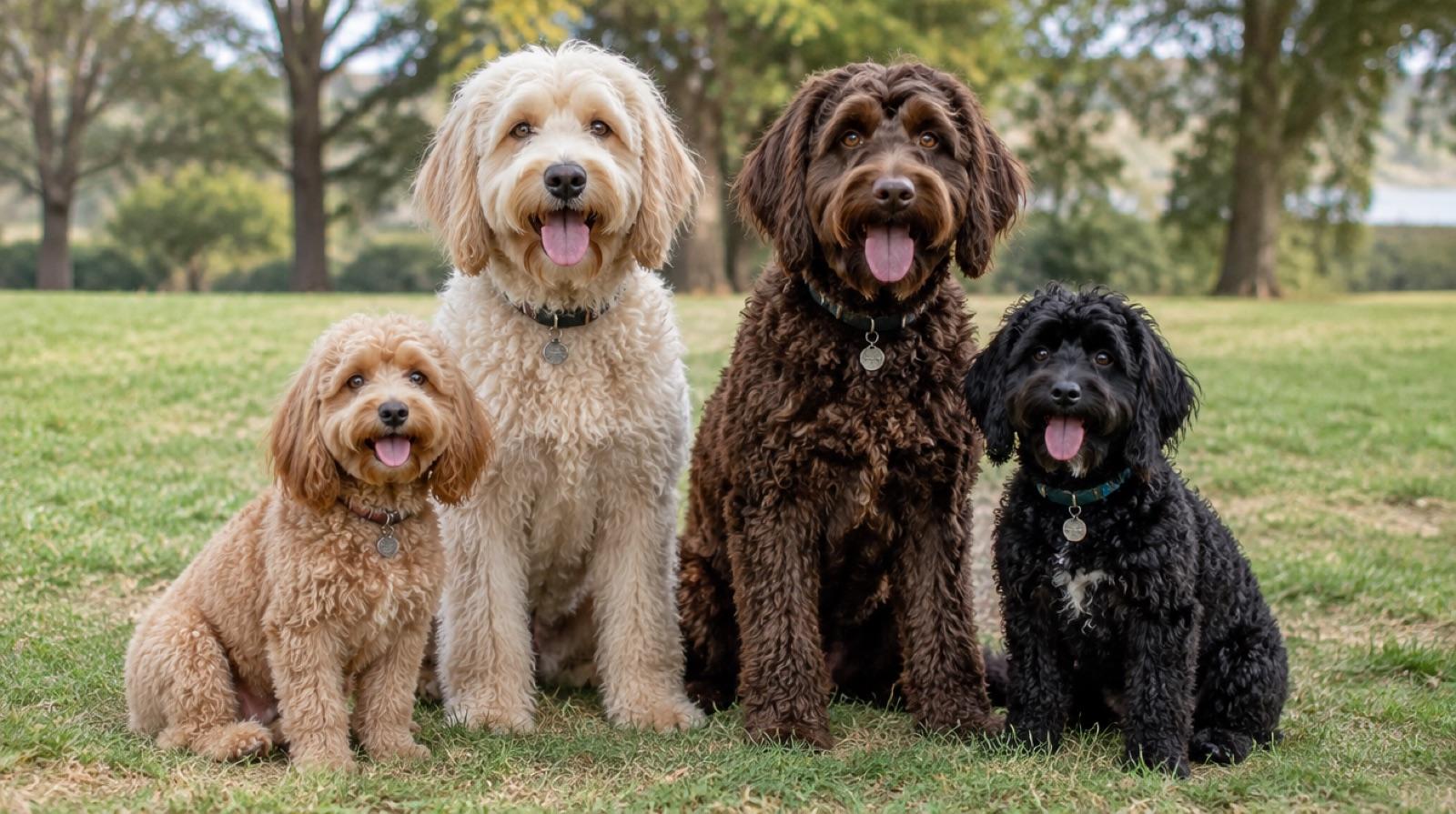
Are oodles breeds?
No. A Cavoodle, Spoodle, Groodle or Labradoodle is a cross between a Poodle and another breed. None of them appears on the Dogs Australia breed listing, so none has a breed standard: there is no official size, coat, colour or temperament to measure a puppy against, and no breed club setting health tests. The state canine bodies that make up Dogs Australia also bar their members from crossbreeding; the Dogs NSW Code of Ethics says a member shall not knowingly let a purebred be mated to a dog of a different breed without Board approval. So every oodle puppy comes from a breeder outside the Dogs Australia system.
That is why this comparison works through the parents. Every row in the table below comes from the parent breeds' Dogs Australia standards or a named club, not from an oodle standard, because there isn't one. A puppy can take after either parent, or land between them.
The four oodles side by side
| Trait | Cavoodle | Spoodle | Groodle | Labradoodle |
|---|---|---|---|---|
| Other parent | Cavalier King Charles Spaniel | Cocker Spaniel | Golden Retriever | Labrador Retriever |
| Other parent's size | 5.4 to 8.2 kg (no height set) | About 38 to 41 cm; about 13 to 14.5 kg | 51 to 61 cm (no weight set) | 55 to 57 cm ideal (no weight set) |
| Other parent's coat | Long, silky, free from curl, plenty of feathering | Flat, silky, never curly, well feathered | Flat or wavy with good feathering, dense undercoat | Short, dense, no wave or feathering, undercoat |
| Other parent's temperament | “Gay, friendly, non-aggressive; no tendency to nervousness” | “Gentle and affectionate, yet full of life and exuberance” | “Kindly, friendly and confident” | “Intelligent, keen and biddable”, “kindly nature” |
| Health tests to ask about | Annual heart check, specialist eye test, DNA tests, MRI where available | prcd-PRA, familial nephropathy, adult onset neuropathy (DNA); hips and elbows | Hips, elbows, eye exam within the last 12 months, specialist heart exam | Australian Labradoodle Association breeders: hips, elbows and a 10-condition DNA panel incl. prcd-PRA and exercise induced collapse |
| Breed standard | None | None | None | None from Dogs Australia; the Australian Labradoodle Association has its own |
Parent sizes, coats and temperaments from the Dogs Australia standards for the Cavalier, Cocker Spaniel, Golden Retriever and Labrador (Cocker height and weight given as approximate; Golden and Labrador ranges cover dogs and bitches). Tests from Dogs Australia, the Cocker Spaniel Club of Qld, the Golden Retriever Club of Queensland and the Australian Labradoodle Association. Breed standard row from the Dogs Australia breed listing and the Australian Labradoodle Association. All read 10 November 2026. An oodle can fall anywhere between its two parents.
The Poodle side is the same for all four, only in different sizes. Under the Dogs Australia standards a Toy Poodle is under 28 cm at the shoulder, a Miniature 28 cm to under 38 cm and a Standard 38 cm and over, and the Standard Poodle standard describes “a very active, intelligent, well balanced and elegant looking dog with good temperament”. Our guide to Poodle sizes and colours compares the three.
Groodle vs Labradoodle (and Goldendoodle)
These are the two big oodles, and they are closer than the names suggest. Both are usually bred from a Standard Poodle, and both retriever parents are large gundogs bred to work with people. A Goldendoodle and a Groodle are the same cross, so “Labradoodle vs Goldendoodle” is this comparison too.
- Coat. This is the clearest difference on the non-Poodle side. The Golden Retriever standard asks for a flat or wavy coat with good feathering; the Labrador standard for a short, dense coat without wave or feathering. A puppy that inherits little of the Poodle coat looks more like its retriever parent, so a Groodle of that kind has longer, feathered hair and a Labradoodle a shorter one.
- Size. Similar. The Golden standard allows 51 to 61 cm across dogs and bitches and the Labrador standard an ideal 55 to 57 cm, and both are crossed with a Standard Poodle of 38 cm and over. Either cross from a Miniature Poodle is smaller.
- Health tests. For the Golden parent, the Golden Retriever Club of Queensland expects hip and elbow scores, an eye examination by an ophthalmologist within the last 12 months and a heart examination by a specialist vet. For a Labradoodle, the Australian Labradoodle Association requires its accredited breeders to screen hips and elbows and to DNA test for ten conditions, including prcd-PRA and exercise induced collapse. For the Standard Poodle parent of either cross, Dogs Victoria lists DNA tests for degenerative myelopathy, neonatal encephalopathy and von Willebrand's disease, and hip x-rays.
- Who stands behind the label. The Australian Labradoodle has an association with accredited breeders, a register and its own standard. The Groodle has nothing equivalent, so every check falls to you.
Who each suits: both suit an active household with time for daily exercise, training and a clip every few weeks for life. Neither is a small-yard dog. Our Groodle and Labradoodle guides cover buying each one in more depth, and our Labrador vs Golden Retriever guide compares the two retriever parents.
Labradoodle vs Australian Labradoodle
A Labradoodle is usually a first cross between a Labrador and a Poodle. The Australian Labradoodle is something more deliberate. The Australian Labradoodle Association says it is “not just a Labrador x Poodle cross” but was developed over many years, and in 2004 it confirmed six approved parent breeds: the Poodle (Standard, Miniature and Toy), the Labrador Retriever, the Irish Water Spaniel, the Curly Coat Retriever and the American and English Cocker Spaniels. Dogs bred with other breeds are not considered for its registration.
Genetics backs up the difference. Two University of Sydney geneticists writing in The Conversation describe an international study finding that dogs in the Australian Labradoodle breed registry are mostly Poodle, not a 50-50 split, after generations of breeders selecting for a Poodle-like coat. A first-cross Labradoodle, by contrast, carries an equal share from each parent breed.
Neither is recognised by Dogs Australia. The association's register is its own, not a Dogs Australia pedigree. The practical upshot for a buyer: if a seller says “Australian Labradoodle”, check them in the association's own accredited breeder directory and ask for the hip, elbow and DNA results its rules require.
Cavoodle vs Spoodle
These are the two small oodles, and both are usually bred from a Toy or Miniature Poodle. The difference is the spaniel.
- Size. The Cavalier standard sets a weight of 5.4 to 8.2 kg; the Cocker Spaniel standard about 13 to 14.5 kg and about 38 to 41 cm at the shoulder. So the spaniel side of a Spoodle is the bigger, sturdier dog, and a Spoodle from a Miniature Poodle can be noticeably larger than a Cavoodle from a Toy.
- Temperament on paper. The Cavalier standard asks for a dog that is “gay, friendly, non-aggressive” with “no tendency to nervousness”; the Cocker standard one that is “gentle and affectionate, yet full of life and exuberance”. The Cocker is a working gundog, so expect a busier dog on that side.
- Health tests. They are different lists. For the Cavalier parent, Dogs Australia recommends an annual heart check (preferably by a cardiologist), an eye test by a specialist ophthalmologist, DNA tests for Curly Coat/Dry Eye and Episodic Falling, and an MRI for syringomyelia where available. For the Cocker parent, the Cocker Spaniel Club of Qld lists DNA tests for prcd-PRA, familial nephropathy and adult onset neuropathy, plus hips and elbows. For a Toy or Miniature Poodle, Dogs Victoria says a DNA test for progressive retinal atrophy (PRA) should be done and lists unstable knees and Legg-Perthes disease as other concerns.
The Cocker Spaniel and the small Poodles are both tested for an inherited form of PRA, so two untested Spoodle parents can pass on the same eye disease. Who each suits: both fit smaller homes and families who will groom regularly; a Spoodle may suit a household wanting a slightly bigger, more outdoorsy small dog. See our Cavoodle and Spoodle guides, and Cavoodle health issues for the heart and spine risks on the Cavalier side.
Cavoodle vs Groodle
This is mostly a size decision. A Cavoodle comes from a toy-group spaniel and usually a Toy or Miniature Poodle. A Groodle comes from a Golden Retriever, 51 to 61 cm at the shoulder, and usually a Standard Poodle, 38 cm and over. One is a small companion dog; the other is usually a large, strong, bouncy dog that needs lead training from day one.
That flows into everything else. Dogs Victoria says the Standard Poodle needs more exercise than the smaller varieties, and a Groodle has a working retriever on the other side as well. A bigger coat takes longer to clip, so grooming costs more. Food, crates, car space and some vet costs scale with size. Choose a Cavoodle if you want a small dog for an apartment or a quieter home; choose a Groodle if you have the space, the time for daily exercise and a household that enjoys a big, active dog.
What do F1, F1b and multigen mean?
They describe how a puppy was bred. An F1 is a first cross between two purebreds. Writing in The Conversation, University of Sydney geneticists explain that first-cross puppies are similar to each other, each carrying exactly half its chromosomes from each parent breed, while later generations vary much more: a puppy can inherit all, half or none of its Poodle grandparents' DNA at any one gene, and one that inherits no Poodle coat genes has a Labrador coat.
F1b is breeder shorthand for a first cross bred back to a purebred, usually a Poodle, which makes a Poodle-type coat more likely but not certain. Multigen means oodle bred to oodle over several generations. No registry outside the Australian Labradoodle Association checks any of these labels, so a generation on an ad is a claim. Meeting both parents tells you more. Our Cavoodle guide has a table of what each label can and cannot tell you.
Is any oodle hypoallergenic?
No. The Australasian Society of Clinical Immunology and Allergy (ASCIA) says: “All dog breeds cause allergies, although some do not shed as much dander, and therefore less allergen is spread.” It also says the main dog allergen is in saliva. A 2012 study from Utrecht (Vredegoor and colleagues) found higher levels of the main dog allergen in hair and coat samples from so-called hypoallergenic breeds, including Labradoodles and Poodles, than from Labradors and other control dogs, and no evidence for calling any breed hypoallergenic.
A low-shedding oodle may suit some allergic people better than a heavy shedder, but that depends on the individual dog and person, not the cross. If anyone at home has asthma or a dog allergy, see a doctor first and spend long, repeated visits with the specific dog. Our hypoallergenic dogs guide covers how to test a match.
Grooming: the cost every oodle shares
A Poodle-type coat keeps growing and does not drop much hair, which is exactly why it mats. Dogs Victoria recommends bathing and clipping a Poodle every 6 to 8 weeks with regular brushing between, and a curly or wavy oodle needs the same. Oodles that take after the spaniel or retriever parent shed more instead. Either way, plan for grooming for the dog's whole life, and remember a Groodle or Labradoodle clip takes longer than a Cavoodle clip. Our Cavoodle grooming guide covers the routine for any small oodle.
Find an oodle near you
Oodles listed right now by the rescues, shelters and council pounds we aggregate. Each listing links to the rescue, where you apply directly.
Oodles in rescue
All four come through Australian rescues and council pounds, mostly as young adults and adults whose owners could no longer keep them, with the occasional puppy. Popular crosses tend to be adopted quickly, so watch the breed pages for Cavoodles, Spoodles, Groodles and Labradoodles, and set alerts. Rescues label crosses in different ways, so the Poodle mix page and the low-shedding listings for your city (Sydney, Melbourne, Brisbane, Perth, Adelaide) are worth checking too.
For a cross, an adult from a rescue answers the questions a puppy cannot. You can see its adult size, its coat and how it behaves with people and other dogs, and it usually arrives desexed, microchipped and vaccinated. What you usually will not get is its generation or its parents' health results, so book a baseline vet check in the first week.
Cost and scams
Because no Dogs Australia breeder breeds oodles and no breed club publishes a guide, there is no reference price for a Cavoodle, Spoodle or Groodle puppy; every seller sets its own. Our Labradoodle guide reports what Australian Labradoodle Association breeders publish on their own websites. Rescue fees are published: RSPCA ACT, for example, lists $1,200 for popular small breed puppies, breed mixes and poodle mixes of any size up to 12 months old (fee structure from 12 January 2026, read 10 November 2026; a reference, not a quote).
Oodles are a favourite of puppy scammers. In May 2020 the ACCC said Cavoodles were among the most common breeds reported in Scamwatch puppy scams, and Scamwatch still warns about fake sites and marketplace listings for popular breeds at prices that are too cheap. Never pay for a puppy you have not seen with its mother, check any breeder number your state requires yourself, and read our puppies for sale: adopt or buy guide for every state's scheme. Before you choose, the what dog breed am I quiz and the dog cost calculator help with size and budget.
Frequently asked questions
What is the difference between a Groodle and a Labradoodle?▼
The non-Poodle parent. A Groodle is a Golden Retriever crossed with a Poodle and a Labradoodle is a Labrador Retriever crossed with a Poodle, both usually with a Standard Poodle. The Dogs Australia standards give the Golden a flat or wavy coat with feathering and the Labrador a short, dense coat without feathering, so a Groodle puppy that takes after its non-Poodle side has a longer, feathered coat. The Labradoodle also has an Australian Labradoodle version with its own association; the Groodle has no equivalent.
Is a Goldendoodle the same as a Groodle?▼
Yes. Goldendoodle and Groodle are two names for the same cross, a Golden Retriever and a Poodle. So labradoodle vs goldendoodle is the same comparison as Groodle vs Labradoodle.
What is the difference between a Cavoodle and a Spoodle?▼
The spaniel parent. A Cavoodle has a Cavalier King Charles Spaniel parent and a Spoodle a Cocker Spaniel parent, and both are usually crossed with a Toy or Miniature Poodle. The Dogs Australia standards put the Cavalier at 5.4 to 8.2 kg and the Cocker Spaniel at about 13 to 14.5 kg, so a Spoodle tends to come from a heavier spaniel parent. The two spaniels also need different health tests.
Which is bigger, a Cavoodle or a Groodle?▼
A Groodle, usually by a long way. A Cavoodle comes from a toy-group spaniel and usually a Toy or Miniature Poodle, while a Groodle comes from a Golden Retriever, which the Dogs Australia standard puts at 51 to 61 cm at the shoulder, and usually a Standard Poodle, 38 cm and over. A Groodle bred from a Miniature Poodle is usually smaller.
Are oodles recognised breeds in Australia?▼
No. The Cavoodle, Spoodle, Groodle and Labradoodle are not on the Dogs Australia breed listing, so none has a breed standard setting its size, coat or temperament. The state canine bodies that make up Dogs Australia, such as Dogs NSW, bar members from crossbreeding their dogs. The Australian Labradoodle Association keeps its own register for Australian Labradoodles, but that is not a Dogs Australia pedigree.
What is the difference between a Labradoodle and an Australian Labradoodle?▼
A Labradoodle is usually a first cross between a Labrador and a Poodle. The Australian Labradoodle Association says the Australian Labradoodle is not just a Labrador x Poodle cross: it was developed over many years from six approved parent breeds, the Poodle, Labrador, Irish Water Spaniel, Curly Coat Retriever and American and English Cocker Spaniels. University of Sydney geneticists writing in The Conversation describe an international study finding that dogs in the Australian Labradoodle breed registry are mostly Poodle in their DNA.
Which oodle is the most hypoallergenic?▼
None of them is hypoallergenic, and no breed or cross can promise it. The Australasian Society of Clinical Immunology and Allergy (ASCIA) says all dog breeds cause allergies, although some do not shed as much dander and so spread less allergen. A 2012 Dutch study found more of the main dog allergen in hair and coat samples from so-called hypoallergenic breeds, including Labradoodles and Poodles, than from Labradors and other control dogs. If someone at home is allergic, see a doctor and spend long visits with the specific dog.
Which oodle is best for a family?▼
There is no winner, because there is no oodle temperament standard. Look at the parents instead: the Dogs Australia standards describe the Cavalier as gay, friendly and non-aggressive, the Cocker as gentle and affectionate yet full of life, the Golden as kindly, friendly and confident, and the Labrador as having a kindly nature. Size and energy matter more for most families: a small Cavoodle and a large Groodle suit very different homes. An adult oodle with a known temperament is the most predictable choice.
Which oodle needs the least grooming?▼
None of them is low-grooming if it has a Poodle-type coat. Dogs Victoria says Poodles are bathed and clipped every 6 to 8 weeks, and a curly or wavy oodle coat needs the same routine plus regular brushing. An oodle that takes after its non-Poodle parent sheds more but may tangle less. Size changes the cost: a Groodle or Labradoodle clip takes longer than a Cavoodle clip.
What health tests should an oodle breeder show me?▼
Results for both parents, chosen for each parent breed. For a Cavalier parent, Dogs Australia recommends an annual heart check, a specialist eye test, DNA tests and an MRI where available. For a Cocker, the Cocker Spaniel Club of Qld lists DNA tests for prcd-PRA, familial nephropathy and adult onset neuropathy, plus hips and elbows. The Golden Retriever Club of Queensland expects hip and elbow scores, an eye examination by an ophthalmologist within the last 12 months and a heart examination by a specialist vet. Poodle tests depend on the size.
Can I adopt an oodle from a rescue?▼
Yes. Cavoodles, Spoodles, Groodles, Labradoodles and other Poodle crosses come through Australian rescues and council pounds, mostly as young adults and adults, with the occasional puppy. They are popular and tend to be adopted quickly, so watch each breed page and set alerts. Rescue labels vary, so also search Poodle cross and Poodle mix.
Is an F1b oodle better than an F1?▼
Not in any way that is guaranteed. F1 means a first cross between two purebreds, and University of Sydney geneticists explain that first-cross puppies all carry half their chromosomes from each breed, while later generations vary much more. F1b is breeder shorthand for a first cross bred back to a purebred, usually a Poodle, so a Poodle-type coat is more likely. No registry checks these labels, so meet both parents.
Sources
- Dogs Australia: Breed listing (March 2026)
- Dogs Australia: Cavalier King Charles Spaniel breed standard
- Dogs Australia: Cocker Spaniel breed standard
- Dogs Australia: Golden Retriever breed standard
- Dogs Australia: Labrador Retriever breed standard
- Dogs Australia: Poodle (Standard) breed standard
- Dogs Victoria: Poodle (Toy) breed profile (sizes, health, grooming)
- Dogs Australia: What to look for when buying a Cavalier King Charles Spaniel puppy
- Cocker Spaniel Club of Qld: Health
- Golden Retriever Club of Queensland: Buying a Golden Retriever
- Australian Labradoodle Association: Parent breeds
- Australian Labradoodle Association: Health testing and breeding strategies
- The Conversation (2020): Australian Labradoodles are more Poodle than Lab
- Dogs NSW: Code of Ethics (June 2026)
- ASCIA: Pet allergy
- Vredegoor et al. (2012), Journal of Allergy and Clinical Immunology: Can f 1 levels in hair and homes of different dog breeds
- ACCC: Don’t get scammed looking for a lockdown puppy (18 May 2020)
- Scamwatch: Buying and selling scams
- RSPCA ACT: Adoption process and fees
Keep reading
Cavoodle puppies: adopt or buy?
Generation labels, scam red flags and the parent health tests for a Cavalier x Poodle.
Groodle puppies: adopt or buy?
Golden Retriever and Standard Poodle screening, size and Groodles in rescue.
Labradoodle puppies: adopt or buy?
What association breeders publish, their mandatory tests, and Labradoodles in rescue.
Spoodle puppies: adopt or buy?
Cocker Spaniel and Poodle tests, size by Poodle variety, and the scam pattern.