The short answer
A Toy Poodle is under 28 cm at the shoulder, a Miniature 28 cm to under 38 cm, and a Standard 38 cm and over, under the Dogs Australia standards. Otherwise all three share one standard. Dogs Victoria gives Toys and Miniatures an average lifespan of 12 to 15 years and Standards 10 to 12. Small Poodles need a DNA test for progressive retinal atrophy plus eye and knee checks; Standards need hip x-rays and their own DNA tests. For colour, the standard allows all solid colours, naming white, cream, brown, apricot, black, silver and blue. Parti (patched) coats are a fault, and merle is not a Poodle colour at all.
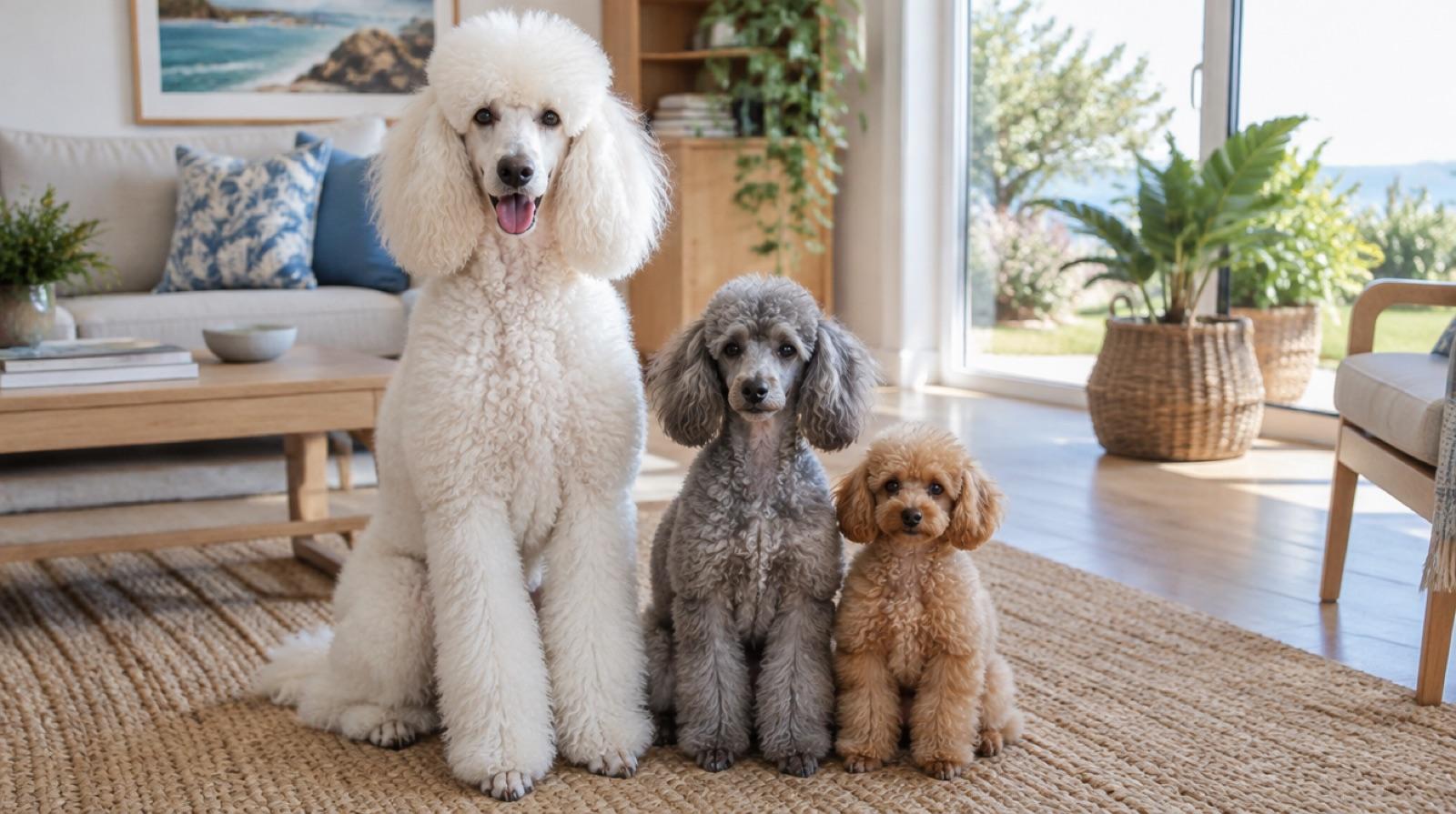
Toy vs Miniature vs Standard Poodle at a glance
Dogs Australia recognises three Poodles in its Non Sporting group, each with its own standard. The Miniature standard says it “should be in every respect a replica, in miniature, of the Poodle (Standard)”, and the Toy standard says it is the same as the other two except for height. So the table below is mostly about what size changes.
| Trait | Toy | Miniature | Standard |
|---|---|---|---|
| Height at shoulder | Under 28 cm | Under 38 cm, not under 28 cm | 38 cm and over |
| Weight | Not set | Not set | Not set |
| Average lifespan (Dogs Victoria) | 12 to 15 years | 12 to 15 years | 10 to 12 years |
| Exercise and space (Dogs Victoria) | Suits apartments and limited space | Suits apartments and limited space | Athletic; needs more exercise |
| Health concerns (Dogs Victoria, Poodle Club of Victoria) | PRA, unstable knees, Legg-Perthes disease | PRA; knee, hip, eye and thyroid problems | Hip dysplasia, degenerative myelopathy, von Willebrand's disease, sebaceous adenitis, bloat, Addison's disease |
| Temperament | One standard for all three: “A very active, intelligent, well balanced and elegant looking dog with good temperament” | ||
| Grooming | Brushing, plus bathing and clipping every 6 to 8 weeks (Dogs Victoria) | ||
Heights and temperament from the Dogs Australia Standard, Miniature and Toy standards; lifespan, exercise and grooming from the Dogs Victoria Poodle profile; health concerns from Dogs Victoria and the Poodle Club of Victoria. All read 10 November 2026. Lifespans are breed averages, not a promise for any one dog.
Dogs Australia keeps the sizes apart. Its registration regulations say the three are judged separately, that “inter variety breeding is NOT approved” and that reclassification on size is not permitted. A puppy is registered as the variety of its parents, which is one reason to meet them: their height is your best guide to the puppy's.
Toy Poodle vs Miniature Poodle: which suits you?
On paper they are the same dog at two heights. In daily life, a few centimetres matter.
- Size around children. A Toy Poodle under 28 cm is a very small dog, so handling by young children needs close supervision. A Miniature is still small but larger, which some families with young children prefer.
- Small-dog health. The American College of Veterinary Surgeons says slipping kneecaps (patellar luxation) mainly affect small dogs, naming miniature poodles among its examples, and that collapsing windpipe (tracheal collapse) most commonly affects small breeds, Poodles among them. Ask your vet about knees and windpipe at the first check.
- Hips. The Poodle Club of America lists a hip evaluation for Miniatures but not Toys, and the Poodle Club of Victoria lists hip problems among Miniature concerns, while Dogs Victoria lists Legg-Perthes disease, a hip condition, among Toy and Miniature concerns.
- Lifestyle. Dogs Victoria says Toy and Miniature Poodles are ideal for apartments or limited space and that all three varieties adapt well. Both are bright, trainable dogs that need mental work as well as walks.
Beware anything sold as smaller than a Toy. “Teacup”, “micro” and “tiny toy” are not Poodle varieties, and breeding for extreme smallness concentrates the small-dog problems above. Our toy dog breeds guide covers the teacup myth across breeds.
Which health tests does each size need?
Different tests, because each size has its own common problems. Ask any breeder for results on both parents.
| Size | Dogs Victoria says | Poodle Club of America lists |
|---|---|---|
| Toy | DNA test for PRA; other concerns unstable knees and Legg-Perthes disease | PRA (prcd) DNA test; yearly specialist eye exam; patella evaluation |
| Miniature | DNA test for PRA; other concerns unstable knees and Legg-Perthes disease | As for the Toy, plus a hip evaluation |
| Standard | DNA tests for degenerative myelopathy, neonatal encephalopathy and von Willebrand's disease; hip x-rays; sebaceous adenitis can be tested for | Hip evaluation; eye exam; thyroid evaluation; DNA tests for neonatal encephalopathy and von Willebrand's disease; heart and skin biopsy optional |
Sources: Dogs Victoria Poodle profile and the Poodle Club of America health statement (December 2024), both read 10 November 2026. A buying checklist, not veterinary advice.
Sebaceous adenitis, a hereditary skin disease in which the oil glands in the skin become inflamed, has no DNA test: the OFA says it is screened by skin biopsy and breeding dogs are retested every one to two years. The Poodle Club of Victoria adds that testing parents and grandparents is no guarantee, but considerably increases your chances of a healthy Poodle. Our Poodle health issues guide explains each condition and the signs to watch for.
What colours does the Poodle standard allow?
All solid colours. The Dogs Australia Poodle standard, which the Miniature and Toy share, says “All solid colours” and then sets the nose, eye and toenail colour that goes with each one. It names seven colours in those rules, and the Dogs Victoria profile lists the same seven. “Clear colours preferred.”
| Colour | Points the standard asks for | Shade can vary until 18 months? |
|---|---|---|
| Black | Black nose, lips, eye rims and toenails | Not listed |
| White | Black nose, lips and eye rims; black toenails desirable | Not listed |
| Cream | Black nose, lips and eye rims; black toenails desirable | Yes |
| Apricot | Dark eyes with black points, or deep amber eyes with liver points | Yes |
| Brown | Dark amber eyes; dark liver nose, lips, eye rims and toenails | Yes |
| Silver | Black nose, lips, eye rims and toenails | Yes |
| Blue | Black nose, lips, eye rims and toenails | Yes |
From the Dogs Australia Poodle (Standard) standard, last updated 10 March 2010, read 10 November 2026. The standard does not name red, but a solid red is a solid colour.
The standard also lists what is not wanted. Its faults include a flesh-coloured nose and “particolours”, defined as white markings on black or coloured Poodles and lemon or other markings on white Poodles. Dogs Australia's registration note on colours says the colours and patterns in the current breed standard decide Main Register eligibility, and dogs with colours or patterns not in the standard go on the Limited Register.
Parti, phantom and merle Poodles
These are the colours you will see advertised that the Australian standard does not include.
- Parti. A coloured Poodle with white patches, or a white one with coloured patches. The standard lists particolours as a fault. White spotting of this kind is common across breeds, and the UC Davis Veterinary Genetics Laboratory lists the Poodle among breeds tested for the piebald variant. A parti Poodle can be purebred; it just is not a standard colour here.
- Phantom. A two-colour pattern, with lighter markings on the face, legs and chest of a darker coat. Because it is not a solid colour, it sits outside the Australian standard's “all solid colours”.
- Merle. A marbled pattern of diluted and full colour. The Kennel Club in the UK stopped registering merle Poodles in January 2020, after requests from a number of breeds, most recently the Poodle Breed Council, saying merle “is not a coat colour recognised as historically occurring in Poodles”. Its genetics manager, Dr Tom Lewis, explained that merle is dominant and so “cannot suddenly ‘emerge’ in a breed after many years”. In other words, a merle Poodle points to another breed somewhere in its background.
Merle also carries a health risk the other colours do not. Two merle parents can produce a double merle puppy with a higher risk of impaired hearing and sight, which is why Dogs Australia has banned merle to merle matings since 2015. Our merle and brindle guide covers the research and cryptic merle, a merle gene that barely shows in the coat.
What genes make a Poodle black, apricot, brown or blue?
A handful of genes that work the same way in most dogs. The UC Davis Veterinary Genetics Laboratory explains that dogs make two pigments, black (eumelanin) and red or yellow (phaeomelanin), and other genes modify them:
- Apricot, red and cream. A dog with two copies of the recessive red variant at the MC1R (E locus) gene cannot make black pigment in its coat. The laboratory says such dogs are expected to have coats in shades of cream, yellow and/or red. Two black carriers can have one of these puppies.
- Brown. Two copies of the brown variant of the TYRP1 (B locus) gene turn black pigment brown, without affecting red pigment. That is why the standard gives brown Poodles liver noses rather than black ones.
- Blue. Two copies of the dilute variant (MLPH, D locus) turn black to blue and brown to lilac.
Silver is less simple. The Australian standard expects silver, like cream, apricot, brown and blue, to show varying shades until 18 months, so a silver puppy's adult colour may not be clear at eight weeks. A DNA colour test of the parents is the reliable way for a breeder to predict colours; for a buyer, the parents' adult coats are the best guide.
Does colour change a Poodle's health or temperament?
Not under the standard, which sets one temperament for every solid colour, and we found no published research linking Poodle solid colours to health or behaviour. The one coat with a documented health risk is merle, which is not a Poodle colour. Be wary of any seller who prices a puppy by “rare” colour: colour is the least important thing about a Poodle, and parents tested for their size's conditions matter far more. The allergy question has nothing to do with colour either: ASCIA says all dog breeds cause allergies, though some shed less dander.
Find a Poodle near you
Poodles of every size, and small dogs generally, listed right now by the rescues we aggregate.
Adopting a Poodle in Australia
Purebred Poodles of every size do reach Australian rescues and council pounds, usually as adults, alongside many more Poodle crosses. A rescue may not know whether a small adult was registered as a Toy or Miniature, but you can see its actual height, coat and colour, and its adult size is settled. See the Poodles listed right now and set an alert; if a cross would suit you, our oodle breeds compared guide covers the main ones.
If you buy a puppy instead, use a Dogs Australia registered breeder who tests for that size's conditions, and ask which variety the parents are registered as. Our Poodle puppies: adopt or buy guide covers breeder checks, prices and scams. Not sure a Poodle is right? Try the what dog breed am I quiz and the dog cost calculator, which includes grooming.
Frequently asked questions
What is the difference between a Toy Poodle and a Miniature Poodle?▼
Height. Under the Dogs Australia standards a Toy Poodle is under 28 cm at the shoulder and a Miniature is under 38 cm but not under 28 cm. Otherwise the standards describe the same dog: the Miniature is a replica in miniature of the Standard, and the Toy standard is the same as the other two except for height. Dogs Australia judges the varieties separately and does not approve breeding between them.
How big does a Toy Poodle get?▼
Under 28 cm at the shoulder. That is the only size rule in the Dogs Australia Toy Poodle standard, which sets no weight. A Poodle that grows to 28 cm or more is a Miniature in size, and Dogs Australia regulations say Poodles cannot be reclassified to another variety on size.
How big is a Standard Poodle?▼
38 cm and over at the shoulder, with no upper limit or weight set in the Dogs Australia standard. Dogs Victoria describes the Standard as an athletic dog that needs more exercise than the smaller varieties.
Is a teacup Poodle a real size?▼
No. Dogs Australia recognises three Poodles: Toy, Miniature and Standard. Teacup, micro and tiny toy are sales words for a small Toy Poodle, not a variety. Very small size is not a health feature: slipping kneecaps and collapsing windpipes are both problems of small dogs.
How long do Toy and Miniature Poodles live?▼
Dogs Victoria gives an average life span of 12 to 15 years for Miniature and Toy Poodles and 10 to 12 years for Standards. These are breed averages, not a promise for any one dog.
What health tests should a Toy or Miniature Poodle breeder do?▼
A DNA test for progressive retinal atrophy (PRA), an eye examination and a kneecap check, plus hips for a Miniature. Dogs Victoria says Toys and Miniatures should have the PRA DNA test and lists unstable knees and Legg-Perthes disease as other concerns. The Poodle Club of America lists the PRA test, a yearly eye exam and a patella evaluation for both sizes, and adds a hip evaluation for Miniatures.
What colours do Poodles come in?▼
Any solid colour. The Dogs Australia standard says all solid colours, and names white, cream, brown, apricot, black, silver and blue in its rules for nose and eye colour. Dogs Victoria lists the same seven. White markings on a coloured Poodle, or markings on a white one, are listed as faults.
Are parti Poodles purebred?▼
A parti Poodle can be a purebred, but its colour is not in the Australian standard. The Dogs Australia Poodle standard asks for solid colours and lists particolours as a fault. Dogs Australia says dogs with colours or patterns not in the breed standard are registered on the Limited Register rather than the Main Register.
Are merle Poodles purebred?▼
Merle is not a Poodle colour. The Australian standard asks for solid colours, and The Kennel Club in the UK stopped registering merle Poodles in 2020, saying merle is not recognised as historically occurring in the breed. Its genetics manager explained that merle is dominant, so it cannot hide in a breed for many years and then suddenly appear. A merle Poodle points to another breed somewhere in its background.
Do Poodle puppies change colour?▼
Some do. The Dogs Australia standard says cream, apricot, brown, silver and blue Poodles may show varying shades of the same colour up to 18 months of age. So a puppy's coat at eight weeks is not a reliable guide to its adult shade; ask the breeder about the parents' adult colours.
Does a Poodle's colour affect its health or temperament?▼
Not in any way the breed standard recognises. The Dogs Australia standard sets the same temperament for every solid colour. The colour with a known health risk is merle, which is not a Poodle colour: two merle parents can produce a double merle puppy with a higher risk of deafness and eye defects.
Should I get a Toy, Miniature or Standard Poodle?▼
Match the size to your life. Dogs Victoria says Toy and Miniature Poodles suit apartments and limited space and the Standard is an athletic dog needing more exercise. Toys are the smallest around young children and small dogs are the most prone to knee and windpipe problems; Standards need room, exercise and a bigger grooming budget. All three need clipping every 6 to 8 weeks.
Sources
- Dogs Australia: Poodle (Standard) breed standard
- Dogs Australia: Poodle (Miniature) breed standard
- Dogs Australia: Poodle (Toy) breed standard
- Dogs Australia: Regulations Part 6, Registration (effective 1 July 2025)
- Dogs Australia: Allowable colours for all breeds
- Dogs Victoria: Poodle (Toy) breed profile (lifespan, sizes, health, colours)
- Poodle Club of America: Health statement (11 December 2024)
- The Poodle Club of Victoria: Health
- American College of Veterinary Surgeons: Patellar luxations
- American College of Veterinary Surgeons: Tracheal collapse
- OFA: Sebaceous adenitis
- UC Davis Veterinary Genetics Laboratory: MC1R (E locus)
- UC Davis Veterinary Genetics Laboratory: Dog coat color and type
- UC Davis Veterinary Genetics Laboratory: Piebald/white spotting (S locus)
- The Kennel Club (UK): Registration of dogs of merle colouring (9 January 2020)
- ASCIA: Pet allergy
Keep reading
Poodle puppies: adopt or buy?
Registered breeders, what one published, scams and Poodles in rescue.
Poodle health issues
Eyes, knees, hips, skin and bloat: what to watch for in each size.
Merle and brindle dogs
Why merle is not a Poodle colour, and the double merle health risk.
Oodle breeds compared
Cavoodle, Spoodle, Groodle and Labradoodle side by side.