The short answer
Merle is a marbled coat caused by an insertion in the PMEL (SILV) pigment gene; brindle is dark stripes over red or fawn, caused by a version of the K locus gene. One copy of merle is a normal colour in breeds such as the Australian Shepherd, Collie and Shetland Sheepdog. Two copies, a double merle from two merle parents, carry a high risk of deafness and eye defects: in one study 15% of double merles were deaf in both ears against 0.9% of single merles. Dogs Australia has banned merle to merle (and dapple to dapple) matings since 2015. Brindle has no known health link. Both colours turn up in Australian rescue, often in crosses.
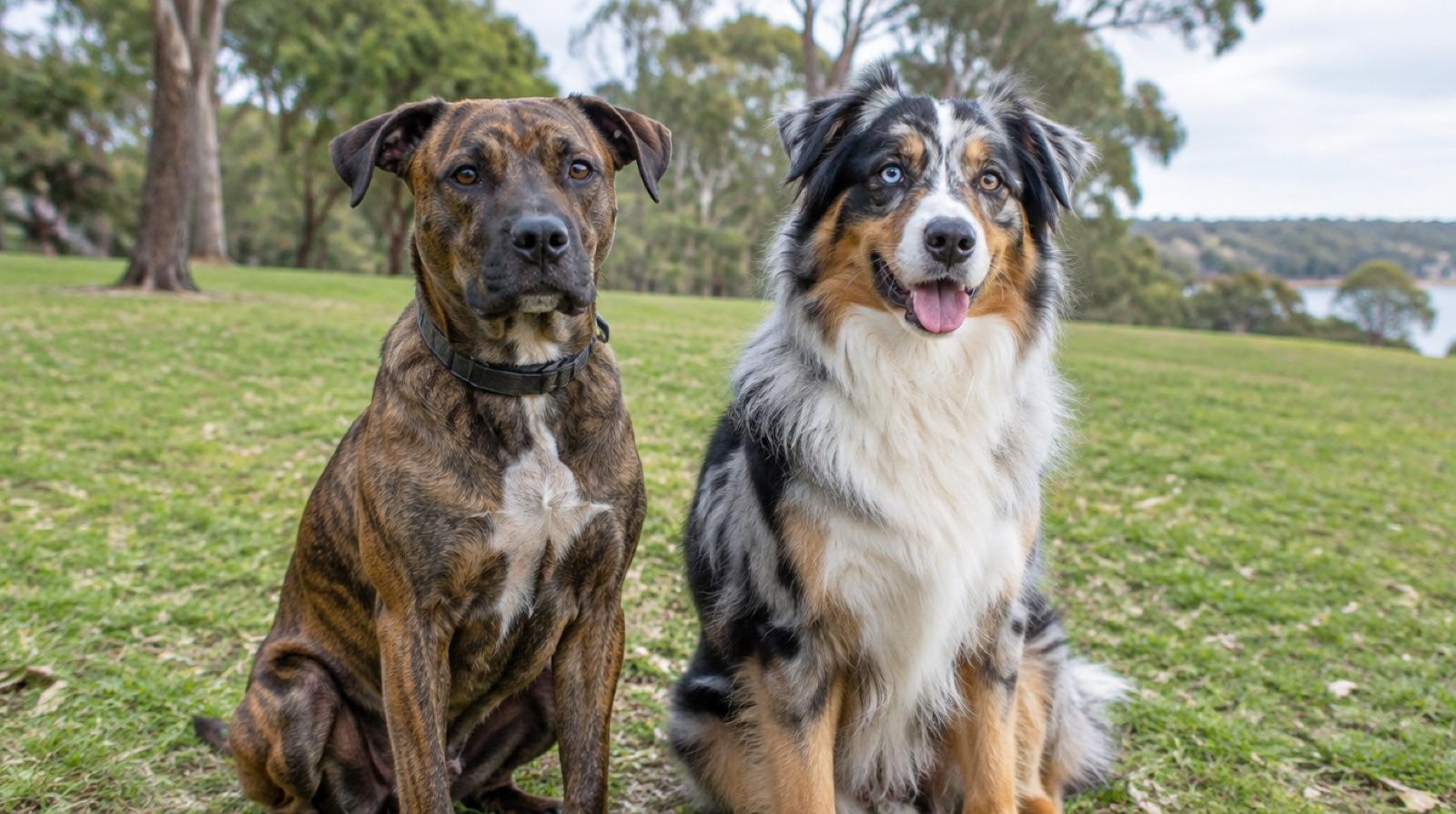
What is a merle dog?
A merle dog has patches of diluted colour scattered among patches of full colour. On a black dog the diluted parts look silvery blue-grey, which is blue merle; on a red dog the same pattern is red merle. The Dogs Australia Shetland Sheepdog and Rough Collie standards describe blue merle as clear silvery blue, splashed and marbled with black. Eyes are often blue or part blue: both standards allow one or both eyes to be blue or blue flecked in merles.
The gene was found in 2006. Researchers at Texas A&M University reported in PNAS that merle is caused by a small piece of inserted DNA (a SINE insertion) in a pigment gene called SILV, now usually called PMEL. They described merle as inherited in an incompletely dominant way, which means one copy shows the pattern and two copies show a stronger effect. The same paper noted that dogs with one or two copies can show a range of hearing and eye abnormalities, which is why the number of copies matters so much.
Two details worth knowing before you fall for a merle puppy. Merle coats change: the Australian Shepherd standard says merles characteristically become darker with age. And merle only dilutes the black or brown pigment, so on a mostly red or cream dog it can be hard or impossible to see, which matters for breeding (below).
What is a double merle, and why is it a health risk?
A double merle inherits the merle gene from both parents. The Louisiana State University veterinary school explains that when two single merles are bred, about 25% of puppies will be double merles, and that these dogs usually have a solid white coat and blue eyes, are often deaf and/or blind, and may be sterile. Its advice is blunt: breeders in these breeds know not to breed merle to merle.
The hearing figures come from a 2009 study of 153 merle dogs of several breeds, each hearing tested with a BAER (brainstem auditory evoked response) test and DNA tested for merle.
| Merle genotype | Deaf in one ear | Deaf in both ears |
|---|---|---|
| Single merle (one copy) | 2.7% | 0.9% |
| Double merle (two copies) | 10% | 15% |
| All merles tested | 4.6% | 4.6% |
Strain et al., Journal of Veterinary Internal Medicine (2009), led from the Louisiana State University School of Veterinary Medicine. The study found no significant link between deafness and eye colour or sex. Study figures, not a prediction for any one dog.
Eyes are the other half of the problem. In a 1978 study of 44 Dachshunds bred to investigate the merle gene, all 11 extreme dapples (double merles) had severe eye defects in variable forms, including small eyes (microphthalmia), small corneas, misplaced pupils, cataracts and colobomas (gaps in eye structures). Single merles showed milder changes, and the solid-coloured control dogs showed almost none of them. Not every double merle is deaf or blind, but no responsible breeder takes the chance.
What is a cryptic or hidden merle?
A merle you cannot see. Later research found merle is not one variant but a range. A 2018 study of 175 Australian Shepherds and related breeds measured the length of the merle insertion and found it varies continuously, with at least four major groups it called cryptic, atypical, classic and harlequin merle. The short “cryptic” versions often behave like no merle at all. A 2018 PLoS ONE study described six merle alleles, each linked to different coat features and different health risk, and found mosaic dogs carrying more than one version in 16.6% of its 181 dogs.
The other way merle hides is under a red coat. Because merle dilutes black and brown pigment, a red or cream dog can carry full merle and show little or none. A 2021 study of 140 Dachshunds found many such hidden merles, and one dog with no visible merle that produced a double merle puppy born without eyes. A 2019 study of the Mudi made the same point: hidden merles can unintentionally produce double merle puppies with eye, hearing and survival problems.
The practical lesson: “only one parent is merle” is not a guarantee in a merle breed. The 2021 Dachshund study concludes that genetic testing for merle before breeding is critical. Ask whether both parents were DNA tested for merle, not just looked at.
What makes a dog brindle?
Brindle is dark stripes over a red, fawn or golden base. The Dogs Australia Boxer standard puts it as black stripes on a golden-yellow or red-brown background, and the French Bulldog standard as a mixture of black hairs and fawn hairs.
The gene is different from merle. A 2007 study in Genetics, using a Labrador and Greyhound cross, mapped a gene called the K locus and found three versions with a dominance order: dominant black, then brindle, then the version that lets yellow, fawn and red show. A companion paper in Science the same year identified the K locus as beta-defensin 103 (CBD103). In plain terms, a dog with the brindle version shows stripes wherever its coat would otherwise be red or fawn, and a dog with dominant black hides brindle altogether.
Brindle carries no known health risk of its own. None of the brindle genetics studies cited here links the pattern to deafness, eye defects or any disease, and it is a standard colour in breeds as different as the Greyhound and the Boxer. A brindle dog's health is about its breed or mix, not its stripes. That is the big difference from merle.
Which breeds come in merle or brindle?
Here is what the Dogs Australia breed standards say for breeds you are likely to meet in Australia, with links to the rescue listings for each.
Dogs Australia breed standards, read 9 and 10 November 2026; the Koolie row is from the Koolie Club of Australia because the Koolie has no Dogs Australia standard page. “Not listed” means the standard does not name the colour; “Allowed” means it falls under “any colour”.
Two breeds need a note. Dachshund dapple is merle by another name, and the Dogs Australia standard lists double dapple, with white all over the body as well as dapple, as unacceptable in any variety. The Great Dane harlequin, white with torn-looking black patches, is merle plus a second gene: a 2011 Genomics study found harlequin needs one copy of the merle insertion and a mutation in a gene called PSMB7, and that two copies of the harlequin gene are lethal before birth.
The Australian Cattle Dog is often called blue, but its coat is speckle, not merle. Our blue heeler vs red heeler guide explains the difference.
See merle and brindle dogs listed by rescues
Rescues list dogs by breed, not colour, so start with the breeds that carry each pattern. Staffies and Greyhounds turn up often in rescue, and both come in brindle.
Is merle allowed in Australia, and how do you spot a bad merle breeder?
Merle is allowed in the breeds whose standards include it. Breeding two merles together is not. Dogs Australia's registration regulations (regulation 6.3.4.2) have prohibited merle to merle and dapple to dapple matings since 1 January 2015, stating that the merle or dapple gene carries an increased risk of impaired hearing and sight problems. Puppies from such a mating can only go on the Limited Register, endorsed never to be upgraded, and a breach is an offence by the owners of the sire and dam. In a Dogs Australia buying guide, the chair of its Canine Health and Wellbeing Committee says merle should never be doubled up because it causes deafness and blindness.
Merle has also been pushed into breeds that never had it. The same Dogs Australia guide says merle does not occur naturally in the French Bulldog and that dogs bred “just for colour” are not purebred French Bulldogs, and since 1 July 2025 the regulations allow merle French Bulldogs (and merle Chihuahuas) on the Limited Register only, never to be upgraded, once DNA has confirmed breed purity and parentage. The Chihuahua, Pomeranian, Whippet and Shih Tzu standards rule merle out.
Warning signs when a seller is advertising merle puppies:
- Both parents are merle. Sometimes offered as a selling point. It is the one pairing Dogs Australia bans, and about a quarter of the puppies would be double merles.
- A mostly white puppy with blue eyes from merle parents. That is the double merle look the Louisiana State University vet school describes. Ask for hearing and eye checks before anything else.
- “The other parent is solid” with no DNA test, in a merle breed. Cryptic and hidden merles look solid. Ask for the merle DNA result.
- Merle in a breed whose standard excludes it, such as a merle French Bulldog, Chihuahua or Pomeranian, sold as “rare” at a premium.
- Pressure to pay a deposit before you see the puppy with its mother. Scamwatch warns that scammers advertise pets that do not exist; meet the pet in person or by video call with the breeder, and check the breeder is legitimate and accredited.
For the state breeder numbers and the full scam checklist, see puppies for sale: adopt or buy?. Breed-specific guides cover the Australian Shepherd, Dachshund, French Bulldog, Chihuahua and Great Dane.
Should you adopt a double merle?
If you can give a deaf or low-vision dog the setup it needs, yes. Double merles do turn up in Australian rescue listings now and then. Rescues usually note on the listing whether a dog is deaf, partly deaf or has limited sight, and a foster carer can tell you how the dog copes day to day.
What living with a deaf dog involves, from SPCA New Zealand's advice:
- Hand signals. Pick clear, distinct gestures for cues like sit, stay and come, and use them consistently. The Louisiana State University vet school publishes a set of hand commands, several borrowed from sign language.
- No startling. Gently tap the floor near a sleeping deaf dog, wave a hand in its line of sight or lightly touch its shoulder.
- Secure fencing, and off-lead only in safely enclosed areas. In public, use a lead or long line.
- No shock collars. SPCA New Zealand warns they can be distressing and may damage your relationship with your dog, and recommends reward-based training.
Low vision needs a predictable home: furniture that stays put, gates at stairs and a calm introduction to new places. Ask your vet to examine the eyes and hearing soon after adoption, and ask the rescue what checks have already been done. A single merle needs no special setup at all, and the Koolie Club of Australia says the way breeders avoid double merles is to breed a merle to a solid-coloured dog.
Weighing up a dog with extra needs? The adoption readiness check takes a few minutes, and our guide to adopting a dog in Australia covers the steps from application to home.
Find a merle or brindle dog near you
Rescues list by breed, so here are the breeds most likely to carry each pattern, by city:
| City | Brindle breeds | Merle breeds |
|---|---|---|
| Sydney | Staffies, Greyhounds | Australian Shepherds, Border Collies |
| Melbourne | Staffies, Greyhounds | Australian Shepherds, Border Collies |
| Brisbane | Staffies, Greyhounds | Australian Shepherds, Border Collies |
| Perth | Staffies, Greyhounds | Australian Shepherds, Border Collies |
| Adelaide | Staffies, Greyhounds | Australian Shepherds, Border Collies |
Every listing links to the rescue, where you apply directly. Not sure which breed suits you? Try the what dog breed am I quiz, and if your rescue dog's coat has you guessing at its mix, see what breed is my rescue dog?.
Frequently asked questions
What is a merle dog?▼
A merle dog has patches of diluted colour mixed with patches of full colour, which gives the marbled look of a blue merle Australian Shepherd or Shetland Sheepdog. A 2006 study in PNAS traced merle to an insertion in a pigment gene called SILV, now usually called PMEL. Merle often comes with blue or part-blue eyes, and the Dogs Australia Australian Shepherd standard notes that merles characteristically become darker with age.
What is a blue merle?▼
Blue merle is merle on a black coat: the diluted patches look silvery blue-grey, with patches of solid black left in. The Dogs Australia Rough Collie and Shetland Sheepdog standards describe it as clear silvery blue, splashed and marbled with black. Red merle is the same pattern on a red coat, and the Australian Shepherd standard lists both.
What is a double merle dog?▼
A double merle has inherited the merle gene from both parents, which can only happen when two merle-carrying dogs are bred together. The Louisiana State University veterinary school says about a quarter of puppies from two single merles are double merles, and that these dogs usually have a solid white coat and blue eyes, are often deaf and/or blind, and may be sterile.
Are double merle dogs deaf?▼
Many are. In a 2009 study of 153 merle dogs tested with a BAER hearing test, 10% of double merles were deaf in one ear and 15% in both, against 2.7% and 0.9% of single merles. Not every double merle is deaf, but the risk is many times higher, and eye defects such as small or malformed eyes are also common in double merles.
Is merle to merle breeding banned in Australia?▼
Yes, for registered breeders. Dogs Australia regulation 6.3.4.2 has prohibited merle to merle and dapple to dapple matings since 1 January 2015, stating that the merle or dapple gene carries an increased risk of impaired hearing and sight problems. Puppies from such a mating are placed on the Limited Register, endorsed never to be upgraded, and the breach is an offence by the owners of both parents.
What is a cryptic merle?▼
A cryptic merle carries a merle gene but shows little or no merle in its coat, so it can be mistaken for a solid-coloured dog. Studies of Australian Shepherds and Dachshunds found merle variants of different lengths, some too short to show, and dogs whose merle was hidden under a red coat. A hidden merle bred to a merle can produce a double merle, which is why researchers recommend a merle DNA test before breeding.
What makes a dog brindle?▼
Brindle is dark stripes over a red, fawn or golden base. It comes from the K locus, a gene identified in 2007 as beta-defensin 103 (CBD103). A 2007 study in Genetics found three versions with an order of dominance: dominant black, then brindle, then the version that lets fawn and red show. Brindle only shows on the red or fawn parts of the coat.
Is brindle linked to health problems like merle is?▼
Not in the research we found. None of the brindle genetics studies cited here links the brindle pattern itself to deafness, eye defects or any other disease, and brindle is a standard colour in breeds from the Greyhound to the Boxer. A brindle dog's health depends on its breed or mix and on the individual, not on its stripes.
Which dog breeds are merle?▼
Under Dogs Australia standards, merle is a listed colour in the Australian Shepherd (blue and red merle), Rough Collie, Shetland Sheepdog, Cardigan Welsh Corgi and Old English Sheepdog (blue merle). Dachshund dapple is the same pattern, and the Great Dane harlequin needs the merle gene plus a second gene. The Koolie Club of Australia says Koolies come in solids and merles.
Which dog breeds are brindle?▼
Brindle is a standard colour under Dogs Australia for breeds including the Greyhound, Staffordshire Bull Terrier, Boxer, Great Dane, Mastiff, Bullmastiff, Cane Corso, French Bulldog, Cardigan Welsh Corgi and three of the six Dachshund varieties. In the Dutch Shepherd, brindle is the defining coat. The Italian Greyhound standard says brindle is not acceptable.
Is a merle French Bulldog or Chihuahua a purebred?▼
Merle is not part of either breed's standard. The Dogs Australia Chihuahua standard says any colour but never merle (dapple), and the French Bulldog standard lists only brindle, fawn and pied. A Dogs Australia buying guide says merle does not occur naturally in the French Bulldog, and since 1 July 2025 merle French Bulldogs and merle Chihuahuas can only be registered on the Limited Register, never to be upgraded, once DNA has confirmed breed purity and parentage.
Can I adopt a double merle dog?▼
Yes, and a deaf or low-vision dog can be a very good companion with the right setup. Rescues usually note on the listing whether a dog is deaf or has limited sight. SPCA New Zealand advises clear hand signals for cues, waking a sleeping deaf dog gently by tapping the floor nearby or lightly touching the shoulder so you do not startle it, secure fencing, and keeping a deaf dog off-lead only in safely enclosed areas. Ask your vet to check the eyes and hearing.
Sources
- Clark et al. (2006), PNAS: Retrotransposon insertion in SILV is responsible for merle patterning of the domestic dog
- Strain et al. (2009), Journal of Veterinary Internal Medicine: Prevalence of deafness in dogs heterozygous or homozygous for the merle allele
- Dausch et al. (1978): Eye changes in the merle syndrome in the dog
- Ballif et al. (2018), Cytogenetic and Genome Research: PMEL insertion lengths and merle in Australian Shepherds
- Langevin et al. (2018), PLoS ONE: Merle phenotypes in dogs, SILV SINE insertions from Mc to Mh
- Ballif et al. (2021), Human Genetics: The PMEL gene and merle (dapple) in the dachshund
- Pelles et al. (2019), Acta Veterinaria Hungarica: Merle allele variations in the Mudi
- Clark et al. (2011), Genomics: Harlequin coat patterning in Great Danes
- Kerns et al. (2007), Genetics: Linkage and segregation analysis of black and brindle coat color in domestic dogs
- Candille et al. (2007), Science: A beta-defensin mutation causes black coat color in domestic dogs
- Louisiana State University School of Veterinary Medicine: Deafness in dogs, genetics
- Louisiana State University School of Veterinary Medicine: Hand commands for deaf animals
- Dogs Australia: Regulations Part 6, Registration (effective 1 July 2025)
- Dogs Australia: What to look for when buying a French Bulldog puppy
- Dogs Australia breed standards (Australian Shepherd, Rough Collie, Shetland Sheepdog, Dachshund, Great Dane, Pomeranian, Boxer and others linked in the tables)
- Koolie Club of Australia: Choosing a puppy
- SPCA New Zealand: Caring for and training a deaf dog
- Scamwatch: Buying and selling scams
Keep reading
Australian Shepherd puppies: adopt or buy?
Hip x-rays, the MDR1 test and why a litter from two merle parents is the one to walk away from.
Blue heeler vs red heeler
The Cattle Dog's speckle is a different pattern from merle. One breed, two colours.
Greyhound adoption in Australia
Brindle is a standard Greyhound colour, and retired racers are adopted across the country.
Puppies for sale: adopt or buy?
The breeder number each state requires, how to check it, and the full scam checklist.