The short answer
A red heeler and a blue heeler are the same breed, the Australian Cattle Dog, in different coats. The Dogs Australia standard allows blue (blue, blue-mottled or blue speckled, with or without markings) and red speckle, and sets the same height (46 to 51 cm for dogs, 43 to 48 cm for bitches) and the same temperament for both. Puppies of both colours are born white and colour up from about three weeks. A University of Queensland study of 899 Cattle Dogs found no link between coat colour and deafness; facial masks mattered more. Choose the dog, not the colour, and search rescue listings for “Cattle Dog”.
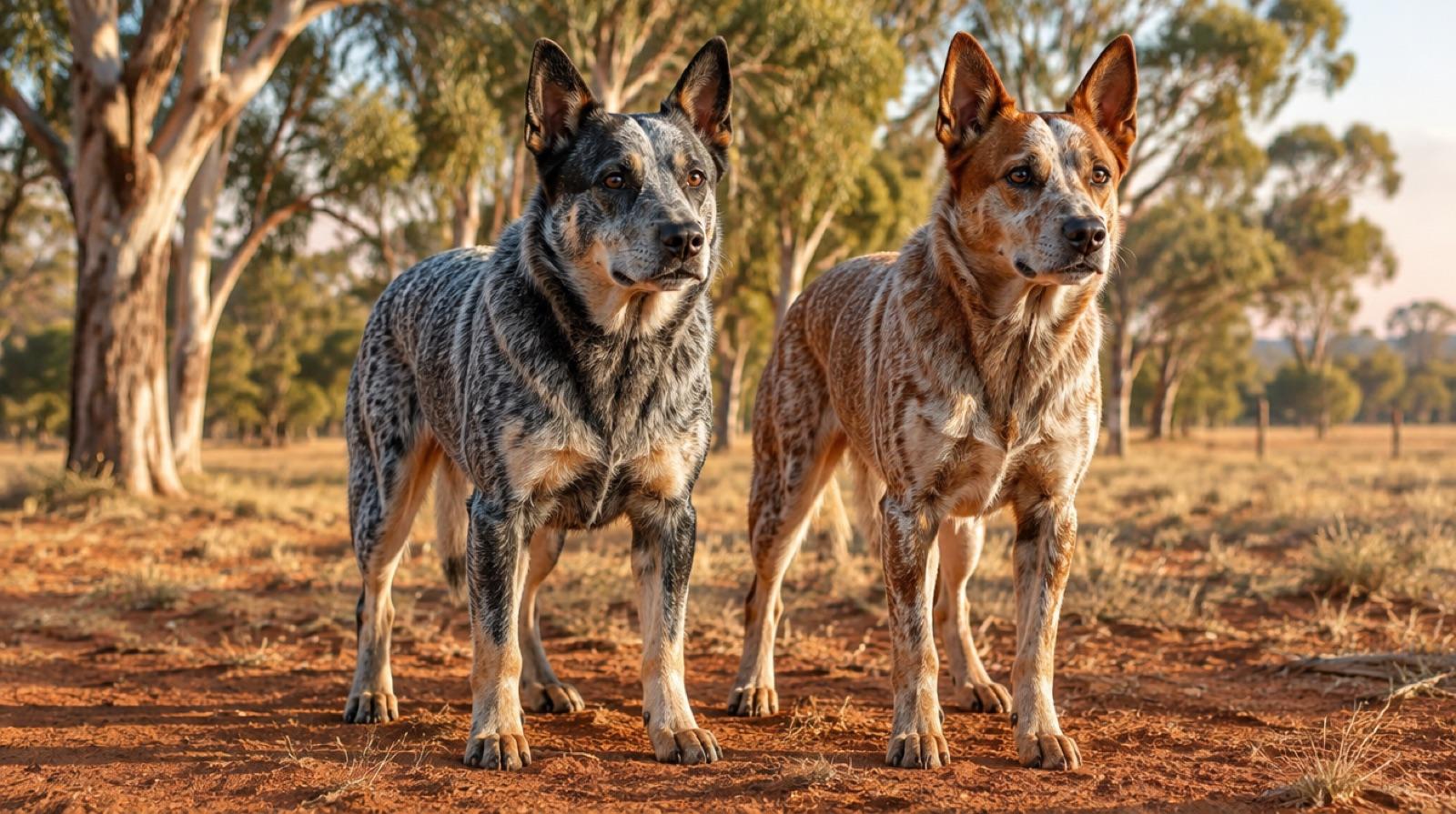
Is a red heeler the same breed as a blue heeler?
Yes. Both are the Australian Cattle Dog. “Blue heeler” and “red heeler” are everyday names for the breed's two colours, and the heeler part comes from the job: the Dogs Australia standard describes a dog bred to move cattle, including by heeling or biting. There is one standard for the breed, and colour is the only part of it that splits into two.
Information from the Australian Cattle Dog Society of NSW on the Dogs Australia breed page lists the accepted colours as blue, blue speckle, blue mottle and red speckle. Here is how the standard describes each.
| Dogs Australia standard | Blue (blue heeler) | Red speckle (red heeler) |
|---|---|---|
| Body colour | Blue, blue-mottled or blue speckled, with or without other markings | A good even red speckle all over, including the undercoat (neither white nor cream) |
| Head markings | Black, blue or tan, evenly distributed for preference | With or without darker red markings; even head markings desirable |
| Tan | Tan on the forelegs, chest, throat, jaws and inside the hind legs; tan undercoat allowed if it does not show through the blue | Not part of the red speckle description |
| Body patches | Black markings on the body not desirable | Red markings on the body permissible but not desirable |
| Height | Dogs 46 to 51 cm; bitches 43 to 48 cm | Dogs 46 to 51 cm; bitches 43 to 48 cm |
| Character and temperament | One description for both: always alert, extremely intelligent, watchful, courageous and trustworthy; naturally suspicious of strangers but must be amenable to handling | |
From the Dogs Australia Australian Cattle Dog standard (last updated 14 December 2009), read 10 November 2026. The standard gives no weight.
“Speckled” and “mottled” describe white hairs mixed through the coloured coat, which is what makes a black-based dog look blue and a red-based dog look red speckled. That speckle is the Cattle Dog's look. It is not the same as merle, the patchy marbled pattern of breeds such as the Australian Shepherd, which our merle and brindle guide explains.
Why are Cattle Dog puppies born white?
Because the colour comes in after birth. Information from the Australian Cattle Dog Society of NSW on the Dogs Australia breed page says Cattle Dog pups are born white, with only black or red head markings and body patches (if any) showing, and that their true colour begins to show at about three weeks of age.
So a litter of white puppies with dark or red ears and eye patches is normal, and you cannot always tell at a glance which will be red and which blue in the first days. The head markings are the early clue: black head markings go with blue dogs, red head markings with red speckles.
The white coat is also part of why hearing matters in this breed. The Louisiana State University veterinary school's deafness genetics page names the Australian Cattle Dog among the breeds with measurable inherited deafness, and explains that most inherited deafness in dogs is associated with pigment genes, the ones that put white in the coat. A 2021 genome study of Australian Cattle Dogs by University of Queensland researchers found deafness associated with a region near MITF, a gene linked to white pigmentation in dogs, while saying the finding still needs to be confirmed.
Does colour affect a heeler's health or temperament?
Not in the evidence we found. The largest study is Australian: a 2012 University of Queensland study of 899 Australian Cattle Dogs, each hearing tested with a BAER (brainstem auditory evoked response) test. It found 10.8% had some deafness, 7.5% in one ear and 3.3% in both, and no significant association between deafness and coat colour. Red and blue dogs were in the same boat.
What did make a difference was white on the face and body, and sex.
| Factor in the 2012 study | Finding |
|---|---|
| Coat colour (red or blue) | No significant association with deafness |
| Masks on both sides of the face | Less likely to be deaf: 4.4% against 14.6% of clear-faced dogs |
| Pigmented body patches | Lower risk of deafness |
| Sex | Females at higher risk than males, after allowing for masks and patches |
Sommerlad et al., BMC Veterinary Research (2012), read 10 November 2026. A study finding, not a prediction for any one dog.
The practical point: a red heeler is not riskier than a blue one, and a dark mask lowers the odds without ruling deafness out. A follow-up study in 2014 of 608 pups from 10 breeding kennels found that ten years of hearing tests had not substantially reduced deafness, and that pups whose four grandparents had all tested normal had the lowest rate. Dogs NSW says all Cattle Dog puppies and breeding stock should have BAER tests, and the Australian Cattle Dog Society of NSW says the test can be done from six weeks. The full list of tests to ask a breeder for is in our Cattle Dog puppies guide.
Temperament is the same story. The standard gives one temperament for the breed, and we found no breed club statement or published study describing a difference between red and blue Cattle Dogs. Ideas like “reds are calmer” or “blues are tougher” are folklore. The individual dog, its socialisation and how much work it gets will tell you far more.
See the red and blue heelers listed right now
Rescues mostly list them as Cattle Dogs or Cattle Dog crosses. These pages show the dogs from the rescues, shelters and council pounds we aggregate, and every listing links to the rescue where you apply.
Is a Stumpy Tail a red or blue heeler with a short tail?
No. The Australian Stumpy Tail Cattle Dog is a separate breed with its own Dogs Australia standard. It comes in blue and red speckle too and stands the same height, which is why it gets mistaken for a heeler, but the build and tail differ.
- Tail. The Australian Cattle Dog has a natural tail reaching about to the hock. The Stumpy's is undocked and naturally no longer than 10 cm.
- Shape. The Stumpy Tail club calls the Stumpy a square dog; the Cattle Dog is longer than it is tall.
- Tan. A blue Cattle Dog may have tan markings; in the Stumpy, tan markings are a serious fault.
- Hearing. A 2010 study of Stumpy Tail Cattle Dogs found 17.8% deaf, so the BAER test matters in this breed as well.
In rescue a Stumpy Tail turns up only now and then. See the Stumpy Tail Cattle Dogs listed by rescues.
Heeler, Kelpie or Koolie: how do you tell a rescue cross?
Often you can't for certain, and that is fine. Cattle Dogs turn up often in Australian rescue listings, many of them as crosses, and a common partner is the Kelpie. Rescue breed labels are best guesses from looks, and the working breeds overlap.
| Breed | Colours (official or club source) | How it can look like a heeler |
|---|---|---|
| Australian Cattle Dog | Blue, blue-mottled or blue speckled; red speckle | The original: white hairs speckled through the coat |
| Kelpie | Black, black and tan, red, red and tan, fawn, chocolate, smoke blue (Dogs Australia) | A red or red and tan Kelpie cross can pass for a red heeler; the Kelpie standard has no speckle |
| Koolie | Solids and merles (Koolie Club of Australia) | A blue merle Koolie can be called a blue heeler, but merle is patches, not speckle |
| Stumpy Tail Cattle Dog | Blue or red speckle; tan a serious fault | Same colours; check the tail and the square build |
The label matters less than the dog in front of you. A Kelpie or Koolie cross needs the same daily work as a heeler. If you want to understand your rescue dog's likely mix, our guide to working out what breed your rescue dog is covers DNA tests and their limits.
Should you pick a red or a blue heeler?
Pick the individual. The colour tells you almost nothing about how the dog will live with you: one standard, one size, one temperament description, and no colour effect on deafness in the main study. What does differ from dog to dog is energy, how it copes alone, how it behaves with children and other pets, and its hearing. A rescue's foster notes cover the first three, and a BAER result or the rescue's own observations cover the last.
Whatever the colour, this is a working breed. Information from the Australian Cattle Dog Society of NSW on the Dogs Australia breed page calls it renowned for its devotion to the family and says Cattle Dogs commonly live to 15 years or more, so plan for a long, active commitment. Our guide to giving a Cattle Dog a job covers the daily work, and smartest dog breeds explains why bright working dogs need more than a walk.
Not sure a heeler suits you? The what dog breed am I quiz and the adoption readiness check take a few minutes, and the dog cost calculator covers the first year. Australian Working Dog Rescue International (workingdogrescue.com.au) is a registered charity that rehomes working breeds, including Cattle Dogs, and general shelters and council pounds list them in every state.
Find a red or blue heeler near you
Cattle Dogs and Cattle Dog crosses, red and blue, listed by rescues by city:
- Cattle Dogs for adoption in Sydney
- Cattle Dogs for adoption in Melbourne
- Cattle Dogs for adoption in Brisbane
- Cattle Dogs for adoption in Perth
- Cattle Dogs for adoption in Adelaide
Local guides to adopting a Cattle Dog, with the rescues that serve each city: Sydney, Melbourne, Brisbane, Perth, Adelaide, Gold Coast, Hobart. For what these conditions mean once you own one, see the Cattle Dog health guide.
Frequently asked questions
Is a red heeler the same breed as a blue heeler?▼
Yes. Red heeler and blue heeler are everyday names for the two colours of one breed, the Australian Cattle Dog. The Dogs Australia breed standard describes a blue dog (blue, blue-mottled or blue speckled) and a red speckle dog, and everything else in the standard, from height to temperament, is the same for both.
What colours does the Australian Cattle Dog come in?▼
Blue and red speckle. Information from the Australian Cattle Dog Society of NSW on the Dogs Australia breed page lists the accepted colours as blue, blue speckle, blue mottle and red speckle. A blue dog may have black, blue or tan markings on the head and tan on the legs, chest and throat. A red speckle dog should be an even red speckle all over, including the undercoat, with or without darker red markings on the head.
Why are blue heeler puppies born white?▼
Cattle Dog puppies are born white with only their black or red head markings and any body patches showing, according to information from the Australian Cattle Dog Society of NSW on the Dogs Australia breed page. Their true colour begins to show at about three weeks of age, so a white newborn is normal for the breed.
Are red heelers more aggressive than blue heelers?▼
There is no evidence that they are. The Dogs Australia standard describes one character for the breed whatever the colour: always alert, extremely intelligent, watchful, courageous and trustworthy, and, in its temperament section, naturally suspicious of strangers but amenable to handling. We found no breed club statement or published study that describes a temperament difference between red and blue Cattle Dogs. The individual dog, its upbringing and its exercise matter far more than its coat.
Are red or blue heelers more likely to be deaf?▼
Colour made no difference in the largest study. A University of Queensland study of 899 Australian Cattle Dogs found no significant association between deafness and coat colour. What did matter was the face and body: dogs with masks on both sides of the face, and dogs with pigmented body patches, were less likely to be deaf, and females were at higher risk than males.
Does the mask on a Cattle Dog's face matter?▼
It can, for hearing. A mask is the patch of colour over the eye and ear on one or both sides of the face; a clear face has none. Masks are worth noticing because the 2012 Australian study found deafness in 4.4% of dogs with masks on both sides against 14.6% of clear-faced dogs. Whatever the face looks like, only a BAER hearing test confirms a puppy's hearing.
Is a Stumpy Tail Cattle Dog a type of heeler?▼
No. The Australian Stumpy Tail Cattle Dog is a separate breed with its own Dogs Australia standard. It also comes in blue and red speckle, but it has a natural tail no longer than 10 centimetres and a square build, and tan markings are a serious fault. A Stumpy Tail is not a blue heeler with a short tail.
How big do red and blue heelers get?▼
The same size. The Dogs Australia standard sets a height of 46 to 51 cm at the withers for dogs and 43 to 48 cm for bitches, with no difference by colour. The standard does not give a weight.
My rescue dog is a red heeler cross. Could it be a Kelpie or Koolie?▼
It could. Rescue breed labels are best guesses from appearance. The Kelpie standard includes red and red and tan, and the Koolie Club of Australia says Koolies come in solids and merles, so a red Kelpie cross or a merle Koolie can be mistaken for a heeler. Speckle, where white and coloured hairs are mixed through the coat, is the Cattle Dog look; merle is a different pattern of patches.
Should I choose a red or a blue heeler?▼
Choose the dog, not the colour. Red and blue Cattle Dogs share one standard, one size and one set of working-dog needs, and the main deafness study found no difference by colour. Pick the individual whose energy, history with children and other pets, and hearing test result suit your home.
Where can I see red and blue heelers for adoption?▼
Most Australian rescues list them as Cattle Dogs or Cattle Dog crosses rather than as red or blue heelers, so search for Cattle Dog. The Australian Cattle Dog breed page on LocalPetFinder shows the dogs listed right now by the rescues, shelters and council pounds we aggregate, with a page for each major city, and every listing links to the rescue where you apply.
Sources
- Dogs Australia: Australian Cattle Dog breed standard
- Dogs Australia: Browse a breed, Australian Cattle Dog (information from the Australian Cattle Dog Society of NSW)
- Dogs Australia: Australian Stumpy Tail Cattle Dog breed standard
- Dogs Australia: Australian Kelpie breed standard
- Australian Stumpy Tail Cattle Dog Club of NSW: Features of the breed
- Koolie Club of Australia: Choosing a puppy
- Sommerlad et al. (2012), BMC Veterinary Research: Deafness in Australian Cattle Dogs and associations with coat characteristics and sex
- Sommerlad et al. (2014), Animal Genetics: Consequences of a screening programme on deafness in the Australian Cattle Dog
- Seddon et al. (2021), Animal Genetics: Deafness in Australian Cattle Dogs, genome-wide association study
- Sommerlad et al. (2010), PLoS ONE: Deafness in Australian Stumpy Tail Cattle Dogs
- Louisiana State University School of Veterinary Medicine: Deafness in dogs, genetics
- Dogs NSW: Breeding basics
- Australian Cattle Dog Society of NSW: Deafness
Keep reading
Cattle Dogs listed by rescues
Red and blue heelers and Cattle Dog crosses listed right now by the rescues and pounds we aggregate.
Cattle Dog puppies: adopt or buy?
What a registered puppy costs, the BAER and PRA tests to ask for, and scam red flags.
Merle and brindle dogs
Why merle is not speckle, what double merle means for hearing and sight, and brindle genetics.
Kelpie puppies: adopt or buy?
The other Australian working breed you see most in rescue, often crossed with a heeler.