The short answer
Buy from a Dogs Australia registered breeder if you want an Aussie puppy: both parents must have had hip x-rays before the litter can be registered, and you should also ask for eye and MDR1 DNA results. Walk away from any litter bred from two merle parents; Dogs Australia has banned merle to merle matings since 2015 because of the risk to hearing and sight. No Aussie club publishes a price; for scale, Australian breed bodies quote $3,500 to $5,000 for other popular pedigree breeds. Adopt if you are open to an adult or an Aussie cross, and set an alert. Prices and fees are reference figures, not quotes.
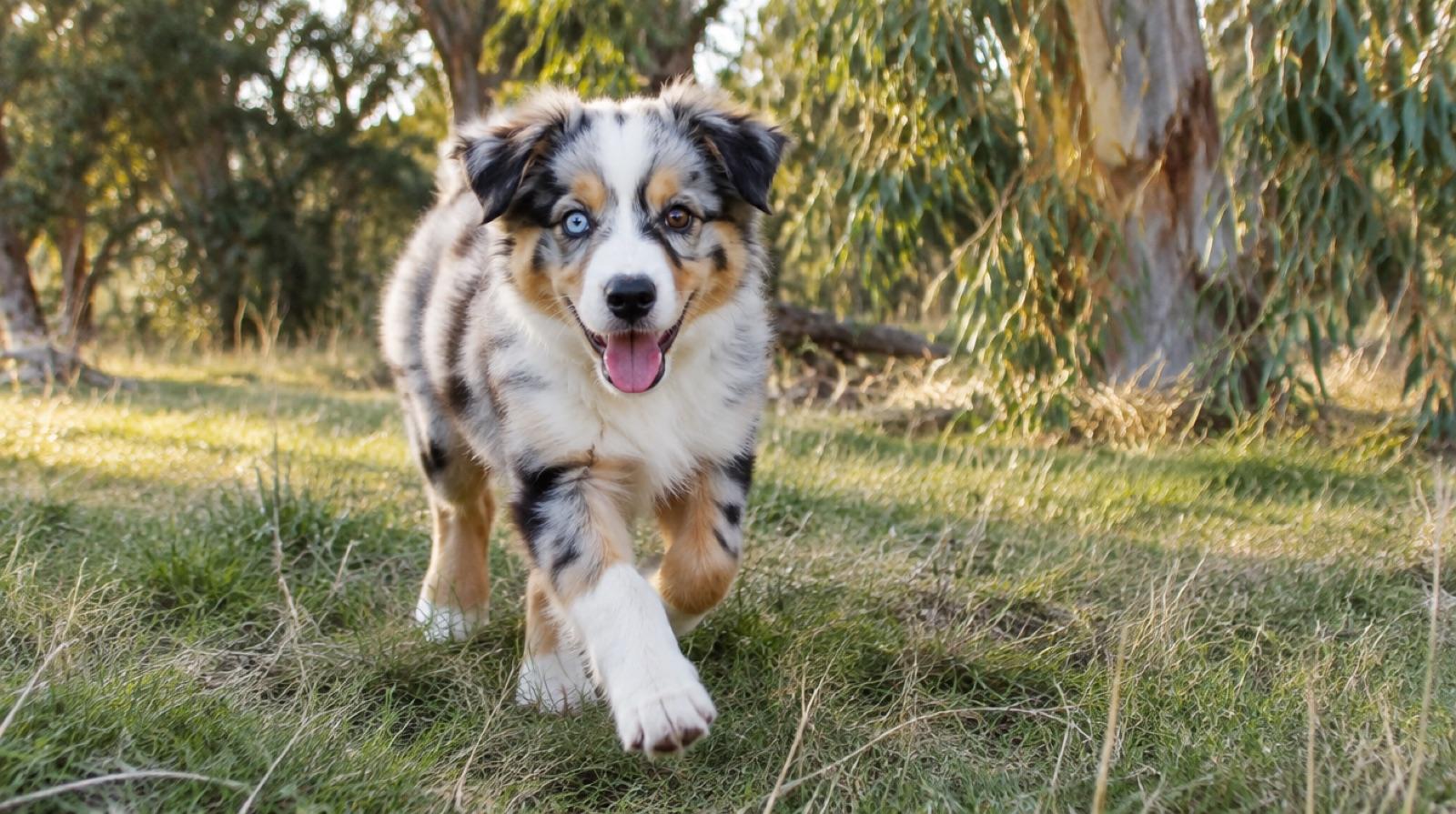
Should you adopt or buy an Australian Shepherd?
Start with the dog, not the colour. The Dogs Australia breed standard describes the Australian Shepherd as an intelligent working dog of strong herding and guarding instincts. That brain and drive are why people love the breed, and why some Aussies end up in rescue when a busy household cannot keep up.
If you want a puppy with known parents, a registered breeder is the realistic route, because purebred Aussie puppies seldom reach rescue. If you are open to an adolescent or adult, or to an Aussie cross, a rescue dog arrives desexed and vaccinated with a personality you can already see, which matters a lot with a high-energy breed.
| Route | Reference cost | What you usually get | Main risk |
|---|---|---|---|
| Dogs Australia registered breeder | No published Aussie figure; ask each breeder (see below) | A purebred puppy from hip-x-rayed parents, with pedigree papers | Eye and MDR1 testing is up to the breeder, so check |
| Australian Shepherd Club of Victoria rescue | Ask the club | A purebred Aussie assessed by people who know the breed, with ongoing breed support | Few dogs at any time; often none listed |
| General rescue or pound | The standard fee, for example $500 to $1,000 at the RSPCA rows below | Aussies and herding crosses, desexed, microchipped and vaccinated | Unknown parent health and MDR1 status |
| Online ad or social media | Often below the going rate | Anything from a real litter to a puppy that does not exist | Scams, untested parents, merle to merle litters |
Reference figures: RSPCA NSW, RSPCA ACT and RSPCA Victoria fee pages, read November 2026. They are not quotes. Breeders and rescues set their own prices and change them.
Which health tests should an Australian Shepherd breeder show you?
One is compulsory. Under the Dogs Australia registration regulations, both parents of every Australian Shepherd litter (where the parents were born after 1 July 2001) must be radiographed and assessed for hip dysplasia before the litter can be registered. The Australian Shepherd Club of Victoria describes this x-ray assessment of breeding pairs as a requirement for the breed, and lists the Australian Canine Eye Scheme (ACES) among its current health issues.
| Check | What it looks for | Compulsory to register the litter? |
|---|---|---|
| Hip x-rays and scoring | Hip dysplasia, a malformed hip joint | Yes, for parents born after 1 July 2001 |
| Eye certificate (ACES) | Inherited eye disease, by a veterinary eye specialist | No |
| MDR1 DNA test | Sensitivity to certain common medicines | No |
| Parents' colours | Whether the litter could include double merles | Merle to merle matings are banned |
Sources: Dogs Australia Regulations Part 6 (version effective 1 July 2025) and Australian Shepherd Club of Victoria, read 9 November 2026. Elbow x-rays and further DNA tests are worth asking about too; ask which tests the breeder runs and why.
Ask to see the certificates, and check the dog names on them match the parents of the litter. If you want to understand these conditions as an owner, our Australian Shepherd health issues guide covers them, and our Border Collie health issues guide covers the herding-breed DNA tests in more depth.
What is MDR1, and why does it matter for an Aussie?
MDR1 is a gene mutation that changes how a dog's body handles certain medicines. Washington State University's veterinary diagnostic laboratory says the mutation can cause severe and life-threatening reactions to some common drugs, and lists its approximate frequency in Australian Shepherds, standard and miniature, at 50%. It says the only way to know whether a dog carries it is to test.
The Australian Shepherd Club of Victoria notes that some common veterinary medicines can cause toxic reactions in dogs with the mutation, that affected dogs can react at much lower doses than other dogs and need alternative drugs, and that it is something all Aussie owners should be aware of. In practice:
- Buying: ask for both parents' MDR1 results. Two clear parents means a clear puppy.
- Adopting: ask whether the dog has been tested. If not, a DNA test arranged through your vet answers it.
- Either way: tell your vet the result, and do not give any parasite or other medicine without checking with your vet first.
We do not list drug names or doses here; that conversation belongs with your vet.
Why are merle to merle litters banned?
Because two copies of the merle gene can damage hearing and sight. Merle is the marbled coat pattern behind blue merle and red merle Aussies, and a single copy is a normal, accepted colour: the breed standard lists blue merle, black, red merle and red, and notes that merles characteristically become darker with age. The trouble starts when two merles are bred together and a puppy inherits the gene from both parents, which breeders call a double merle.
Dogs Australia has acted on it. Its registration regulations have prohibited merle to merle matings in all breeds since 1 January 2015, stating that the merle gene carries an increased risk of impaired hearing and sight. A breach is an offence by the owners of the sire and dam, and the puppies can only go on the Limited Register, never to be upgraded. In a separate Dogs Australia buying guide, the chair of its Canine Health and Wellbeing Committee says merle should never be doubled up because it causes deafness and blindness.
Ask every seller the colour of both parents. If both are merle, do not buy, whatever the price or the eye colour. A registered breeder cannot register that litter normally, so a seller offering one is either unregistered or breaking the rules.
See the Australian Shepherds listed right now
Aussies and Aussie crosses from the rescues, shelters and council pounds we aggregate, each with its rescue, desexing and microchip details. Every listing links to the rescue, where you apply directly.
How much is an Australian Shepherd puppy from a registered breeder?
There is no published figure for the breed. We found no Australian Shepherd club page and no Dogs Australia page that quotes a price. Ask each breeder, and compare what the price includes: hip certificates, eye and MDR1 results for both parents, the register the puppy goes on, and the breeder's return policy.
For scale only, the Australian breed bodies we found that publish a figure for a popular pedigree breed both land in the same band. The German Shepherd Dog Club of Victoria puts the average German Shepherd puppy at $3,500 to $5,000, and Dogs Australia says to expect $4,000 to $5,000 for a Cavalier King Charles Spaniel. Those are other breeds, not an Aussie price. A higher price for a particular colour or eye colour buys you nothing in health terms.
Run the first year through the dog cost calculator, including training classes. With this breed, training is not optional.
What do Australian Shepherds in rescue look like?
Mostly adolescents and young adults, plus Aussie crosses. The common story is a puppy bought for its looks that grew into a clever, busy herding dog with more energy than the home expected. Many of those dogs settle well with an owner who gives them daily exercise and something to think about.
The breed club rescue
The Australian Shepherd Club of Victoria runs a rescue service. Its policy says it acts as a resource to owners, shelters and welfare groups, tries to keep dogs in their current homes with advice where it can, and takes in and rehomes suitable purebred Aussies through rescue volunteers. As a state club with contacts around Australia, it describes itself as a first point of contact for people considering the breed. Its page lists any Aussies available for adoption and gives a rescue email address. Often none are listed, which the club says is exactly how it likes it.
Aussies and herding crosses also reach general rescues and pounds. If you are flexible on breed, Border Collies and Border Collie crosses are another clever herding option worth a look: Sydney, Melbourne, Brisbane, Perth, Adelaide.
What does a rescue Aussie cost?
| Rescue | Fee | Checked |
|---|---|---|
| RSPCA NSW | $620 puppy under 12 months; $500 dog over 12 months | 9 Nov 2026 |
| RSPCA ACT | $900 for popular medium to large breed puppies and mixes up to 12 months | 9 Nov 2026 |
| RSPCA Victoria | $500 to $1,000 adult dog | 9 Nov 2026 |
Fees as published on the date shown. They are a reference, not a quote: rescues change fees and price some dogs individually. The fee normally covers desexing, microchipping, vaccinations and a vet check.
How do Australian Shepherd puppy scams work?
Never send a deposit for an Aussie puppy you have not seen with its mother, in person or at least on a live video call. A seller who asks for more money after the first payment, for transport, a crate or insurance, is following the standard scam script.
Scamwatch says scammers set up fake websites, social media profiles and marketplace listings offering popular breeds or cute puppies that do not exist. Its advice: view the puppy in person, ask for a video call if you cannot visit, check that the breeder is legitimate, and compare prices, because a very cheap pet is likely a scam.
Aussie versions of the pattern to watch for:
- Eye colour and merle pricing. Ads that charge more for blue eyes or a merle coat are selling looks. The standard accepts brown, blue and amber eyes in any combination.
- “Both parents are merle.” Sometimes said as a selling point. It is the one litter Dogs Australia bans.
- No hip certificates. A registered Aussie litter cannot exist without them, so a seller who has none is not selling a registered litter.
- No breeder number. NSW, Victoria, Queensland, South Australia and the ACT all require an identifying number in puppy ads. Look it up yourself on the official register.
Our guide to puppies for sale in Australia has the full state-by-state table of breeder numbers and what to do if you have already paid.
When is a registered breeder the better choice?
Rescue is not right for everyone. A registered breeder is a reasonable choice if you want to do herding, agility or other dog sports with a puppy from known working or sport lines, if you need a dog raised around young children or livestock from the start, or if you want MDR1 and eye status known before the dog comes home.
- Registration. Enter the breeder's prefix or membership number in the Dogs Australia registered breeder check. It confirms membership, not puppy quality.
- Hip certificates for both parents, with names that match the litter.
- Eye and MDR1 results for both parents.
- The parents' colours, confirming they are not both merle.
- A written contract covering health problems, register type and whether the breeder will take the dog back.
Is an Australian Shepherd the right dog for you?
The Dogs Australia standard describes a medium-sized working dog, 51 to 58.5 cm at the shoulder for males and 45.5 to 53.5 cm for females, with an even disposition: good natured and seldom quarrelsome. It also describes strong herding and guarding instincts, and those instincts come home with the dog.
Be honest about two things before you apply. Exercise and work: an Aussie needs daily physical exercise and mental work, and our guide to Australian Shepherd exercise and stimulation covers what that looks like. Children: Dogs Victoria notes that a high-energy herding breed may not be the right match for a home with young children, and that children are most commonly injured by their own dog or a friend's dog, so always supervise. Not sure it fits? Try the what dog breed am I quiz and the adoption readiness check.
Find an Australian Shepherd near you
Australian Shepherds and Aussie crosses listed by rescues, by city:
- Australian Shepherds for adoption in Sydney
- Australian Shepherds for adoption in Melbourne
- Australian Shepherds for adoption in Brisbane
- Australian Shepherds for adoption in Perth
- Australian Shepherds for adoption in Adelaide
Local guides to adopting an Aussie, with the rescues that serve each city: Sydney, Melbourne, Brisbane, Perth, Adelaide, Gold Coast.
Frequently asked questions
How much is an Australian Shepherd puppy in Australia?▼
No Australian Shepherd club or Dogs Australia page we read publishes a price, so ask each registered breeder. For scale, Australian breed bodies that publish figures for other popular pedigree breeds quote $3,500 to $5,000 (German Shepherd Dog Club of Victoria) and $4,000 to $5,000 (Dogs Australia, for Cavaliers). These are reference figures read in November 2026, not quotes.
Is the Australian Shepherd an Australian breed?▼
Despite the name, no. The Dogs Australia breed standard gives its country of development as the United States of America, and registers it as its own breed in the Working Dogs group. It is not the same breed as a Kelpie or an Australian Cattle Dog, so when a rescue lists a herding cross, ask what is known about its background.
What health tests does an Australian Shepherd breeder have to do?▼
Hip x-rays are compulsory. Under Dogs Australia rules, both parents of any Australian Shepherd litter (where the parents were born after 1 July 2001) must be radiographed and assessed for hip dysplasia before the litter can be registered. Other tests depend on the breeder, so also ask about elbows, an eye certificate under the Australian Canine Eye Scheme (ACES), and an MDR1 DNA test.
What is MDR1 in Australian Shepherds?▼
MDR1 is a gene mutation that makes some dogs sensitive to certain common medicines, which can cause severe and life-threatening reactions. Washington State University's veterinary laboratory puts its approximate frequency in Australian Shepherds at 50%. The Australian Shepherd Club of Victoria says affected dogs need alternative drugs. The only way to know is a DNA test; give the result to your vet.
What is a double merle Australian Shepherd?▼
A double merle is a puppy that inherits the merle gene from both parents, which happens when two merles are bred together. Dogs Australia has banned merle to merle matings in all breeds since 1 January 2015, because the merle gene carries an increased risk of impaired hearing and sight. Puppies from such a mating can only go on the Limited Register, never to be upgraded.
Is a merle Australian Shepherd unhealthy?▼
A single merle is a normal, accepted colour: the Dogs Australia standard lists blue merle and red merle alongside black and red. The risk is in breeding two merles together. Ask the breeder the colour of both parents. If both are merle, walk away, and report it to the breeder's state canine body.
Can I adopt an Australian Shepherd in Australia?▼
Yes, though purebred Aussies are not common in rescue. The Australian Shepherd Club of Victoria runs a rescue service that takes in and rehomes Aussies and lists any dogs available on its website, and Aussies and Aussie crosses also reach general rescues and council pounds. Watch the breed page and set an alert.
How much does it cost to adopt an Australian Shepherd?▼
Usually the rescue's standard fee, with desexing, microchipping and vaccinations included. RSPCA NSW lists $620 for a puppy under 12 months and $500 for an older dog, RSPCA ACT charges $900 for popular medium to large breeds and mixes up to 12 months, and RSPCA Victoria lists $500 to $1,000 for adult dogs. These are reference figures from November 2026, not quotes.
Are Australian Shepherds good family dogs?▼
For active families with time to train, often yes. The Dogs Australia standard describes an intelligent working dog of strong herding and guarding instincts, good natured and seldom quarrelsome. Dogs Victoria notes that a high-energy herding breed may not be the right match for a home with young children, and that children are most commonly injured by their own dog or a friend's dog. Supervise young children with any dog.
Why do Australian Shepherds end up in rescue?▼
Usually because the dog's energy and intelligence outgrew the home. A herding dog that is bored can bark, chase, dig and nip at heels. The same dog, with daily exercise and a job such as training or dog sport, is often a different animal. A rescue can tell you how a particular Aussie behaves at home.
Is an Australian Shepherd a scam target?▼
Any in-demand breed is, and merle puppies with blue eyes photograph well in ads. Scamwatch warns that scammers set up fake websites, social media profiles and marketplace listings offering popular breeds that do not exist, and that a very cheap pet is likely a scam. Never pay for a puppy you have not seen with its mother.
How do I check an Australian Shepherd breeder is registered?▼
Enter the breeder's prefix or membership number in the Dogs Australia registered breeder check, then look up the breeder number your state requires on the official state register yourself. Ask to see both parents' hip certificates, since registration of the litter depends on them, along with any eye and MDR1 results.
Sources
- Dogs Australia: Australian Shepherd breed standard
- Dogs Australia: Regulations Part 6, the register and registration (effective 1 July 2025)
- Dogs Australia: What to look for when buying a French Bulldog puppy (merle advice)
- Dogs Australia: registered breeder check
- Australian Shepherd Club of Victoria: Health
- Australian Shepherd Club of Victoria: Rescue
- Washington State University WADDL: MDR1 in dogs
- Scamwatch: Buying and selling scams (pet scams)
- Dogs Victoria: Children and dogs fact sheet (September 2024)
- German Shepherd Dog Club of Victoria: Puppy FAQs (price comparison)
- Dogs Australia: Buying a Cavalier King Charles Spaniel puppy (price comparison)
- RSPCA NSW: Adoption fees
- RSPCA ACT: Adoption process
- RSPCA Victoria: The adoption process
Keep reading
Australian Shepherds listed by rescues
Aussies and Aussie crosses listed right now by the rescues and shelters we aggregate across Australia.
Border Collie puppies: adopt or buy?
The DNA and hip tests a collie breeder should show you, and what rescue collies are like.
Kelpie puppies: adopt or buy?
Working or show Kelpie, the two registries, and Kelpies in Australian rescue.
Puppies for sale: adopt or buy?
The breeder number each state requires, how to check it, and rescue puppy fees.