The short answer
A Pugalier can inherit the Pug's breathing risk (BOAS) and the Cavalier's heart and spine risks, and we found no study showing the cross avoids them. If you buy, you will be buying from a crossbreed breeder, so meet both parents, choose a longer muzzle and open nostrils, listen to their breathing at rest and after a walk, ask for heart checks on the Cavalier parent, and check the state breeder number yourself. We found no member-breeder or breed club Pugalier price, so we quote none. To adopt, check the live listings for Pug and Cavalier crosses, which change daily; RSPCA NSW listed $500 for a dog over 12 months when we read its fee page on 11 November 2026. Fees change, so check with the rescue: reference only, not a quote.
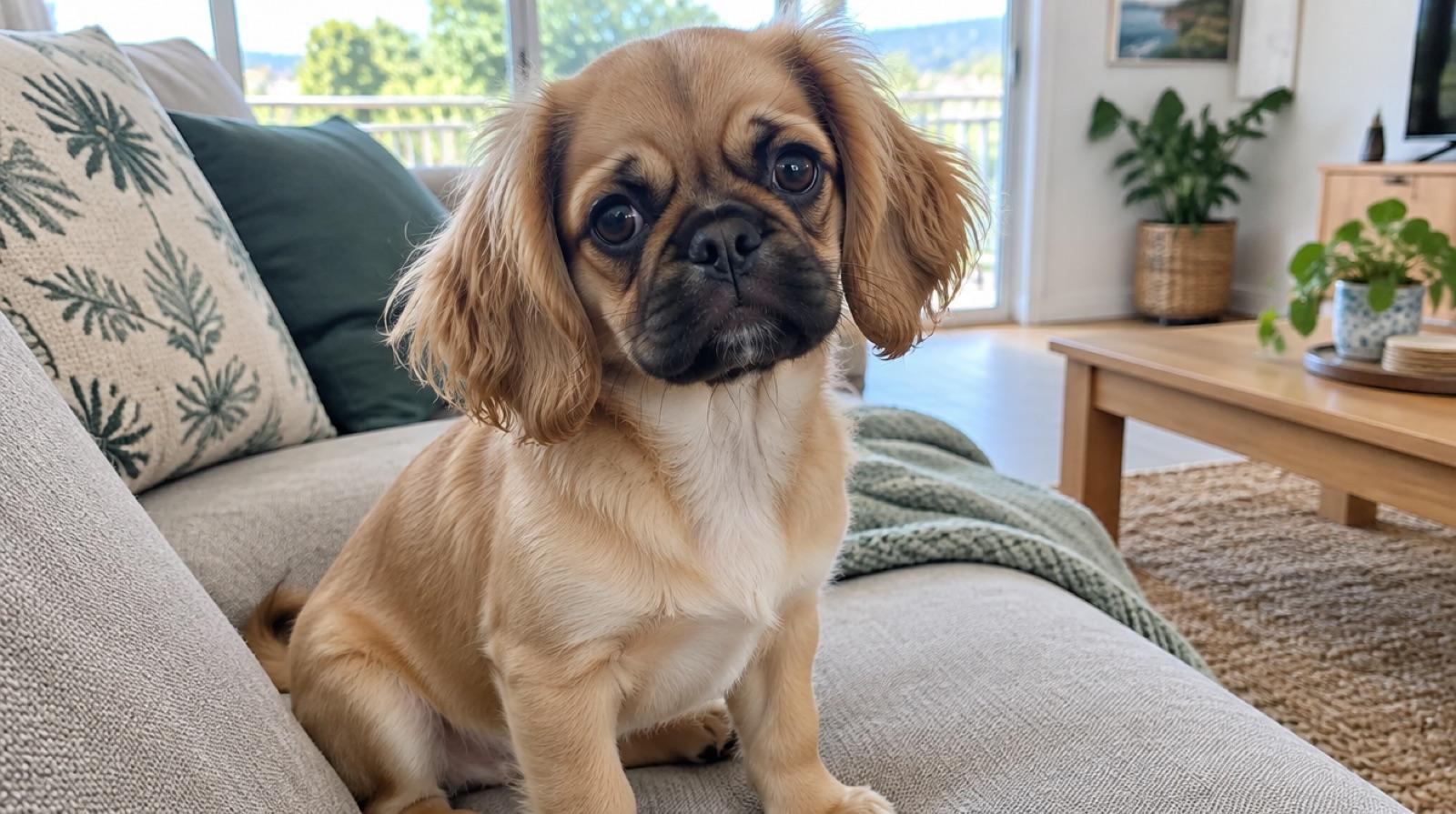
What exactly is a Pugalier?
A Pugalier is a cross between a Pug and a Cavalier King Charles Spaniel. It is not a breed in the formal sense. Dogs Australia publishes a breed standard for each purebred breed it recognises, and the Pugalier is not on that list. For a buyer that means:
- No standard to measure a puppy against. Face shape, size, coat and temperament depend on the parents, and can vary within one litter.
- No breed club. Nobody sets minimum health checks for Pugalier litters or publishes a reference price.
- No Dogs Australia pedigree. Member breeders' codes forbid crossbreeding without prior approval; that has its own section below.
Both parents are companion breeds with gentle reputations. The Pug standard describes great charm, dignity and intelligence and an even-tempered, happy and lively disposition; the Cavalier standard describes a sporting, affectionate, absolutely fearless dog that is gay, friendly and non-aggressive.
| Parent breed | Weight in the standard | Face and coat |
|---|---|---|
| Pug | Ideal 6.3 to 8.1 kg | Flat-faced; the standard asks for well-open nostrils and says pinched nostrils and heavy over-nose wrinkle are unacceptable and should be heavily penalised |
| Cavalier King Charles Spaniel | 5.4 to 8.2 kg | A longer muzzle (about 3.8 cm from the base of the stop to the tip of the nose); long, silky coat with plenty of feathering |
From the Dogs Australia Pug and Cavalier King Charles Spaniel standards, read 11 November 2026. Neither standard sets a height, so the comparison is by weight.
Should you adopt or buy a Pugalier?
Adopt if you can be flexible about age and label. With an adult Pug cross or Cavalier cross from a rescue, you pay the rescue's published fee, and with this cross that is a real advantage: you can see the dog's face, hear how it breathes and ask what the rescue's vet found before you commit. Buy if you need a young puppy and are ready to judge both parents yourself, because no breed club does it for you.
| Route | Reference cost | What you usually get | Main risk |
|---|---|---|---|
| Crossbreed breeder | No published benchmark; each seller sets its own price | A puppy whose adult face and breathing you cannot yet see | Breathing, heart and spine risks from both sides; nobody sets minimum tests |
| Rescue or council pound | The rescue's published fee (see below) | Whatever is listed on the day, often under a parent breed's name; ask what the fee includes | Parents' history unknown; existing conditions may need care |
| Online ad or social media | Anything; a very cheap puppy is a warning sign | Anything from a real litter to a puppy that does not exist | Scams and untested parents |
If what you want is a dog with known screening, look at the parent breeds, which have breed standards and Dogs Australia registered breeders: our Pug and Cavalier King Charles Spaniel adopt-or-buy guides cover the tests a registered breeder of each does.
Is a Pugalier healthier than a Pug or a Cavalier?
Nobody has shown that it is. We found no study of Pug and Cavalier crosses. The closest evidence is a 2024 Royal Veterinary College study of 9,402 UK dogs, an owner survey of dogs up to five years old, which compared three popular Poodle crosses (including the Cavapoo, a Cavalier cross) with their purebred parent breeds. The odds of common owner-reported disorders did not differ in 86.6% of comparisons; the crosses had higher odds in 7.0% and lower odds in 6.4%. The authors wrote that crosses with a parent breed that has known health issues, such as a flat-faced breed, may still benefit and do relatively better than that parent, and that more research is needed. That is a possibility, not a finding about Pugaliers.
So go in assuming a Pugalier can inherit the problems of either parent. The three that matter most are below, each from vet-school or peer-reviewed research on the parent breed. Our Sydney health guides cover living with them: Pug health issues and Cavalier health issues.
Breathing: BOAS, from the Pug side
Brachycephalic obstructive airway syndrome (BOAS) is a breathing disorder in which soft tissue blocks the airway of a flat-faced dog. A Royal Veterinary College study of UK primary-care records (O'Neill and colleagues, 2022) compared 4,308 Pugs with 21,835 other dogs and found Pugs had 53.92 times the odds of a BOAS diagnosis, and 1.86 times the odds of at least one disorder of any kind in the year studied.
What decides the risk is the face, not the name. In a study of 700 dogs of diverse breeds and conformations (Packer and colleagues, 2015), BOAS risk increased sharply as relative muzzle length shortened, BOAS occurred only in dogs whose muzzles were less than half their cranial length, and thicker necks and obesity raised the risk further. A Pugalier with a Cavalier-length muzzle sits in a different place on that curve from one with a Pug face, and the cross label does not tell you which you will get. When you meet the parents and the puppy, look at the muzzle and nostrils, and listen at rest and after a short walk. Loud breathing at rest, snoring, gagging or tiring quickly are reasons to talk to a vet.
The heart: mitral valve disease, from the Cavalier side
Degenerative mitral valve disease is a slow failure of a heart valve, often first heard by a vet as a murmur. In English primary-care records from 2010 and 2011 (Mattin and colleagues, 2015), Cavaliers made up 32.4% of the dogs diagnosed with it, and the odds rose strongly with age. In a separate study of Cavaliers in English practices (Summers and colleagues, 2015), a heart murmur was the most common disorder recorded, in 30.9% of the 1,749 dogs reviewed. Interestingly, the 2022 study above found Pugs had lower odds of a heart murmur than other dogs, but no one has measured what that means for a cross. Ask whether the Cavalier parent has had its heart checked, and have your vet listen at every check-up.
The spine: Chiari-like malformation and syringomyelia, from the Cavalier side
Syringomyelia is a condition in which fluid-filled cavities form in the spinal cord. In Cavaliers it is linked to Chiari-like malformation, where the back of the skull is too small for the brain. In a peer-reviewed study (Parker and colleagues, 2011), 555 Cavaliers whose owners reported no signs were MRI scanned: syringomyelia was found in 25 per cent of dogs aged 12 months, rising to 70 per cent of dogs aged 72 months or more. As that study shows, a dog can have a cavity and show no signs. A 2017 study (Nalborczyk and colleagues) describes scratching towards one shoulder or the neck without touching the skin, often called “phantom scratching”, as a classic sign of severe syringomyelia. No study covers Pugaliers. If you see those signs in any dog, see your vet.
Figures are from UK and European study populations as published; they describe the parent breeds, not Pugaliers, and they are not veterinary advice.
What should a Pugalier breeder show you?
Because no club sets a minimum, use the parent breeds' lists as your standard. Our Pug guide and Cavalier guide set out the tests Dogs Australia and the Cavalier clubs list for each breed. At a minimum, ask for:
- Both parents, in person or on a live video call. Look at their muzzles and nostrils, and listen to them breathe at rest and after a short walk.
- Heart results for the Cavalier parent, with dates and the dog's name or microchip number. A certificate from years ago tells you less than a recent one.
- Any eye, knee, DNA or MRI results the breeder has for either parent, in writing.
- The puppy's own vet check, and your own vet's check before you commit if possible.
- The state breeder number, checked by you on the official register (see the scam section below).
Why is there no Dogs Australia registered Pugalier breeder?
Because the codes Dogs Australia members follow forbid crossbreeding unless their state body approves it in advance. The Dogs NSW Code of Ethics (clause 17) says a member shall not knowingly permit a purebred dog to be mated to a dog of a different breed or a cross-bred dog unless the mating is for the health, welfare or development of a breed and the Board has approved it in advance; it adds that the prohibition does not apply to guide and working dogs. Dogs Victoria's code (20.1.15) says dogs “are not permitted to be mated to a dog or bitch of a different breed, to a cross bred dog or bitch”. The national Dogs Australia Code of Practice (clause 16) says a member shall not permit its purebred dogs to be mated to a dog of a different breed or a cross bred dog “without the prior approval of the member’s Member Body”.
So Pugalier litters are generally bred outside that system. Some breeders belong to other registries, which Dogs Australia says are not affiliated with it and cannot issue its certified pedigrees. That does not make every Pugalier breeder a poor one; it means the checks are yours to make.
How do you keep a Pugalier safe in the heat?
Plan as if it has a Pug's face, because it may. The RSPCA says flat-faced breeds have a reduced capacity to cool down by panting, and that overweight animals overheat faster and have a limited capacity for cooling. Walk early and late in summer, keep the dog lean, give it shade and a cool indoor space, and never leave it in a car. If you suspect heatstroke, the RSPCA says to cool the dog with room-temperature or cool water and get veterinary help immediately. Our Pug breathing and heat care guide has more on summer routines.
See Pug and Cavalier crosses listed by rescues right now
A Pugalier may be listed as a Pug cross or a Cavalier cross. Every listing links to the rescue, where you apply directly, and an alert tells you when a new one arrives.
What does a Pugalier cost?
We cannot give you a breeder price we can stand behind. For purebred breeds we read the prices that Dogs Australia member breeders publish on their own websites and report what we find. That method has nothing to measure for a Pugalier, because member breeders' codes forbid crossbreeding without prior approval, and there is no breed club guide. Any figure on a listing site is one seller's asking price, not a benchmark, and a high price does not buy health checks. Ask what the price includes.
What we can show you is what rescues publish:
| Rescue | Fee as published | Read |
|---|---|---|
| RSPCA NSW | $620 puppy under 12 months; $500 dog over 12 months | 11 Nov 2026 |
| RSPCA ACT | $1,200 for popular small breed puppies, breed mixes or poodle mixes of any size with high adoption demand, up to 12 months; $395 for dogs over 6 months and under 8 years | 11 Nov 2026 |
Reference only, not a quote. These are the fees each rescue published on the date shown; fees change, so check with the rescue. RSPCA ACT says every animal it adopts out is desexed and microchipped (where appropriate); ask any rescue what its fee includes.
With a cross that can inherit breathing and heart problems, the bigger number is often the vet bill. Look at pet insurance early, before any condition is recorded, run the first year through the dog cost calculator, and read our guide to cheaper vet care.
What do Pugaliers in rescue look like?
Rescues often do not use the name. A Pugalier may be listed as a Pug cross, a Cavalier cross or a small mixed breed. Listings change daily, so search all of these:
- Pugs and Pug crosses: Sydney, Melbourne, Brisbane, Perth, Adelaide.
- Cavaliers and Cavalier crosses: Sydney, Melbourne, Brisbane, Perth, Adelaide.
- Small dogs: Sydney, Melbourne, Brisbane, Perth, Adelaide.
- Mixed breeds: Sydney, Melbourne, Brisbane, Perth, Adelaide.
An adult tells you what a puppy cannot: the shape its face has grown into, how it breathes, and anything the rescue's vet has already found. Ask the rescue what checks it has done, book your own vet visit in the first week, and look at insurance before anything is recorded. Our Sydney guides cover adopting each parent breed: adopting a Pug and adopting a Cavalier. For the process, read adopting a dog in Australia.
How do Pugalier scams work, and how do you check a seller?
Never pay for a Pugalier you have not seen with its mother, in person or on a live video call. Check every number the seller gives you on the official register yourself.
Scamwatch says scammers set up fake websites, social media profiles and marketplace listings for popular breeds and pets that do not exist, and that if a pet is very cheap, it is likely a scam. It advises viewing the pet in person or on a video call. A Dogs Victoria fact sheet says scam ads often feature breeds and mixes in high demand, naming Pugs and Cavoodles among them, and warns that ads may display microchip, source or membership numbers lifted from legitimate breeders. Claims to test before you pay:
- “Healthier than a Pug” or “no breathing problems”. No study has shown it. Look at the face and listen to the breathing yourself.
- “Heart tested” without paperwork. Ask for the certificate, its date and the dog it belongs to.
- Photos of someone else's litter. A reverse image search and a search of the ad's exact wording can find the same material elsewhere.
The check that matters most is the state number: a breeder identification number in NSW, a Pet Exchange Register source number in Victoria, a supply number in Queensland or a DACO breeder number in South Australia. Look it up on the official register yourself and confirm it matches the seller and the microchip. Our puppies for sale guide sets out every state's scheme and what to do if you have already paid.
Is a Pugalier the right dog for you?
For many households a small, affectionate companion is exactly right; the commitment is health. Be honest about three things: money for vet care and insurance, a summer plan with a cool room, and keeping the dog lean for life. If those worry you, an adult rescue dog with a known face and a recent vet check is the lower-risk way into these breeds. Not sure it fits? Try the what dog breed am I quiz and the adoption readiness check, and read our guides to apartment dogs and calm dog breeds.
Weighing other small dogs too? Other adopt-or-buy guides cover the Cavoodle, French Bulldog, Boston Terrier and Shih Tzu.
Find a Pug or Cavalier cross near you
Each page shows dogs listed right now by rescues in that city, and each listing links to the rescue where you apply directly.
- Pugs and Pug crosses for adoption in Sydney
- Pugs and Pug crosses for adoption in Melbourne
- Pugs and Pug crosses for adoption in Brisbane
- Pugs and Pug crosses for adoption in Perth
- Pugs and Pug crosses for adoption in Adelaide
- Cavaliers and Cavalier crosses for adoption in Sydney
- Cavaliers and Cavalier crosses for adoption in Melbourne
- Cavaliers and Cavalier crosses for adoption in Brisbane
- Cavaliers and Cavalier crosses for adoption in Perth
- Cavaliers and Cavalier crosses for adoption in Adelaide
Frequently asked questions
What is a Pugalier?▼
A Pugalier is a cross between a Pug and a Cavalier King Charles Spaniel. It is not a breed recognised by Dogs Australia, so there is no breed standard, no breed club and no Dogs Australia pedigree. Size, face shape, coat and temperament depend on the parents and can vary within one litter.
How much does a Pugalier puppy cost in Australia?▼
We have no breeder price we can stand behind. Our method reads the prices that Dogs Australia member breeders publish on their own websites, but the codes those members follow forbid crossbreeding without prior approval from their state body, so there is no member-breeder Pugalier price to survey, and no breed club publishes a guide. Each seller sets its own price. For comparison, RSPCA NSW listed $620 for a puppy under 12 months and $500 for a dog over 12 months when we read its fee page on 11 November 2026. Fees change, so check with the rescue: reference only, not a quote.
Are Pugaliers healthier than Pugs or Cavaliers?▼
There is no evidence either way. We found no study of Pug and Cavalier crosses. A 2024 Royal Veterinary College owner survey of three other popular crosses (dogs up to five years old) found their owner-reported health largely similar to their purebred parent breeds, and its authors said a cross with a flat-faced parent might do better than that parent, but that this needs research. Until a study shows it, assume a Pugalier can inherit the problems of either parent.
Can a Pugalier have breathing problems (BOAS)?▼
Yes, if it has a short muzzle. BOAS, brachycephalic obstructive airway syndrome, is a breathing disorder of flat-faced dogs. A Royal Veterinary College study of 700 dogs found the risk of BOAS rises sharply as relative muzzle length shortens, and BOAS occurred only in dogs whose muzzles were less than half their cranial length. The cross label tells you nothing; the individual dog's face does. Choose parents and a puppy with a longer muzzle, open nostrils and quiet breathing.
Can a Pugalier get the Cavalier heart condition?▼
It may. Mitral valve disease is a slow degeneration of a heart valve. In a study of English primary-care vet records, Cavaliers made up 32.4% of the dogs diagnosed with it, and in a separate study a heart murmur was recorded in 30.9% of the Cavaliers whose records were reviewed. There is no research on Pugaliers, so ask your vet to listen to the heart at every check-up.
What is syringomyelia, and can a Pugalier get it?▼
Syringomyelia is a condition in which fluid-filled cavities form in the spinal cord, linked in Cavaliers to a skull that is too small at the back (Chiari-like malformation). In a peer-reviewed MRI study of 555 Cavaliers whose owners reported no signs, it was found in 25 per cent of dogs aged 12 months, rising to 70 per cent at 72 months or more. No study covers Pugaliers. Tell your vet if any dog scratches at the air near its neck or seems sore around the neck.
How big does a Pugalier get?▼
Small, but it varies. The Dogs Australia Pug standard gives an ideal weight of 6.3 to 8.1 kg, and the Cavalier King Charles Spaniel standard a weight of 5.4 to 8.2 kg. A Pugalier is likely to fall around those figures, but no standard sets its size; meet the parents.
Do Pugaliers cope with Australian heat?▼
Treat a short-faced Pugalier as you would a Pug. The RSPCA says flat-faced breeds have a reduced capacity to cool down by panting, and that overweight animals overheat faster. Walk early and late in summer, keep the dog lean, give shade and a cool indoor space, and never leave it in a car. Heatstroke is an emergency: get veterinary help immediately.
Can I buy a Pugalier from a Dogs Australia registered breeder?▼
Not in the usual way. The national Dogs Australia Code of Practice says a member shall not permit its purebred dogs to be mated to a dog of a different breed or a cross bred dog without the prior approval of its state body. The Dogs NSW Code of Ethics says a member shall not knowingly permit such a mating unless it is for the health, welfare or development of a breed and the Board has approved it in advance (the clause does not apply to guide and working dogs), and the Dogs Victoria code says dogs are not permitted to be mated to a dog of a different breed or a cross bred dog. Pugalier breeders may belong to other registries, which Dogs Australia says are not affiliated with it.
Can I adopt a Pugalier?▼
Check the live listings, which change daily. A Pugalier may be listed as a Pug cross, a Cavalier cross or a small mixed breed rather than by name, so search the Pug and Cavalier breed pages and the small dog listings, and set alerts.
How do I check a Pugalier seller?▼
Check the breeder number your state requires on the official register yourself, such as the breeder identification number in NSW, the Pet Exchange Register source number in Victoria or the supply number in Queensland, and confirm it matches the seller and the puppy's microchip. Meet the mother where the puppies are raised, listen to both parents breathe at rest and after a short walk, ask for any heart checks on the Cavalier parent, and never pay for a puppy you have not seen in person or on a live video call.
Sources
- Dogs Australia: How to choose a puppy (breed standards and other registries)
- Dogs Australia: Pug breed standard (last updated 1 December 2022)
- Dogs Australia: Cavalier King Charles Spaniel breed standard (last updated 3 August 2008)
- O'Neill et al. (2022), Canine Medicine and Genetics: Health of Pug dogs in the UK (Royal Veterinary College VetCompass)
- Packer et al. (2015), PLOS ONE: Impact of facial conformation on canine health: BOAS (Royal Veterinary College)
- Summers et al. (2015), Canine Genetics and Epidemiology: disorders recorded in Cavalier King Charles Spaniels in England
- Mattin et al. (2015), Journal of Veterinary Internal Medicine: degenerative mitral valve disease in dogs in England
- Parker et al. (2011), Veterinary Record: prevalence of asymptomatic syringomyelia in Cavalier King Charles Spaniels
- Nalborczyk et al. (2017), BMC Veterinary Research: MRI characteristics for phantom scratching in canine syringomyelia
- Bryson et al. (2024), PLOS ONE: owner-reported health of Cockapoo, Labradoodle and Cavapoo dogs compared with their parent breeds
- RSPCA Knowledgebase: How can I protect my dog from heatstroke? (updated 8 May 2023)
- Dogs NSW: Code of Ethics (June 2026), clause on crossbreeding
- Dogs Victoria: Part 20 Codes (Code of Practice 20.1.15)
- Dogs Australia: National Code of Practice (amended October 2024), clause 16
- Scamwatch: Buying and selling scams (pet scams)
- Dogs Victoria: Identifying puppy scams and puppy farms (fact sheet A7, 23 September 2022)
- RSPCA NSW: Adoption fees
- RSPCA ACT: Adoption process and fees
Keep reading
Pug puppies: adopt or buy?
The breathing research, the DNA, spine and eye tests for Pugs, and Pugs in rescue.
Cavalier King Charles puppies: adopt or buy?
Heart, eye, DNA and MRI screening for Cavaliers, and the rescue route.
Pugs and Pug crosses listed by rescues
Pugs and Pug crosses listed right now by the rescues and shelters we aggregate.
Cavaliers and Cavalier crosses listed by rescues
Cavaliers and Cavalier crosses listed right now by the rescues and shelters we aggregate.