The short answer
Choose a Border Collie if you want a focused, highly trainable working dog (48 to 53 cm for males under the Dogs Australia standard) and can give it daily mental work as well as exercise. Choose an Australian Shepherd if you want a slightly bigger, sturdier herding dog (males 51 to 58.5 cm) with a bobbed or docked tail and a guarding streak, and you will socialise it well. Aussies carry the MDR1 drug sensitivity mutation far more often (about 50% against under 5% in Border Collies, per Washington State University), so ask for a DNA result. Avoid any litter bred from two merles. Neither breed suits a home with little time.
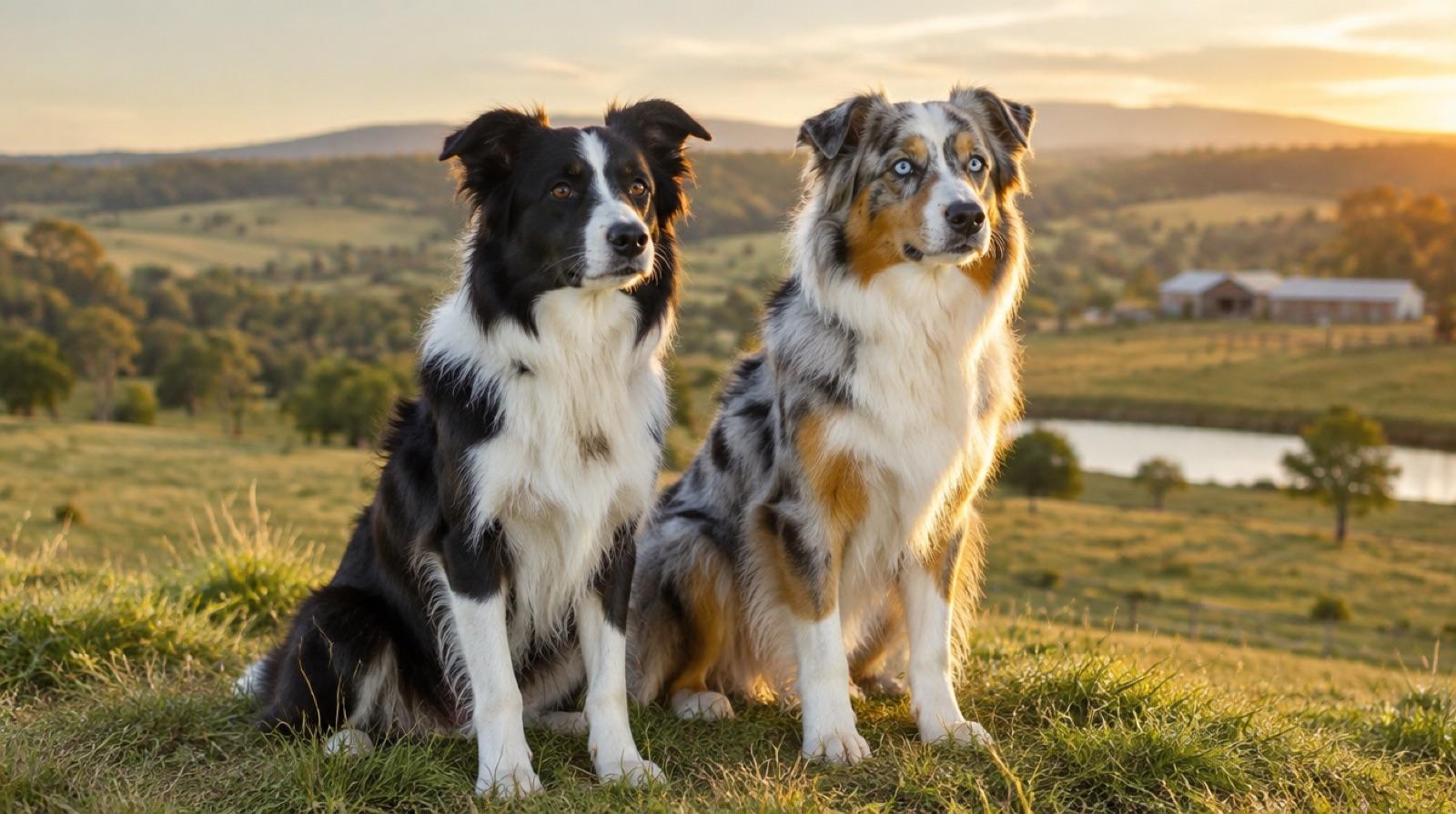
How are a Border Collie and an Aussie different?
They share a group and a job title, but their standards describe different dogs. The Dogs Australia Border Collie standard says the breed is “highly intelligent, with an instinctive tendency to work and is readily responsive to training,” with a nature “at all times kindly disposed towards stock.” The Border Collie Club of NSW text on the Dogs Australia breed page describes the famous Border Collie “creep” and the motionless stance of a dog giving stock the “eye”.
The Australian Shepherd standard calls the Aussie “an intelligent working dog of strong herding and guarding instincts” with “the stamina to work all day.” It describes an even disposition, “good natured, seldom quarrelsome,” and adds that Aussies “may be somewhat reserved in initial meetings.” That guarding streak, and the reserve with strangers, is the biggest temperament difference between the two.
Neither breed is Australian. The Border Collie breed page traces the breed to the border of Scotland and England, first imported to Australia in 1901. The Aussie breed page says the Australian Shepherd was developed in America, was reintroduced to Australia in 1990 and was recognised here on 1 January 1994.
Border Collie vs Australian Shepherd side by side
Every entry below is from the two Dogs Australia breed standards unless it names a breed page, all read on 10 November 2026.
| Border Collie | Australian Shepherd | |
|---|---|---|
| Dogs Australia group | Group 5 (Working Dogs) | Group 5 (Working Dogs) |
| Bred for | A working sheep dog able to endure long periods of active duty | Herding and guarding; stamina to work all day |
| Height (male) | 48 to 53 cm | 51 to 58.5 cm (preferred) |
| Height (female) | 46 to 51 cm | 45.5 to 53.5 cm (preferred) |
| Weight | Not set | Not set; “solidly built with moderate bone” |
| Temperament | “Highly intelligent”, “readily responsive to training”, loyal and faithful | “Good natured, seldom quarrelsome”; “may be somewhat reserved in initial meetings” |
| Coat | Two varieties, moderately long or smooth; dense topcoat, soft dense undercoat | Medium texture and length, straight to wavy, weather resistant; undercoat varies with climate |
| Colours | “Variety of colours permissible. White should never predominate”; the breed page lists blue merle among accepted colours | Blue merle, black, red merle, red, each with or without white markings and tan points |
| Eyes | Harmonising with the coat, darker preferred; lighter allowed in chocolates and blue in merles | Brown, blue, amber or any combination, including flecks and marbling |
| Tail | Moderately long, set on low, with an upward swirl | Docked or naturally bobbed, no more than four inches; the breed page says natural tails range from a very short bob to full length |
| Lifespan (breed page) | Not stated | Most live 12 to 15 years |
| MDR1 frequency (WSU) | Under 5% | About 50% |
Sources: Dogs Australia Border Collie and Australian Shepherd standards; the Border Collie and Australian Shepherd breed pages; Washington State University. Standards describe the ideal show dog; working-line dogs, rescue dogs and crosses vary a lot.
Which has more work drive?
Both have plenty; it shows differently. A Border Collie's drive is intense and focused: the stare, the crouch and the sudden turn of speed described on its breed page. The club says “most of today's Borders don't work,” so their energy and intelligence go into obedience, agility, tracking and showing, and that the breed “needs a structured and disciplined environment” with mental exercise “just as important as physical exercise.”
The Aussie's breed page says Aussies settle into suburban life when their physical and mental needs are met, can be destructive like any breed when they are not, and that drive levels vary within a litter, with “the odd couch potato” for a more laid-back family. The guarding instinct in its standard means early, steady socialisation with visitors matters more than with a Border Collie.
- Herding at home: both breeds may chase and nip at running children, bikes or other pets. It needs redirecting into a game or a job, not punishing.
- Daily needs: real exercise every day plus training, puzzle games or a dog sport. Our Border Collie adolescence and training guide covers the adolescent stage, when many young herding dogs are surrendered.
- Apartments: rarely a good match for either. A calm older rescue dog with a committed owner can manage; a young working-line dog usually cannot.
What about merle, and is it a health risk?
Merle is a marbled coat pattern that both breeds can carry. It is an accepted colour in the Aussie standard (blue merle and red merle) and on the Border Collie breed page (blue merle). One copy of the merle gene is a normal colour. The risk comes from breeding two merles together: a puppy that inherits merle from both parents, a double merle, has a higher risk of hearing and sight problems.
That is why Dogs Australia has banned merle to merle matings in all breeds since 1 January 2015, and puppies from such a mating can only go on the Limited Register. Ask any breeder the colour of both parents. If both are merle, walk away. Be wary too of ads that sell a puppy on a rare colour or blue eyes rather than on health results.
Our merle and brindle dogs guide explains the genetics, cryptic merle, and the research on double merle deafness and eye defects.
Which health tests should each breeder show you?
The lists overlap but are not the same. The table sets out what each breed's Australian clubs say.
| Test | Border Collie | Australian Shepherd |
|---|---|---|
| Hips and elbows | X-rays and scoring (CHEDS); scores should be given to buyers | Hip x-rays compulsory before a litter can be registered; elbow scoring widely done |
| Eyes | CEA/CH DNA test; glaucoma (goniodysgenesis) DNA test; ACES eye exam for glaucoma, PRA and PLL | Hereditary cataract (HSF4) named as a main concern; ask for an ACES eye certificate |
| MDR1 drug sensitivity | DNA test listed | Named as a main concern; affected dogs need alternative drugs (ASCV) |
| Other DNA tests | TNS, NCL5, Raine syndrome, IGS, sensory neuropathy, degenerative myelopathy, early adult onset deafness | Ask the breeder which tests the parents have had and why |
| No test available | Discoid lupus (collie nose), epilepsy and Border Collie collapse: ask about family history | Ask about family history of any inherited condition |
From the National Border Collie Council and the Border Collie Club of NSW (Dogs Australia breed page); the Australian Shepherd Association NSW (Dogs Australia breed page), the Australian Shepherd Club of Victoria and Dogs Australia Regulation Part 6. A buying checklist, not veterinary advice.
MDR1 deserves a word on its own. Washington State University's veterinary laboratory says dogs carrying it can become very ill or die if given certain common medicines, and puts the approximate frequency at about 50% in Australian Shepherds, under 5% in Border Collies and about 10% in herding breed crosses. The only way to know is a DNA test. If you adopt a herding cross, it is worth asking your vet about testing, and either way tell your vet the breed.
For what these conditions mean day to day, read our Border Collie health guide and the Sydney Australian Shepherd health guide.
How do their coats cope with Australian heat?
Both are double-coated dogs bred for outdoor work, and both can cope with Australian conditions if you plan for the hot months. The Aussie standard notes that the undercoat varies with climate, and the Border Collie club says the coat can mat during a coat drop if dead hair is not brushed out. Brush regularly, and more during seasonal shedding, rather than shaving the coat.
The RSPCA Knowledgebase on heatstroke lists exercise and hot, humid conditions without enough shade and water among the risk factors, and advises exercising dogs at the coolest times of day. A herding dog will keep working long after it should stop, so on hot days you have to call the end of the game. Walk early or late, carry water, and give a cool, shaded rest area.
Who suits each breed?
There is no winner here, only a better fit.
- A Border Collie suits someone who enjoys training most days, wants a dog for agility, obedience, herding or another sport, and likes a dog that watches every move. The breed club says Borders need an active owner who involves the dog in family life.
- An Australian Shepherd suits an active owner who wants a slightly bigger, sturdier herding dog, will socialise it with visitors from day one, and is comfortable with a dog that may be reserved with strangers.
- Neither suits a home where the dog would be alone in a yard all day, or someone wanting a calm, low-shedding dog. Our calm dog breeds guide and the what dog breed am I quiz are better starting points.
Weighing up other working breeds too? A Kelpie or Australian Cattle Dog asks for a similar commitment, and both appear in Australian rescue far more often than purebred Aussies. Our smartest dog breeds guide explains what the intelligence rankings actually measured.
Adopt or buy a Border Collie or Aussie?
For most people, start with rescue. Border Collies and collie crosses are listed regularly by the rescues and pounds we aggregate, usually as young adults whose energy outgrew their first home. Two rescues specialise in the herding breeds: Border Collie Rescue Australia and Australian Working Dog Rescue International. Purebred Australian Shepherds are less common in rescue, though crosses appear, and the Australian Shepherd Club of Victoria runs a rescue service. An adult in foster care comes with notes on energy, children, cats and strangers, which is exactly what you need to know with these breeds.
A Dogs Australia registered breeder is a reasonable choice if you need a puppy for stock work or a dog sport, or want known parents and health results. Our Border Collie and Australian Shepherd adopt-or-buy guides cover pricing, breeder checks and scam red flags, and the puppies for sale guide has each state's breeder number rules. On “mini Aussies”: the Dogs Australia breed listing has the Miniature American Shepherd as a separate breed, so ask any breeder which breed and register a puppy will be on.
See Border Collies and Aussies for adoption
Many rescue herding dogs are crosses. The listing tells you the dog's real energy and how it is with children and other pets, which matters more than the label.
See Border Collies →See Australian Shepherds →Find a Border Collie or Aussie near you
- Sydney: Border Collies and Australian Shepherds for adoption, plus our Sydney Border Collie and Australian Shepherd adoption guides
- Melbourne: Border Collies and Australian Shepherds for adoption, plus our Melbourne Border Collie and Australian Shepherd adoption guides
- Brisbane: Border Collies and Australian Shepherds for adoption, plus our Brisbane Border Collie and Australian Shepherd adoption guides
- Perth: Border Collies and Australian Shepherds for adoption, plus our Perth Border Collie and Australian Shepherd adoption guides
- Adelaide: Border Collies and Australian Shepherds for adoption, plus our Adelaide Border Collie and Australian Shepherd adoption guides
Before you apply, take the adoption readiness check and run a working dog's first year through the dog cost calculator.
Frequently asked questions
What is the difference between a Border Collie and an Australian Shepherd?▼
Both are medium-sized herding dogs in the Dogs Australia Working Dogs group, but they differ in build, coat, tail and drive. The Border Collie standard stresses an instinctive tendency to work and a nature kindly disposed towards stock. The Australian Shepherd standard describes strong herding and guarding instincts and a dog that may be reserved on first meeting. Aussies have a docked or naturally bobbed tail; Border Collies have a long, low-set tail.
Is an Australian Shepherd bigger than a Border Collie?▼
Slightly, and with a wider range. The Dogs Australia standards give a preferred height of 51 to 58.5 cm for male Australian Shepherds and 45.5 to 53.5 cm for females, against 48 to 53 cm for male Border Collies and 46 to 51 cm for females. Neither standard sets a weight. The Aussie is also described as solidly built with moderate bone and slightly longer than tall.
Is the Australian Shepherd an Australian breed?▼
No. The breed club text on the Dogs Australia breed page says the Australian Shepherd was developed in America, with early ancestors linked to Basque shepherds who arrived from Australia with sheep. Dogs Australia recognised the breed on 1 January 1994. The Border Collie is not Australian either: it comes from the border of Scotland and England and was first imported here in 1901.
Which is easier to train, a Border Collie or an Aussie?▼
Both learn fast, which cuts both ways. The Border Collie standard calls it readily responsive to training, and the Dogs Australia breed pages describe both breeds excelling at obedience and agility. The real question is whether you can give either one daily mental work. A bored herding dog teaches itself habits such as barking, chasing and nipping at heels.
What is MDR1 and which breed has it?▼
MDR1 is a gene mutation that makes some dogs sensitive to certain common medicines, which can cause severe reactions. Washington State University's veterinary laboratory puts its approximate frequency at 50% in Australian Shepherds and under 5% in Border Collies, and around 10% in herding breed crosses. The only way to know about a particular dog is a DNA test. Give the result to your vet.
What health tests should a Border Collie breeder do?▼
The National Border Collie Council and the Border Collie Club of NSW list DNA tests including Collie eye anomaly (CEA), trapped neutrophil syndrome (TNS), neuronal ceroid lipofuscinosis (NCL5), Imerslund-Grasbeck syndrome (IGS) and MDR1, plus hip and elbow scoring and eye examination by a canine ophthalmologist. The council says copies of the sire's and dam's DNA results and hip and elbow scores should be made available to puppy buyers.
What health tests should an Australian Shepherd breeder do?▼
Hip x-rays are compulsory for a registered litter: under Dogs Australia rules both parents (born after 1 July 2001) must be radiographed and assessed for hip dysplasia. The Australian Shepherd Association NSW text on the Dogs Australia breed page also names hereditary cataracts (HSF4) and MDR1 as main concerns and says hip and elbow scoring is widely done. Ask for those results and an eye certificate.
Are merle Border Collies and Aussies healthy?▼
A single merle is an accepted colour in both breeds and is not a health problem on its own. The risk comes from breeding two merles together, which can produce a double merle with impaired hearing or sight. Dogs Australia has banned merle to merle matings since 1 January 2015. Ask the breeder the colour of both parents, and walk away if both are merle.
Which sheds more?▼
Both shed and both have a double coat. The Border Collie standard describes a dense topcoat and a soft, dense undercoat in both its long and smooth varieties, and the breed club says the coat can mat during a coat drop if dead hair is not removed. The Aussie standard says its undercoat varies with climate, and its breed page says grooming increases during seasonal shedding. Neither suits someone wanting a low-shedding dog.
Which is better for a family, a Border Collie or an Australian Shepherd?▼
Neither is better in general; it depends on the family's time and energy. The Aussie breed page says Aussies make wonderful family dogs when their needs are met, and the Border Collie breed page says Borders need an active owner who involves the dog in family activities. Herding instincts can show as chasing and nipping at running children, so supervise young children with either breed.
Can I adopt a Border Collie or Australian Shepherd?▼
Yes. Border Collies and collie crosses are listed regularly by Australian rescues, and Border Collie Rescue Australia and Australian Working Dog Rescue International focus on the herding breeds. Purebred Aussies are less common in rescue, though Aussie crosses do appear, and the Australian Shepherd Club of Victoria runs a rescue service. An adult rescue dog's energy level is already known, which matters with these breeds.
Is a Miniature Australian Shepherd the same breed?▼
Not under Dogs Australia. Its breed listing has the Miniature American Shepherd as a separate breed from the Australian Shepherd. Rescue listings often use mini Aussie loosely, so judge the dog's actual size and energy rather than the label, and ask a breeder which register a puppy will be on.
Sources
- Dogs Australia: Border Collie breed standard
- Dogs Australia: Australian Shepherd breed standard
- Dogs Australia: Border Collie breed page (Border Collie Club of NSW)
- Dogs Australia: Australian Shepherd breed page (Australian Shepherd Association NSW)
- Dogs Australia: Breed listing (August 2026)
- Dogs Australia: Regulation Part 6, Registration
- National Border Collie Council: Breed health
- Australian Shepherd Club of Victoria: Health
- Washington State University: MDR1 in dogs
- RSPCA Knowledgebase: How can I protect my dog from heatstroke?
Keep reading
Border Collie puppies: adopt or buy?
The breeder health tests, why young collies reach rescue, and scam red flags.
Australian Shepherd puppies: adopt or buy?
Compulsory hip x-rays, the MDR1 test, the merle to merle ban and rescue Aussies.
Merle and brindle dogs
The genes behind each coat, double merle hearing and eye risk, and cryptic merle.
Australian Shepherds for adoption
Aussies and Aussie crosses, when the rescues we track have one listed.