The short answer
If you want a papered Turkish Angora kitten, buy from a breeder registered with a cat council, and expect to search: in November 2026 we found no member breeder publishing kittens or a price on its own website, and no council or club publishes a price, so ask registered breeders directly. For a white kitten, ask about hearing, because white cats with blue eyes are more likely to be deaf. If papers do not matter, rescues list long-haired and white cats of all ages for a rescue fee (RSPCA NSW listed $270 for a kitten under 6 months on 12 November 2026). Fees change, so check with them; reference only, not a quote.
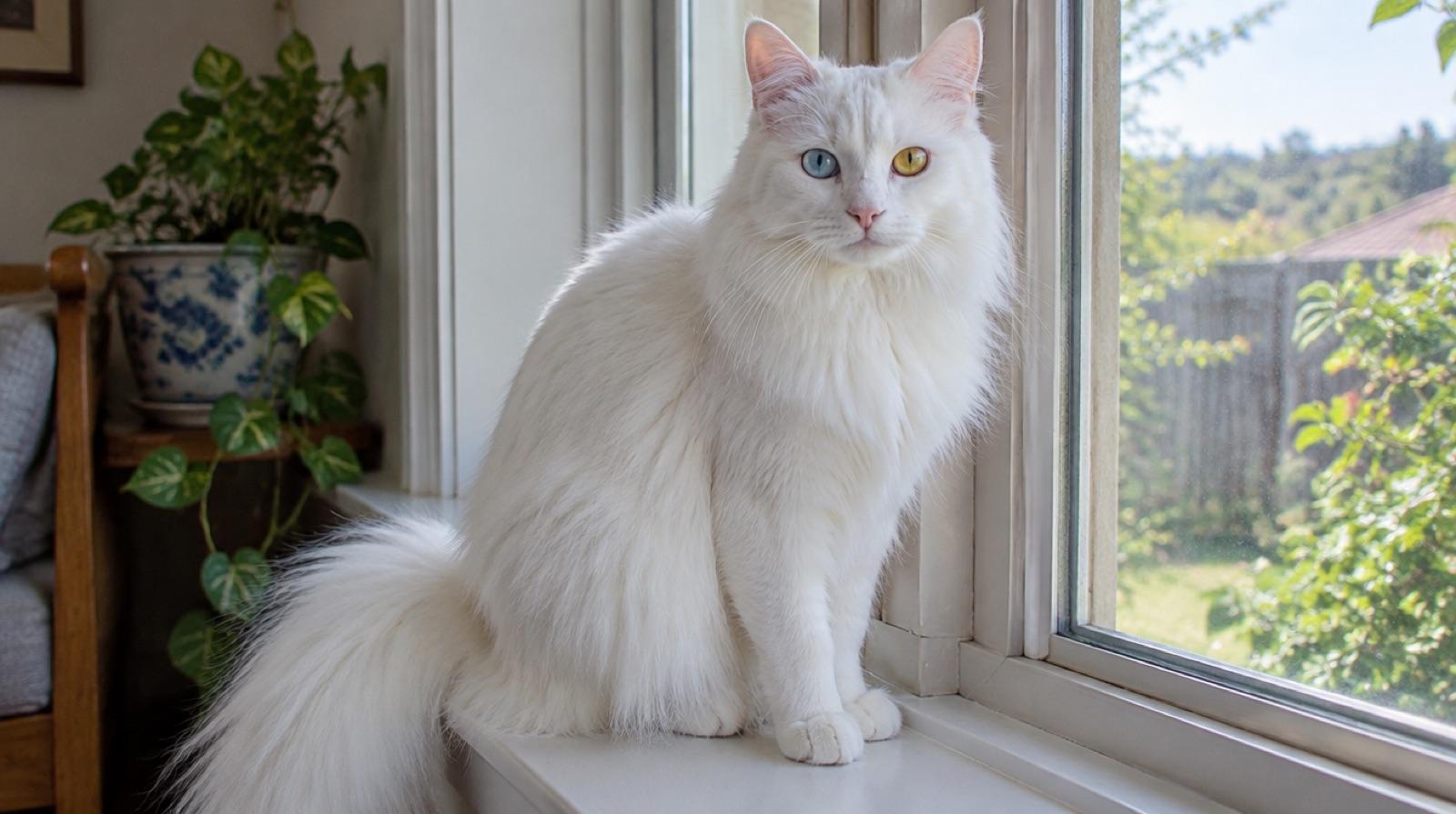
Should you adopt or buy a Turkish Angora?
It depends on whether the papers matter. If you want a pedigree Turkish Angora with known parents, a breeder registered with a cat council is the only route that gives you that, and with this breed you should expect to make enquiries and wait. If what you want is an elegant, silky-coated, people-focused cat, the long-haired and white cats in rescue are worth a look first: numbers change daily, and the fee covers desexing, microchipping and vaccination.
The RSPCA Australia Knowledgebase encourages prospective owners to adopt from the RSPCA or another reputable animal welfare, rehoming or rescue organisation. If you buy from a breeder, it suggests at a minimum checking they are registered by the relevant authority in your state or territory, visiting the place where the animal was born, and meeting the parents, especially the mother.
| Route | Reference cost | What you usually get | Main risk |
|---|---|---|---|
| Registered breeder | No price published on member breeders' own websites (November 2026); ask | A papered kitten with known parents | No breeder listed in the council directories we checked; hearing and DNA results still need asking about |
| Rescue | A rescue fee; see the examples below | Long-haired and white cats of all ages, desexed, microchipped and vaccinated | Unknown parents; a breed label in a listing describes looks, not papers |
| Online ad or social media | Anything; Scamwatch says a very cheap pet is likely a scam | Anything from a real litter to a kitten that does not exist | Scams, unregistered breeding, long-haired moggies sold as Angoras |
Rescue fees read 12 November 2026 on the pages linked below. Reference only, not a quote: rescues set and change their own fees, so check with them.
Is the Turkish Angora recognised in Australia?
Yes. The CCCA and the ACF each publish a Turkish Angora standard, and ANCATS includes the breed in its breed profiles. Read on 12 November 2026:
| Registry | What it publishes | Outcrosses |
|---|---|---|
| CCCA | A Turkish Angora standard, issue date February 2025: “a balanced, graceful cat with a fine, silky coat that shimmers with every movement, in contrast to the firm, long muscular body beneath it.” | None |
| ACF | A Turkish Angora standard, effective 1 January 2018, which names the CCCA (2016) as its source | None |
| ANCATS | A breed profile describing “an ancient naturally occurring cat thought to originate from the mountainous regions of Turkey”, active, intelligent and outgoing | Not stated on the profile |
Overseas, TICA and the Cat Fanciers' Association both have Turkish Angora breed pages; neither page we read gives a recognition date. TICA traces the North American line to cats exported from the Ankara Zoo in the 1960s, and gives a medium-sized cat of 5 to 10 pounds (about 2.3 to 4.5 kg), with males typically larger. ANCATS says the breed was widely used in Persian breeding programs and was nearly lost as a pure breed until controlled breeding programs were introduced in Turkey.
What the Australian standard asks for
- Body: long and slender, finely boned with firm muscles, the rump slightly higher than the shoulders. The CCCA says balance, grace and fineness of bone matter more than size, and disqualifies a cobby body or a kinked tail.
- Head and ears: a medium-long smooth wedge, with large, pointed, tufted ears set high and close together.
- Coat: single coated, with a long, full tail and ruff that have a silk-like sheen, and “britches” on the hind legs.
- Colour: all colours and patterns of equal value, except chocolate, lilac, cinnamon, fawn, caramel, apricot and the Himalayan pattern. The ACF list of exclusions is similar and also rules out marbled tabby and pointed patterns.
- Eyes: blue, green, green-gold, amber or odd-eyed. A note added to the CCCA standard on 24 February 2025 says blue or odd eyes are only allowed for white cats or cats with white in van, bi-colour or any amount of white.
What does a Turkish Angora kitten cost in Australia?
We could not find a published price. No Australian cat council or club publishes a Turkish Angora price, and Cats Victoria (GCCFV) says kitten pricing is up to individual breeders and will vary depending on the breed. In November 2026 we looked for Turkish Angora catteries on council breeder lists and through search, and read what we could find of their own websites. We found none publishing a current Turkish Angora price on its own site: the Cats Victoria and GCCFSA breeder directories have no Turkish Angora category, the NSW CFA directory returned no Turkish Angora listings, and the other leads we found were overseas catteries or directory listings without a cattery website. That is what we could check, not proof that no Australian breeder exists. We do not quote prices from listing sites, social media or general breed websites.
| Route | Reference figure | Read |
|---|---|---|
| Member breeders | No price published on their own websites; ask each breeder | 12 Nov 2026 |
| Cat councils and clubs | No Turkish Angora price published | 12 Nov 2026 |
| RSPCA NSW | $270 kitten under 6 months; $220 cat over 6 months | 12 Nov 2026 |
| Cat Protection Society of NSW | $150 per cat or kitten; $250 for two | 12 Nov 2026 |
Reference figures only, not quotes. Rescues set and change their own fees, so check with them; RSPCA NSW says its animals are desexed, microchipped, vaccinated and health-checked before adoption. Fees in other states are in our guide to kittens for sale in Australia.
When you ask a breeder, ask what the price includes. Cats Victoria suggests asking whether the kitten is desexed, how many vaccinations it has had, whether it is microchipped and whether there is a health guarantee, and says the kitten must be 10 weeks of age or older before it comes to you. ANCATS rules set 10 weeks as the minimum and ANCATS recommends 12.
Which health checks should a Turkish Angora breeder do?
The list is short. The Australian Cat Federation's minimum testing list (October 2025) names one DNA test for the breed, and the CFA says Turkish Angoras are not known for any specific health problems. The question that matters most for many buyers is hearing, because so many Angoras are white.
| Check | Why | Source |
|---|---|---|
| PKD 1 DNA test | Polycystic kidney disease; the only DNA test the ACF lists for the breed (at one laboratory) | ACF |
| Hearing (BAER) test for white kittens | White cats can be prone to deafness, especially blue-eyed cats; the CFA says some regions require white kittens to have a BAER test | CFA; International Cat Care |
| Blood type | The ACF says AB blood group types should be monitored in all breeds | ACF |
A buying checklist, not veterinary advice. Read 12 November 2026.
International Cat Care says a white cat with two blue eyes is three to five times more likely to be deaf than a white cat with two non-blue eyes, and one with a single blue eye about twice as likely. It describes BAER (brainstem auditory evoked response) testing as a simple, non-invasive test done at veterinary specialist centres, and says many breeds now insist on white cats being checked before breeding. A deaf cat can live a good indoor life, but you should know before you commit. Our white cats guide covers the research in more depth.
See long-haired cats listed near you
Long-haired cats and kittens from the rescues and shelters we aggregate, with each rescue's notes on personality and other pets. Numbers change daily. Every listing links to the rescue, where you apply directly.
What is a Turkish Angora like to live with?
Active and involved. The Cat Fanciers' Association lists the personality as busy and curious, calls the breed one of the most interactive and affectionate of all, and says it is often called doglike. TICA says Turkish Angoras are extremely agile, turn up in high places such as the top of a door, and can open cabinets and doors. It describes a sociable breed best suited to a home with another cat or dog for company if nobody is home all day.
Grooming is lighter than the coat suggests. The CFA says the single coat is not prone to matting, making the breed one of the easiest longhairs to care for, and that combing two or three times a month should control shedding in younger cats; TICA suggests a comb through once a week.
- Good fit: a busy household that wants a playful, people-focused cat, with time for daily play and secure climbing space indoors.
- Think twice: long days out with no other pet at home, or a wish for a quiet lap cat.
- Not a reason to choose one: allergies. ASCIA says all cat breeds can cause allergies; our hypoallergenic cats guide covers how to test a cat first.
Not sure what kind of cat suits you? Try the what cat breed am I quiz, and see our cost of owning a cat guide for the ongoing costs.
How do you check a Turkish Angora breeder?
Rescue is not right for everyone. A registered breeder makes sense if you want a kitten with known parents, plan to show, or want a particular colour. If you go that way:
- Registration. Ask which council the breeder belongs to: ANCATS, a member body of the Australian Cat Federation, or a member council of the CCCA. Check with that council directly, not through a link the seller sends.
- Papers that say Turkish Angora. Not Turkish Van, not a longhair cross. Neither Australian standard allows an outcross.
- Hearing results for a white kitten, and the PKD 1 result for both parents.
- The mother, in person or on a live video call, and where the kittens are raised, before any deposit.
- Age and paperwork. At least 10 weeks old, vaccinated, microchipped and desexed or with desexing agreed in writing.
- Your state's rules. Some states require a breeder or source number in kitten ads. Our kittens for sale guide has the state-by-state table.
What do Turkish Angora scams look like?
Never pay for a kitten you have not seen with its mother, in person or at least on a live video call, and never pay a deposit to a seller you cannot verify.
Scamwatch says scammers set up fake websites, and fake social media and marketplace profiles, to get you to pay for popular breeds and pets that do not exist. Its advice: view the pet in person by visiting the breeder or seller, ask to see the pet on a video call with the breeder, verify the breeder is legitimate and accredited, and compare prices, because a very cheap pet is likely a scam. It also warns about being asked to pay by money order, pre-loaded card, or to several different PayIDs or accounts.
- A fluffy white kitten sold as an Angora. Without council papers, a long-haired white kitten could be any cat.
- “Registered” with no council named, or a membership you cannot confirm with that council.
- “Hypoallergenic” promises. ASCIA says all cat breeds can cause allergies.
- Copied photos. Run a reverse image search on the kitten photos and search a sentence of the ad.
If you have already paid, contact your bank straight away and report it to Scamwatch.
Where to find a Turkish Angora type cat to adopt
We do not have a Turkish Angora breed page, so watch the long-haired and white cat listings and set an alert. A rescue's breed label describes how a cat looks; ask the foster carer about personality, energy and, for a white cat, hearing.
Long-haired cats in the big cities
- Long-haired cats for adoption in Sydney
- Long-haired cats for adoption in Melbourne
- Long-haired cats for adoption in Brisbane
- Long-haired cats for adoption in Perth
- Long-haired cats for adoption in Adelaide
White cats
White cats in Sydney, White cats in Melbourne, White cats in Brisbane, White cats in Perth, White cats in Adelaide. Australia-wide: the white cat page and the Domestic Longhair page.
Comparing longhairs? Our guides to Persian kittens and Norwegian Forest Cat kittens cover two very different coats. Before you apply, the adoption readiness check takes a few minutes, and our guide to adopting a cat in Australia walks through the process.
Frequently asked questions
Should I adopt or buy a Turkish Angora kitten?▼
Buy from a breeder registered with a cat council if it has to be a papered Turkish Angora with known parents, and expect to search and wait: we could not find a member breeder publishing kittens or a price on its own website in November 2026. If what you want is a graceful, silky, semi-longhaired cat, check the long-haired and white cats in rescue near you. Numbers change daily, so check the live listings.
How much is a Turkish Angora kitten in Australia?▼
We could not find a published price. No Australian cat council or club publishes one, Cats Victoria (GCCFV) says kitten pricing is up to individual breeders, and in November 2026 we found no member breeder publishing a Turkish Angora price on its own website. We do not quote prices from listing sites. A rescue cat costs the normal rescue fee, for example $220 for a cat over 6 months at RSPCA NSW (read 12 November 2026; fees change, so check with them; reference only, not a quote).
Is the Turkish Angora recognised in Australia?▼
Yes. The Coordinating Cat Council of Australia publishes a Turkish Angora standard (issue date February 2025), the Australian Cat Federation publishes one (effective 1 January 2018), and ANCATS carries a Turkish Angora breed profile on its find-a-breeder page. Overseas, both TICA and the Cat Fanciers' Association have breed pages for it.
Are Turkish Angoras always white?▼
No. TICA says white is the most common colour but all traditional colours are accepted. The CCCA standard accepts all colours and patterns except chocolate, lilac, cinnamon, fawn, caramel, apricot and the Himalayan (pointed) pattern. The CFA says the first Turkish Angoras to reach the US in 1954 were treated as an all-white breed.
Are white Turkish Angoras deaf?▼
Some white cats are, so ask. The Cat Fanciers' Association says white cats can be prone to deafness, especially blue-eyed cats, and International Cat Care says a white cat with two blue eyes is three to five times more likely to be deaf than one with two non-blue eyes. A BAER hearing test, done at veterinary specialist centres, tells you about an individual kitten.
What health tests should a Turkish Angora breeder do?▼
The Australian Cat Federation's minimum testing list (October 2025) names one DNA test for the Turkish Angora: PKD 1, for polycystic kidney disease, listed at one laboratory. The ACF also says AB blood group types should be monitored in all breeds. For white kittens, ask about hearing. The CFA says Turkish Angoras are not known for any specific health problems.
Do Turkish Angoras need a lot of grooming?▼
Less than most longhairs. The Cat Fanciers' Association says the single coat is not prone to matting, making it one of the easiest longhair cats to care for, and that combing two or three times a month should control shedding in younger cats. TICA suggests a comb through once a week.
What is a Turkish Angora like to live with?▼
Busy. The CFA calls the breed one of the most interactive and affectionate of all, often described as doglike. TICA says Turkish Angoras are extremely agile, can open cabinets and doors, and suit a home that has another cat or dog for company if nobody is home all day. Every cat is an individual, so ask about the one you are meeting.
What is the difference between a Turkish Angora and a Turkish Van?▼
They are separate breeds with separate standards. The CCCA lists the Turkish Angora and the Turkish Van as two Group 1 breeds, and the CFA describes the Turkish Van by its pattern, with markings primarily on the head and tail. A long-haired white cat in rescue could resemble either, or neither; only registration papers show a pedigree.
Are Turkish Angoras hypoallergenic?▼
No cat breed is. The Australasian Society of Clinical Immunology and Allergy (ASCIA) says that as all cats have sebaceous glands, all cat breeds can cause allergies. A single coat is not the same as less allergen. If anyone at home is allergic, get medical advice and spend real time with the individual cat first.
How old should a Turkish Angora kitten be when it goes home?▼
At least 10 weeks. ANCATS rules set 10 weeks as the minimum and ANCATS recommends 12, and Cats Victoria (GCCFV) says a kitten must be 10 weeks of age or older, vaccinated, desexed and microchipped before it comes to you. A seller offering a younger kitten is a warning sign.
Sources
- Coordinating Cat Council of Australia: Turkish Angora standard (February 2025)
- Australian Cat Federation: Turkish Angora standard (effective 1 January 2018)
- Australian Cat Federation: DNA health testing by breed (Oct 2025)
- ANCATS: Find a breeder and breed profiles
- ANCATS: Registration rules
- TICA: Turkish Angora breed page
- Cat Fanciers' Association: Turkish Angora breed profile
- International Cat Care: Inherited deafness in white cats (updated September 2025)
- Cats Victoria (GCCFV): Breeders and buying a kitten
- NSW CFA: Breeder's directory
- GCCFSA: Find a breeder
- RSPCA Australia Knowledgebase: Where should I go for a new companion animal?
- Scamwatch: Buying and selling scams (pet scams)
- ASCIA: Pet allergy
- RSPCA NSW: Adoption fees
- Cat Protection Society of NSW: Cats for adoption
Keep reading
White cats: genetics, deafness and care
Why white cats are white, what hearing-tested studies found, and sun care in Australia.
Norwegian Forest Cat kittens: adopt or buy?
A heavier, double-coated longhair: registry standards, health tests and rescue.
Hypoallergenic cats in Australia
What ASCIA says about cat allergies and how to test a cat before you adopt.
Kittens for sale: adopt or buy?
State breeder rules, how to check a seller, and what rescue kittens cost.