The short answer
If you want an Exotic kitten, buy from a breeder registered with a cat council who shows you negative PKD1 DNA results for both parents and breeds for open nostrils and clear eyes, not the flattest possible face. No council or club publishes a price. In November 2026 only two member breeders we found published one on their own websites, both starting at $2,500 for a Persian or Exotic, which is too small a sample for a range, so ask several what their price includes. If an adult cat suits you, check the Persian and indoor cat listings in your city, where a rescue fee of a few hundred dollars includes desexing, microchipping and vaccination. Fees were read 12 November 2026 and are a reference, not a quote.
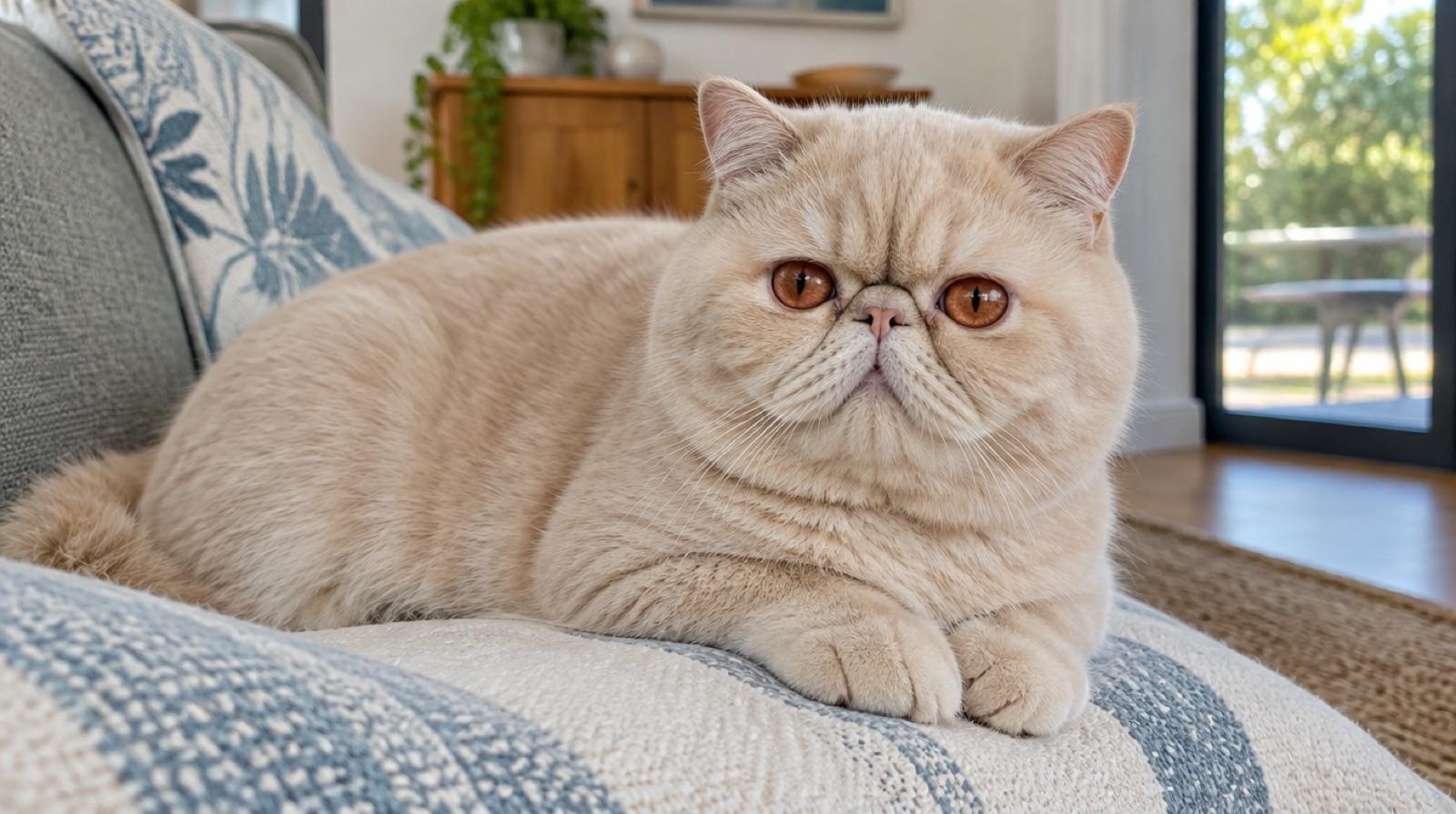
Should you adopt or buy an Exotic Shorthair?
It depends on whether you need a kitten with known parents. A rescue may list an Exotic or Exotic cross under Persian, so if an adult cat suits you, check the Persian and indoor cat listings; numbers change daily, and the fee includes desexing, microchipping and vaccination. If you want a kitten with a PKD-negative background and a moderate face, a council-registered breeder who can prove both is the honest answer.
- A registered breeder. The two member breeders we found publishing a price start at $2,500; ask several. The trap is a seller with no PKD certificates, or one breeding the most extreme faces.
- A rescue, shelter or council pound. A few hundred dollars, vet work done. The trap is assuming every flat-faced cat is healthy: ask what the vet check found about breathing, eyes and teeth.
- An online ad. The highest risk: untested litters, or no kitten at all. Scamwatch says a very cheap pet is likely a scam.
What do the registries say an Exotic is?
The CCCA, the ACF and ANCATS all recognise the Exotic, under slightly different names. The CCCA and ACF standards tie it directly to the Persian, and ANCATS describes it as bred from American Shorthairs and Persians. Here is what each said when we read it on 12 November 2026.
| Registry | What its standard or profile says |
|---|---|
| CCCA, Exotic (Nov 2024) | “The type standard is the same for all Persians and Exotic Shorthairs.” Nostrils “large and open, allowing for ease of breathing”; penalises a stained face or runny, stained eyes. Allowable outcross: Persian. |
| ACF, Exotic Shorthair (Oct 2021) | “The shorthair version of the Persian.” Nose leather broad “with open nasal apertures”; pinched nostrils are a fault. Allowable outcross: Persian. |
| ANCATS, Exotic Persian Shorthair | An American variety produced in the 1950s from American Shorthairs and Persians. |
| CFA (US), Exotic | Established as a breed in 1966; nose short, snub and broad “with open nostrils”; disqualifies a nose break level with or higher than the top of a fully opened eye. |
Notice that the CCCA, ACF and CFA standards all ask for open nostrils, and each penalises or disqualifies features linked to the most extreme faces. A breeder who points to the standard to defend a cat that cannot breathe quietly at rest is not reading it closely. The coat, in the CCCA's words, is medium in length: slightly longer than other shorthair breeds, but not long enough to flow.
What does a flat face mean for an Exotic's health?
Watch the parents breathe while they rest. Open nostrils, quiet breathing and clear eyes are what you want. Noisy breathing or constantly wet eyes in the parents is a warning for the kittens.
The RSPCA Knowledgebase lists flat-faced, or brachycephalic, cats such as Persians and Exotic Shorthairs among the main cat breeds in Australia with significant welfare problems. It says they have changes to the airway like those in flat-faced dogs: narrowed nostrils and airways and a longer than normal soft palate, which make it harder to breathe and can mean the cat tires after short bursts of play. International Cat Care, writing about the Persian, describes the same problems when the face is severely flat:
- Breathing. Small nostrils and a soft palate that is too long; brachycephalic obstructive airway syndrome (BOAS) is common, and in some cases severe.
- Eyes. Large, protruding eyes that do not close fully, leading to problems such as keratitis and corneal sequestrum, and deformed tear ducts that leave the eyes running.
- Teeth and jaws. Teeth that do not line up, so the cat cannot bite and chew properly.
- Skin. Excess facial skin folds, which can predispose to bacterial or fungal skin infections.
Research backs this up. A 2016 study in PLOS ONE used 1,000 owner questionnaires and photographs to measure cats' faces. Cats with shorter muzzles and noses set closer to the eyes had more owner-reported breathing noise and difficulty, and that was linked with tear staining and a less active life. The authors concluded that brachycephalic types such as Persians or Exotics are more likely to have breathing problems.
The RSPCA states that it opposes selective breeding that produces exaggerated features harmful to an animal's health or welfare. That is a welfare position, not a law, and the practical upshot for a buyer is simple: choose a breeder producing moderate faces, and see the parents. Our guide to doll-face versus flat-face Persians covers the difference in more detail, and it applies to Exotics too.
Why does the PKD test matter for Exotics?
Polycystic kidney disease (PKD) is an inherited condition in which fluid-filled cysts grow in the kidneys and can eventually cause kidney failure. The UC Davis Veterinary Genetics Laboratory says it is autosomal dominant, so a cat with one copy is affected and passes it to half its kittens on average, and it lists the Exotic Shorthair among breeds suitable for testing. International Cat Care says PKD was found in more than a third of all Persian and Exotic cats in the 1990s when screening tests became available. In Australia, a University of Sydney study published in 2001 scanned 320 Persians and related breeds, including 17 Exotics, and found it in 45% of cats in Sydney and 42% in Brisbane.
Screening is how breeders bring those numbers down, so testing is the first thing to ask about. The Australian Cat Federation's minimum testing list for the Exotic Shorthair includes:
| Test | What it screens for | What good looks like |
|---|---|---|
| PKD1 DNA test | Polycystic kidney disease | Both parents negative, with laboratory certificates naming the cat |
| PRA-pd DNA test | Persian-type progressive retinal atrophy, an inherited eye disease | Parents clear, or a carrier mated only to a clear cat |
| Persian-breed tests | The ACF says Exotics are freely interbred with Persians and should be tested for all diseases relevant to the Persian | Ask what the breeder tests for and why |
| Blood group | AB blood types, which the ACF says should be monitored in all breeds | Known for both parents |
Sources: ACF DNA health testing by breed (October 2025); UC Davis VGL; Barrs et al. 2001. A buying checklist, not veterinary advice.
The heart is worth a question too. The ACVIM consensus statement on feline cardiomyopathies names the Persian among pedigree breeds believed to be at increased risk of hypertrophic cardiomyopathy (HCM). It does not name the Exotic, but given how closely the two are bred, ask whether the breeding cats have had heart checks.
See Persians and flat-faced cats listed near you
A rescue may list an Exotic under Persian. Numbers change daily, so check the live listings; each one links to the rescue, where you apply directly.
What does an Exotic kitten cost in Australia?
No Australian cat council or club publishes an Exotic guide price, and Cats Victoria (GCCFV) says kitten pricing is up to individual breeders. In November 2026 we read the websites of Exotic catteries that show council membership on their own site. Only two published a pet price there, one in NSW and one in Queensland, and both use one price for Persians and Exotics. One gives a range of $2,500 to $4,500, with most of its kittens between $3,000 and $3,500 depending on colour and quality; the other lists companion kittens at $2,500. Neither page carries a 2026 date, so we checked the Internet Archive, which holds 2026 copies of both showing the same prices. Two breeders is too few to call a range, so treat these as examples and ask each breeder. We never quote prices that appear only on listing sites.
| Route | Reference figure | Read |
|---|---|---|
| Member breeders publishing a pet price (2 only) | From $2,500; one says most kittens are $3,000 to $3,500 (same price for Persians and Exotics); sample too small for a range | 12 Nov 2026, breeders' own websites |
| Cat councils and clubs | No Exotic price published | 12 Nov 2026 |
| RSPCA NSW | $270 kitten under 6 months; $220 cat over 6 months | 12 Nov 2026 |
| Cat Protection Society of NSW | $150 per cat or kitten; $250 for two | 12 Nov 2026 |
Reference figures only, not quotes. Breeder prices were read on breeders' own websites, never on listing sites; both breeders' prices include desexing, microchipping and vaccination. Breeders and rescues set and change their own prices, so check with them; rescue fees usually include desexing, microchipping and vaccination. Fees in other states are in our guide to kittens for sale in Australia.
When you ask breeders, ask what the price includes. Cats Victoria says a kitten should be 10 weeks of age or older, vaccinated, desexed and microchipped before it comes to you, and suggests asking about a health guarantee. The eye and dental problems the RSPCA describes in flat-faced cats can mean extra vet visits; the cost of owning a cat guide covers the running costs.
How much grooming does an Exotic need, and what is it like to live with?
The coat is the reason most people choose an Exotic over a Persian. The Cat Fanciers' Association says Exotics shed more heavily than Persians, mostly in season, but a weekly combing with a steel comb is enough for most of the year, a bath may help in shedding season, and mats are uncommon if the coat is not neglected. The face is the daily job: wipe the eyes and any facial folds gently and keep them dry.
On temperament, the CFA describes Exotics as quiet, loyal companions, devoted but not intrusive, adaptable at any age, and sometimes shy with other animals at first. It says some people find them a bit more active and playful than Persians, and that you may hear purrs but rarely meows.
- Good fit: a calm indoor home that wants a gentle, quiet companion without daily coat care.
- Think twice: a hot home with no cooling, or a household that wants an athletic cat. The RSPCA Knowledgebase says flat-faced cats often tire easily.
- Choose a moderate face if you can. It gives the cat more room to breathe, drain its tears and chew.
Not sure what kind of cat suits you? Try the what cat breed am I quiz, or dog or cat? if you are still deciding on the species.
How do you check an Exotic breeder?
- Confirm the registration yourself. Ask which council the breeder belongs to: ANCATS, a member body of the Australian Cat Federation, a member council of the CCCA, or another body. Then check with that council directly.
- Check your state's number. NSW, Victoria, South Australia and the ACT set rules for kitten ads. The state-by-state table is in our kittens for sale guide.
- See the PKD and PRA certificates for both parents. “PKD negative” on a website is a claim; the laboratory certificate is the evidence.
- Look at the parents' faces. Open nostrils, quiet breathing at rest and dry eyes.
- Meet the kitten with its mother, in person or on a live video call.
- Read the contract. Ask what happens if the kitten develops an inherited condition, and whether the breeder offers a health guarantee.
What do Exotic kitten scams look like?
Scamwatch says scammers set up fake websites to sell popular breeds, and fake social media and marketplace profiles for pets that do not exist. Its advice: view the pet in person or on a video call with the breeder, verify the breeder is legitimate and accredited, and compare prices, because a very cheap pet is likely a scam. It also warns about being asked to pay by money order, pre-loaded card, or to several different PayIDs or accounts.
- A very cheap kitten available today, with papers you cannot confirm.
- No PKD certificate, or a certificate that does not name the parent cats.
- No visit and no live video call with the kitten and its mother.
- Copied photos. Run a reverse image search on the kitten photos.
If you have already paid, contact your bank straight away and report it to Scamwatch.
Where to find an Exotic or flat-faced cat to adopt
Numbers change daily, so watch the live listings and set an alert. A rescue may list an Exotic or Exotic cross under Persian. Ask the rescue what its vet check found about the eyes, breathing, teeth and kidneys.
Persian listings in the big cities
- Persian cats for adoption in Sydney
- Persian cats for adoption in Melbourne
- Persian cats for adoption in Brisbane
- Persian cats for adoption in Perth
- Persian cats for adoption in Adelaide
- Australia-wide: the Persian breed page and the British Shorthair breed page.
Indoor cats near you
- Indoor cats in Sydney
- Indoor cats in Melbourne
- Indoor cats in Brisbane
- Indoor cats in Perth
- Indoor cats in Adelaide
City guides for flat-faced breeds
- Persian health issues (Sydney)
- Persian health issues (Melbourne)
- Persian adoption in Sydney
- Persian adoption in Brisbane
Before you apply, the adoption readiness check takes five minutes, and our guide to adopting a cat in Australia walks through the process.
Frequently asked questions
How much is an Exotic Shorthair kitten in Australia?▼
No cat council or club publishes a guide price. In November 2026 we found only two member breeders publishing a pet price on their own websites, and both use one price for Persians and Exotics: one gives a range of $2,500 to $4,500, with most of its kittens between $3,000 and $3,500, and the other lists companion kittens at $2,500. Two breeders is too small a sample for a range, so treat these as examples and ask several breeders what their price includes. We never quote listing-site prices. A rescue cat costs the normal rescue fee, for example $220 for an adult cat at RSPCA NSW. All figures were read 12 November 2026; fees change, so check with them. Reference only, not a quote.
What is the difference between an Exotic and a Persian?▼
The coat. The Australian Cat Federation's standard calls the Exotic the shorthair version of the Persian, and the Coordinating Cat Council of Australia says the type standard is the same for all Persians and Exotic Shorthairs. The Cat Fanciers' Association says Exotics were consistently bred back to Persians, so there is practically no difference in personality. The Exotic's coat is dense and plush, slightly longer than other shorthairs but not long enough to flow.
Do Exotic Shorthairs have breathing problems?▼
Many flat-faced cats do. The RSPCA Knowledgebase names Persians and Exotic Shorthairs as brachycephalic breeds and says they have narrowed nostrils and airways and a longer than normal soft palate, which makes breathing harder and can mean they tire easily. A 2016 study in PLOS ONE found that cats with shorter muzzles had more owner-reported breathing noise and difficulty. A cat with a less extreme face has more room to breathe.
Why do Exotics have runny eyes?▼
Because a very flat face changes how tears drain. International Cat Care says that in brachycephalic cats the tear ducts are deformed, which makes it hard for tears to drain, and the RSPCA Knowledgebase lists tear duct abnormalities and eye inflammation among the problems of flat-faced cats. A 2016 PLOS ONE study also linked tear staining with breathing problems in cats with shorter faces. Have a vet check eyes that run all the time.
What is PKD and do Exotics get it?▼
Polycystic kidney disease is an inherited condition in which cysts grow in the kidneys and can lead to kidney failure. International Cat Care says it was found in more than a third of all Persian and Exotic cats in the 1990s when screening became available. A University of Sydney study scanned Persians and related breeds, including Exotics, and found it in 45% of cats in Sydney and 42% in Brisbane. A DNA test now identifies affected cats.
What health tests should an Exotic breeder do?▼
The Australian Cat Federation's minimum testing list for the Exotic Shorthair (October 2025) names the PKD1 DNA test and the Persian PRA test (PRA-pd), an inherited eye disease. Because Exotics are freely interbred with Persians, it recommends testing for all diseases relevant to the Persian as well. Ask for both parents' written results, and ask how the breeder selects for open nostrils and clear eyes.
How much grooming does an Exotic need?▼
Far less than a Persian, but not none. The Cat Fanciers' Association says a weekly combing is enough for most of the year, that Exotics shed heavily in season and may need a bath then, and that mats are uncommon if the coat is cared for. A flat-faced cat also needs the corners of its eyes and the sides of its nose cleaned gently and regularly.
What is an Exotic Shorthair like to live with?▼
The Cat Fanciers' Association describes Exotics as quiet, loyal companions that are devoted but not intrusive, adaptable at any age, and initially shy with other animals before learning to live peacefully with them. It says you may hear purrs but meows are rare. The RSPCA Knowledgebase adds that flat-faced cats often tire easily, so a calm, cool indoor home suits many.
Can you adopt an Exotic Shorthair from a rescue in Australia?▼
Numbers change daily, so check the live listings rather than relying on a general answer. A rescue may list an Exotic under Persian, so watch the Persian breed pages and the indoor cat pages for your city and set an alert. Ask the rescue what its vet check found about breathing, eyes, teeth and kidneys.
How do I avoid an Exotic kitten scam?▼
Scamwatch says scammers set up fake websites for popular breeds and fake social media and marketplace profiles for pets that do not exist. See the kitten with its mother in person or on a live video call, confirm the breeder's council membership with the council itself, ask for the PKD certificates, and be wary of a very cheap price, which Scamwatch says is likely a scam.
Where can I see flat-faced cats for adoption right now?▼
LocalPetFinder lists cats from the rescues, shelters and council pounds we aggregate, refreshed regularly. Open the Persian page for Sydney, Melbourne, Brisbane, Perth or Adelaide, browse indoor cats in your city, and set an alert so you hear about new arrivals early. Each listing links to the rescue, where you apply directly.
Sources
- International Cat Care: Persian cats and brachycephaly (updated September 2025)
- RSPCA Knowledgebase: Health and welfare issues of exaggerated physical features in cats
- Farnworth et al. 2016, PLOS ONE: Flat feline faces and respiratory abnormalities
- University of Sydney (Barrs et al.), Australian Veterinary Journal 2001: PKD in Persians and related breeds
- UC Davis Veterinary Genetics Laboratory: PKD1 test
- ACVIM consensus statement on feline cardiomyopathies (2020)
- Australian Cat Federation: DNA health testing by breed (Oct 2025)
- Coordinating Cat Council of Australia: Exotic standard (November 2024)
- Australian Cat Federation: Exotic Shorthair standard (effective October 2021)
- ANCATS (Australian National Cats): breed profiles
- Cat Fanciers' Association: Exotic breed profile and standard
- Cats Victoria (GCCFV): Breeders and buying a kitten
- Scamwatch: Buying and selling scams (pet scams)
- RSPCA NSW: Adoption fees
- Cat Protection Society of NSW: Cats for adoption
Keep reading
Persian kittens: adopt or buy?
The same breed type in a long coat: daily grooming, the PKD test and flat-face health.
Doll-face Persian vs flat-face
What the research says about breathing, eyes and teeth, and how to tell the types apart.
British Shorthair kittens: adopt or buy?
A round-faced, plush-coated cat with a longer nose: heart and kidney screening and rescue.
Kittens for sale: adopt or buy?
Every state's rules for kitten ads, the scam checks, and what rescues charge.