The short answer
A doll-face Persian and a flat-faced (peke-face) Persian are one breed with two head types. The flat face is the show type most registry standards describe today. The doll-face has a longer nose and a rounder face, so its airway, tear ducts and teeth have more room. International Cat Care says brachycephalic obstructive airway syndrome is common in flat-faced Persians, and the Royal Veterinary College found that 64.9% of Persian cats had at least one disorder recorded. The RSPCA Australia Knowledgebase states the RSPCA is opposed to breeding for exaggerated features. Both types need grooming every day. Both turn up in rescue, usually as adults, and adoptable Persians and crosses are listed nationally.
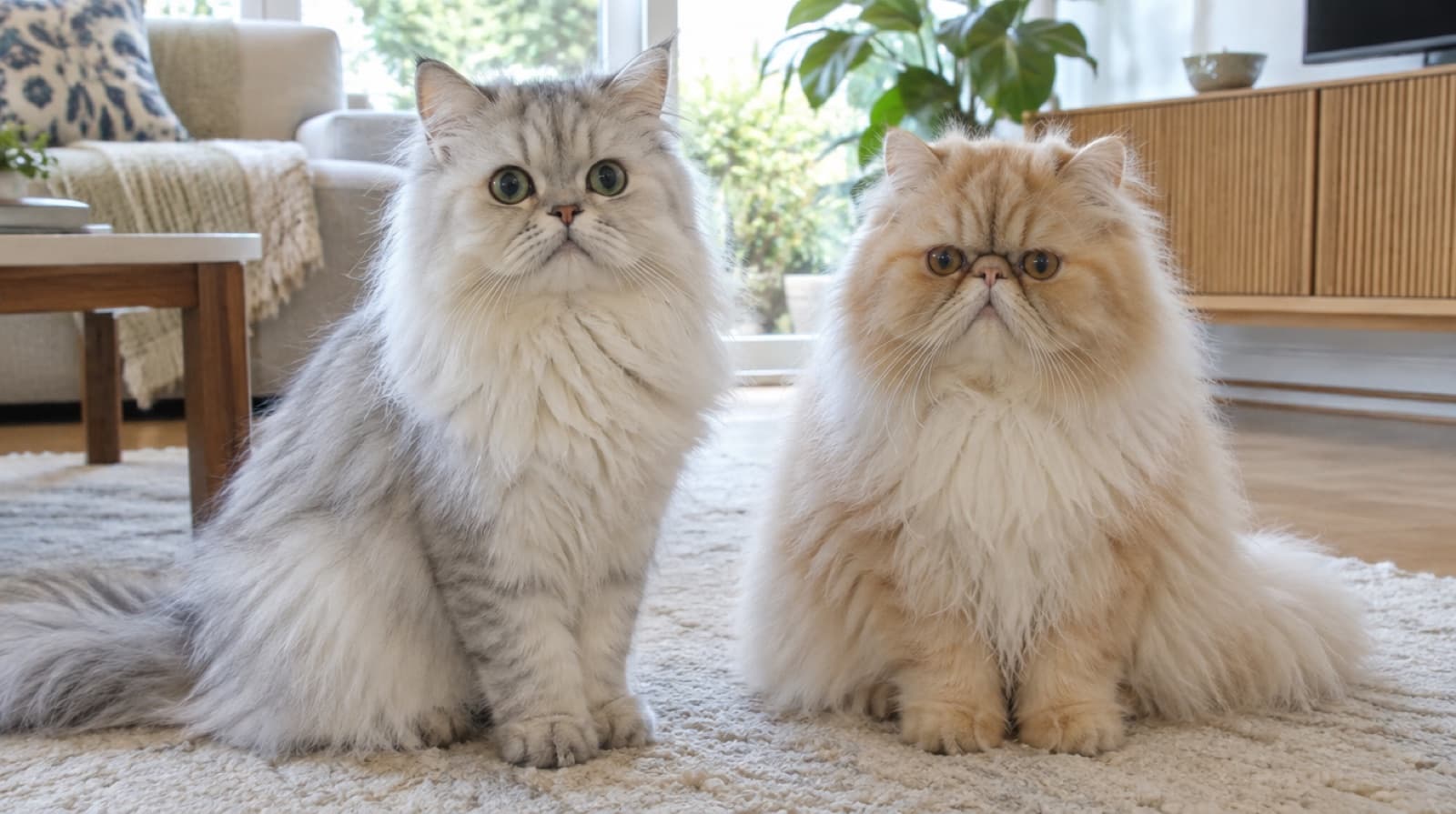
What is the difference between a doll-face and a flat-faced Persian?
The difference is the head, and only the head. A doll-face Persian has a nose of ordinary length, set lower on the face, with a visible muzzle and a gentle stop between the eyes. A flat-faced Persian has a very short nose set high between the eyes, so the forehead, nose and chin sit almost in one vertical line. Coat, body, temperament and the rest of the breed are shared.
The flat face is the modern show type. Registry standards such as the CFA Persian standard are written around that look, and show breeders select for it. The doll-face is a description of a look, not a separate breed or a registered variety. It is closer to the Persians photographed in the early twentieth century, before selection pushed the nose upwards.
Why it matters is simple. The shorter the skull, the less room there is for the airway, the tear ducts and the teeth. Welfare bodies in Australia and overseas now treat the extreme flat face as a health problem bred on purpose, and that view shapes everything else on this page.
Doll-face vs flat-face Persian: side by side
The table compares the two types on the points that affect daily life with the cat. The health rows summarise what the sources below say about flat-faced Persians as a group; any single cat can be better or worse than the pattern.
| Feature | Doll-face (traditional) | Flat-face (show, peke-face) |
|---|---|---|
| Nose and muzzle | Nose of normal length, set lower, with a clear muzzle. The face reads as a round cat face. | Very short nose set high between the eyes. Forehead, nose and chin close to one vertical line. |
| Eyes and tear staining | Tear ducts drain more normally. Some staining in pale cats, usually mild. | Eyes run constantly and stain the face (International Cat Care). Tear duct abnormalities (RSPCA Knowledgebase). Daily cleaning needed. |
| Breathing | Open airway for its size. Generally breathes quietly and copes better with warm weather. | Brachycephalic obstructive airway syndrome is common (International Cat Care). Narrowed nostrils and a long soft palate (RSPCA Knowledgebase). Snoring and open-mouth breathing are warning signs. |
| Dental | Jaw long enough for the teeth to line up. Normal dental care still needed. | Dental malocclusion, where the teeth do not meet properly (International Cat Care). Dental problems (RSPCA Knowledgebase). Crowded teeth trap food. |
| Grooming | Full Persian coat. Daily combing, with the face easier to keep clean. | Full Persian coat plus daily face and eye cleaning. The skin folds around the nose need checking. |
| Typical price difference | Often advertised below show-bred kittens. Rarely the top of a breeder's price list. | Show-quality kittens from registered breeders sit at the top of the range. Pet-quality kittens from the same litters cost less. |
Neither column is a promise. A doll-face Persian can carry other inherited problems, and a flat-faced Persian can live a long, comfortable life with good care. The columns describe risk, not fate.
What do vets and welfare bodies say about flat-faced Persians?
Three sources carry most of the weight here, and they agree. International Cat Care, the UK feline welfare charity, says brachycephalic obstructive airway syndrome, usually shortened to BOAS, is common in flat-faced Persians. It also describes dental malocclusion, where the teeth do not meet properly, and eyes that run constantly and cause tear staining.
The RSPCA Australia Knowledgebase states that the RSPCA is opposed to selective breeding that produces exaggerated features. It lists what the flat face does to brachycephalic cats such as Persians and Exotic Shorthairs: narrowed nostrils, a long soft palate, tear duct abnormalities and dental problems. This is the Australian welfare position, and it is why you will not see the RSPCA promote the extreme show head.
The Royal Veterinary College put numbers to it. In its study of Persian cats, 64.9% of Persian cats had at least one disorder recorded. Dental disease was recorded in 11.3% and eye discharge in 5.8%. Those figures cover Persians as a breed, not flat-faced cats alone, so read them as a breed-wide picture with the flat face as one driver.
The research literature uses the same two names you see in adverts. A paper by Schmidt and colleagues in the Journal of Veterinary Internal Medicine and a 2024 review in Animals both treat the peke-face and doll-face as the two ends of the Persian skull. If your cat snores, breathes with its mouth open, struggles after mild play or has a face that is always wet, book a vet visit rather than waiting for it to settle.
Where do the names doll-face and peke-face come from?
Peke-face is named after the Pekingese, the dog breed with a famously short muzzle. Veterinary literature uses the term for the flat-faced Persian, the type whose nose sits up between the eyes. Doll-face is the term for the traditional type with the longer nose, and the same papers use it. You will also hear “traditional Persian” and “old-style Persian” for the doll-face, and “ultra-face” or “extreme” for the flattest show cats.
None of these are registry names. A pedigree certificate will say Persian, full stop. If a breeder tells you a doll-face is a “rare original breed” with its own papers, that is a sales line, not a registration. The same goes for the reverse: a flat face does not make a cat a better or purer Persian, only a Persian bred closer to the current show standard.
How do you care for either type of Persian in Australia?
Both types need the same baseline care, and the flat face adds a layer on top. Start with the coat. A Persian coat mats fast, and a mat pulls the skin every time the cat moves. Comb to the skin every day, not just over the top. Pay attention to the armpits, belly, behind the ears and under the tail. If the coat is already matted, a groomer or vet should remove it. Do not cut mats out with scissors at home.
Clean the eyes daily. Use a soft cloth or pad dampened with water, one side per eye, wiping away from the nose. On a flat-faced cat, check the fold of skin where the nose meets the face, because moisture sits there and the skin can get sore. If the discharge turns thick, yellow or green, or the eye looks red or half-closed, that is a vet visit rather than a cleaning problem.
Respect the heat. An Australian summer is hard on a brachycephalic cat because a shortened airway makes panting less effective, and a Persian wears a heavy coat on top. Keep the cat indoors on hot days, keep at least one room cool, provide fresh water in more than one place, and never leave the cat in a car or a sun-filled room. Open-mouth breathing in a resting cat is an emergency sign.
Keep the cat indoors or in a secure enclosure. The coat collects burrs, grass seeds and ticks outside, and a flat-faced cat is slow to escape a dog or a car. Most Australian rescues now require indoor or enclosed living for the cats they rehome, and a Persian is the clearest case for it.
Watch the teeth and the weight. Crowded teeth trap food and lead to dental disease, which the Royal Veterinary College found in a notable share of Persians. Ask your vet to check the mouth at every visit. Keep the cat lean, because extra weight makes breathing harder for a cat whose airway is already narrow. Any medication, diet change or airway surgery is a conversation with your own vet, who can see the cat in front of them.
Searching “doll face Persian kittens for sale”? Read this first
Many people arrive at this page from a search for doll-face Persian kittens for sale, or the price of one. We are an adoption aggregator and do not sell cats, but we can tell you how to buy safely if that is the path you take. Start with a registered breeder. In Australia that means a breeder registered with a recognised cat body, such as Australian National Cats Inc (ANCATS), which has a public Check a Member lookup, or a member body of the Australian Cat Federation (ACF) or the Co-Ordinating Cat Council of Australia (CCCA). Ask for the registration number and check it yourself.
Then ask the health questions that matter for this breed. Have the parents been screened for inherited conditions, and can you see the results? How do the parents breathe at rest and after play? Can you meet the kitten and at least one parent in person, or on a live video call? A good breeder expects these questions. A breeder who dodges them, or who only has photos, is telling you something.
The scam pattern is consistent. Scamwatch, run by the ACCC, advises buyers to view the pet in person, ask for a video call and compare pricing, because a very cheap pet is likely a scam. The usual sequence is a kitten priced well under the going rate, a deposit to hold it, and then new requests for transport, crate, insurance or vet fees before a kitten that never arrives. Persians, with their high demand and photogenic kittens, are a favourite for these adverts.
In NSW there is one more protection worth knowing. Under the NSW Breeding Code, a buyer who returns a kitten to a breeder within 3 days receives a 50% refund. Ask any breeder, in any state, what happens if the kitten does not work out, and get the answer in writing.
Do Persians turn up in Australian rescue?
Yes, and more often than most pedigree cats. Across the rescues we aggregate, Persians and Persian crosses appear regularly. Most are adults rather than kittens. The common story is an older cat surrendered when the daily grooming became too much, when a mat problem turned into a vet bill, or when breathing or eye costs mounted on a flat-faced cat. These are not bad cats. They are cats whose care load outran a household.
That makes rescue a serious option for anyone drawn to the breed, and especially for anyone who wants the doll-face look. Shelters do not sort by head type, but you can see it in the photos, and an adult cat shows you exactly the face, coat and breathing it will have for life. A rescue Persian also comes desexed, microchipped and vaccinated, with a fee that is a small fraction of a breeder price. RSPCA NSW lists a cat over 6 months at $220, and the Cat Protection Society of NSW charges $150 per cat or kitten, both including desexing and a vet check.
If you want a purebred and are prepared to wait, DCH Animal Adoptions in NSW runs a wait list for purebred cats including Persians. For everything listed right now, the national Persian page pulls together adoptable Persians and crosses from the rescues we aggregate, and the Sydney cat listings show what is close to home for NSW readers.
Before you apply, be honest about the grooming. Ten minutes with a comb every day, for the life of the cat, is the price of any Persian. If that sounds like a lot, our adoption readiness check is a good place to think it through. And if you already have a Persian you can no longer care for, our rehoming guide explains how to find the next home without handing the cat to a stranger online.
Which Persian should you choose?
If you are choosing a kitten, the welfare evidence points one way. A doll-face Persian gives you the coat, the calm temperament and the look most people picture, with far less of the breathing, eye and dental burden that comes with the extreme flat face. International Cat Care, the RSPCA and the Royal Veterinary College are not describing rare complications. They are describing the normal consequences of a shortened skull.
If you are choosing an adult from rescue, the head type is already set and so is the cat. Meet it, watch it breathe at rest, look at its eyes and teeth, and ask the rescue about its vet history. A flat-faced Persian in rescue still deserves a good home, and knowing what its face means lets you give it one with your eyes open.
Frequently asked questions
Is a doll-face Persian a different breed from a flat-faced Persian?▼
No. Both are Persians. Doll-face describes the traditional type with a longer nose and a rounder, more cat-shaped face. Flat-face (also called peke-face) describes the modern show type with a very short nose set high between the eyes. Registries recognise one Persian breed; the two names describe two looks within it.
Do doll-face Persians have health problems too?▼
They can, but the problems tied to a flat face are much less likely. The airway, eye drainage and bite problems that International Cat Care and the RSPCA describe come from the shortened skull. A Persian with a normal-length nose has more room for its airway, tear ducts and teeth. Doll-face Persians still need daily grooming and can still carry other inherited conditions, so ask about health testing either way.
Why does my flat-faced Persian have wet, brown-stained eyes all the time?▼
Because the shortened skull changes how the tear ducts drain. International Cat Care says the eyes of flat-faced Persians run constantly, which causes tear staining, and the RSPCA Knowledgebase lists tear duct abnormalities among the welfare problems of brachycephalic cats. Gentle daily cleaning helps with the staining, but have your vet check the eyes, because constant running can also mean irritation or infection.
What does peke-face mean?▼
Peke-face is the term veterinary literature uses for the flat-faced Persian, named after the Pekingese dog, which has a similarly short muzzle. Doll-face is the term for the traditional, longer-nosed type. You will see both words in breeder adverts and in research papers.
Are flat-faced Persians banned or restricted in Australia?▼
No. There is no ban on owning or breeding flat-faced Persians in Australia. The RSPCA Australia Knowledgebase states that the RSPCA is opposed to selective breeding that produces exaggerated features, and it names brachycephalic cats such as Persians and Exotic Shorthairs. That is a welfare position, not a law.
How much more does a doll-face Persian cost than a flat-faced one?▼
There is no fixed gap. Price follows pedigree, show quality and demand more than head shape. Show-bred flat-faced kittens from registered breeders tend to sit at the top of the range, while doll-face kittens are often advertised lower. A Persian kitten offered for a fraction of the going rate, or shipped sight unseen, is a scam signal rather than a bargain.
Can a Persian live outdoors in Australia?▼
A Persian is far safer indoors. The long coat picks up burrs, seeds and ticks, and a flat-faced cat is a poor candidate for a hot Australian afternoon because a shortened airway makes panting less effective. Keep the cat inside or in a secure enclosure, keep rooms cool in summer, and never leave a brachycephalic cat in a parked car or a sunny room.
Do Persians turn up in Australian rescue?▼
Yes. Across the rescues we aggregate, Persians and Persian crosses appear regularly. Many are older cats surrendered when the grooming workload or vet bills became too much. DCH Animal Adoptions in NSW runs a wait list for purebred cats including Persians, and the national Persian page on LocalPetFinder shows what is listed right now.
Sources
- International Cat Care: Persian cats and brachycephaly (26 Sep 2025)
- RSPCA Australia Knowledgebase: health and welfare issues associated with exaggerated physical features in cats (3 Dec 2024)
- Royal Veterinary College: disorders of Persian cats
- Schmidt et al., Journal of Veterinary Internal Medicine (brachycephaly in Persian cats)
- Animals (2024) review of feline brachycephaly
- Cat Fanciers Association: Persian breed standard
- Australian National Cats Inc (ANCATS): Check a Member
- Scamwatch (ACCC): buying and selling scams
Keep reading
Persian cats for adoption in Australia
Every Persian and Persian cross currently listed across the rescues we aggregate, by state and city.
Applehead Siamese vs modern Siamese
Another breed split into a traditional and a show look. How to tell them apart and which Australian registries recognise what.
Maine Coon price in Australia
What registered breeders list, why the cheap ads are scams, and the rescue route most buyers miss.
Cats for adoption in Sydney
Current Sydney cat listings from RSPCA NSW, Cat Protection Society of NSW, AWL NSW and other rescues, in one place.