The short answer
A Basenji is a clean, independent, “barkless but not mute” hound that needs secure fencing and an owner who enjoys a clever, strong-minded dog. If you buy, use a Dogs Australia registered breeder who can show the parents' DNA results for Fanconi syndrome, an inherited kidney disease, and for PRA, plus eye checks, and expect to wait for the once-a-year winter litters. We found no member breeder that publishes a price on its own website, so ask each one. If you adopt, Basenjis and Basenji crosses reach general rescues, usually as adults, and a rescue can tell you how the dog copes with fences and time alone. Rescue fees below are reference figures, not quotes; check with the rescue.
Should you adopt or buy a Basenji?
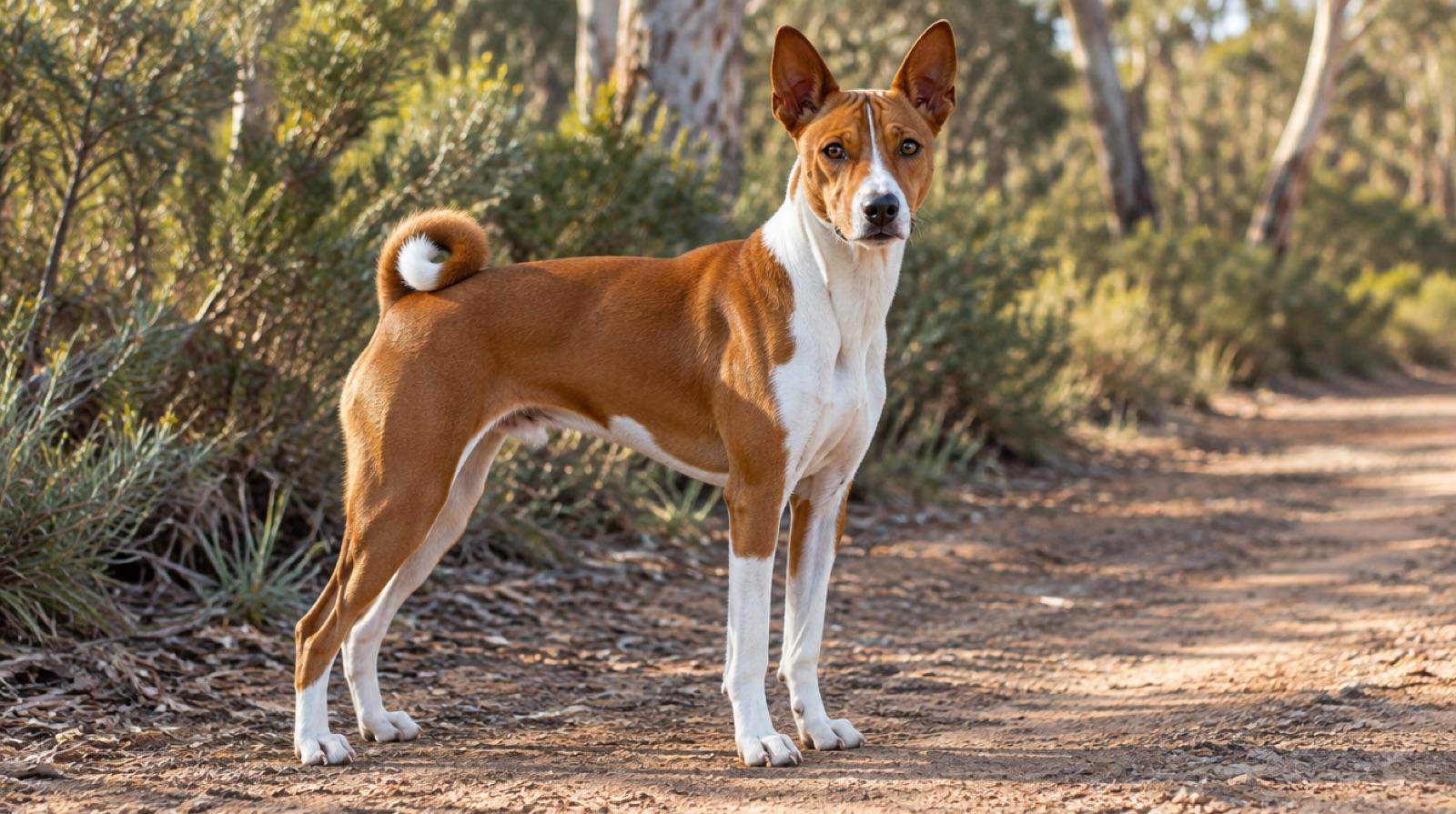
Start with the breed, not the route. The Dogs Australia breed standard places the Basenji in the Hound group and describes a lightly built, finely boned dog of “gazelle-like grace” that is “barkless but not mute”, with its own noise, a mixture of a chortle and a yodel. It calls the temperament “intelligent, independent, but affectionate and alert”, and says the breed can be aloof with strangers. The breed information on Dogs NSW, written for the Basenji Club of NSW, adds that this intelligence does not necessarily make a Basenji easy to train.
Either route can work. A registered breeder who DNA tests the parents gives you the best odds with a puppy, but you will probably wait for the winter litters. A rescue gives you an adult whose habits with fences, other pets and time alone are already known. The route to avoid is an ad for a Basenji puppy with no parent test results.
| Route | Reference cost | What you usually get | Main risk |
|---|---|---|---|
| Dogs Australia registered breeder | No member breeder we checked published a price; ask each one | A puppy with pedigree papers, often on the Limited Register, from DNA-tested parents | Once-a-year litters and waiting lists |
| General rescue or council pound | The standard fee, for example $395 to $1,000 at the RSPCA rows below | Adult Basenjis and Basenji crosses, desexed and microchipped | Listings come and go; you may wait |
| Online ad or unregistered seller | Any price; a cheap price is a scam warning | Untested parents, or a puppy that does not exist | Fanconi or PRA risk unknown, and scams |
Reference figures: the RSPCA NSW, RSPCA ACT and RSPCA Victoria fee pages, read 11 November 2026. They are not quotes; rescues change their fees, so check with them.
What is Fanconi syndrome, and why does the DNA test matter?
In Basenjis, Fanconi syndrome is an inherited disorder of the kidney tubules. A recent account is a 2024 study in the journal Genes by Farias, Mhlanga-Mutangadura, Guo, Hansen, Johnson and Katz at the University of Missouri. It describes the disease as a failure of the kidneys' proximal tubules to reabsorb substances, so glucose, amino acids and phosphate are lost in the urine. Its key points for a buyer:
- It starts late. The first signs are usually drinking and urinating more, weight loss and a poor coat, and in most Basenjis the disease begins between 4 and 7 years of age.
- It appears to be inherited as a recessive trait, based on earlier reports. In the study, all 32 affected Basenjis carried two copies of the variant, one from each parent.
- The late onset is part of why it persisted. The authors say this is one reason selective mating had not removed it from the breed.
- The DNA test is well supported. They found a deletion in the FAN1 gene; among 78 Basenjis of known disease status, test result and disease agreed almost completely, with one exception out of 33 dogs carrying two copies. The variant was not found in 120 unaffected dogs from 81 other breeds.
For a puppy buyer, the practical point is that a young puppy will look healthy either way. What protects it is the parents' DNA results. The Victorian Basenji Breed Association says a breeder should be able to provide certificates of both parents' Fanconi status, with at least one parent DNA certified normal, or a certificate showing the puppy is normal, or clear by parentage. If your Basenji ever starts drinking much more than usual, see a vet.
Which health tests should a Basenji breeder show you?
The Australian clubs line up closely. Dogs NSW says breeders test for persistent pupillary membranes (PPM), progressive retinal atrophy (PRA) and Fanconi syndrome, and that these hereditary conditions are uncommon, with DNA testing for PRA and Fanconi now an asset in preventing them. The Victorian Basenji Breed Association's breeder directory sets out what its listed breeders have agreed to:
| Check | Dogs NSW (Basenji Club of NSW) | Victorian Basenji Breed Association |
|---|---|---|
| Fanconi syndrome (DNA) | Breeders test | All eligible bitches (entire and over 12 months) tested as a minimum; no pairing that could produce an affected puppy |
| Progressive retinal atrophy (DNA) | Breeders test | Tested as a minimum; at least one parent DNA certified normal |
| Eye examination | Breeders test for persistent pupillary membranes | Recommends parents and puppy are examined under ACES |
| Breeding limits | Not stated | No bitch bred more than twice in 18 months; vet certificate before breeding a bitch over 8 |
| Microchip | Not stated | Puppy microchipped before homing |
Sources: Dogs NSW Basenji page, VBBA breeder directory and VBBA breeder selection, read 11 November 2026. ACES is the Australian Canine Eye Scheme.
The association also suggests a written contract that lists the health testing done on the puppy and its parents and says the Basenji is to be returned to the breeder whatever its age if you cannot keep it. Our Basenji health guide covers living with these conditions in more depth.
Why are Basenji puppies only born once a year?
Because the breed usually cycles once a year. Dogs NSW says Basenjis tend to cycle just once a year, all around the same time, with puppies in Australia arriving between May and July, and that the small group of registered breeders has limited numbers each “puppy season”. The Victorian Basenji Breed Association likewise says puppies are generally born in winter and advises contacting a breeder well in advance.
Registered numbers are small. Dogs Australia's registration figures show 79 Basenjis registered in 2025 and 90 in 2018. In practice, if you want a registered puppy, talk to breeders well before winter and expect a waiting list.
How much is a Basenji puppy from a registered breeder?
We could not find a published figure. In November 2026 we read the own websites of Basenji breeders that show Dogs Australia membership, leaving out listing and marketplace sites. None of them published a price for a pet puppy on their own site, and we found no Australian Basenji club that publishes a guide price. Prices on listing sites, or from sellers whose sites showed no membership, are not something we quote.
When you ask a breeder for a price, ask what it includes: the parents' Fanconi and PRA certificates, the puppy's eye check, vaccinations and microchip, the register type and desexing agreement, and whether the breeder will take the dog back. Budget for what comes after, too. The dog cost calculator gives a first-year figure, and our guides to cheaper vet care and desexing costs help with the rest. Secure fencing may be the biggest one-off cost.
See the Basenjis listed right now
Basenjis and Basenji crosses from the rescues, shelters and council pounds we aggregate, each with its rescue, desexing and microchip details. Every listing links to the rescue, where you apply directly.
What do Basenjis in rescue look like?
Mostly adults, plus Basenji crosses. Basenjis come into rescue for the same reasons as other dogs, such as an owner moving or no longer being able to manage, and sometimes because the household underestimated a clever, independent hound that escapes or gets bored. With a cross, temperament varies, so the foster carer's or shelter's notes on the individual dog matter more than the breed label.
That is the advantage of adopting: you can ask whether the dog climbs or digs under fences, how it goes with cats and other dogs, and how it copes alone, before you sign anything. Our Basenji adoption guide for Sydney covers the local side. You can also ask the Basenji club in your state whether it knows of an older Basenji needing a home.
What does a rescue Basenji cost?
| Rescue | Fee as published | Read |
|---|---|---|
| RSPCA NSW | $620 puppy under 12 months; $500 dog over 12 months | 11 Nov 2026 |
| RSPCA ACT | $395 for dogs over 6 months and under 8 years; $650 for popular breeds and mixes with high adoption demand over 12 months and under 8 years (the page does not say which breeds count as popular) | 11 Nov 2026 |
| RSPCA Victoria | $500 to $1,000 for adult dogs | 11 Nov 2026 |
Reference only, not a quote. These are the fees each rescue published on the date shown; fees change and some dogs are priced individually, so check with the rescue. The fee normally covers desexing, microchipping, vaccinations and a vet check. Read our guide to adopting a dog in Australia.
If no Basenji is listed near you, browse small dogs as well: Sydney, Melbourne, Brisbane, Perth, Adelaide.
How do Basenji puppy scams work?
Never send a deposit for a Basenji puppy you have not seen with its mother, in person or at least on a live video call. A seller who asks for more money after the first payment, for transport, a crate or insurance, is following the standard scam script.
Scamwatch warns that scammers set up fake websites, social media profiles and marketplace listings for pets that do not exist, and that a very cheap pet is likely a scam. Dogs Victoria's puppy scam fact sheet adds that fake ads may display microchip, source or membership numbers lifted from legitimate breeders. What to watch for with a Basenji:
- No Fanconi or PRA certificates. “Vet checked” is not the same as DNA tested parents.
- Puppies out of season. Australian Basenji litters mostly arrive in winter, so a puppy ready at an unusual time of year deserves extra questions.
- Borrowed numbers. A real breeder's membership or source number in an ad proves nothing on its own. Contact the breeder through Dogs Australia or the state body, not the ad.
- Colours outside the standard. The standard allows black and white, red and white, black, tan and white (tricolour) and brindle, each with white markings.
Our guide to puppies for sale in Australia has the state-by-state table of breeder numbers, how to check each one, and what to do if you have already paid.
When is a registered breeder the better choice?
Rescue is not right for everyone. A registered breeder is a reasonable choice if you want a puppy and are prepared to wait for a winter litter from tested parents, or if you have kept Basenjis or other primitive breeds before. Check these before you pay:
- Registration. Ask for the breeder's prefix and membership number and check them with Dogs Australia or the state body. It confirms membership, not puppy quality.
- Fanconi and PRA certificates for both parents, or for the puppy, by registered name.
- Eye checks for the parents and the puppy under ACES.
- Honesty about the breed. The association says a good breeder will tell you the negatives as well as the positives.
- A written contract covering health problems, register type, desexing and return to the breeder.
Is a Basenji the right dog for you?
The appeal is real. The standard calls the Basenji “remarkable for its cleanliness in every way”, and Dogs NSW says it has no doggy odour, cleans itself like a cat, sheds little, and can adapt to apartment living with enough exercise. Be honest about three things before you apply. Fencing: Dogs NSW recommends a strong, unclimbable fence well positioned at ground level, and a secure lead on outings, because a Basenji on the chase will not come back when called. Training: an intelligent dog is not always an obedient one, and Dogs NSW says a Basenji can devise an infinite variety of mischief. Noise: it does not bark, but it is not silent.
Not sure it fits? Try the what dog breed am I quiz and the adoption readiness check, and read our Basenji temperament and training guide.
Find a Basenji near you
Basenjis and Basenji crosses listed by rescues, by city:
- Basenjis for adoption in Sydney
- Basenjis for adoption in Melbourne
- Basenjis for adoption in Brisbane
- Basenjis for adoption in Perth
- Basenjis for adoption in Adelaide
Local guides to adopting a Basenji, with the rescues that serve each city: Sydney, Melbourne, Brisbane, Perth, Adelaide, Gold Coast.
More adopt-or-buy guides: Shiba Inu, Whippet, Italian Greyhound, Beagle, Jack Russell Terrier, Cairn Terrier, Pekingese.
Frequently asked questions
How much is a Basenji puppy in Australia?▼
We could not find a published price. None of the Dogs Australia member breeders whose own websites we read in November 2026 listed a price for a pet Basenji puppy, and we found no Australian Basenji club that publishes a guide price. Ask each registered breeder and compare what is included. Any figure a breeder gives you is their price on the day, not a quote from us.
What is Fanconi syndrome in Basenjis?▼
In Basenjis, Fanconi syndrome is an inherited kidney disorder in which the kidney tubules fail to reabsorb substances such as glucose and amino acids. A 2024 study in the journal Genes says the first signs are usually drinking and urinating more, weight loss and a poor coat, and that in most Basenjis it starts between 4 and 7 years of age. See a vet if your Basenji starts drinking much more than usual.
Is there a DNA test for Fanconi syndrome?▼
Yes. The 2024 study by Farias and colleagues at the University of Missouri linked the disease to a deletion in the FAN1 gene and found almost complete agreement between the test result and disease in 78 Basenjis. The Victorian Basenji Breed Association says breeders should be able to show the parents' Fanconi DNA status, with at least one parent certified normal.
Why can a Basenji develop Fanconi if the puppy seems healthy?▼
Because it is a late-onset disease. Signs usually appear in middle age, which the 2024 study says is part of why selective mating alone did not remove it from the breed. That is why the parents' DNA results matter more than how a young puppy looks.
What other health tests do Basenji breeders do?▼
Dogs NSW, in breed information written for the Basenji Club of NSW, says breeders test for persistent pupillary membranes (PPM), progressive retinal atrophy (PRA) and Fanconi syndrome. The Victorian Basenji Breed Association asks its directory breeders to test for Fanconi and PRA as a minimum and recommends eye checks under the Australian Canine Eye Scheme (ACES).
Do Basenjis bark?▼
Not in the usual way. The Dogs Australia standard calls the Basenji barkless but not mute, with its own special noise, a mixture of a chortle and a yodel. Dogs NSW says they make a full range of other dog noises, so a Basenji is not a silent dog.
Are Basenjis hard to keep in a yard?▼
They need secure fencing. Dogs NSW says the Basenji hunts by scent, sight and hearing and is deaf to all entreaties to return once on the chase, so it needs a fenced yard and a secure lead and collar on outings. It recommends a strong, unclimbable fence well positioned at ground level.
When are Basenji puppies born?▼
Mostly in winter. Dogs NSW says Basenjis tend to cycle once a year, with puppies in Australia arriving between May and July, and that registered breeders have limited numbers each season. Contact breeders well in advance and expect a waiting list.
How big does a Basenji get?▼
The Dogs Australia standard gives an ideal height of 43 cm for dogs and 40 cm for bitches, and an ideal weight of 11 kg and 9.5 kg. Dogs NSW says you can expect 12 to 15 years from a Basenji.
Can I adopt a Basenji in Australia?▼
Yes, sometimes. Basenjis and Basenji crosses reach general rescues and council pounds, usually as adults. Watch the Basenji listings, set an alert, and apply quickly when one appears. A rescue can tell you how the dog copes with fences, other pets and time alone before you commit.
How much does it cost to adopt a Basenji?▼
You pay the rescue's standard fee. RSPCA NSW listed $620 for a puppy under 12 months and $500 for a dog over 12 months, RSPCA ACT listed $395 for dogs over 6 months and under 8 years, and $650 for adult dogs of popular breeds with high adoption demand, without listing which breeds those are, and RSPCA Victoria listed $500 to $1,000 for adult dogs. These were the fees published when we read them in November 2026; they are a reference, not a quote, so check with the rescue.
How do I avoid Basenji puppy scams?▼
Only pay for a puppy you have seen with its mother, in person or at least on a live video call, and ask for the parents' Fanconi and PRA results. Scamwatch says a very cheap pet is likely a scam, and Dogs Victoria warns that fake ads may show microchip, source or membership numbers lifted from real breeders. A litter offered far outside the usual winter season deserves extra questions.
Sources
- Dogs Australia: Basenji breed standard (last updated 23 Jan 2015)
- Dogs Australia: National Animal Registration Analysis 2018 to 2025
- Dogs NSW: Basenji breed information (written for the Basenji Club of NSW)
- Victorian Basenji Breed Association: Basenji puppy breeders
- Victorian Basenji Breed Association: Breeder directory and health and breeding guide commitments
- Victorian Basenji Breed Association: Breeder selection
- Farias, Mhlanga-Mutangadura, Guo, Hansen, Johnson and Katz (2024), FAN1 deletion variant in Basenji dogs with Fanconi syndrome, Genes 15(11):1469 (University of Missouri)
- Scamwatch: Buying and selling scams (pet scams)
- Dogs Victoria: A7 Identifying puppy scams and puppy farms (fact sheet)
- RSPCA NSW: Adoption fees
- RSPCA ACT: Adoption process
- RSPCA Victoria: The adoption process
Keep reading
Basenjis listed by rescues
Basenjis and Basenji crosses listed right now by the rescues and shelters we aggregate across Australia.
Basenji temperament and training
The independent, cat-like hound, recall, escape habits and how to train one.
Basenji health issues
Fanconi syndrome, eye conditions and the checks to plan for.
Shiba Inu puppies: adopt or buy?
Another clean, strong-minded breed, its health checks and Shibas in rescue.