The short answer
Five breeds are banned from import into Australia: the American Pit Bull Terrier (or pit bull terrier), Dogo Argentino, Perro de Presa Canario, Fila Brasileiro and Japanese Tosa. Queensland has made all five prohibited dogs since 28 August 2024, so owning one without a reasonable excuse is an offence there. NSW, Victoria, Western Australia and Tasmania call them restricted breeds and South Australia prescribed breeds: existing dogs can be kept only under strict rules, and selling, giving away and breeding them are banned or need council approval. The ACT has no restricted breeds, and the Northern Territory has no territory-wide list. The Staffy, the American Staffordshire Terrier and the American Bully are not on any state list, although a council can still assess an individual dog.
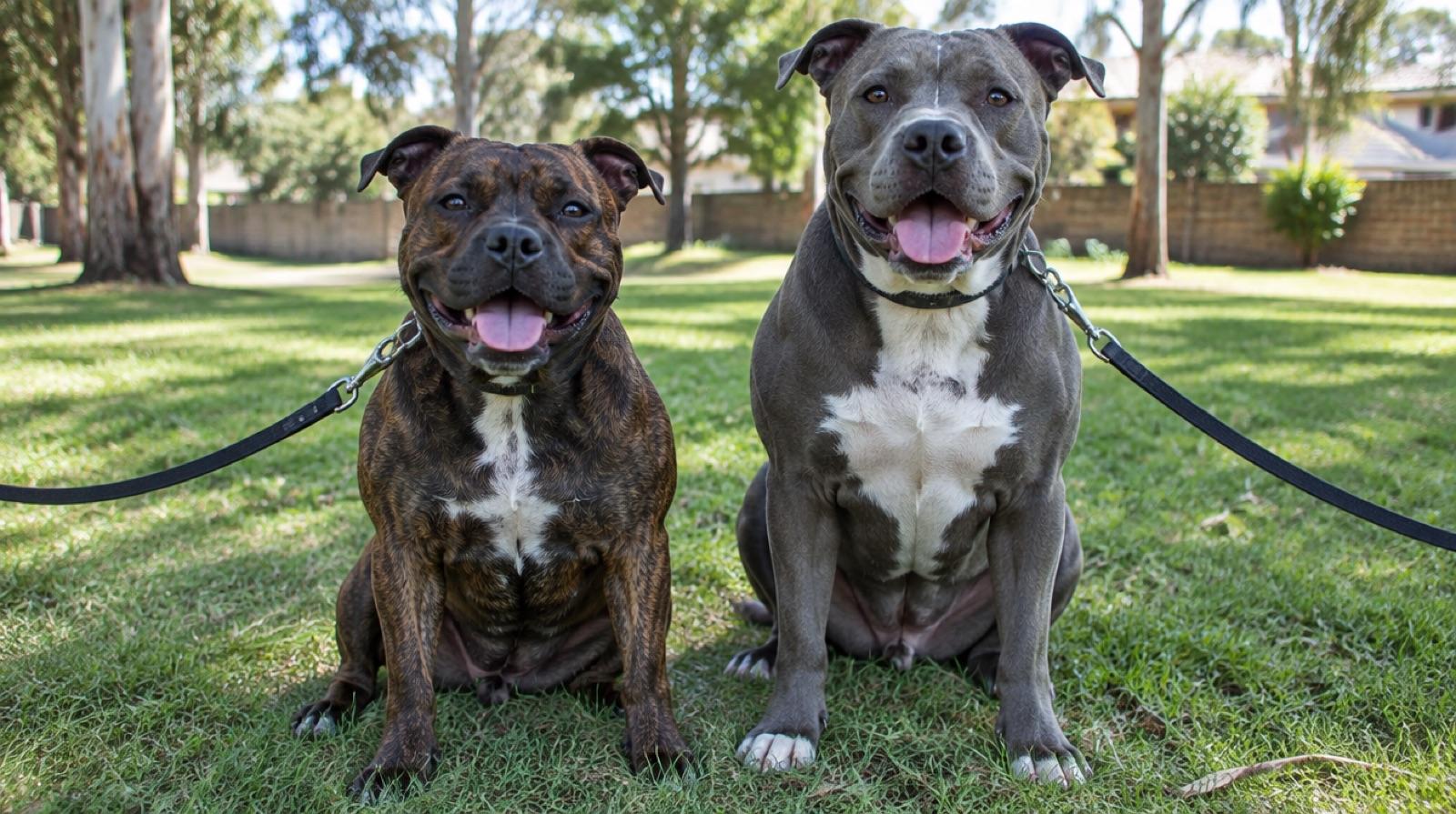
Which dog breeds are banned in Australia?
Five. Schedule 1 of the Customs (Prohibited Imports) Regulations 1956 lists goods whose import is “prohibited absolutely”, and item 26 names “Dogs of the following breeds: (a) dogo Argentino; (b) fila Brasileiro; (c) Japanese tosa; (d) American pit bull terrier or pit bull terrier; (e) Perro de Presa Canario or Presa Canario”. The Department of Agriculture's cats and dogs FAQ repeats that these pure breeds cannot be imported into Australia.
Every state then names the same five in its own law, with different words and different consequences. That is why you will read “banned”, “restricted”, “prohibited” and “prescribed” for the same dogs.
| Breed | What it is | Our guide |
|---|---|---|
| American Pit Bull Terrier (or pit bull terrier) | The breed most people mean by "pit bull". Not the Staffy or the American Staffordshire Terrier. | Staffy vs pit bull |
| Dogo Argentino | A white Argentinian big-game hunting breed. | Dogo Argentino in Australia |
| Perro de Presa Canario (or Presa Canario) | A mastiff-type breed from the Canary Islands. | Presa Canario in Australia |
| Fila Brasileiro | A large Brazilian mastiff-type breed. | Covered on this page |
| Japanese Tosa | A large Japanese mastiff-type breed. | Covered on this page |
What does each state call them?
We read each Act or official page on 11 and 12 November 2026. NSW, Western Australia and Tasmania also tie their lists to the import ban, so a breed added to it would be caught too, and Queensland defines a prohibited dog as any breed banned from import.
| Jurisdiction | Term used | Breeds named | Also covers |
|---|---|---|---|
| Commonwealth | Import "prohibited absolutely" | The five breeds above | None (Customs (Prohibited Imports) Regulations 1956, Sch 1 item 26) |
| NSW | Restricted dog | The five breeds | Any other breed banned from import; any dog a council officer declares restricted; any breed added by regulation (Companion Animals Act 1998 s 55(1)) |
| VIC | Restricted breed dog | The five breeds | Pure or cross bred dogs that fit the approved Standard, assessed by a trained council officer (Agriculture Victoria; Domestic Animals Act 1994) |
| QLD | Prohibited dog (since 28 August 2024) | The five breeds | Defined as any breed banned from import; for this rule a breed does not include a crossbreed (Animal Management (Cats and Dogs) Act 2008 s 103A) |
| WA | Dangerous dog (restricted breed) | The five breeds (pit bull terrier listed separately) | Any other breed banned from import; the Act also covers a mix where one breed is restricted (Dog Regulations 2013 r 4; Dog Act 1976 s 3(1)) |
| SA | Prescribed breed | The five breeds | The Board says SA has no banned breeds; prescribed breeds must not be sold, given away or advertised (Dog and Cat Management Board) |
| TAS | Restricted breed dog | The five breeds | Any other breed banned from import; an authorised person declares a particular dog (Dog Control Act 2000 s 29A) |
| ACT | None | None | "There are no restricted breeds in the ACT." Each dog is assessed on its behaviour (ACT City Services) |
| NT | No territory-wide list | None territory-wide | Councils make their own by-laws; check with yours (City of Darwin by-laws (example)) |
Read 11 and 12 November 2026. South Australia spells two names “Fila Braziliero” and “Dogo Argentinia”. This is a summary of what the official sources say, not legal advice; laws change, so check your state's page and your council.
Queensland is the strictest. Chapter 4A of the Animal Management (Cats and Dogs) Act 2008 commenced on 28 August 2024 and replaced the old restricted dog permits. Section 103B says a person must not own, or be a responsible person for, a prohibited dog unless they have a reasonable excuse, with a maximum penalty of 150 penalty units, and it is a reasonable excuse if the dog is an assistance animal. Supplying one, and giving or taking one for breeding, are separate offences. Older Queensland guides that describe permits and enclosures for new owners are out of date.
Are pit bulls banned in Australia?
The American Pit Bull Terrier is. It is one of the five import-banned breeds, Queensland prohibits it, and NSW, Victoria, Western Australia, South Australia and Tasmania restrict or prescribe it. Western Australia's Dog Regulations list “American pit bull terrier” and “pit bull terrier” as two separate items, so both names are covered.
The confusion comes from the word itself. RSPCA Australia points out that “pit bull” is not a recognised pure breed but “a descriptive label given to dogs that loosely share some physical features.” In everyday speech people use it for almost any muscular, short-coated, broad-headed dog, which is how Staffies and Staffy crosses get caught up in it. The law, though, names a breed, and the two breeds most often mistaken for it are treated differently:
- Staffordshire Bull Terrier: not on any state or territory list.
- American Staffordshire Terrier: Agriculture Victoria says “American Staffordshire Terriers are not restricted breed dogs in Victoria”, and Queensland's Act (s 63A) says an American Staffordshire terrier “is not of the breed American pit bull terrier”.
Our Staffy vs pit bull guide covers how the breeds differ and why looks alone are an unreliable guide to breed.
Which breeds are often thought to be banned but are not?
None of the breeds below is named on any Commonwealth, state or territory list we read. That is not the same as “never restricted”: a council officer can still assess an individual dog, and any dog of any breed can be declared dangerous or menacing after an incident.
| Breed | What the law says | Read more |
|---|---|---|
| Staffordshire Bull Terrier (Staffy) | No state or territory list names it. | Guide and dogs listed now |
| American Staffordshire Terrier | Victoria says it is "not restricted"; Queensland s 63A says it is not an American pit bull terrier. | Guide |
| American Bully (any size, including XL) | No Commonwealth, state or territory list names it; crosses of a listed breed are covered in some states. | Guide and dogs listed now |
| Bull Arab | No state or territory list names it. | Guide and dogs listed now |
| Rottweiler | No state or territory list names it. | Guide and dogs listed now |
| Cane Corso | No state or territory list names it; Dogs Australia recognises the breed. | Guide and dogs listed now |
What about crosses and dogs of unknown breed?
This is where the states differ most, and where most real questions come from, because few rescue dogs have papers.
- Western Australia: the Dog Act 1976 defines a dangerous dog (restricted breed) to include a dog that “is a mix of 2 or more breeds, one being a breed prescribed by the regulations to be a restricted breed”.
- Victoria: Agriculture Victoria says restricted breed dogs are dogs that fit the approved Standard and “may be pure or cross bred”. A trained council authorised officer makes the assessment.
- NSW: a council can declare a dog restricted, and the Office of Local Government describes certificates for a dog assessed as not a restricted breed or a cross of one.
- Queensland: for prohibited dogs, the Act says “a breed does not include a crossbreed”. But an authorised person can seize a dog they reasonably believe is a prohibited dog.
- South Australia and Tasmania: the Board's page and the Tasmanian Act do not mention crosses. In Tasmania an authorised person declares a particular dog having regard to approved guidelines.
The practical rule is the same everywhere: if a dog of uncertain breed interests you, ask your council how it would treat that dog before you take it on, and prefer a rescue or council pound that gives you an adoption record. Our guide to what breed your rescue dog is covers what DNA tests can and cannot tell you.
What does a restriction mean for an existing owner?
Where a dog is already lawfully kept as a restricted or prescribed breed, the conditions are strict and differ by state. This table sets out what each official source lists, as read on 12 November 2026; your council can tell you how it applies to a particular dog.
| State | Keeping the dog | Selling, giving away, breeding |
|---|---|---|
| NSW | Microchipped, registered, desexed; supervised by someone over 18; council-certified enclosure at home; muzzled and securely leashed outside it; prescribed collar; annual permit; "dangerous dog" warning signs | Must not sell, give away, advertise or transfer; must not breed (NSW OLG control requirements) |
| VIC | Desexed (unless a vet certifies otherwise); ISO microchip; prescribed collar at all times; warning signs at all entrances; escape-proof housing with a 1.8 m perimeter fence; muzzled and leashed off the premises with a person 18 or over | Must not be sold, given away or transferred, except surrender to a council pound or shelter or after the owner dies; breeding is a criminal offence (max 6 months jail or 60 penalty units) (Agriculture Victoria) |
| QLD | Owning one without a reasonable excuse is an offence (max 150 penalty units); an assistance animal is a reasonable excuse; transitional rules cover dogs that held a restricted dog permit before 28 August 2024 | Must not supply one, or give or take one for breeding (Queensland Act ss 103B to 103D) |
| WA | Must be sterilised once 3 months old | Must not be advertised, sold, bought or otherwise transferred, with narrow exceptions; must not be bred; fines up to $10,000 under the Act (Dog Act 1976 ss 33GB to 33GD) |
| SA | Effectively confined to the property; muzzled and physically restrained in public; evidence of desexing if a council officer asks | Must not be sold, given away or advertised for sale or give away (Dog and Cat Management Board) |
| TAS | Once declared: desexed and microchipped within 28 days; muzzled in public on a lead of no more than 2 m held by a person over 18; approved collar; warning signs | No sale or transfer without the council general manager’s written approval; surrender to a pound or approved animal welfare organisation is not an offence (Dog Control Act 2000 ss 32 to 34C) |
Penalties and details change; check the source for your state. Figures are reference only, not a quote.
What if your council says your dog is a restricted breed?
Act quickly, because the time limits are short.
- NSW: the Office of Local Government says the council issues a notice of intention and you have 28 days to lodge an objection. It is an offence to sell, advertise, give away or transfer a proposed or declared restricted dog in the meantime.
- Victoria: you can apply to VCAT for a review within 14 days of a declaration, and Agriculture Victoria says the onus is then on the owner to prove the dog is not a restricted breed.
- Tasmania: you may appeal to the Tasmanian Civil and Administrative Tribunal within 28 days of being served the notice, and the Act puts the onus on the person asserting the dog is not a restricted breed (see also the Department of Justice page).
- Western Australia: the Dog Act has a similar onus in s 45(2A).
Read the notice carefully and get legal advice. Victoria, for example, lists a certificate signed by a vet and pedigree certificates from the Australian National Kennel Council system as proof of breed, so keep any papers you have, along with the adoption record.
Why you will not find these breeds on adoption lists
Because rescues cannot rehome them. Selling or giving away a restricted, prohibited or prescribed dog is banned in most states, so rescues and council pounds do not knowingly list one. When we checked the Australian listings we aggregate in November 2026, none was labelled as a Dogo Argentino, Presa Canario, Fila Brasileiro or Japanese Tosa, and none was labelled as a purebred American Pit Bull Terrier.
What you will find, in large numbers, are Staffies, American Staffordshire Terriers, Bull Arabs and their crosses. They are among the dogs most often listed by the rescues we aggregate, and none of those breeds is on a state list. Every listing links to the rescue, where you apply directly.
The same goes for adverts. If someone offers a “pit bull”, Dogo or Presa puppy, either the dog does not exist or the law in most states says it cannot be sold or given away; NSW, Western Australia and South Australia ban the advert itself. Scamwatch says scammers set up fake websites and profiles for pets that do not exist, so never pay a deposit for a dog you have not seen in person or on a video call.
Staffies you can adopt right now
Staffordshire Bull Terriers and crosses listed by rescues, shelters and council pounds, refreshed regularly. Numbers change daily.
What about New Zealand?
New Zealand has its own rules. Schedule 4 of the Dog Control Act 1996 lists the Brazilian Fila, Dogo Argentino, Japanese Tosa and Perro de Presa Canario breeds and the American Pit Bull Terrier type, and section 33C says those dogs must be classified as menacing. A menacing dog must be muzzled in public, the council can require it to be neutered, and the classification stays with the dog. The Staffordshire Bull Terrier is not listed. None of the Australian state rules above apply in New Zealand.
Find a dog you can adopt near you
- Staffordshire Bull Terriers for adoption in Sydney
- Staffordshire Bull Terriers for adoption in Melbourne
- Staffordshire Bull Terriers for adoption in Brisbane
- Staffordshire Bull Terriers for adoption in Perth
- Staffordshire Bull Terriers for adoption in Adelaide
Before you apply, read adopting a dog in Australia, and if you rent, check our renting with pets guide. If you want a large, strong dog, the guard dog guide covers protective breeds that no state list names.
Frequently asked questions
What dog breeds are banned in Australia?▼
Five breeds cannot be imported into Australia: the American Pit Bull Terrier (or pit bull terrier), Dogo Argentino, Perro de Presa Canario (or Presa Canario), Fila Brasileiro and Japanese Tosa. Queensland has made all five prohibited dogs since 28 August 2024, so owning one without a reasonable excuse is an offence there. NSW, Victoria, Western Australia and Tasmania list them as restricted breeds and South Australia as prescribed breeds, with strict owner rules and bans or limits on selling, giving away and breeding. The ACT has no restricted breeds and the Northern Territory has no territory-wide list.
Are pit bulls banned in Australia?▼
The American Pit Bull Terrier is. It is one of the five breeds whose import is prohibited absolutely, Queensland prohibits owning one without a reasonable excuse, and NSW, Victoria, Western Australia, South Australia and Tasmania restrict it, banning or limiting sale, gifts and breeding. The ACT has no restricted breeds and the Northern Territory has no territory-wide list. The word pit bull is also used loosely for muscular, short-coated dogs: the Staffordshire Bull Terrier and the American Staffordshire Terrier are separate breeds that no state list names.
Are pit bulls illegal to own in Australia?▼
In Queensland, yes, unless you have a reasonable excuse such as the dog being an assistance animal; the maximum penalty is 150 penalty units, and transitional rules cover dogs that held a restricted dog permit before 28 August 2024. In NSW, Victoria, Western Australia, South Australia and Tasmania an existing dog can be kept only under strict conditions, such as desexing, a secure enclosure and a muzzle in public. Nowhere can you lawfully import one, and buying a new one is banned or tightly limited in every state.
Are Staffies banned in Australia?▼
No. No state or territory list names the Staffordshire Bull Terrier, and Staffies and Staffy crosses are among the dogs most often listed by the rescues we aggregate. A council officer can still assess an individual dog, and any dog of any breed can be declared dangerous or menacing after an incident.
Is the American Staffordshire Terrier banned in Australia?▼
No. Agriculture Victoria says American Staffordshire Terriers are not restricted breed dogs in Victoria, Queensland's Act says an American Staffordshire terrier is not of the breed American pit bull terrier, and no other state list names it. Keep pedigree papers or a vet certificate if you have them, because councils assess individual dogs.
Is the American Bully banned in Australia?▼
No list names it. We found no Commonwealth, state or territory list that names the American Bully, the XL Bully or any bully size. But Western Australia's Act covers a mix where one breed is restricted, Victoria's Standard covers pure or cross bred dogs, and NSW and Victorian councils, a Tasmanian authorised person and a Queensland authorised person can act on an individual dog. Ask your council before taking one on.
Is a pit bull cross legal in Australia?▼
It depends on the state. Western Australia's Dog Act includes a mix of two or more breeds where one is restricted. Victoria's approved Standard covers pure or cross bred dogs, and a NSW council can declare a cross of a restricted breed. Queensland's Act says that for prohibited dogs a breed does not include a crossbreed, but an authorised person can seize a dog they reasonably believe is prohibited. Ask your council before you take on a dog described as a pit bull cross.
Which states have no restricted dog breeds?▼
The ACT. ACT City Services says there are no restricted breeds in the ACT and that each dog is assessed on its individual behaviour, history and the circumstances of an incident. The Northern Territory has no territory-wide companion animal law, so restrictions come from council by-laws. Neither changes the Commonwealth import ban.
Can I buy a pit bull, Dogo or Presa puppy in Australia?▼
Treat any offer as unlawful or a scam. The five breeds cannot be imported, Queensland bans supplying them, NSW, Victoria, Western Australia and South Australia ban selling or giving them away, and Tasmania requires the council general manager's written approval for any transfer. NSW, Western Australia and South Australia also ban advertising one. Do not pay a deposit; Scamwatch warns that scammers advertise pets that do not exist.
What happens if my council says my dog is a restricted breed?▼
You can usually challenge it, and the time limits are short. In NSW the council issues a notice of intention and you have 28 days to object. In Victoria you can ask VCAT to review a declaration within 14 days. In Tasmania you can appeal to the Tasmanian Civil and Administrative Tribunal within 28 days. In Victoria, Tasmania and Western Australia the onus is on the owner to show the dog is not a restricted breed. Read the notice carefully and get legal advice.
Are Rottweilers or Cane Corsos banned in Australia?▼
No. No state or territory list names the Rottweiler or the Cane Corso. Like any dog, an individual Rottweiler or Cane Corso can be declared dangerous or menacing after an incident.
Which dog breeds are restricted in New Zealand?▼
New Zealand has its own law. Schedule 4 of the Dog Control Act 1996 lists the Brazilian Fila, Dogo Argentino, Japanese Tosa and Perro de Presa Canario breeds and the American Pit Bull Terrier type, and those dogs must be classified as menacing. A menacing dog must be muzzled in public and the council can require it to be neutered. The Staffordshire Bull Terrier is not listed.
Sources
- Customs (Prohibited Imports) Regulations 1956, Schedule 1 item 26
- Department of Agriculture, Fisheries and Forestry: Cats and dogs frequently asked questions
- NSW Legislation: Companion Animals Act 1998, s 55
- NSW Office of Local Government: Restricted dogs
- NSW Office of Local Government: Control requirements for restricted dogs
- Agriculture Victoria: Owning a restricted breed dog
- Agriculture Victoria: About restricted breed dogs
- Queensland Animal Management (Cats and Dogs) Act 2008 (current)
- Queensland Government: Regulated dogs
- WA Dog Act 1976
- WA Dog Regulations 2013
- Dog and Cat Management Board (SA): Prescribed breeds
- Tasmanian Legislation: Dog Control Act 2000 (current)
- Tasmanian Department of Justice: Dangerous and restricted breed dogs
- ACT City Services: Dog attacks and dangerous dogs
- City of Darwin: Animal by-laws and infringement offences
- RSPCA Knowledgebase: What is the RSPCA’s view on breed specific legislation?
- New Zealand Legislation: Dog Control Act 1996, Schedule 4
- Scamwatch: Buying and selling scams
Keep reading
Staffy vs pit bull
How to tell them apart, why looks mislead, and what the law means for a Staffy cross.
Dogo Argentino in Australia
The import ban and every state rule for the Dogo, quoted law by law, plus lawful large breeds.
Presa Canario in Australia
The mastiff-type breed on the import ban and every state list, with lawful mastiff alternatives.
American Bully puppies: adopt or buy?
Why no list names the American Bully, what crosses mean, and what to ask before you buy.