The short answer
An Australian Terrier suits an active home with secure fencing and no pet rabbits or guinea pigs. If you buy, use a Dogs Australia registered breeder, ask about kneecaps and whether diabetes has occurred in the puppy's relatives (an Australian study found the breed had the highest odds of diabetes of the breeds it reported). Few breeders publish a price: of the member breeders whose own websites we read in November 2026, one member breeder published $2,200 for a pet puppy (November 2026), and one breeder is not a range. If you adopt, Aussies and Aussie crosses reach general rescues, usually as adults. All figures are reference only, not quotes; check with the breeder or rescue.
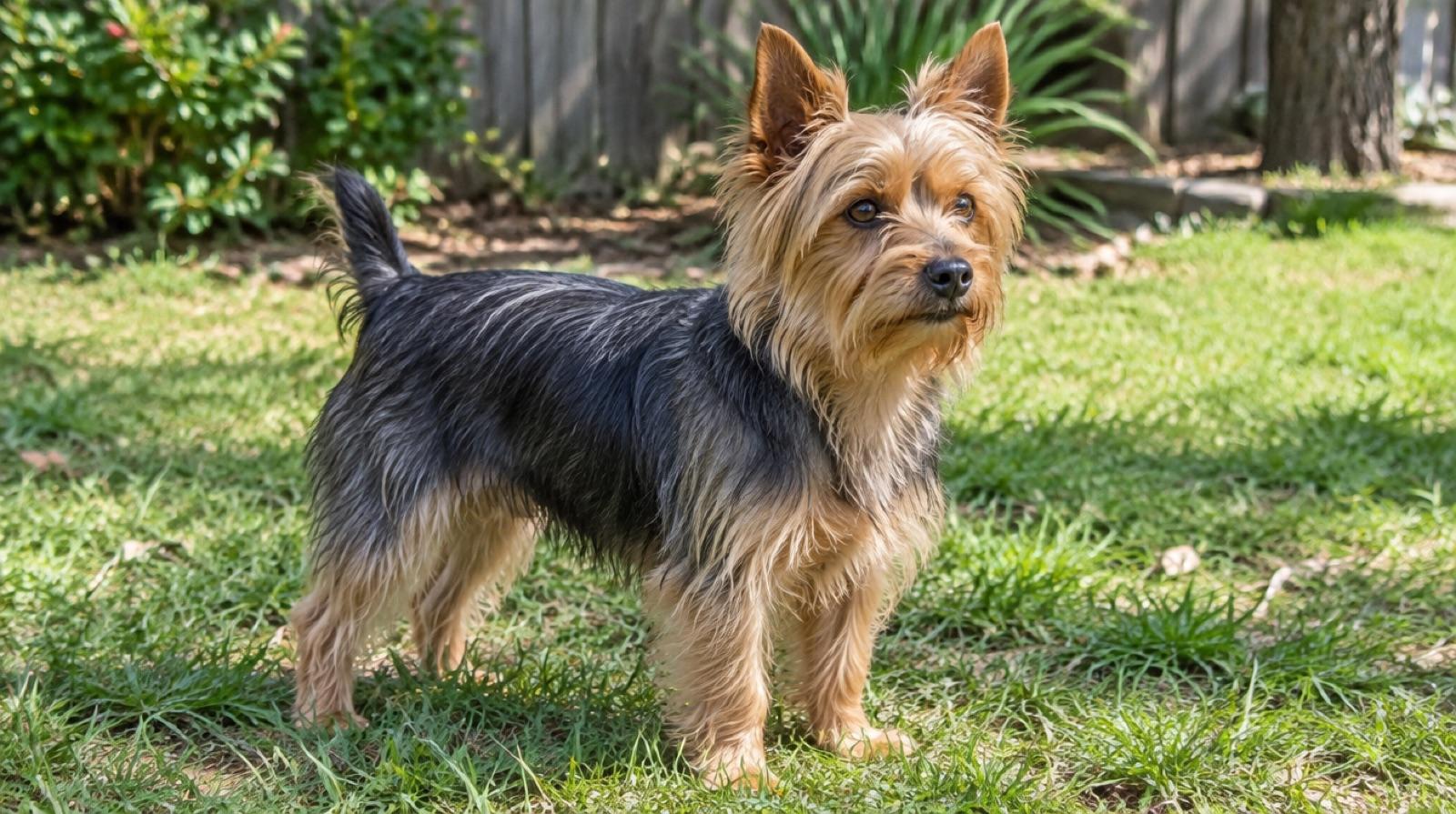
Should you adopt or buy an Australian Terrier?
Start with the dog, not the route. The Dogs Australia breed standard describes “a sturdy low-set dog, rather long in proportion to height with strong Terrier character, alertness, activity and soundness”, and its temperament as “essentially a working terrier, but its loyalty and even disposition make it equally suitable as a companion dog.” Dogs Victoria adds that Aussies need secure fencing and should be walked on a lead in case they find something worth a chase.
Either route can work. A registered breeder who knows the family's health history gives you the best odds with a puppy. A rescue gives you an adult whose character with people and other animals is already known. The route to avoid is a cheap online ad with no information about the parents.
| Route | Reference cost | What you usually get | Main risk |
|---|---|---|---|
| Dogs Australia registered breeder | Few publish a price; one member breeder listed $2,200 for a pet puppy | A puppy with pedigree papers, usually on the Limited Register for pet homes | Waiting lists; few litters each year |
| General rescue or council pound | The standard fee, for example the RSPCA rows below | Adult Aussies and Aussie crosses, desexed and microchipped | Listings come and go; you may wait |
| Online ad or unregistered seller | Any price; a very cheap price is a scam warning | Unknown parents, or a puppy that does not exist | No health history, and scams |
Reference only, not quotes. The breeder figure was read on the breeder's own website and the rescue fees on the RSPCA pages named below, all on 11 November 2026; prices and fees change, so check with them.
Where does the Australian Terrier come from?
From Australia, out of British stock. Dogs Australia's breed page describes small terriers that came out on the First Fleet and later ships to kill vermin, and says the mixed terriers evolved into a breed suited to this country: small, rough-coated, with a large ruff and apron, killing vermin and snakes and keeping watch on isolated homes and goldfields claims. It says the first standard for the Australian Terrier was written in 1887 in Victoria, with the colour already set as blue and tan. No one can say exactly which terriers went into the mix, because breeders kept their records to themselves.
Today's standard (last updated 18 October 2012) places the breed in Group 2 (Terriers) and asks for:
| Trait | What the Dogs Australia standard says |
|---|---|
| Height | Dogs approximately 25 cm at the withers; bitches slightly less |
| Weight | Dogs approximately 6.5 kg; bitches slightly less |
| Coat | Harsh, straight, dense top coat approximately 6 cm long with a short, soft undercoat; a definite ruff around the neck |
| Colour | Blue, steel blue or dark grey blue with rich tan; or clear sandy or red. White markings on chest or feet must be penalised |
| Temperament | “Essentially a working terrier” with loyalty and an even disposition |
Dogs Victoria gives an average life span of 11 to 16 years and describes the Aussie as alert, intelligent, inquisitive and loving, not a constant barker but one that barks at something amiss.
What health questions should you ask a breeder?
Three things matter most: kneecaps, diabetes in the family, and any DNA results for the parents. Dogs Australia calls the Aussie a very basic little dog that is relatively free of hereditary faults, says that as in all small breeds there is sometimes a degree of patella displacement (a slipping kneecap), and says hip problems such as Legg-Perthes disease are now almost non-existent because breeders have worked since the 1970s to eliminate them.
Diabetes: what the Australian research found
A VetCompass Australia study published in Veterinary Record in 2020 used the records of 134,329 dogs seen at 152 first-opinion clinics in 2017. Compared with a reference group of rarer breeds and unidentified crossbreeds, Australian Terriers and their crosses had the highest odds of diabetes of the breeds it reported (odds ratio 7.93, 95% confidence interval 2.83 to 22.27). The study found diabetes in 0.36% of the dogs overall.
A 2020 study in PLoS ONE of 483 related Australian Terriers bred in the United States estimated the heritability of diabetes at 0.18 and found the inheritance was polygenic, with no evidence of a single gene of large effect. In plain terms: genes play a part, but there is no one DNA test that rules diabetes out. So ask the breeder whether any of the puppy's close relatives developed diabetes, and talk to your vet if your Aussie starts drinking or urinating more than usual.
DNA tests
The Australian Terrier Club of South Australia publishes a list of Australian Terriers reported clear of von Willebrand's disease (a bleeding disorder) and degenerative myelopathy (a progressive spinal cord disease). Ask the breeder which DNA tests the parents have had and to see the reports by registered name.
| Check | Why ask | What to ask for |
|---|---|---|
| Kneecaps (patellar luxation) | Dogs Australia says it sometimes occurs, as in all small breeds | A vet's patella check on both parents |
| Diabetes in the family | Highest odds of the breeds in the Australian VetCompass study | An honest answer about parents, grandparents and littermates |
| Von Willebrand's disease and degenerative myelopathy (DNA) | On the Australian Terrier Club of SA testing list | Both parents' DNA reports |
Sources as linked, read 11 November 2026. A test being on a club list shows what can be tested, not how common a condition is. This is a buying checklist, not veterinary advice. Our Australian Terrier health guide covers living with these conditions.
How much is an Australian Terrier puppy from a registered breeder?
Few breeders publish one. In November 2026 we read the own websites of Australian Terrier breeders that show Dogs Australia membership through a state body, leaving out listing and marketplace sites. One Dogs Queensland member breeder published $2,200 for a pet puppy (November 2026), on a page updated in July 2026. The others published no price. One breeder is not a range, so treat it as a single example and ask several breeders. We found no Australian Terrier club that publishes a guide price.
| Who published it | Reference figure | Read |
|---|---|---|
| One Dogs Queensland member breeder, own website, pet puppy | $2,200 (one breeder, not a range) | 11 Nov 2026 |
Reference only, not a quote. Breeders set their own prices and change them, so check with the breeder and ask what is included.
Registered Aussie puppies are not plentiful. Dogs Australia's registration figures show 229 Australian Terriers registered in 2025, against 332 in 2018. These are registrations, not litters, but they suggest registered puppies are not easy to find. Clubs can point you to breeders: the Australian Terrier Club of Queensland, for example, publishes a breeders directory. Budget for what comes after the price, too: the dog cost calculator gives a first-year figure, and our guides to cheaper vet care and desexing costs help with the rest.
See the Australian Terriers listed right now
Australian Terriers and Aussie crosses from the rescues, shelters and council pounds we aggregate, each with its rescue, desexing and microchip details. Every listing links to the rescue, where you apply directly.
What do Australian Terriers in rescue look like?
Mostly adults, plus Aussie crosses. They come into rescue for the same reasons as other dogs, such as a move or an owner who can no longer manage, and sometimes because a busy terrier's digging, barking or escaping was more than the household expected. With a cross, coat and temperament vary, so the foster carer's or shelter's notes on the individual dog matter more than the breed label.
That is the advantage of adopting: you can ask how the dog goes with children, cats and other dogs, whether it digs or escapes, and what its vet notes say, before you sign anything. Our Australian Terrier adoption guide for Sydney covers the local side.
What does a rescue Australian Terrier cost?
| Rescue | Fee as published | Read |
|---|---|---|
| RSPCA NSW | $620 puppy under 12 months; $500 dog over 12 months | 11 Nov 2026 |
| RSPCA ACT | $395 for dogs over 6 months and under 8 years; $650 for popular breeds and mixes with high adoption demand aged over 12 months and under 8 years; $1,200 for popular small breed puppies with high adoption demand up to 12 months (the page does not say which breeds count as popular) | 11 Nov 2026 |
| RSPCA Victoria | $500 to $1,000 for adult dogs | 11 Nov 2026 |
Reference only, not a quote. These are the fees each rescue published on the date shown; fees change and some dogs are priced individually, so check with the rescue. Read our guide to adopting a dog in Australia.
If no Australian Terrier is listed near you, browse small dogs as well: Sydney, Melbourne, Brisbane, Perth, Adelaide.
How do Australian Terrier puppy scams work?
Never send money for an Australian Terrier puppy you have not seen with its mother, in person or at least on a live video call.
Scamwatch warns that scammers set up fake websites, social media profiles and marketplace listings for pets that do not exist, and that a very cheap pet is likely a scam. Dogs Victoria's puppy scam fact sheet adds that fake ads may display microchip, source or membership numbers lifted from legitimate breeders. What to watch for with an Aussie:
- Borrowed numbers. A real breeder's membership or source number in an ad proves nothing on its own. Contact the breeder through Dogs Australia or the state body, not the ad.
- Colours outside the standard. The standard allows blue and tan shades, or clear sandy or red. Anything sold as a rare colour is not what the standard describes.
- “Registered” with no named body. Ask which body issued the papers; papers from a registry outside Dogs Australia are not Dogs Australia pedigree papers.
- No answers about health. A seller who cannot tell you about kneecaps or diabetes in the family is not giving you the information you need.
Our guide to puppies for sale in Australia has the state-by-state table of breeder numbers, how to check each one, and what to do if you have already paid.
When is a registered breeder the better choice?
Rescue is not right for everyone. A registered breeder is a reasonable choice if you want a puppy and are prepared to wait, if you want to show or do dog sports from puppyhood, or if you have watched the rescue listings for months and no adult has suited your home. Check these before you pay:
- Registration. Ask for the breeder's prefix and membership number and check them with Dogs Australia or the state body. It confirms membership, not puppy quality.
- Kneecaps checked by a vet in both parents.
- Diabetes in the puppy's close relatives, asked about directly.
- DNA reports for the parents, by registered name.
- The mother and where the puppies are raised, before any deposit.
- A written contract covering health problems, register type, desexing and whether the breeder will take the dog back.
Is an Australian Terrier the right dog for you?
The appeal is real: Dogs Victoria calls the Aussie an even-tempered, versatile dog that delights in human company and is equally at home on a farm or in a suburban backyard. Be honest about three things before you apply. Terrier drive: it will chase, and Dogs Victoria says Aussies find rabbits, guinea pigs and chooks very tempting. Fencing: you need a secure yard and a lead on walks. Coat: a brush or comb a couple of times a week, with the feet trimmed and nails cut.
Not sure it fits? Try the what dog breed am I quiz and the adoption readiness check, and read our guide to family dogs in Australia.
Find an Australian Terrier near you
Australian Terriers and Aussie crosses listed by rescues, by city:
- Australian Terriers for adoption in Sydney
- Australian Terriers for adoption in Melbourne
- Australian Terriers for adoption in Brisbane
- Australian Terriers for adoption in Perth
- Australian Terriers for adoption in Adelaide
Local guides to adopting an Australian Terrier, with the rescues that serve each city: Sydney, Melbourne, Brisbane, Perth, Adelaide, Gold Coast.
More adopt-or-buy guides: Australian Silky Terrier, Tenterfield Terrier, Cairn Terrier, Border Terrier, Yorkshire Terrier, Koolie.
Frequently asked questions
Should I adopt or buy an Australian Terrier puppy?▼
Either can work. Buy from a Dogs Australia registered breeder if you want a puppy and are happy to wait, and ask about kneecaps and any diabetes in the puppy's relatives. Adopt if you would like an adult whose energy and manners with children, cats and other dogs are already known. Australian Terriers and their crosses reach general rescues and council pounds from time to time.
How much is an Australian Terrier puppy in Australia?▼
Few breeders publish a price. Of the member breeders whose own websites we read in November 2026, one Dogs Queensland member breeder published $2,200 for a pet puppy (November 2026). One breeder is not a range, so ask several registered breeders and compare what is included. This is a reference figure, not a quote; prices change, so check with the breeder.
Is the Australian Terrier an Australian breed?▼
Yes. Dogs Australia says the breed developed here from small British terriers brought by early settlers, that the first standard was written in Victoria in 1887, and that the colour was set as blue and tan even then. The current Dogs Australia standard places it in Group 2 (Terriers).
Are Australian Terriers prone to diabetes?▼
Australian research points that way. A VetCompass Australia study of 134,329 dogs at 152 first-opinion clinics in 2017 found Australian Terriers and their crosses had the highest odds of diabetes of the breeds the study reported (odds ratio 7.93) compared with a reference group of rarer breeds and unidentified crossbreeds. A 2020 study of a related US population found the inheritance is polygenic, with no single gene of large effect. Ask the breeder about diabetes in the family and see a vet if your dog drinks or urinates more than usual.
What health tests should an Australian Terrier breeder do?▼
Ask about kneecaps (patellar luxation), which Dogs Australia says sometimes occurs in the breed, and ask for any DNA results the breeder holds for the parents. The Australian Terrier Club of South Australia publishes a list of dogs reported clear of von Willebrand's disease, a bleeding disorder, and degenerative myelopathy, a spinal cord disease. Ask whether diabetes has occurred in the puppy's close relatives.
How big does an Australian Terrier get?▼
Small and sturdy. The Dogs Australia standard gives dogs approximately 25 cm at the withers and approximately 6.5 kg, with bitches slightly less. Dogs Victoria gives an average life span of 11 to 16 years.
What colours do Australian Terriers come in?▼
Two colour groups, according to the standard: blue, steel blue or dark grey blue with rich tan, and clear sandy or red. White markings on the chest or feet must be penalised. A seller offering other colours as rare is not offering something the standard describes.
Are Australian Terriers good with children and other pets?▼
Often, with supervision. Dogs Victoria says Aussies are great with families and usually good with other dogs and cats, but that as terriers they are not so good with small animals such as rabbits, guinea pigs and chooks. Supervise children with any dog, and ask a rescue how an individual dog has gone with your kind of household.
Do Australian Terriers need much grooming?▼
Not a lot, but some. The standard describes a harsh, straight, dense top coat about 6 cm long over a short, soft undercoat, with a ruff around the neck. Dogs Victoria says the coat needs a brush or comb a couple of times a week, the hair around and under the feet trimmed, and the nails cut.
Can I adopt an Australian Terrier?▼
Yes, sometimes. Australian Terriers and Australian Terrier crosses come through general rescues and council pounds, usually as adults. Watch the Australian Terrier listings, set an alert, and apply quickly when one suits. A rescue can tell you how the dog goes with children, cats and other dogs.
How do I avoid Australian Terrier puppy scams?▼
Only pay for a puppy you have seen with its mother, in person or at least on a live video call. Scamwatch says scammers use fake websites, social media profiles and marketplace listings for pets that do not exist, and that a very cheap pet is likely a scam. Dogs Victoria warns that fake ads can show microchip, source or membership numbers lifted from real breeders, so check any number yourself.
Sources
- Dogs Australia: Australian Terrier breed standard (last updated 18 Oct 2012)
- Dogs Australia: Australian Terrier breed information
- Dogs Australia: National Animal Registration Analysis 2018 to 2025
- Dogs Victoria: Australian Terrier breed information
- Yoon et al. (2020), Veterinary Record: Diabetes mellitus in dogs attending primary care clinics in Australia (VetCompass Australia)
- Mui et al. (2020), PLoS ONE: Heritability of diabetes in Australian Terriers
- Australian Terrier Club of South Australia: Genetic testing
- Australian Terrier Club of Queensland: Breeders directory
- Scamwatch: Buying and selling scams
- Dogs Victoria: A7 Identifying puppy scams and puppy farms (fact sheet, Sept 2022)
- RSPCA NSW: Adoption fees
- RSPCA ACT: Adoption process
- RSPCA Victoria: The adoption process
Keep reading
Australian Terriers listed by rescues
Australian Terriers and Aussie crosses listed right now by the rescues and pounds we aggregate across Australia.
Australian Terrier health issues
Diabetes, kneecaps, hips and allergies: the checks to plan for.
Australian Terrier coat care
The harsh weatherproof coat, hand stripping versus clipping, and the rugged look.
Silky Terrier puppies: adopt or buy?
The Aussie's silky-coated relative from the Toy group, and its own breeder and scam questions.