The short answer
A Tenterfield Terrier suits an active home that wants a small, smart, low-grooming terrier and can fence it in. If you buy, use a Dogs Australia registered breeder and ask for both parents' DNA results for congenital hypothyroidism with goitre (CHG) and primary lens luxation (PLL), the two conditions Dogs Australia links to the breed. Few breeders publish a price: of the member breeders whose own websites we read in November 2026, one member breeder published $2,000 for a puppy (November 2026), and one breeder is not a range. If you adopt, Tenterfields and small terrier crosses reach general rescues, usually as adults. All figures are reference only, not quotes; check with the breeder or rescue.
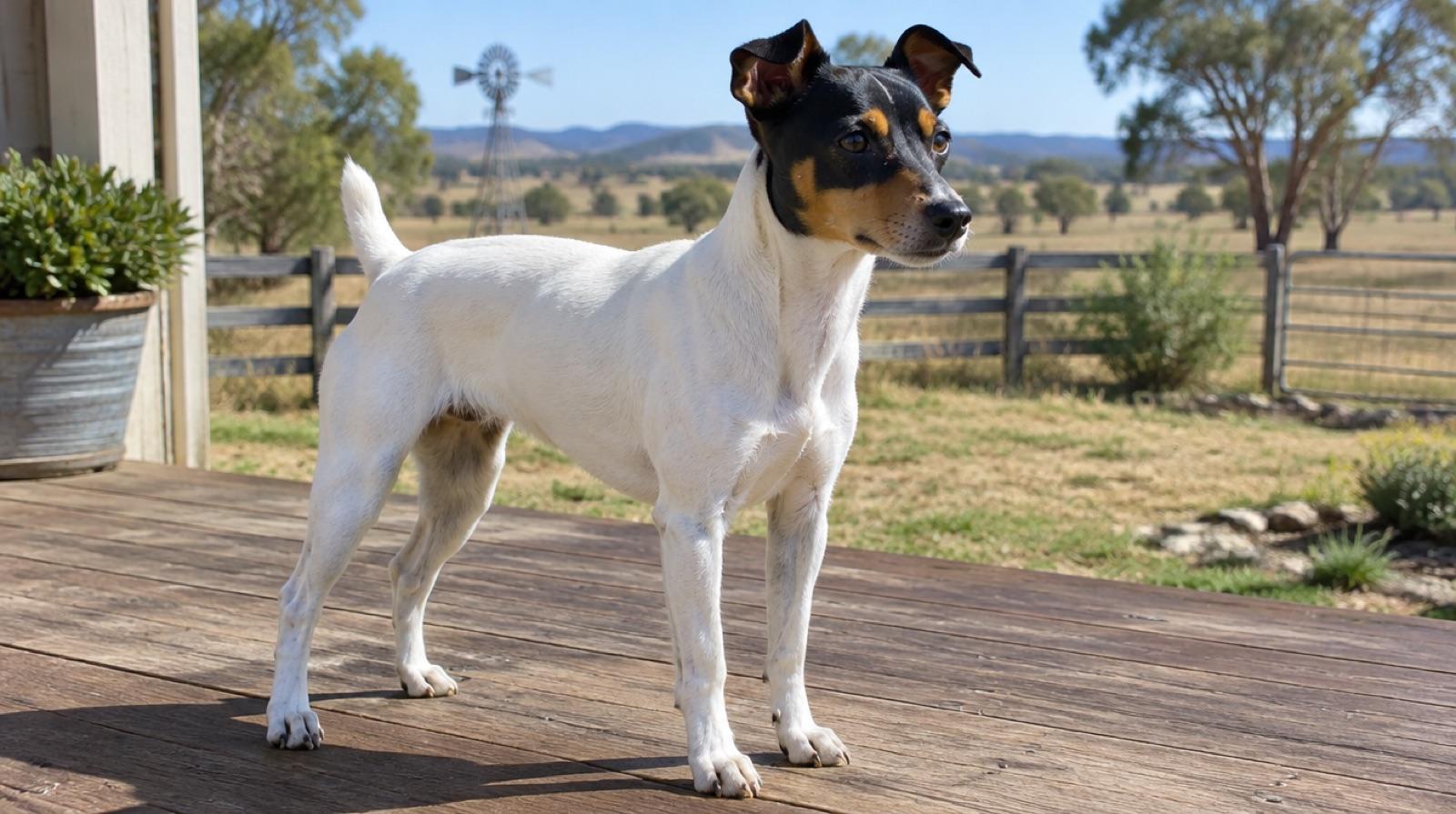
Should you adopt or buy a Tenterfield Terrier?
Start with the dog, not the route. The Dogs Australia breed standard describes “a strong, active, agile working terrier of great versatility and of pleasing proportion”, with a temperament that is “confident, with an eagerness to learn, showing great loyalty to its owner and although fearless and bold at work, he is an ideal companion dog in the home.” Dogs Australia's breed page adds that some people misread a Tenterfield's vocal enthusiasm as aggression, and that true to terrier form they will defend themselves if they feel threatened.
Either route can work. A registered breeder who DNA tests the parents gives you the best odds with a puppy. A rescue gives you an adult whose character with people and other animals is already known. The route to avoid is a cheap “mini foxie” ad with no papers and no test results.
| Route | Reference cost | What you usually get | Main risk |
|---|---|---|---|
| Dogs Australia registered breeder | Few publish a price; one member breeder listed $2,000 | A puppy with pedigree papers, ideally from CHG and PLL tested parents | Waiting lists |
| General rescue or council pound | The standard fee, for example the RSPCA rows below | Adult Tenterfields and small terrier crosses, desexed and microchipped | Breed label is a best guess |
| Online ad or unregistered seller | Any price; a very cheap price is a scam warning | A “mini foxie” of unknown breeding, or a puppy that does not exist | No DNA testing, and scams |
Reference only, not quotes. The breeder figure was read on the breeder's own website and the rescue fees on the RSPCA pages named below, all on 11 November 2026; prices and fees change, so check with them.
When was the Tenterfield Terrier recognised?
In 2002. The Dogs Australia breed listing (August 2026) places the Tenterfield Terrier in Group 2 (Terriers), and the standard gives Australia as the country of origin. The Dogs Australia pages we read do not give a recognition date, so here is what the breed's own clubs say:
| Source | What it says |
|---|---|
| National Tenterfield Terrier Council | “They were accepted as an Australian Breed in 2002” |
| Tenterfield Terrier Club of Queensland | The breed “gained official recognition on the 1st January 2002” |
| Tenterfield Terrier Club of WA: history of the breed | On 1 January 2002 the breed received recognition as a new breed by the ANKC and was placed on the development register; owners have shown the breed since 1 June 2002 |
| Tenterfield Terrier Club of WA: history of the club | The ANKC decided at its October 2001 meeting to grant full recognition; Tenterfields could enter official events from June 2002 |
The ANKC is the Australian National Kennel Council, the body now called Dogs Australia. Before recognition the dogs were known as mini foxies. Dogs Australia says that name was inappropriate because the breed is not a miniature of the Fox Terrier, and that the breed was named after Peter Allen's grandfather, the “Tenterfield Saddler”, who was well known for owning and breeding these terriers. The WA club says about 85% of returned votes in a ballot of club members chose the name Tenterfield Terrier, and that the Tenterfield Terrier Club of Australia was established in January 1993.
One practical point for buyers: a Miniature Fox Terrier is not on the Dogs Australia breed listing, so a puppy sold as a “mini foxie” or “Tenterfield type” without Dogs Australia papers is not a registered Tenterfield Terrier.
What should a Tenterfield look like?
The standard (last updated 17 April 2019) asks for:
| Trait | What the Dogs Australia standard says |
|---|---|
| Height | 25.5 to 30.5 cm, ideal 28 cm, not exceeding 30.5 cm |
| Weight | In proportion to the size of the dog (no figure given) |
| Coat | Short and smooth; a single-coated dog |
| Colour | Predominantly white with black, tan, blue or liver markings; tricolour common; brindle markings acceptable but not preferred; full colour coats not acceptable |
| Tail | Traditionally docked; undocked tails can be of varying lengths and bob tails often occur |
The National Tenterfield Terrier Council notes that pups in one litter can be born with tails of varying lengths. Dogs Australia calls the Tenterfield the only terrier with the natural bob tail gene and describes the coat as “wash and wear” with an occasional brush. It gives a life span of 12 to 20 years; Dogs Victoria gives an average of 10 to 15 years.
Which DNA tests should a Tenterfield breeder show you?
Two, for both parents: CHG and PLL. Dogs Australia says the breed is known for a long life with no major health issues, but that “congenital hypothyroidism with goitre has been associated with the breed and more recently primary lens luxation”, and that the national Tenterfield community is testing to prevent affected puppies being produced.
| Test | What it is | What to ask for |
|---|---|---|
| CHG (congenital hypothyroidism with goitre) | An inherited condition in which young puppies cannot make enough thyroid hormone | Both parents' DNA results; the Queensland club says a carrier mated to a clear dog will never produce an affected puppy |
| PLL (primary lens luxation) | An inherited eye condition in which the lens slips out of place, usually at 3 to 5 years | Both parents' DNA results; carriers and affected dogs bred only to clear dogs |
| Bite | The standard asks for full dentition and a complete scissor bite, and says a wry mouth should be heavily penalised | A vet check of the puppy |
CHG
A 2012 study in the Journal of Veterinary Internal Medicine, led by researchers at Michigan State University, investigated a cluster of cases in Tenterfield puppies. It found a recessive mutation in the thyroid peroxidase gene, an enzyme needed to make thyroid hormone, and made a carrier test available for breeders. Because it is recessive, a puppy is only affected if both parents carry the gene. The Tenterfield Terrier Club of Queensland explains that a carrier will never develop the condition, and that a clear to clear mating can never produce a carrier.
PLL
The Queensland club's PLL page says the club was approached in 2006 by University of Queensland researchers to provide dogs for research to locate the gene responsible in the breed, that a faulty gene was found, that a cheek swab test can identify the gene in puppies as young as four weeks (if weaned), and that the risk of a carrier developing PLL is between 2% and 20%. It strongly recommends that all breeders DNA test their dogs before breeding, and says affected dogs and carriers can be bred only with clear dogs. Any change in your dog's eyes is a reason to see a vet promptly.
Sources as linked, read 11 November 2026. This is a buying checklist, not veterinary advice. Our Tenterfield Terrier health guide covers knees, heart and teeth.
How much is a Tenterfield Terrier puppy from a registered breeder?
Few breeders publish one. In November 2026 we read the own websites of Tenterfield breeders that show Dogs Australia membership through a state body, leaving out listing and marketplace sites. One Dogs NSW member breeder published $2,000 for a puppy, with transport extra (November 2026), on a page dated August 2026. The others published no price, or had not updated their sites in years. One breeder is not a range, so treat it as a single example and ask several breeders. We found no Tenterfield club that publishes a guide price.
| Who published it | Reference figure | Read |
|---|---|---|
| One Dogs NSW member breeder, own website | $2,000 plus any transport (one breeder, not a range) | 11 Nov 2026 |
Reference only, not a quote. Breeders set their own prices and change them, so check with the breeder and ask what is included.
Dogs Australia's registration figures show 336 Tenterfield Terriers registered in 2025, against 511 in 2018. These are registrations, not litters. When you ask a breeder for a price, ask what it includes: the parents' CHG and PLL results, vaccinations and microchip, the register type and desexing agreement, and whether the breeder will take the dog back. The dog cost calculator gives a first-year figure after the price tag.
See the Tenterfield Terriers listed right now
Tenterfields and Tenterfield crosses from the rescues, shelters and council pounds we aggregate, each with its rescue, desexing and microchip details. Every listing links to the rescue, where you apply directly.
What do Tenterfield Terriers in rescue look like?
Mostly adults, plus small smooth-coated terrier crosses. Small white terriers with black or tan markings are easy to mislabel as Tenterfield, Jack Russell or Fox Terrier, so a rescue's breed label is a best guess; read its notes on the individual dog. They come into rescue for the same reasons as other dogs, and sometimes because the barking, digging or escaping was more than the household expected.
Adopting lets you ask how the dog goes with children, cats and other dogs, whether it digs or escapes, and what its vet notes say, before you sign anything. Our Tenterfield Terrier adoption guide for Sydney covers the local side.
What does a rescue Tenterfield cost?
| Rescue | Fee as published | Read |
|---|---|---|
| RSPCA NSW | $620 puppy under 12 months; $500 dog over 12 months | 11 Nov 2026 |
| RSPCA ACT | $395 for dogs over 6 months and under 8 years; $650 for popular breeds and mixes with high adoption demand aged over 12 months and under 8 years; $1,200 for popular small breed puppies with high adoption demand up to 12 months (the page does not say which breeds count as popular) | 11 Nov 2026 |
| RSPCA Victoria | $500 to $1,000 for adult dogs | 11 Nov 2026 |
Reference only, not a quote. These are the fees each rescue published on the date shown; fees change and some dogs are priced individually, so check with the rescue. Read our guide to adopting a dog in Australia.
If no Tenterfield is listed near you, browse small dogs as well: Sydney, Melbourne, Brisbane, Perth, Adelaide.
How do Tenterfield Terrier puppy scams work?
Never send money for a Tenterfield puppy you have not seen with its mother, in person or at least on a live video call.
Scamwatch warns that scammers set up fake websites, social media profiles and marketplace listings for pets that do not exist, and that a very cheap pet is likely a scam. Dogs Victoria's puppy scam fact sheet adds that fake ads may display microchip, source or membership numbers lifted from legitimate breeders. What to watch for with a Tenterfield:
- “Mini foxie” or “Tenterfield type” with no papers. Only a puppy with Dogs Australia papers is a registered Tenterfield Terrier.
- Colours outside the standard. The standard asks for a predominantly white dog with markings and says full colour coats are not acceptable. A puppy sold as a rare colour is not what the standard describes.
- No CHG or PLL results. A seller who has not tested the parents is not doing what the clubs recommend.
- Borrowed numbers. A real breeder's membership or source number in an ad proves nothing on its own. Contact the breeder through Dogs Australia or the state body, not the ad.
Our guide to puppies for sale in Australia has the state-by-state table of breeder numbers, how to check each one, and what to do if you have already paid.
When is a registered breeder the better choice?
Rescue is not right for everyone. A registered breeder is a reasonable choice if you want a puppy from tested parents, if you want to show or do dog sports such as agility, flyball or earthdog from puppyhood, or if you have watched the rescue listings for months and no adult has suited your home. Check these before you pay:
- Registration. Ask for the breeder's prefix and membership number and check them with Dogs Australia or the state body. It confirms membership, not puppy quality.
- CHG and PLL results for both parents, by registered name.
- A vet check of the puppy, including its bite.
- The mother and where the puppies are raised, before any deposit.
- A written contract covering health problems, register type, desexing and whether the breeder will take the dog back.
Is a Tenterfield Terrier the right dog for you?
The appeal is real: Dogs Australia describes a dog that is active, extremely agile, very intelligent and adaptable, as happy working on farmland as curled up on a lap in a small apartment, and says Tenterfields are very compatible with other pets if introduced as a puppy. Dogs Victoria adds that, like all terriers, they need a firm hand and must be taught what is expected of them. Be honest about three things before you apply. Energy: Dogs Australia says they can walk many miles with an active owner. Voice: an alert watchdog that will tell you about visitors. Prey drive: a ratting terrier will chase, so you need secure fencing.
Not sure it fits? Try the what dog breed am I quiz and the adoption readiness check. Our Tenterfield temperament and family life guide covers day-to-day living with one.
Find a Tenterfield Terrier near you
Tenterfield Terriers and Tenterfield crosses listed by rescues, by city:
- Tenterfield Terriers for adoption in Sydney
- Tenterfield Terriers for adoption in Melbourne
- Tenterfield Terriers for adoption in Brisbane
- Tenterfield Terriers for adoption in Perth
- Tenterfield Terriers for adoption in Adelaide
Local guides to adopting a Tenterfield, with the rescues that serve each city: Sydney, Melbourne, Brisbane, Perth, Adelaide, Gold Coast.
More adopt-or-buy guides: Jack Russell Terrier, Fox Terrier, Australian Terrier, Australian Silky Terrier, Border Terrier, Koolie.
Frequently asked questions
Should I adopt or buy a Tenterfield Terrier puppy?▼
Either can work. Buy from a Dogs Australia registered breeder if you want a puppy, and ask for the parents' DNA results for congenital hypothyroidism with goitre (CHG) and primary lens luxation (PLL). Adopt if you would like an adult whose energy and manners with children, cats and other dogs are already known. Tenterfields and small terrier crosses reach general rescues and council pounds.
When was the Tenterfield Terrier recognised?▼
In 2002. The National Tenterfield Terrier Council says the breed was accepted as an Australian breed in 2002, and the Queensland and Western Australian breed clubs give the date as 1 January 2002. The WA club says the decision was made at the national kennel council's October 2001 meeting and that the breed could enter official events from June 2002. Dogs Australia lists it in Group 2 (Terriers).
How much is a Tenterfield Terrier puppy in Australia?▼
Few breeders publish a price. Of the member breeders whose own websites we read in November 2026, one Dogs NSW member breeder published $2,000 for a puppy (November 2026). One breeder is not a range, so ask several registered breeders and compare what is included. This is a reference figure, not a quote; prices change, so check with the breeder.
Is a Tenterfield Terrier the same as a mini foxie?▼
Not today. Dogs Australia says the breed was once known as the mini foxy, and that the name was changed because the breed is not a miniature of the Fox Terrier. The Tenterfield Terrier is on the Dogs Australia breed listing; a Miniature Fox Terrier is not. A puppy sold as a mini foxie is not a Dogs Australia registered Tenterfield unless it has Dogs Australia papers.
What DNA tests should a Tenterfield breeder do?▼
Ask for CHG and PLL results for both parents. Dogs Australia says congenital hypothyroidism with goitre has been associated with the breed and, more recently, primary lens luxation, and that breeders are testing to prevent affected puppies. The Tenterfield Terrier Club of Queensland strongly recommends DNA testing before breeding and says carriers and affected dogs should only be bred to clear dogs.
What is CHG in Tenterfield Terriers?▼
Congenital hypothyroidism with goitre is an inherited condition in which puppies cannot make enough thyroid hormone. A 2012 study in the Journal of Veterinary Internal Medicine found the cause in Tenterfield Terriers, a recessive mutation in the thyroid peroxidase gene, and made a carrier test available. A puppy is only affected if both parents carry the gene, which is why breeders test.
What is primary lens luxation?▼
An inherited eye condition in which the fibres holding the lens break down so the lens slips out of place. The Tenterfield Terrier Club of Queensland says it usually shows at 3 to 5 years of age, that a cheek swab DNA test can be done on puppies from four weeks, and that the risk of a carrier developing it is between 2% and 20%. Any change in a dog's eyes is a reason to see a vet promptly.
How big does a Tenterfield Terrier get?▼
Small. The Dogs Australia standard gives a height of 25.5 to 30.5 cm, with 28 cm the ideal, and asks for weight in proportion to size. Dogs Australia's breed page gives a life span of 12 to 20 years; Dogs Victoria gives an average of 10 to 15 years.
Why do some Tenterfield Terriers have short tails?▼
Some are born that way. The standard says tails can be of varying lengths and that bob tails often occur, and Dogs Australia calls the Tenterfield the only terrier with the natural bob tail gene. Puppies in one litter can have tails of different lengths, so a long tail is normal too.
Can I adopt a Tenterfield Terrier?▼
Yes, sometimes. Tenterfields and small smooth-coated terrier crosses come through general rescues and council pounds, usually as adults. A rescue's breed label for a small white terrier is a best guess, so read the notes on the individual dog. Watch the Tenterfield listings and set an alert.
How do I avoid Tenterfield Terrier puppy scams?▼
Only pay for a puppy you have seen with its mother, in person or at least on a live video call, and ask for the parents' CHG and PLL results. Scamwatch says a very cheap pet is likely a scam, and Dogs Victoria warns that fake ads can show microchip, source or membership numbers lifted from real breeders. Check any number yourself with Dogs Australia or the state body.
Sources
- Dogs Australia: Tenterfield Terrier breed standard (last updated 17 Apr 2019)
- Dogs Australia: Tenterfield Terrier breed information
- Dogs Australia: Breed listing, August 2026
- Dogs Australia: National Animal Registration Analysis 2018 to 2025
- Dogs Victoria: Tenterfield Terrier breed information
- National Tenterfield Terrier Council of Australia
- Tenterfield Terrier Club of Queensland: History
- Tenterfield Terrier Club of Queensland: Primary lens luxation
- Tenterfield Terrier Club of Queensland: Congenital hypothyroidism (CHG)
- Tenterfield Terrier Club of Western Australia: History of the breed
- Tenterfield Terrier Club of Western Australia: History of the club
- Dodgson, Day and Fyfe (2012), Journal of Veterinary Internal Medicine: Congenital hypothyroidism with goiter in Tenterfield terriers
- Scamwatch: Buying and selling scams
- Dogs Victoria: A7 Identifying puppy scams and puppy farms (fact sheet, Sept 2022)
- RSPCA NSW: Adoption fees
- RSPCA ACT: Adoption process
- RSPCA Victoria: The adoption process
Keep reading
Tenterfield Terriers listed by rescues
Tenterfields and Tenterfield crosses listed right now by the rescues and pounds we aggregate across Australia.
Tenterfield Terrier health problems
Knees, heart and teeth: what Tenterfield owners should know.
Tenterfield temperament and family life
Living with a bright, busy Tenterfield and training the terrier drive.
Jack Russell puppies: adopt or buy?
Another small white working terrier, its own standard and checks, and rescue.