The short answer
A Flat-coated Retriever is a happy, people-loving retriever that needs a lot of exercise: the UK Royal Kennel Club lists more than 2 hours a day. Go in knowing about cancer: the abstract of a UK cohort study published in 2009 reports that 72 of the 174 Flat-coats it followed (42%) died of confirmed cancer, with soft tissue sarcoma the most common type. If you buy, use a Dogs Australia registered breeder who can show both parents' hip and elbow scores and an eye examination including gonioscopy, and who will talk openly about the ages and causes of death in the pedigree. None of the member breeders whose websites we read in November 2026 published a price, so ask each one. If you adopt, check the large dog and family dog listings (numbers change daily) and set an alert. Any fee here is a reference, not a quote; check with the breeder or rescue.
Should you adopt or buy a Flat-coated Retriever?
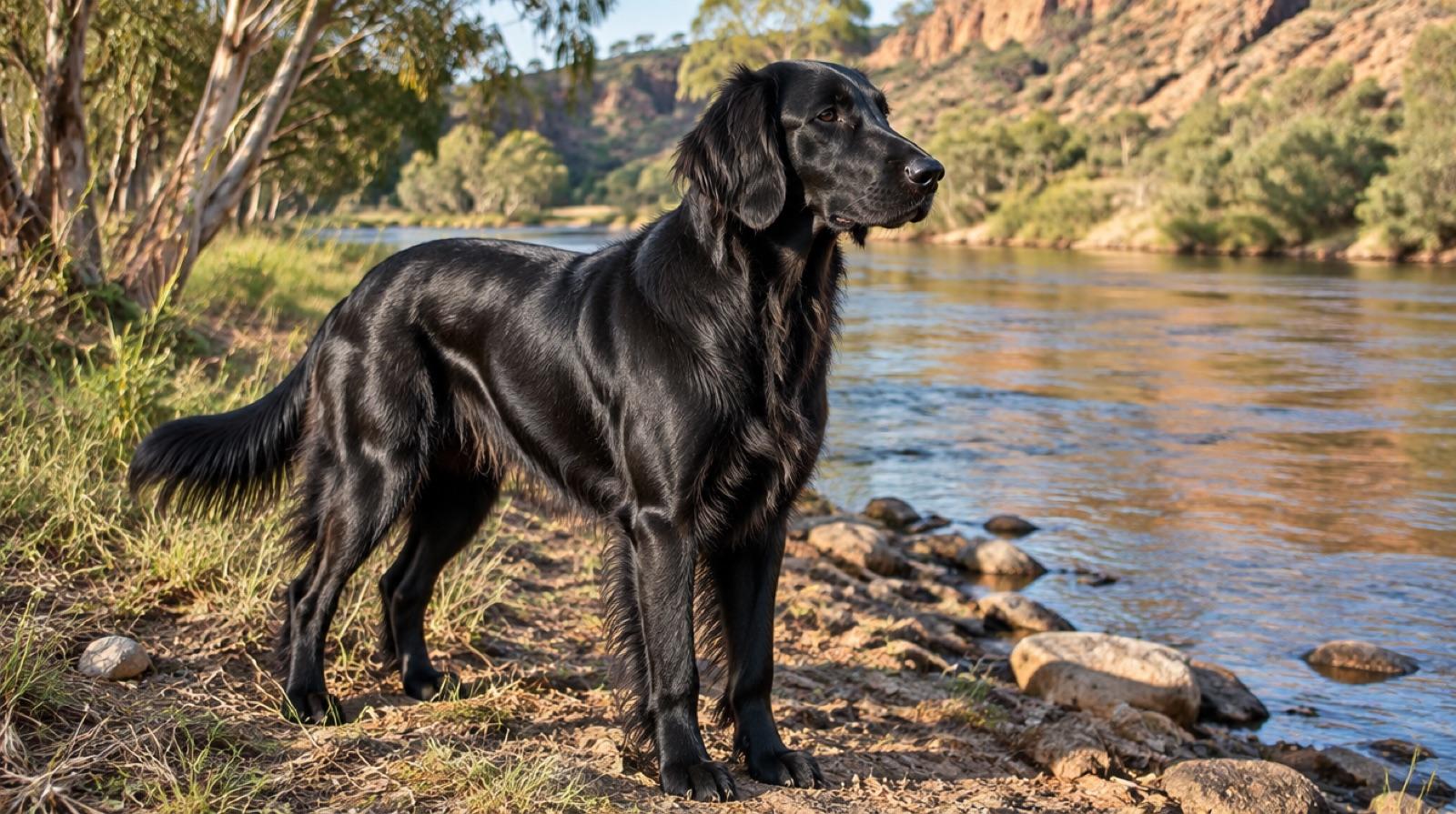
Either route can work. The Dogs Australia breed standard, which places the Flat Coated Retriever in Group 3, Gundogs, describes “a bright, active dog of medium size with an intelligent expression”, “generously endowed with natural gundog ability, optimism and friendliness demonstrated by enthusiastic tail action”. Its temperament line is short: “Confident and kindly.”
A registered breeder who scores hips and elbows, checks eyes including gonioscopy and talks honestly about cancer in the lines gives you the best odds and a puppy you raise yourself. Rescue gives you a dog whose energy and manners you can see first; check the live listings, as numbers change daily. The route to avoid is an online ad for a cheap “black retriever” with no health results and no breeder you can check.
| Route | Reference cost | What you usually get | Main risk |
|---|---|---|---|
| Dogs Australia registered breeder | No member breeder we checked published a price on its own website (November 2026); ask each one | A pedigree puppy; ask for both parents' hip, elbow and eye (gonioscopy) results | Waiting lists |
| General rescue or council pound | The rescue's published fee; RSPCA Victoria, for example, listed $500 to $1,000 for an adult dog | A Flat-coat or retriever cross, desexed and microchipped | Availability changes daily; check the live listings |
| Online ad with no checkable breeder | Anything, from suspiciously cheap to full price | Unknown parents, no health results, or a puppy that does not exist | Untested parents and scams |
Reference figures: the RSPCA Victoria adoption page, read 12 November 2026. Not a quote. Breeders and rescues set their own prices and change them, so check with them.
What is a Flat-coated Retriever like to live with?
Cheerful, affectionate and busy for life. Dogs Victoria says the Flat-coat has been described as the canine Peter Pan, that “he never grows up and is always ready for fun and play, even when advanced in age”, and that he is confident and kindly with a strong desire to please. It calls the breed firstly a companion that craves human company, not a one-man dog, and says a Flat-coat does not like to be left alone for long periods and is not suited to large kennels.
Be realistic about the energy. Dogs Victoria says the breed is best suited to an active person or family because it needs regular exercise, whether walking, running or swimming, that secure fencing is a necessity, and that Flat-coats are good family dogs although they can knock over small children through exuberance. The UK Royal Kennel Club lists more than 2 hours of exercise a day, and Dogs Australia's puppy-choosing advice says a working dog or gundog “will be active in mind and body and will require regular occupation and a lot of exercise”.
| Trait | What the source says |
|---|---|
| Height | Preferred 58 to 61 cm for dogs and 56 to 58 cm for bitches (breed standard) |
| Weight | Preferred, in hard condition, 27 to 36 kg for dogs and 25 to 32 kg for bitches (breed standard) |
| Colour | Black or liver only (breed standard) |
| Coat | Dense, of fine to medium texture, as flat as possible (breed standard) |
| Grooming | Weekly brushing, with minor trimming around the feet and ears (Dogs Victoria) |
| Exercise | Regular walking, running or swimming (Dogs Victoria); more than 2 hours a day (Royal Kennel Club) |
| Life span | Average 11 to 12 years (Dogs Victoria); under 10 years (Royal Kennel Club) |
Sources: Dogs Australia breed standard, Dogs Victoria and the Royal Kennel Club, read 12 November 2026.
What does the research say about cancer in Flat-coats?
It is the health issue every Flat-coat buyer should know about. The figures below come from the abstract of a UK study by Dobson and colleagues, published in Veterinary and Comparative Oncology in 2009 (we read the abstract; the full paper is behind a paywall). The study recruited 174 Flat-coated Retrievers aged 2 to 7 in 1996 and followed them with a yearly health census until 2007. Of the dogs followed, 72 (42%) died of confirmed cancer, a further 20 died of tumours that were not confirmed, 61 (35%) died of non-cancer conditions, and the cause of death was unknown for 19.
Soft tissue sarcoma, especially histiocytic sarcoma, was the most common cancer type, affecting 32 dogs (44% of the cancers), and the authors concluded that “soft tissue sarcoma, particularly histiocytic sarcoma, is a major cause of mortality in this breed”. The median age at death was 8 years for dogs with sarcoma and 9 years for all dogs with tumours, against 12 years for dogs that died of non-cancer conditions.
Two cautions. This was one UK cohort followed until 2007, not a measure of Australian Flat-coats today, and there is no DNA test that rules cancer out. What you can do is ask a breeder how long the dogs in the pedigree lived and what they died of, and take any new lump or swelling to your vet promptly rather than waiting.
Which health tests should a Flat-coat breeder show you?
Dogs Victoria calls the Flat Coated Retriever generally a healthy breed, but says conditions that occur occasionally include hip dysplasia and elbow dysplasia. It also says eye checks are recommended and must include a gonioscopy examination for glaucoma, plus checks for evidence of progressive retinal atrophy (PRA) and cataracts. Gonioscopy examines the drainage angle inside the eye.
Here is what Dogs Victoria names, next to what two overseas bodies list: the UK Royal Kennel Club and the US national breed club's recommendations published by the American Kennel Club. The overseas lists are for asking an Australian breeder questions, not Australian rules:
| Test | Dogs Victoria profile | Royal Kennel Club (UK, overseas) | US national breed club via AKC (overseas) |
|---|---|---|---|
| Hip scoring | Hip dysplasia named | Best practice | Recommended |
| Elbow scoring | Elbow dysplasia named | Best practice | Not listed |
| Eye examination with gonioscopy | Recommended, including gonioscopy, PRA and cataracts | Good practice (eye scheme with gonioscopy) | Recommended (ophthalmologist evaluation) |
| Patella evaluation | Not stated | Not listed | Recommended |
Sources: Dogs Victoria Flat Coated Retriever profile, the Royal Kennel Club and the American Kennel Club's list of national breed club recommendations, read 12 November 2026. A buying checklist, not veterinary advice.
Ask to see the certificates for both parents, with names that match the litter. Dogs Victoria warns that a claim of “clear of all hereditary disease” based on a DNA test alone should ring alarm bells, because there are many breed-specific diseases without a DNA test; hips and elbows, for example, are checked by X-ray scoring.
How much is a Flat-coat puppy from a registered breeder?
We quote no breeder price, because none of the member breeders whose websites we read published one. In November 2026 we read the own websites of Flat-coated Retriever breeders who are members of Dogs Australia state bodies, leaving out listing and classified sites, and found no published price. Not every breeder has a website of its own, and we found no guide price from a breed club or state body. We cannot speak for every breeder, so ask each one.
Ask for the price in writing and compare what it includes: the parents' hip, elbow and eye results, the vet check, vaccination and microchip, whether the puppy is on the Limited Register with a desexing agreement, and whether the breeder will take the dog back if your circumstances change. Dogs Australia also suggests asking whether your own vet can check the puppy.
You may need to wait for a litter. Dogs Australia's registration figures show 58 Flat Coated Retrievers registered in 2025, against 76 in 2021 (registrations, not litters bred). The dog cost calculator gives a first-year budget beyond the purchase.
Survey of member breeders' own websites, November 2026. Any price a breeder gives you is theirs to set; prices change, so check with them. Nothing here is a quote.
See the large dogs listed right now
Large dogs from the rescues, shelters and council pounds we aggregate, including retrievers and retriever crosses when they are listed, each with its rescue, desexing and microchip details. Every listing links to the rescue, where you apply directly.
What do Flat-coats in rescue look like?
It varies. Check the live listings, as numbers change daily; a Flat-coat in rescue may be an adult or a retriever cross, and a good rescue will tell you how the dog is with children, other dogs, recall and time alone. If you adopt an adult, ask whether anything is known about its health history, and ask your vet about a baseline check, including any lumps.
Browse family dogs listed by rescues too: Sydney, Melbourne, Brisbane, Perth, Adelaide.
What does a rescue Flat-coat cost?
| Rescue | Fee as published | Read |
|---|---|---|
| RSPCA NSW | $620 puppy under 12 months; $500 dog over 12 months | 12 Nov 2026 |
| RSPCA Victoria | $650 to $1,000 puppy under 6 months; $500 to $1,000 adult dog | 12 Nov 2026 |
Reference only, not a quote. These are the fees each rescue published on the date shown; fees change and some dogs are priced individually, so check with the rescue. Read our guides to adopting a dog in Australia and adopting a senior dog.
How do Flat-coat puppy scams work?
Never send a deposit for a Flat-coat puppy you have not seen with its mother, in person or at least on a live video call. A seller who asks for more money after the first payment, for shipping or transport, matches the scam pattern Dogs Victoria describes.
Scamwatch warns that scammers set up fake websites, and fake profiles on social media and online marketplaces, for pets that do not exist, and that if a pet is very cheap it is likely a scam. Dogs Victoria's puppy scam fact sheet adds that fake ads may display microchip, source or membership numbers lifted from legitimate breeders. Checks to make before you pay:
- Health results. Ask for the parents' hip and elbow scores and a current eye certificate including gonioscopy, with names that match the litter.
- Colour. The breed standard says black or liver only, so ask questions if a “Flat-coat” is offered in another colour as a pedigree dog.
- Borrowed numbers. Dogs Victoria says to contact the organisation a seller claims membership of and check the number is valid and matches the breeder's name, location and breed.
- Copied photos. Dogs Victoria passes on the ACCC's advice to use a reverse image search to check whether the photos appear on other websites.
Our guide to puppies for sale in Australia has the state-by-state table of breeder numbers, how to check each one, and what to do if you have already paid.
When is a registered breeder the better choice?
Rescue is not right for everyone, and if you want a Flat-coat puppy specifically, waiting for a registered breeder is reasonable. Check these before you pay:
- Registration. Ask for the breeder's prefix and membership number and check them through Dogs Australia's breeder search or your state body.
- Hip and elbow scores for both parents.
- A current eye certificate for both parents, including gonioscopy.
- An honest longevity history: how long the dogs in the pedigree lived and what they died of, including cancer.
- A written contract covering health problems, register type, desexing and whether the breeder will take the dog back.
Is a Flat-coated Retriever the right dog for you?
The appeal is real: a joyful, affectionate retriever that stays playful into old age. Be honest about three things before you apply anywhere: a lot of exercise every day, ideally with swimming or retrieving; company, because the breed does not like being left alone for long; and the cancer risk, which means budgeting for vet visits and possibly a shorter life than you hope. Not sure? Try the what dog breed is right for me quiz, the dog exercise calculator and the adoption readiness check, and compare with our guide to family dogs.
Find a Flat-coated Retriever near you
We do not have a dedicated Flat-coated Retriever listing page yet, so look through the large dogs listed by rescues in your city and set an alert:
- Large dogs for adoption in Sydney
- Large dogs for adoption in Melbourne
- Large dogs for adoption in Brisbane
- Large dogs for adoption in Perth
- Large dogs for adoption in Adelaide
More retriever and gundog adopt-or-buy guides: Golden Retriever, Labrador, Chesapeake Bay Retriever, Toller, Gordon Setter.
Frequently asked questions
How much is a Flat-coated Retriever puppy in Australia?▼
We have no current published figure to quote. In November 2026 we read the own websites of Flat-coated Retriever breeders who are members of Dogs Australia state bodies, and none published a price. We found no guide price from a breed club or state body, and we do not use listing sites. Ask each breeder for the price in writing and compare what is included.
Do Flat-coated Retrievers get cancer?▼
Cancer is the big health question in this breed. The abstract of a UK study that followed 174 Flat-coated Retrievers from 1996 to 2007 (Dobson and colleagues, Veterinary and Comparative Oncology, 2009) reports that 72 of them (42%) died of confirmed cancer, and the authors concluded that soft tissue sarcoma, particularly histiocytic sarcoma, is a major cause of death in the breed. Ask a breeder about the age and cause of death of dogs in the pedigree, and see a vet promptly about any new lump.
How long do Flat-coated Retrievers live?▼
Dogs Victoria gives an average life span of 11 to 12 years, and the UK Royal Kennel Club lists under 10 years. The abstract of a 2009 UK cohort study reports a median age at death of 9 years for dogs with tumours and 12 years for dogs that died of non-cancer conditions. That is one UK group of dogs, not a figure for Australian Flat-coats today.
What health tests should a Flat-coated Retriever breeder do?▼
Ask for hip and elbow scores and a current eye examination that includes gonioscopy for both parents. Dogs Victoria names hip and elbow dysplasia and says eye checks must include gonioscopy for glaucoma and checks for progressive retinal atrophy and cataracts. The US national breed club, as published by the American Kennel Club, also recommends a patella evaluation.
What is gonioscopy?▼
Gonioscopy is an eye examination of the drainage angle inside the eye. Dogs Victoria says Flat-coat eye checks must include a gonioscopy examination for glaucoma, and the UK Royal Kennel Club lists eye testing with gonioscopy as good practice for the breed.
How much exercise does a Flat-coated Retriever need?▼
A lot. The UK Royal Kennel Club lists more than 2 hours of exercise a day, and Dogs Victoria says the breed is best suited to an active person or family because it needs regular exercise, whether walking, running or swimming.
Are Flat-coated Retrievers good family dogs?▼
They can be, for an active family. Dogs Victoria says they are good family dogs, although they can knock over small children through exuberance, and most accept other pets. It also says a Flat-coat does not like to be left alone for long periods. Always supervise children and dogs together.
Why is the Flat-coat called the Peter Pan of dogs?▼
Because it stays playful. Dogs Victoria says the Flat-coated Retriever has been described as the canine Peter Pan: it never grows up and is always ready for fun and play, even when advanced in age.
What colours do Flat-coated Retrievers come in?▼
Black or liver only, according to the Dogs Australia breed standard, which describes a dense coat of fine to medium texture, as flat as possible.
How big is a Flat-coated Retriever?▼
Medium sized by its standard. The Dogs Australia breed standard gives a preferred height of 58 to 61 cm for dogs and 56 to 58 cm for bitches, and a preferred weight in hard condition of 27 to 36 kg for dogs and 25 to 32 kg for bitches.
Can I adopt a Flat-coated Retriever in Australia?▼
You can look. A Flat-coat in rescue may be an adult or a retriever cross, and numbers change daily, so check the large dog and family dog listings in your city and set an alert.
How do I avoid Flat-coated Retriever puppy scams?▼
Only pay for a puppy you have seen with its mother, in person or at least on a live video call. Scamwatch says a very cheap pet is likely a scam, and Dogs Victoria warns that fake ads may show microchip, source or membership numbers lifted from real breeders. Check any membership number with the state body yourself.
Sources
- Dogs Australia: Flat Coated Retriever breed standard (last updated 3 August 2008)
- Dogs Australia: How to choose a puppy
- Dogs Australia: Choosing a breeder
- Dogs Australia: Find a breeder
- Dogs Australia: National Animal Registration Analysis 2018 to 2025
- Dogs Victoria: Flat Coated Retriever breed profile
- Dogs Victoria: A10 Understanding health testing results (fact sheet, May 2025)
- Royal Kennel Club (UK): Flat Coated Retriever breed page and health tests
- American Kennel Club: Sporting Group health testing requirements (national breed club recommendations)
- Dobson J, Hoather T, McKinley TJ, Wood JLN. Mortality in a cohort of flat-coated retrievers in the UK. Veterinary and Comparative Oncology 2009;7(2):115-121
- Scamwatch: Buying and selling scams (pet scams)
- Dogs Victoria: A7 Identifying puppy scams and puppy farms (fact sheet, copyright 2023)
- RSPCA NSW: Adoption fees
- RSPCA Victoria: The adoption process
Keep reading
Large dogs in Sydney
Large dogs, including retrievers and retriever crosses when listed, from the rescues we aggregate.
Golden Retriever puppies
Health tests, breeder checks and rescue for the best-known retriever.
Chesapeake Bay Retriever puppies
The tough, protective water retriever: DNA tests, honesty about temperament and rescue.
Puppies for sale: adopt or buy?
The breeder number each state requires, how to check it, and rescue puppy fees.