The short answer
A Chesapeake Bay Retriever is a tough, loyal, protective retriever that needs a lot of exercise and early socialisation: Dogs Victoria says it is reserved and cautious with strangers and must be properly socialised and trained from an early age. If you buy, use a Dogs Australia registered breeder who can show both parents' hip and elbow scores, an eye examination and DNA results for PRA, exercise-induced collapse (EIC) and degenerative myelopathy (DM). None of the member breeders whose websites we read in November 2026 published a price, so ask each one. If you adopt, check the live Chessie listings (numbers change daily) and set an alert. Any fee here is a reference, not a quote; check with the breeder or rescue.
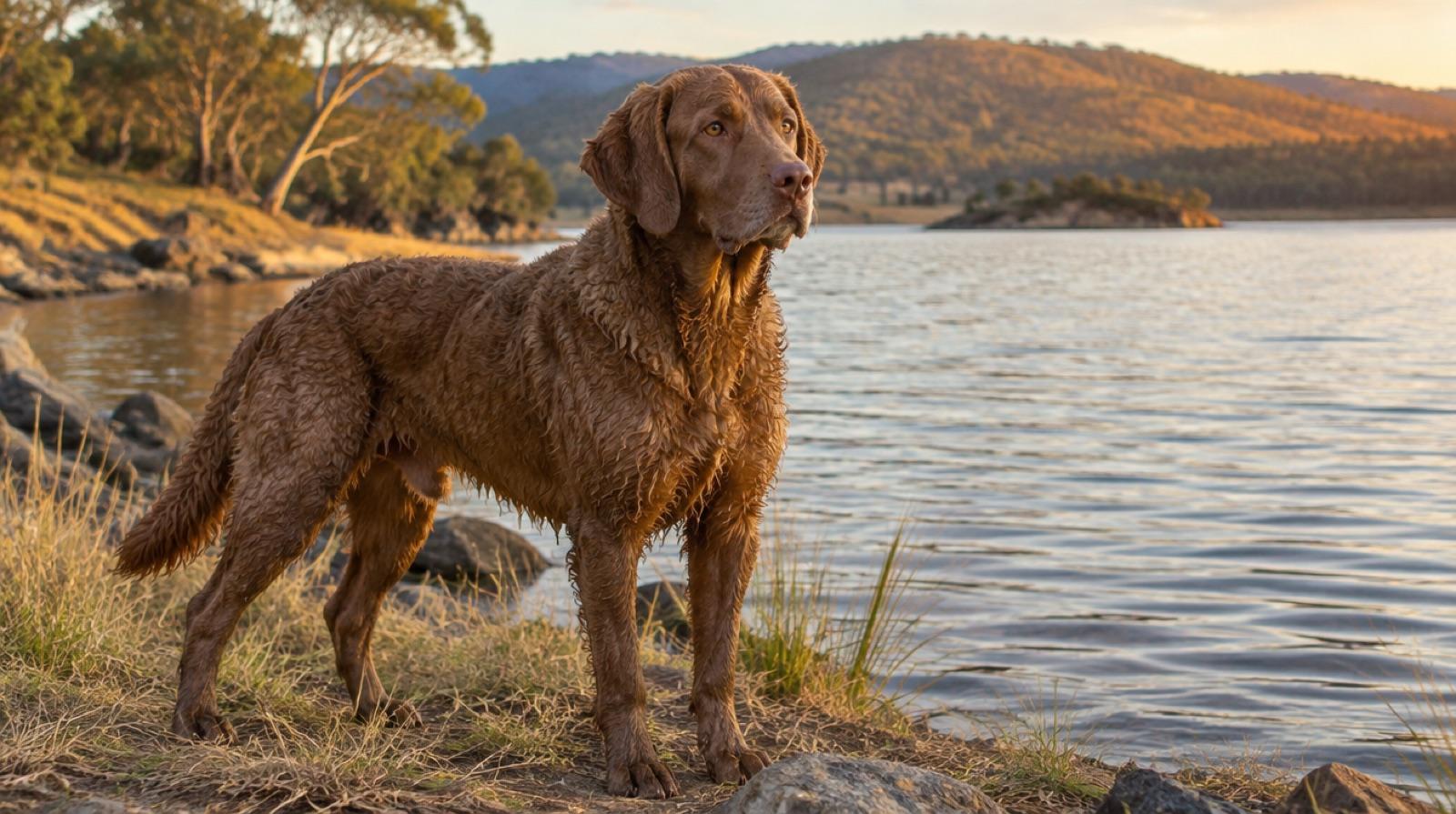
Should you adopt or buy a Chesapeake Bay Retriever?
Either route can work, if you want this temperament. The Dogs Australia breed standard, which places the breed in Group 3, Gundogs, says it was developed along the Chesapeake Bay “to hunt waterfowl under the most adverse weather and water conditions”, often breaking ice during repeated retrieves. It values the breed's “bright and happy disposition, intelligence, quiet good sense, and affectionate protective nature”, and adds that “extreme shyness or extreme aggressive tendencies are not desirable in the breed either as a gun dog or companion”.
A registered breeder who scores hips and elbows, checks eyes and DNA tests for PRA, EIC and DM gives you the best odds against the breed's known inherited problems and a puppy you can socialise from the start. Rescue gives you a dog whose manners with strangers and other dogs you can see first; check the live listings, as numbers change daily. The route to avoid is an online ad for a cheap “Chessie” with no health results and no breeder you can check.
| Route | Reference cost | What you usually get | Main risk |
|---|---|---|---|
| Dogs Australia registered breeder | No member breeder we checked published a price on its own website (November 2026); ask each one | A pedigree puppy; ask for both parents' hip, elbow, eye and DNA (PRA, EIC, DM) results | Waiting lists |
| General rescue or council pound | The rescue's published fee; RSPCA Victoria, for example, listed $500 to $1,000 for an adult dog | A Chessie or cross, desexed and microchipped | Availability changes daily; check the live listings |
| Online ad with no checkable breeder | Anything, from suspiciously cheap to full price | Unknown parents, no health results, or a puppy that does not exist | Untested parents and scams |
Reference figures: the RSPCA Victoria adoption page, read 12 November 2026. Not a quote. Breeders and rescues set their own prices and change them, so check with them.
What is a Chesapeake Bay Retriever like to live with?
Devoted to its own people, cautious with everyone else. Dogs Victoria says the Chessie has a bright and happy disposition with an affectionate, protective nature, and that it becomes firmly attached to its family, so it “does not rehome well and needs to be in a ‘forever’ home”. It calls the breed intensely affectionate, sensitive and perceptive, reserved and cautious with strangers, and a good watchdog, and says that because of its natural protective instincts it must be properly socialised and trained from an early age.
It is also a working dog. Dogs Victoria says this active dog needs regular attention and exercise and is best suited to someone with an active lifestyle, and the UK Royal Kennel Club lists more than 2 hours of exercise a day. Dogs Australia's puppy-choosing advice says a working dog or gundog “will be active in mind and body and will require regular occupation and a lot of exercise”. The coat is built for water: the standard says it should resist water “in the same way that a duck's feathers do”.
| Trait | What the source says |
|---|---|
| Height | Males 58.42 to 66.04 cm, females 53.34 to 60.96 cm (breed standard) |
| Weight | Males 29.51 to 36.32 kg, females 24.97 to 31.78 kg (breed standard) |
| Colour | Any colour of brown, sedge or deadgrass, self-coloured preferred; black disqualifies (breed standard) |
| Coat | A short, harsh, wavy outer coat and a dense, fine, woolly undercoat with an abundance of natural oil (breed standard) |
| Grooming | Little grooming; drops coat twice a year; regular bathing not advised (Dogs Victoria) |
| Exercise | Regular attention and exercise; an active owner (Dogs Victoria); more than 2 hours a day (Royal Kennel Club) |
| Life span | Average 12 to 14 years (Dogs Victoria); over 10 years (Royal Kennel Club) |
Sources: Dogs Australia breed standard, Dogs Victoria and the Royal Kennel Club, read 12 November 2026.
Which health tests should a Chesapeake breeder show you?
Dogs Victoria calls the Chesapeake Bay Retriever generally a healthy breed, but says conditions that occur occasionally include hip dysplasia and elbow dysplasia, and that progressive retinal atrophy (PRA), exercise-induced collapse (EIC) and degenerative myelopathy (DM) have DNA tests to rule out disease in the parents. (Its page spells the first as “Progressive Retinal Apathy”; it evidently means atrophy.) The UC Davis Veterinary Genetics Laboratory describes the two less familiar conditions:
- Exercise-induced collapse. A genetic neuromuscular disorder with muscle weakness, lack of coordination and life-threatening collapse after intense exercise in dogs that otherwise look healthy; affected dogs show signs after 5 to 20 minutes of strenuous exercise. Signs can appear as early as 5 months of age. If a dog collapses, call your vet now.
- Degenerative myelopathy. An inherited neurologic disorder with gradual muscle wasting and loss of coordination, usually starting in the hind limbs in adulthood (at least 8 years of age). UC Davis names the Chesapeake Bay Retriever among breeds reported as clinically affected, and notes that not every dog with two copies of the variant develops the disease.
Here is what Dogs Victoria names, next to what two overseas bodies list: the UK Royal Kennel Club and the US national breed club's recommendations published by the American Kennel Club. The overseas lists are for asking an Australian breeder questions, not Australian rules:
| Test | Dogs Victoria profile | Royal Kennel Club (UK, overseas) | US national breed club via AKC (overseas) |
|---|---|---|---|
| Hip scoring | Hip dysplasia named | Good practice | Recommended |
| Elbow scoring | Elbow dysplasia named | Good practice | Recommended |
| PRA-prcd (DNA) | DNA test for parents | Best practice | Recommended |
| Exercise-induced collapse (DNA) | DNA test for parents | Not listed | Recommended |
| Degenerative myelopathy (DNA) | DNA test for parents | Good practice | Recommended |
| Eye examination | Not stated | Best practice | Recommended |
| Genetic diversity | Not stated | Good practice | Not listed |
Sources: Dogs Victoria Chesapeake Bay Retriever profile, the Royal Kennel Club and the American Kennel Club's list of national breed club recommendations, read 12 November 2026. A buying checklist, not veterinary advice.
Ask to see the certificates for both parents, with names that match the litter. Dogs Victoria warns that a claim of “clear of all hereditary disease” based on a DNA test alone should ring alarm bells, because there are many breed-specific diseases without a DNA test; hips and elbows, for example, are checked by X-ray scoring.
How much is a Chesapeake puppy from a registered breeder?
We quote no breeder price, because none of the member breeders whose websites we read published one. In November 2026 we read the own websites of Chesapeake Bay Retriever breeders who are members of Dogs Australia state bodies, leaving out listing and classified sites, and found no published price. Not every breeder has a website of its own, and we found no guide price from a breed club or state body. We cannot speak for every breeder, so ask each one.
Ask for the price in writing and compare what it includes: the parents' hip, elbow, eye and DNA results, the vet check, vaccination and microchip, whether the puppy is on the Limited Register with a desexing agreement, and whether the breeder will take the dog back if your circumstances change. Dogs Australia also suggests asking whether your own vet can check the puppy.
Expect to wait for a litter. Dogs Australia's registration figures show 8 Chesapeake Bay Retrievers registered in 2025, against 63 in 2021 (registrations, not litters bred). The dog cost calculator gives a first-year budget beyond the purchase.
Survey of member breeders' own websites, November 2026. Any price a breeder gives you is theirs to set; prices change, so check with them. Nothing here is a quote.
See the Chessies listed right now
Chesapeake Bay Retrievers and crosses from the rescues, shelters and council pounds we aggregate, each with its rescue, desexing and microchip details. Every listing links to the rescue, where you apply directly.
What do Chessies in rescue look like?
It varies. Check the live listings above, as numbers change daily; a Chessie in rescue may be an adult or a cross, and a good rescue will tell you how the dog is with strangers, children, other dogs and time alone. Given what Dogs Victoria says about the breed bonding firmly and not rehoming easily, ask how the dog has settled with its carers, and plan for a patient settling-in period.
If you are flexible on breed, browse large dogs listed by rescues: Sydney, Melbourne, Brisbane, Perth, Adelaide.
What does a rescue Chessie cost?
| Rescue | Fee as published | Read |
|---|---|---|
| RSPCA NSW | $620 puppy under 12 months; $500 dog over 12 months | 12 Nov 2026 |
| RSPCA Victoria | $650 to $1,000 puppy under 6 months; $500 to $1,000 adult dog | 12 Nov 2026 |
Reference only, not a quote. These are the fees each rescue published on the date shown; fees change and some dogs are priced individually, so check with the rescue. Read our guide to adopting a dog in Australia.
How do Chesapeake puppy scams work?
Never send a deposit for a Chesapeake puppy you have not seen with its mother, in person or at least on a live video call. A seller who asks for more money after the first payment, for shipping or transport, matches the scam pattern Dogs Victoria describes.
Scamwatch warns that scammers set up fake websites, and fake profiles on social media and online marketplaces, for pets that do not exist, and that if a pet is very cheap it is likely a scam. Dogs Victoria's puppy scam fact sheet adds that fake ads may display microchip, source or membership numbers lifted from legitimate breeders. Checks to make before you pay:
- Health results. Ask for the parents' hip and elbow scores, eye examination and PRA, EIC and DM DNA results, with certificates whose names match the litter.
- Colour. The standard disqualifies a black coat, so a black “Chesapeake” is not a pedigree Chessie.
- Borrowed numbers. Dogs Victoria says to contact the organisation a seller claims membership of and check the number is valid and matches the breeder's name, location and breed.
- Copied photos. Dogs Victoria passes on the ACCC's advice to use a reverse image search to check whether the photos appear on other websites.
Our guide to puppies for sale in Australia has the state-by-state table of breeder numbers, how to check each one, and what to do if you have already paid.
When is a registered breeder the better choice?
Rescue is not right for everyone, and if you want a Chesapeake puppy to socialise from the start, waiting for a registered breeder is reasonable. Check these before you pay:
- Registration. Ask for the breeder's prefix and membership number and check them through Dogs Australia's breeder search or your state body.
- Hip and elbow scores for both parents.
- DNA results for PRA-prcd, EIC and DM, and a current eye examination, for both parents.
- Meeting the parents, so you can see how they behave with visitors.
- A written contract covering health problems, register type, desexing and whether the breeder will take the dog back.
Is a Chesapeake Bay Retriever the right dog for you?
The appeal is real: a loyal, hardy, water-loving dog that bonds deeply with its family. Be honest about three things before you apply anywhere: plenty of exercise every day, ideally with swimming and retrieving; early and ongoing socialisation for a dog that is naturally protective and cautious with strangers; and a lifetime commitment, because the breed does not rehome easily. Not sure? Try the what dog breed is right for me quiz, the dog exercise calculator and the adoption readiness check, and compare with our guide to family dogs.
Find a Chesapeake Bay Retriever near you
Chessies and crosses listed by rescues, by city:
- Chesapeake Bay Retrievers for adoption in Sydney
- Chesapeake Bay Retrievers for adoption in Melbourne
- Chesapeake Bay Retrievers for adoption in Brisbane
- Chesapeake Bay Retrievers for adoption in Perth
- Chesapeake Bay Retrievers for adoption in Adelaide
More retriever and gundog adopt-or-buy guides: Labrador, Golden Retriever, Flat-coated Retriever, Toller, German Shorthaired Pointer.
Frequently asked questions
How much is a Chesapeake Bay Retriever puppy in Australia?▼
We have no current published figure to quote. In November 2026 we read the own websites of Chesapeake Bay Retriever breeders who are members of Dogs Australia state bodies, and none published a price. We found no guide price from a breed club or state body, and we do not use listing sites. Ask each breeder for the price in writing and compare what is included.
What health tests should a Chesapeake Bay Retriever breeder do?▼
Ask for hip and elbow scores, an eye examination, and DNA results for progressive retinal atrophy (PRA-prcd), exercise-induced collapse (EIC) and degenerative myelopathy (DM) for both parents. Dogs Victoria names hip and elbow dysplasia and says PRA, EIC and DM have DNA tests to rule out disease in the parents.
What is exercise-induced collapse?▼
The UC Davis Veterinary Genetics Laboratory describes exercise-induced collapse (EIC) as a genetic neuromuscular disorder with muscle weakness, lack of coordination and life-threatening collapse after intense exercise in otherwise healthy-looking dogs, with signs after 5 to 20 minutes of strenuous exercise. It lists the Chesapeake Bay Retriever among the breeds appropriate for testing. If a dog collapses, call your vet now.
What is degenerative myelopathy?▼
The UC Davis Veterinary Genetics Laboratory describes degenerative myelopathy (DM) as an inherited neurologic disorder with gradual muscle wasting and loss of coordination, usually starting in the hind limbs in adulthood (at least 8 years of age). It names the Chesapeake Bay Retriever among breeds reported as clinically affected, and says not every dog with two copies of the gene variant develops the disease.
Is a Chesapeake Bay Retriever protective?▼
Yes. Dogs Victoria describes an affectionate, protective nature, says the Chessie is reserved and cautious with strangers and a good watchdog, and says that because of its natural protective instincts it must be properly socialised and trained from an early age. The breed standard says extreme shyness or extreme aggressive tendencies are not desirable.
Do Chesapeake Bay Retrievers rehome well?▼
Dogs Victoria says the Chessie becomes firmly attached to its family, so it does not rehome well and needs to be in a forever home. If you adopt one, expect to give it time, and ask the rescue how the dog has settled with its carers.
How much exercise does a Chesapeake Bay Retriever need?▼
A lot. The UK Royal Kennel Club lists more than 2 hours of exercise a day, and Dogs Victoria says this active dog needs regular attention and exercise and is best suited to someone with an active lifestyle.
How do you groom a Chesapeake Bay Retriever?▼
Not much, but do not over-bath. Dogs Victoria says the coat needs little grooming and drops twice a year, that regular brushing keeps shedding down, and that regular bathing is not advised because the natural oil in the coat keeps it water resistant.
What colour is a Chesapeake Bay Retriever?▼
Any shade of brown, sedge or deadgrass. The Dogs Australia breed standard says the colour must be as nearly that of its working surroundings as possible, that self-coloured dogs are preferred, and it disqualifies a black coat.
How long do Chesapeake Bay Retrievers live?▼
Dogs Victoria gives an average life span of 12 to 14 years, and the UK Royal Kennel Club lists over 10 years.
Can I adopt a Chesapeake Bay Retriever in Australia?▼
You can look. A Chessie in rescue may be an adult or a cross, and numbers change daily, so check the live Chesapeake listings, set an alert, and also browse large dogs in your city.
How do I avoid Chesapeake Bay Retriever puppy scams?▼
Only pay for a puppy you have seen with its mother, in person or at least on a live video call. Scamwatch says a very cheap pet is likely a scam, and Dogs Victoria warns that fake ads may show microchip, source or membership numbers lifted from real breeders. Check any membership number with the state body yourself.
Sources
- Dogs Australia: Chesapeake Bay Retriever breed standard (last updated 16 August 2010)
- Dogs Australia: How to choose a puppy
- Dogs Australia: Choosing a breeder
- Dogs Australia: Find a breeder
- Dogs Australia: National Animal Registration Analysis 2018 to 2025
- Dogs Victoria: Chesapeake Bay Retriever breed profile
- Dogs Victoria: A10 Understanding health testing results (fact sheet, May 2025)
- Royal Kennel Club (UK): Chesapeake Bay Retriever breed page and health tests
- American Kennel Club: Sporting Group health testing requirements (national breed club recommendations)
- UC Davis Veterinary Genetics Laboratory: Exercise-induced collapse (EIC)
- UC Davis Veterinary Genetics Laboratory: Degenerative myelopathy (DM)
- Scamwatch: Buying and selling scams (pet scams)
- Dogs Victoria: A7 Identifying puppy scams and puppy farms (fact sheet, copyright 2023)
- RSPCA NSW: Adoption fees
- RSPCA Victoria: The adoption process
Keep reading
Chessies listed by rescues
Chesapeake Bay Retrievers and crosses listed right now by the rescues and shelters we aggregate across Australia.
Labrador puppies
Health tests, breeder checks and rescue for Australia’s favourite retriever.
Flat-coated Retriever puppies
The playful black retriever: cancer research, eye tests and rescue.
Puppies for sale: adopt or buy?
The breeder number each state requires, how to check it, and rescue puppy fees.