The short answer
If you want a papered Cornish Rex kitten, buy from a breeder registered with a cat council and ask for both parents' DNA results, starting with hypokalaemia, and their blood types. We cannot give a breeder price: in November 2026 no council or club published one, and we found no registered cattery's own website with a pet kitten price we could confirm as current, so ask each breeder. Do not buy a Cornish Rex as an allergy cure: ASCIA says all cat breeds can cause allergies. If what you want is an active, affectionate short-haired cat rather than the papers, rescues list short-haired cats of all ages, desexed, microchipped and vaccinated, for a rescue fee (RSPCA NSW listed $270 for a kitten under 6 months on 12 November 2026). Fees change, so check with the rescue; reference only, not a quote.
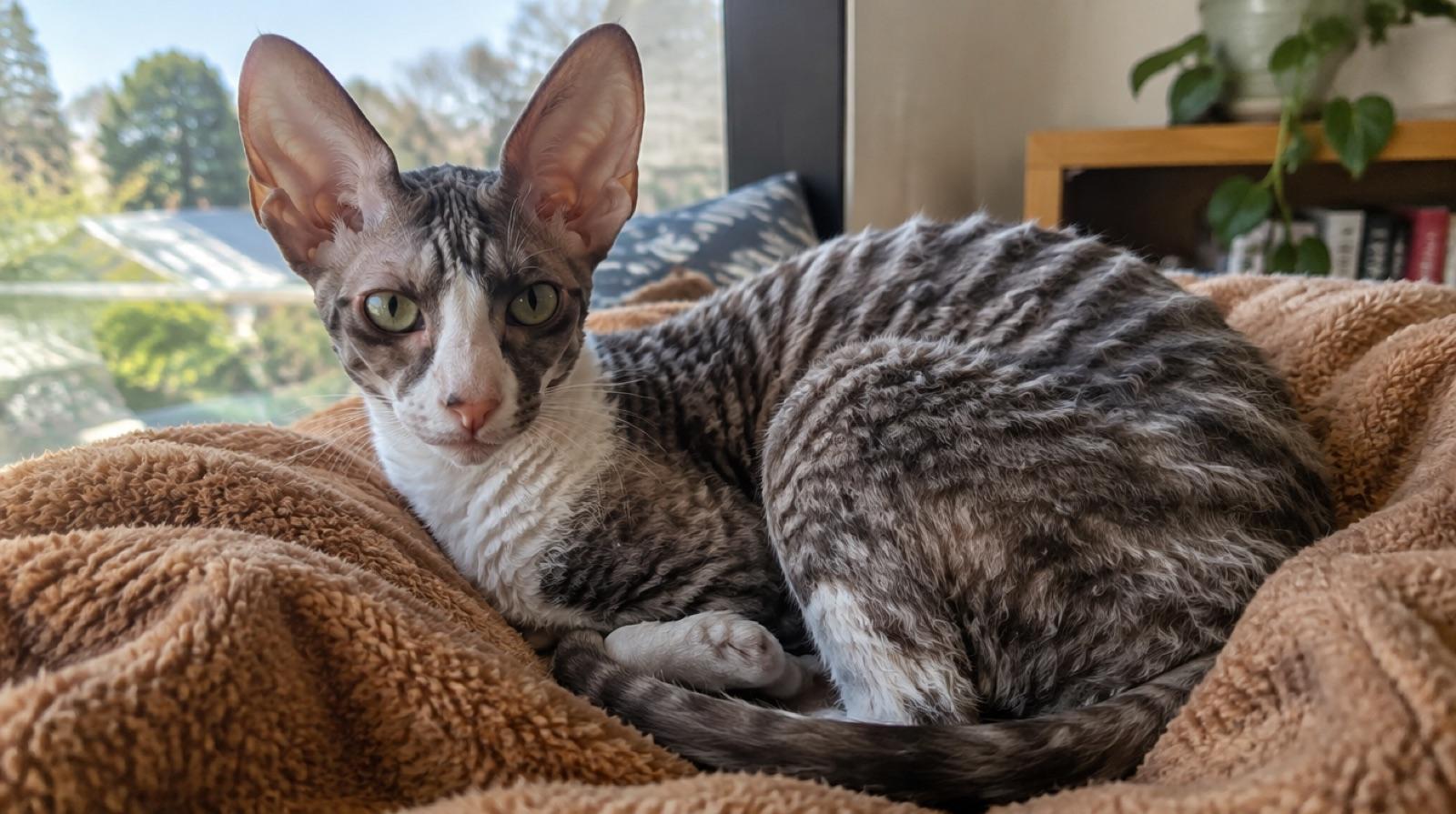
Should you adopt or buy a Cornish Rex?
It depends on whether the papers matter to you. If you want a purebred Cornish Rex kitten with known parents and DNA results, a breeder registered with a cat council is the route that gives you those. If what you want is an active, affectionate, short-haired cat, rescues list short-haired cats of all ages that come desexed, microchipped and vaccinated, with notes from the people who have been caring for them.
If allergies are the reason you are looking at a Cornish Rex, read the allergy section first. It changes the decision more than price does.
The RSPCA Australia Knowledgebase recommends adopting from the RSPCA or another reputable rescue organisation first. If you buy from a breeder, it suggests confirming they are registered with the relevant authority in your state or territory, inspecting where the animal was born, and meeting the parents, especially the mother.
| Route | Reference cost | What you usually get | Main risk |
|---|---|---|---|
| Registered breeder | No current published price found (November 2026); ask each breeder | A papered kitten with known parents, vaccinated and microchipped, sold desexed or with desexing agreed | Waiting lists; DNA and blood type results still need asking about |
| Rescue | A rescue fee; see the examples below | Short-haired cats and crosses of all ages, desexed, microchipped and vaccinated | Unknown parents; whether a Cornish Rex is listed near you changes daily |
| Online ad or social media | Anything; Scamwatch says a very cheap pet is likely a scam | Anything from a real litter to a kitten that does not exist | Scams, unregistered breeding, allergy promises |
Breeder prices and rescue fees read 12 November 2026 on the pages linked below. Reference only, not a quote: breeders and rescues set and change their own prices, so check with them.
What does a Cornish Rex kitten cost from a registered breeder?
We cannot give one. No Australian cat council or club publishes a Cornish Rex price guide, and Cats Victoria (GCCFV) says kitten pricing is up to individual breeders and varies by breed. In November 2026 we read the websites of Cornish Rex catteries that show registration with an Australian cat council. Most published no price at all. One undated page did show a pet price, but we could not show it was current in 2026, so we left it out, along with prices that appeared only on listing sites or social media. Ask every breeder you talk to for the price in writing and what it includes.
| Route | Reference figure | Read |
|---|---|---|
| Council-registered breeders (own websites) | No pet kitten price we could confirm as current | 12 Nov 2026 |
| Cat councils and clubs | No Cornish Rex price published | 12 Nov 2026 |
| RSPCA NSW, kitten under 6 months | $270 | 12 Nov 2026 |
| RSPCA NSW, cat over 6 months | $220 | 12 Nov 2026 |
| Cat Protection Society of NSW | $150 per cat or kitten; $250 for two | 12 Nov 2026 |
Reference figures only, not quotes. Breeder prices were read on breeders' own websites, never on listing sites, and fees change, so check with the breeder or rescue. RSPCA NSW says its animals are desexed, microchipped, vaccinated and health-checked before adoption. Fees in other states are in our guide to kittens for sale in Australia.
What the price should buy you, going by the councils' own guidance:
- A kitten of at least 10 weeks. ANCATS rules set 10 weeks as the minimum and ANCATS recommends 12.
- Desexed, vaccinated and microchipped. Cats Victoria (GCCFV) says a kitten should be all three before it comes to you, and suggests asking whether the breeder supplies a health guarantee.
- Registration papers from a cat council, and DNA and blood type results for the parents (see below).
Is a Cornish Rex hypoallergenic?
No cat breed is hypoallergenic. If someone at home has a cat allergy or asthma, see a doctor before you bring any cat home, Cornish Rex included.
The Cornish Rex appears on lists of hypoallergenic cats, because its coat has no guard hairs and the CFA says it sheds only minimally. But the Australasian Society of Clinical Immunology and Allergy (ASCIA) says the main cat allergen is produced by sebaceous glands in the cat's skin, and that as all cats have sebaceous glands, all cat breeds can cause allergies. Less hair is not the same as less allergen.
RSPCA South Australia lists the Devon and Cornish Rex among cat breeds that are considered hypoallergenic in a November 2020 article, but says on the same page that no furry friend is 100% allergen free. In practice: if you are mildly allergic and still want a cat, get medical advice first, then judge the individual cat over several long visits. A breeder who promises you will not react is selling, not informing. Our guide to hypoallergenic cats in Australia covers the evidence and the testing in full.
What does the Australian standard ask for?
The Coordinating Cat Council of Australia standard (issue date February 2025) describes “an elegant, well-muscled, alert, medium-sized cat of foreign type” whose most distinctive features are “its short, soft, plush, rippling or wavy coat, its longish head, large ears and characteristic tuck up of the stomach.” It allows no outcross to other breeds.
| Feature | What the standard says |
|---|---|
| Coat | Short, soft and plushy, without guard hairs, and should wave, ripple or curl; coat and whiskers carry 40 of the 100 points |
| Whiskers and eyebrows | Crinkled, rather coarse and of medium length |
| Body and legs | Slender, hard and muscular, with a very slight arch in the back; long, slender legs that give the look of being on tiptoes |
| Head and ears | A head about one third longer than it is wide; large ears set rather high |
| Colour | All colours and patterns accepted, with no points for coat colour; pointed cats must have blue eyes |
| Show faults | Baldness, bare patches or a straight coat rule a cat out of awards; bare patches are a fault in kittens and a serious fault in adults |
From the Coordinating Cat Council of Australia Cornish Rex standard, read 12 November 2026.
The coat comes from a recessive gene. The Cat Fanciers' Association traces the breed to a curly-coated kitten born on a farm in Cornwall, England in 1950, and the UC Davis Veterinary Genetics Laboratory says the trait is inherited in an autosomal recessive fashion and fixed in the breed. A kitten with a straight coat or bald patches sold as a purebred Cornish Rex does not match the standard.
On personality, the CFA calls Cornish Rex extremely intelligent, adaptable and adventurous, devoted to their people and often called “Velcro kitties” for wanting physical contact. It describes high activity levels, big appetites and a habit of playing with things they should not, and says they will chat but are not given to loud vocalising. As with any breed, the individual cat matters most.
Which health tests should a Cornish Rex breeder show you?
The Australian Cat Federation's DNA tests by breed list (October 2025) sets the minimum recommended testing for each breed it recognises. For the Cornish Rex it lists:
| Test | What it screens for |
|---|---|
| Hypokalaemia (Burmese type) | An inherited low-potassium condition that causes bouts of muscle weakness |
| PRA rdAc | A late-onset progressive retinal atrophy: UC Davis says affected cats have normal vision at birth that slowly degenerates to blindness |
| PKD 1 | Polycystic kidney disease |
| AB blood group | The ACF says blood group types should be monitored in all breeds; see below for why it matters here |
Source: ACF DNA tests by breed (October 2025), read 12 November 2026. A test being on the list means breeders should screen for it, not that every line carries it. This is a buying checklist, not veterinary advice.
Hypokalaemia. International Cat Care names the Cornish Rex among the Burmese-related breeds affected by inherited periodic hypokalaemia. It says signs usually first appear in kittens, that a simple gene test is available, and recommends testing potential breeding cats.
Blood type. The UC Davis Veterinary Genetics Laboratory lists the Cornish Rex among breeds with a high frequency of the blood type B gene. It says type B cats have strong natural antibodies against type A blood, so blood must be cross-matched before any transfusion, and that mating a type B queen to a type A or AB tom can cause neonatal isoerythrolysis, a potentially lethal disease, in the kittens. Ask whether the parents were blood typed, and tell your vet your cat's breed.
The CFA calls the Cornish Rex a sturdy, vigorous breed with no inherited health issues, while warning that the fragile coat may not protect against the sun and that these cats are easily chilled. The Australian testing list is still worth working through. Our Sydney guide to Cornish Rex health issues covers the signs worth a vet visit.
See the Cornish Rex listed right now
Cornish Rex and Cornish Rex crosses from the rescues and shelters we aggregate, with each rescue's notes on personality, other pets and indoor life. Numbers change daily. Every listing links to the rescue, where you apply directly.
What about Cornish Rex in rescue?
Numbers change daily, so check the live listings rather than relying on any rule of thumb. The Cornish Rex breed page shows what the rescues we aggregate have listed right now, and an alert tells you when a new one appears.
A rescue cat's papers are rarely known, but its personality is. A foster carer can tell you how active a cat is, how much contact it wants, how it copes with other pets and whether it has any skin or coat needs, which matters more for a daily match than a label. Our Cornish Rex adoption guide for Sydney covers applying through New South Wales rescues.
How do you check a Cornish Rex breeder?
Rescue is not right for everyone. A registered breeder makes sense if you want a kitten with known parents, DNA and blood type results, or if you plan to show. If you go that way:
- Registration. Ask which cat council the breeder belongs to: ANCATS, the Australian Cat Federation and its member bodies, or the Coordinating Cat Council of Australia and its members. Check with the council yourself, not through a link the seller sends.
- DNA results for both parents against the ACF list above, starting with hypokalaemia, and both parents' blood types.
- The mother, in person or on a live video call, and where the kittens are raised, before any deposit.
- Age and paperwork. At least 10 weeks old, vaccinated, microchipped and desexed or with desexing agreed in writing.
- How they handle allergies. A good answer sends you to your doctor and offers long visits. A promise that you will not react is not a good answer.
- Your state's rules. Some states require a breeder or source number in kitten ads. Our kittens for sale guide has the state-by-state table.
Get deposit terms in writing before you pay anything.
What do Cornish Rex scams look like?
Never pay for a kitten you have not seen with its mother, in person or at least on a live video call, and never pay a deposit to a seller you cannot verify.
Scamwatch says scammers set up fake websites, and fake social media and marketplace profiles, to get you to pay for popular breeds and pets that do not exist. Its advice: view the pet in person by visiting the breeder or seller, ask to see the pet on a video call with the breeder, check the breeder is legitimate and accredited, and compare prices, because a very cheap pet is likely a scam.
Checks that fit this breed in particular:
- Allergy guarantees. ASCIA says all cat breeds can cause allergies, so a guarantee is a sales line, whoever makes it.
- “Registered” with nobody in particular. Ask which council, get the prefix or member number, and check it with that council.
- The wrong coat. A straight-coated or patchy kitten sold as a purebred Cornish Rex does not match the standard.
- Copied photos. Run a reverse image search on the kitten photos and search a sentence of the ad.
If you have already paid, contact your bank straight away and report it to Scamwatch.
Is a Cornish Rex the right cat for you?
- Good fit: an active, attentive home that wants a playful, affectionate cat, with someone around much of the day, and that can keep a thin-coated cat warm in winter and out of strong sun in summer.
- Think twice: someone who wants a calm, independent cat, or who is away for long days.
- Not a reason to choose one: allergies, for the reasons above.
Warmth and coat care are covered in our Sydney guide to Cornish Rex coat and warmth. Weighing up other low-coat breeds? See our hairless cat breeds guide and the Sphynx adopt or buy guide. Not sure what suits you? Try the what cat breed am I quiz.
Find a Cornish Rex near you
- Cornish Rex for adoption in Sydney
- Cornish Rex for adoption in Melbourne
- Cornish Rex for adoption in Brisbane
- Cornish Rex for adoption in Perth
- Cornish Rex for adoption in Adelaide
- Australia-wide: the Cornish Rex breed page.
Planning an indoor life for your cat? Rescues flag cats suited to it: indoor cats in Sydney, Melbourne, Brisbane, Perth, Adelaide.
More on the breed from our Sydney guides: Cornish Rex adoption in Sydney, Cornish Rex health issues and Cornish Rex coat and warmth. Before you apply, the adoption readiness check takes a few minutes, and our guide to adopting a cat in Australia walks through the process.
Frequently asked questions
Should I adopt or buy a Cornish Rex kitten?▼
Buy from a breeder registered with a cat council if it has to be a papered Cornish Rex kitten with known parents and DNA results. Adopt if what you want is an active, affectionate, short-haired cat: rescues list short-haired cats of all ages, desexed, microchipped and vaccinated, for a rescue fee. Numbers in rescue change daily, so check the live listings.
How much is a Cornish Rex kitten in Australia?▼
We cannot give a current breeder price. No Australian cat council or club publishes a Cornish Rex price, and Cats Victoria (GCCFV) says kitten pricing is up to individual breeders. In November 2026 we found no council-registered Cornish Rex cattery whose own website showed a pet kitten price we could confirm as current in 2026, so ask each breeder what theirs is and what it includes. Rescue fees are published: on 12 November 2026 RSPCA NSW listed $270 for a kitten under 6 months. Fees change; reference only, not a quote.
What does the Australian standard say a Cornish Rex is?▼
The Coordinating Cat Council of Australia standard (February 2025) describes an elegant, well-muscled, alert, medium-sized cat of foreign type whose most distinctive features are its short, soft, plush, rippling or wavy coat, its longish head, large ears and characteristic tuck-up of the stomach. All colours and patterns are accepted.
Why is the Cornish Rex coat curly?▼
Because of a recessive gene. The Cat Fanciers' Association says the breed began with a curly-coated kitten born in Cornwall, England in 1950, and that test breedings showed the mutation was recessive. The UC Davis Veterinary Genetics Laboratory says the trait is inherited in an autosomal recessive fashion and is fixed in the breed. The Australian standard says the coat has no guard hairs and should wave, ripple or curl.
Are Cornish Rex cats hypoallergenic?▼
No cat breed is. The Australasian Society of Clinical Immunology and Allergy (ASCIA) says that as all cats have sebaceous glands, all cat breeds can cause allergies. In a November 2020 article, RSPCA South Australia lists the Devon and Cornish Rex among cat breeds that are considered hypoallergenic, but says no furry friend is 100% allergen free. Get medical advice and test the individual cat over long visits before committing.
What health tests should a Cornish Rex breeder do?▼
Ask about the tests the Australian Cat Federation lists as minimum testing for the breed (October 2025): progressive retinal atrophy (PRA rdAc), hypokalaemia and PKD 1. The ACF also says AB blood group types should be monitored in all breeds, which matters for the Cornish Rex. Ask to see results for both parents; treatment questions are for your vet.
Do Cornish Rex cats get hypokalaemia?▼
The breed can carry it. International Cat Care names the Cornish Rex among Burmese-related breeds affected by inherited periodic hypokalaemia, a low-potassium condition that causes bouts of muscle weakness, says a simple gene test is available, and recommends testing potential breeding cats. See a vet if a kitten shows weakness, such as a drooping head.
Why does a Cornish Rex's blood type matter?▼
Because the blood type B gene is common in the breed. The UC Davis Veterinary Genetics Laboratory lists the Cornish Rex among breeds with a high frequency of the blood type B gene, says blood must be cross-matched for transfusion, and says mating a type B queen to a type A or AB tom can cause a potentially lethal disease in the kittens. Ask the breeder whether the parents were blood typed, and tell your vet the breed.
Do Cornish Rex cats get cold?▼
They do. The Cat Fanciers' Association says the lack of guard hairs makes the coat fragile, that these cats are easily chilled in cold weather, and that the coat may not protect them from the sun, so they can get sunburned. Give a Cornish Rex warm, sheltered spots indoors and keep it out of strong sun.
Are Cornish Rex cats good pets?▼
For an active, attentive home. The Cat Fanciers' Association calls them extremely intelligent, adventurous and devoted to their people, often called Velcro kitties because they like physical contact, with high activity levels and big appetites. They suit people who want an interactive cat rather than an independent one.
How do you groom a Cornish Rex?▼
Very little brushing, but some upkeep. The Cat Fanciers' Association says regular combing is not needed, that the ears can build up wax quickly and should be cleaned often, and that an occasional bath may be needed because some cats become greasy, followed by a towel dry, never a blow dryer.
How old should a Cornish Rex kitten be when it goes home?▼
At least 10 weeks, and ANCATS recommends 12. ANCATS rules set 10 weeks as the minimum, and Cats Victoria (GCCFV) says a kitten should be 10 weeks or older, vaccinated, desexed and microchipped before it comes to you. A seller offering a younger kitten is a warning sign.
Sources
- Coordinating Cat Council of Australia: Cornish Rex standard (Feb 2025)
- Cat Fanciers' Association: Cornish Rex breed profile
- Australian Cat Federation: DNA tests by breed (Oct 2025)
- International Cat Care: Hypokalaemia in cats
- UC Davis Veterinary Genetics Laboratory: Cornish Rex tests
- UC Davis Veterinary Genetics Laboratory: AB blood group in domestic cat breeds
- ASCIA: Pet allergy
- RSPCA South Australia: Pets for people with allergies (2020)
- ANCATS: Registration rules
- Cats Victoria (GCCFV): Breeders and buying a kitten
- RSPCA Australia Knowledgebase: Where should I go for a new companion animal?
- Scamwatch: Buying and selling scams (pet scams)
- RSPCA NSW: Adoption fees
- Cat Protection Society of NSW: Cats for adoption
Keep reading
Cornish Rex listed by rescues
Cornish Rex and Cornish Rex crosses listed right now by the rescues and shelters we aggregate.
Devon Rex kittens: adopt or buy?
A different curly-coated breed from a different gene: breeder checks, health tests and the rescue route.
Hypoallergenic cats in Australia
What ASCIA says about cat allergies, why no breed is a guarantee, and how to test a cat before you adopt.
Kittens for sale: adopt or buy?
State breeder rules, how to check a seller, and what rescue kittens cost.