The short answer
Labradors come in black, yellow (light cream to red fox) and liver/chocolate, and the Dogs Australia standard says any other colour is unacceptable. Golden Retrievers come in any shade of gold or cream, “neither red nor mahogany.” Lab colour is set by two genes: one for yellow (E locus) and one for chocolate (B locus), both recessive, so black parents can have yellow or chocolate puppies. Silver, charcoal and champagne Labs are not recognised by the National Labrador Retriever Breed Council. “English cream” and “white” Goldens are pale Goldens within the Australian standard, not rare varieties. The one colour-health link with good evidence is in chocolate Labradors: a UK study of vet records found a shorter median lifespan and more ear and skin disease.
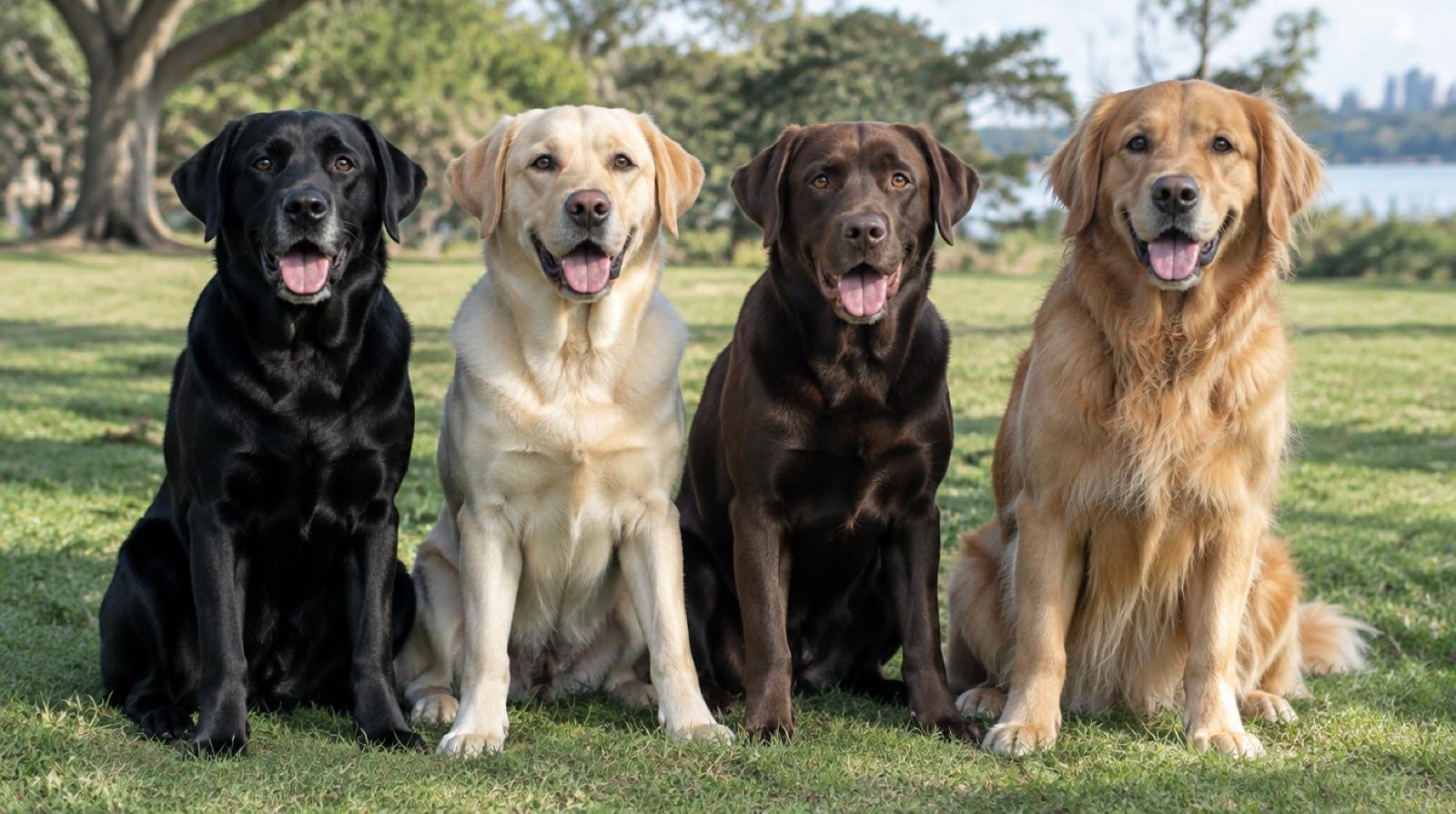
What colours do the breed standards allow?
Both breeds are registered in Australia by Dogs Australia, and each standard is short and specific about colour. Every line below is quoted or summarised from the Labrador Retriever and Golden Retriever standards (all standards are listed on Dogs Australia's browse a breed page).
| Labrador Retriever | Golden Retriever | |
|---|---|---|
| Allowed colours | “Wholly black, yellow and liver/chocolate” | “Any shade of gold or cream” |
| Range within a colour | Yellows from light cream to red fox; livers/chocolates from light to dark | Any shade (no range set out) |
| Excluded | “Any other colour or combination of colours unacceptable” | “Neither red nor mahogany” |
| White allowed | Small white spot on chest and rear of front pasterns | A few white hairs on chest only |
| Eyes | Brown or hazel | Dark brown |
| Silver, charcoal, champagne | Not recognised (breed council) | Not applicable |
Sources: Dogs Australia standards, read 10 November 2026 (Labrador standard last updated 2018, Golden Retriever 2015); National Labrador Retriever Breed Council buyers guide for silver, charcoal and champagne.
The breed council guide adds the plain-English version: Labradors come in three recognised colours, yellows “may range from pale cream through to a really dark shade of yellow called fox red,” and chocolates “used to be referred to as liver.” So a “white Lab” is a pale yellow and a “fox red Lab” is a dark yellow: both are standard.
What genes make a Labrador black, yellow or chocolate?
Two genes, both well mapped. A 2002 study by Schmutz, Berryere and Goldfinch genotyped dogs of known colour and found:
- The E locus (MC1R) decides yellow. Every red, yellow or gold dog they tested had two copies of a variant of MC1R that stops black or brown pigment forming in the coat. Geneticists write this as e/e.
- The B locus (TYRP1) decides black or brown. All 43 brown dogs carried two or more of three TYRP1 variants that interfere with the gene; none of the 34 black dogs did. A chocolate Lab is b/b.
- The nose gives it away. In the yellow dogs, a black or brown nose matched the absence or presence of those same brown variants exactly. A yellow Lab with a liver-coloured nose is carrying two brown copies under the yellow.
| Labrador colour | E locus | B locus | Nose |
|---|---|---|---|
| Black | At least one E | At least one B | Black |
| Chocolate | At least one E | b/b | Brown |
| Yellow, black nose | e/e | At least one B | Black |
| Yellow, brown nose | e/e | b/b | Brown |
Based on Schmutz et al. 2002. Simplified: other genes affect shade, and some colour tests report more variants.
Because yellow and chocolate are both recessive, colour can hide for generations. Two black parents that each carry e can have yellow puppies, and two that each carry b can have chocolate ones. Two yellow parents (both e/e) can only have yellow puppies. If colour matters to you, a breeder can show the parents' DNA colour results.
What sets the shade, cream to fox red? Nobody knows yet. A 2020 study by Weich and colleagues at UC Davis found that a copy-number variant near a gene called KITLG is associated with light versus dark red in several breeds, but noted that the Golden Retriever and Labrador Retriever “had variability at the CNV, but it did not correlate to their coat colors,” and that their variation is not explained by another known dilution variant either. So for now, no DNA test predicts whether a yellow Lab or a Golden will be pale or dark.
What about silver, charcoal and champagne Labradors?
They are not recognised in Australia. The National Labrador Retriever Breed Council buyers guide says silver, charcoal and champagne “are not recognised as purebred Labrador Retriever colours and should be avoided,” and that Labradors “do not carry the dilute gene that is responsible for these colours.” The Dogs Australia standard lists only black, yellow and chocolate, and calls any other colour unacceptable.
The colours themselves come from dilution. In dogs, coat colour dilution is inherited as a recessive trait linked to the MLPH (melanophilin) gene, according to Drogemuller and colleagues (2007), and lightens black to a silvery grey-blue, as Philipp and colleagues (2005) describe. Both papers also note that in some dilute dogs the colour comes with hair loss and recurring skin inflammation, called colour dilution alopecia. They studied other breeds (Pinschers and Large Munsterlanders among them), so this is a known risk of dilution in dogs generally, not a measured rate in dilute Labradors.
What that means for a buyer: a puppy advertised as a rare silver Lab at a premium is, in the breed council's words, a colour to avoid. If you are offered one, ask which Dogs Australia state body registered the litter and check it yourself; our Labrador puppies guide covers breeder checks and scams. In rescue, a grey retriever-type dog is simply a dog; judge it on temperament and health like any other.
What colours are Golden Retrievers, and what is an English cream?
Every Golden is genetically a yellow dog. Weich and colleagues describe the Golden Retriever, like the yellow Labrador, as a breed with non-functional MC1R, the same e/e result that makes a Lab yellow. The breed's whole range, from pale cream to deep gold, is shade variation within that one colour, and as above, its genetic cause has not yet been found.
- “English cream” and “white” Goldens. In Australia, cream is inside the standard: the Dogs Australia standard allows “any shade of gold or cream.” The label grew up in markets that use the American Kennel Club standard, which says a body colour that is “either extremely pale or extremely dark is undesirable,” so pale dogs were marketed there as a special type. It is not a separate breed, and a white Golden is a pale cream one.
- “Red” Goldens. The Dogs Australia standard says “neither red nor mahogany,” so a very dark red-gold dog falls outside the colour the standard asks for, although it may still be a registered Golden.
- Puppy shade. The AKC standard asks judges to give “some latitude” to a light puppy whose colouring shows promise of deepening with maturity. In other words, a pale Golden puppy may darken as it grows.
- Black. Not a Golden colour at all. The AKC standard calls any noticeable area of black or off-colour hair a serious fault.
A price premium for a cream, white or red Golden buys a colour, not better health or temperament. What protects a Golden puppy is the paperwork on the parents (hips, elbows, eyes and heart), which our Golden Retriever puppies guide sets out.
See the Labradors and Goldens listed right now
Every colour, from the rescues we aggregate in each city. Each listing links to the rescue, where you apply.
Is coat colour linked to health?
For chocolate Labradors, there is good evidence of an association. For Goldens, and for black versus yellow Labs, we found no peer-reviewed study showing a colour effect.
The key study is McGreevy and colleagues (2018), a team from the University of Sydney, the University of Melbourne, the University of Queensland and the Royal Veterinary College. They used VetCompass, which collects records from UK first-opinion vet practices, covering 33,320 Labradors under care in 2013, with full disorder data extracted for a random sample of 2,074.
| Measure (UK Labradors) | Black | Yellow | Chocolate |
|---|---|---|---|
| Share of dogs with colour recorded | 44.6% | 27.8% | 23.8% |
| Median lifespan | 12.1 years (black and yellow together, n = 139) | 10.7 years (n = 34) | |
| Ear infection (otitis externa) | 12.8% | 17.0% | 23.4% |
| Hot spots (pyo-traumatic dermatitis) | 1.1% | 1.6% | 4.0% |
Source: McGreevy et al. 2018, Canine Genetics and Epidemiology. All three differences were statistically significant in the paper. General information, not veterinary advice.
How to read it fairly:
- It is UK data. We found no Australian study of colour and health in Labradors. The dogs and breeding lines here may differ.
- The lifespan figure rests on small numbers: 34 chocolate dogs with recorded deaths.
- It is an association, not a cause. The authors point out chocolate is recessive, so breeders aiming for chocolate litters may breed from a narrower set of lines, which could carry other disease genes along. Colour itself may not be the reason.
- It is an average. Plenty of chocolate Labs live long, healthy lives. The useful action is to ask a breeder about ear and skin problems in their lines, and to keep up ear checks with your vet.
The everyday health issues for every Lab colour are weight and joints: the same study found overweight or obesity recorded in 8.8% of Labradors and degenerative joint disease in 5.5%. For Goldens, the big health story is cancer risk, not colour; see our Golden Retriever health guide and the Labrador health guide.
Does colour change temperament?
No study we found shows it. The Labrador standard asks for one temperament in every colour (“Intelligent, keen and biddable, with a strong will to please. Kindly nature”), as does the Golden standard (“Kindly, friendly and confident”). Owner lore about calmer yellows or livelier chocolates is not backed by research we could find. What does change behaviour is age, training and exercise, and whether a dog comes from working or show lines, so ask the rescue or breeder about the individual dog. Our Labrador vs Golden Retriever guide compares the breeds side by side.
How do you adopt a Lab or Golden in a particular colour?
Be open on colour and set alerts. Labradors and Lab crosses come through Australian rescue often; Goldens far less often. Fees go by age and rescue, not colour: RSPCA NSW lists $620 for a puppy and $500 for an adult dog (checked 10 November 2026; reference figures, not quotes).
A registered breeder is a reasonable choice if you want a puppy of a set colour; check the parents' colour DNA, hip and elbow scores and eye certificates, as our Labrador and Golden Retriever puppy guides explain. Crosses are worth a look too: the Goldador and retriever mixes. Before you commit, run the dog cost calculator and the adoption readiness check, or try the what dog breed am I quiz.
Find one near you
- Sydney: Labradors, Golden Retrievers, Lab and Golden puppies
- Melbourne: Labradors, Golden Retrievers, Lab and Golden puppies
- Brisbane: Labradors, Golden Retrievers, Lab and Golden puppies
- Perth: Labradors, Golden Retrievers, Lab and Golden puppies
- Adelaide: Labradors, Golden Retrievers, Lab and Golden puppies
- Australia-wide: all Labradors and all Golden Retrievers. City guides: Labrador adoption in Sydney, Golden Retriever adoption in Sydney.
Frequently asked questions
What colours do Labradors come in?▼
Three: black, yellow and liver/chocolate. The Dogs Australia standard says these are the only correct colours, that yellows range from light cream to red fox and chocolates from light to dark, and that a small white spot on the chest is permissible. Any other colour or combination of colours is unacceptable under the standard.
What colours do Golden Retrievers come in?▼
Any shade of gold or cream. The Dogs Australia standard says the colour should be neither red nor mahogany, and allows a few white hairs on the chest only. So a Golden can be anything from pale cream to a rich gold.
Are silver Labradors purebred?▼
Not according to the Australian breed council. The National Labrador Retriever Breed Council buyers guide says silver, charcoal and champagne are not recognised purebred Labrador colours and should be avoided, because Labradors do not carry the dilute gene responsible for them. The Dogs Australia standard lists only black, yellow and chocolate.
What makes a Labrador black, yellow or chocolate?▼
Two genes. One (the E locus, MC1R) decides whether the dog can make black or brown pigment in its coat at all; a dog with two copies of the recessive e variant is yellow. The other (the B locus, TYRP1) decides black or brown; a dog with two brown variants is chocolate. A 2002 study by Schmutz and colleagues genotyped both genes in dogs of known colour, and found that the brown variants also give a yellow dog a brown nose.
Can two black Labradors have yellow or chocolate puppies?▼
Yes, if both parents carry the hidden variant. Yellow and chocolate are both recessive, so two black Labs that each carry one yellow (e) copy can have yellow puppies, and two that each carry one brown (b) copy can have chocolate puppies. A DNA test of the parents tells you what they carry.
Do chocolate Labradors live shorter lives?▼
In one large UK study they did. McGreevy and colleagues (2018) used VetCompass records of UK Labradors and found a median lifespan of 10.7 years for chocolate dogs against 12.1 years for black and yellow dogs. The lifespan comparison rested on 34 chocolate and 139 other dogs with recorded deaths, it is UK first-opinion data, and it shows an association, not a cause.
Do chocolate Labs have more ear and skin problems?▼
In the same UK study, yes. Ear infections (otitis externa) were recorded in 23.4% of chocolate Labradors against 12.8% of black and 17.0% of yellow, and hot spots (pyo-traumatic dermatitis) in 4.0% against 1.1% and 1.6%. The authors suggest breeding from a narrower set of lines to get chocolate may carry other disease genes along. Ask any breeder about ear and skin problems in their lines.
What is an English cream Golden Retriever?▼
A marketing name for a pale cream Golden, not a separate breed. In Australia, cream is simply within the standard: Dogs Australia allows any shade of gold or cream. The name comes from markets that use the American Kennel Club standard, which calls an extremely pale or extremely dark body colour undesirable, so pale dogs from UK-style lines were promoted as something special.
Are red Golden Retrievers purebred?▼
A very dark Golden can be purebred, but red is outside the Australian standard. Dogs Australia says the colour should be neither red nor mahogany. A dark, red-gold dog may still be a registered Golden; it simply would not be the colour the standard asks for. A higher price for a red Golden is a sales point, not a mark of quality.
Is there a white or black Golden Retriever?▼
No. A white Golden is a very pale cream one, which the Dogs Australia standard allows. A black dog sold as a Golden is not a Golden under the standard, which allows only gold or cream; the American standard calls any noticeable area of black a serious fault. Black retriever-type dogs in rescue are usually Labradors or crosses.
Does coat colour change a Lab's or Golden's temperament?▼
No study we found shows that it does. Each Dogs Australia standard describes one temperament for the whole breed, whatever the colour. The colour differences with published evidence are health differences in chocolate Labradors, and those are averages, not predictions for one dog.
Does colour change the adoption fee?▼
No. Rescue fees go by age, size and rescue, not colour. As a reference, RSPCA NSW lists $620 for a puppy and $500 for an adult dog (checked 10 November 2026). These are reference figures, not quotes; check the rescue's own page.
Sources
- Dogs Australia: Labrador Retriever breed standard
- Dogs Australia: Golden Retriever breed standard
- Dogs Australia: Browse a breed
- National Labrador Retriever Breed Council of Australia: Buyers guide (PDF)
- American Kennel Club: Golden Retriever standard (1981, reformatted 1990)
- Schmutz, Berryere and Goldfinch (2002): TYRP1 and MC1R genotypes and their effects on coat color in dogs, Mammalian Genome
- Weich et al. (2020): Pigment intensity in dogs is associated with a copy number variant upstream of KITLG, Genes
- Philipp et al. (2005): Polymorphisms within the canine MLPH gene are associated with dilute coat color in dogs, BMC Genetics
- Drogemuller et al. (2007): A noncoding MLPH SNP represents a candidate causal mutation for coat color dilution in dogs, Journal of Heredity
- McGreevy et al. (2018): Labrador retrievers under primary veterinary care in the UK: demography, mortality and disorders, Canine Genetics and Epidemiology
- RSPCA NSW: Adoption fees
Keep reading
Labrador vs Golden Retriever
Size, coat, temperament, health and which is easier to find in Australian rescue.
Labrador puppies: adopt or buy?
Hip and elbow scores, eye and DNA tests, scam red flags and rescue Labs.
Golden Retriever puppies: adopt or buy?
What breeders charge, the health certificates to ask for and rescue Goldens.
Merle and brindle dogs
The other dog colours with a health story, and which breeds carry them.