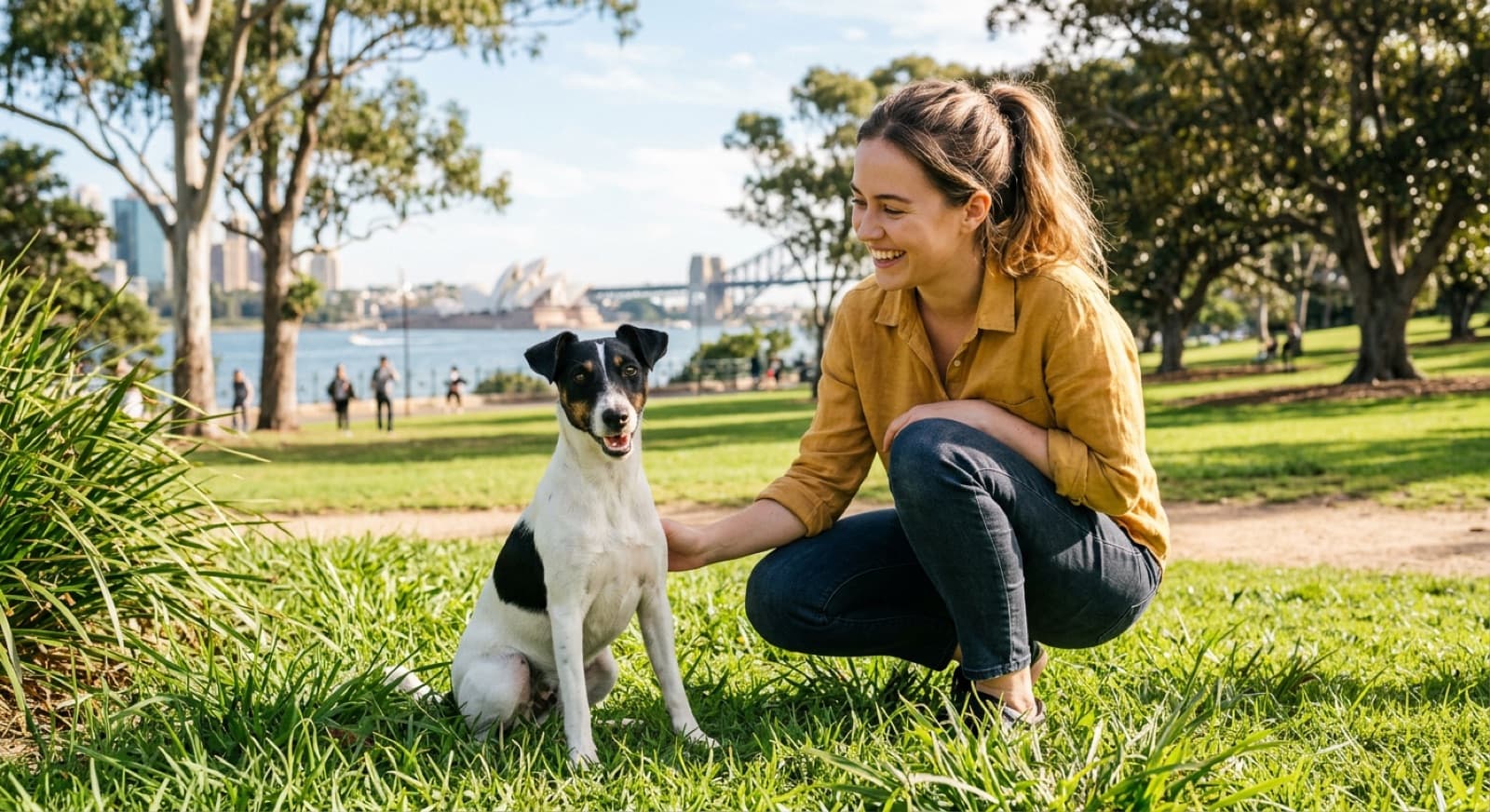
The short answer
You can adopt a Fox Terrier in Sydney, but be patient and be honest about the breed. A Fox Terrier is a small, bold, clever working terrier, roughly four to eight kilograms, far busier and gamier than its size suggests, with a strong prey drive and a habit of barking at everything. There are three types you will meet: the Smooth Fox Terrier, the Wire Fox Terrier, and the smaller Australian-developed Miniature Fox Terrier, or mini foxie. They are affectionate and lively with their people and make sharp little watchdogs, but they need real daily exercise, mental work and secure fencing because they dig, climb and escape. Full purebreds are uncommon in rescue, so set alerts across the five main NSW rescues, be application-ready, and stay open to a Foxie cross or an older dog. Adoption runs about $400 to $650 for an adult, all-inclusive, against far more from a breeder. Adopting is cheaper and lets you see the dog you are actually getting.
What a Fox Terrier actually is
Before you go looking, it helps to be clear on the basics. Unlike a doodle or a designer cross, a Fox Terrier is a purebred, a proper working breed developed in England to bolt foxes from their earth during the hunt and to clear vermin. It is a small dog, usually around four to eight kilograms depending on the type, but do not let the size fool you. This is a bold, game, hardy little terrier, far more determined and driven than its weight suggests. The build is neat and athletic, and the expression is unmistakably keen. A Fox Terrier is almost always watching, listening and ready to move.
There are three types you are likely to meet. The Smooth Fox Terrier has a short, flat, easy-care coat. The Wire Fox Terrier has a dense, harsh, wiry coat that needs more grooming, and is the classic square-jawed show terrier many people picture. The Miniature Fox Terrier, or mini foxie, is a smaller type developed here in Australia from Fox Terrier stock as a compact ratting and hunting dog, and it is one of the most popular small companions in the country. All three share the same core: bold, clever, endlessly busy, packed with drive and curiosity, and usually white with tan or black markings.
The temperament is the part that matters most for adoption, because it is where the surprises live. Fox Terriers are affectionate, lively and devoted with their people, and they make alert little watchdogs that miss nothing. But they are working terriers to the core, and that brings three traits every prospective owner needs to understand. The first is energy and drive. A Foxie was bred to work hard and think for itself, so it needs real daily exercise and something to do with its clever brain, not a token stroll.
The second is prey drive. They started as fox and vermin hunters, so many have a powerful instinct to chase small, fast-moving animals, and they will dig under and climb over fencing to get to something. The third is a real talent for barking and escaping. A bored Foxie will bark at the postie, the neighbour's cat and the wind, dig under the fence, and become a determined escape artist. Put together, this is a small dog with a large working engine: robust, cheerful, sharp and outdoorsy, well suited to an active owner or family who can give a busy terrier a real job. It is not a quiet apartment ornament, and going in expecting one is exactly how Foxies end up in rescue.
Why Fox Terriers end up in Sydney rescue
A Fox Terrier in rescue is rarely a broken dog. It is usually a devoted little terrier whose energy or instincts outran its last home. Understanding the common reasons tells you whether the breed is genuinely right for you.
The energy was underestimated. This is the big one. People see a small, smart, handsome dog and picture a low-key lap companion, then discover a tireless working terrier that needs a proper walk plus running, a game or training most days, and mental work on top. When that does not happen, a bored Foxie does not switch off. It barks, digs, chews and finds its own entertainment, and that is often the point where an owner gives up. A Fox Terrier is as much dog as many breeds twice its size.
The barking. Foxies are vocal, alert watchdogs by nature, and a bored or under-exercised one can bark a lot. In a Sydney unit or a townhouse with close neighbours, nuisance barking is a common trigger for complaints and, eventually, a surrender. It is manageable with exercise, training and mental stimulation, but an owner who expected a quiet dog is often caught off guard.
The escaping and digging. Fox Terriers were bred to go to ground, so digging is hardwired, and they are agile climbers too. An ordinary suburban fence is not always enough, and a Foxie that gets out to chase a cat or follow a scent is a genuine risk to itself on Sydney roads. Owners who did not secure the yard, or who left a bored dog alone in it, sometimes reach rescue after one too many escapes.
The prey drive. A Foxie with a strong prey drive can be trouble in a home with a cat, chickens or small pets if it was never assessed for it, and a chase incident can be the trigger for a surrender. It can also make off-lead walks stressful if recall was never trained, because a terrier locked onto a scent or a rabbit can be very hard to call off.
Life changes and housing. Many Foxies reach rescue through no fault of their own, after a relationship breakdown, a new baby, an owner moving into aged care, or a move to a rental or strata building that will not take a dog. If you can commit to the exercise, the training, the secure fencing and managing the barking, you are looking at a wonderful adoption. If you wanted a truly quiet, low-energy dog, being honest now saves a Foxie from being the next surrender.
Where to adopt a Fox Terrier or cross in Sydney
Because full purebred Fox Terriers are uncommon in general rescue, a wide alert net is the right approach. Set listing alerts on every rescue you would consider, and stay open to a Foxie cross, a mini foxie or an older dog. For a fuller directory, see our Sydney adoption resources hub.
1. RSPCA NSW
The Sydney Adoption Centre at Yagoona plus regional NSW centres. Fox Terriers and Foxie crosses come through occasionally via owner surrender, and every adoption includes desexing, vaccination, microchipping, a vet workup and a behavioural assessment. A surrendered dog often arrives with a known history the team can talk you through, including its energy level, its barking and how it goes with other animals, which is exactly what you want to know for a working terrier. Apply at rspcansw.org.au.
2. Animal Welfare League NSW
AWL NSW runs the Kemps Creek Shelter plus around a dozen volunteer branches across the state. Purebred Foxies are uncommon on the roster but do appear, often as crosses or mini foxies. Adoption includes desexing, vaccination, microchipping and a vet check, with staff who can talk through what a busy little terrier needs day to day. Current listings on awlnsw.com.au.
3. Sydney Dogs and Cats Home
The city's oldest shelter, founded in 1946, at Strathfield South. It takes a broad mix of dogs through owner surrender and council contracts, so a Fox Terrier, mini foxie or Foxie cross turns up from time to time. Adoption includes desexing, vaccination, microchipping, parasite treatment and a vet check. More at sydneydogsandcatshome.org.
4. Monika's Doggie Rescue
No-kill foster-based rescue at Doggiewood in Ingleside on the Northern Beaches. Because the dogs live in foster homes, the notes on a Foxie's energy, recall, barking and behaviour around cats and other animals tend to be detailed and honest, which is exactly what you need for a terrier with a real prey drive. Adoption includes a home check. Listings at doggierescue.com.
5. Maggie's Rescue
Inner West rescue based in Marrickville, running a foster-to-adopt model with a trial built into every adoption, which is genuinely useful for checking a Foxie fits your home, your routine and your fencing before you commit. Information and application links at maggiesrescue.org.
Some adopters search for a dedicated Fox Terrier Rescue NSW, but we cannot verify a currently active organisation by that name, so use the general rescues above, set alerts, and be wary of any group that asks for money before you have confirmed a real address, a current adoptable-dog list and charitable status. Browse the Fox Terriers, mini foxies and Foxie crosses currently listed on the Sydney Fox Terrier listings.
What a Fox Terrier costs: adopt versus buy
Adoption is far cheaper at the outset. A rescue fee for an adult Fox Terrier through a Sydney rescue commonly runs about $400 to $650, and a puppy $580 to $850, and that fee already covers desexing, vaccination, microchipping, worm and flea treatment and a vet check.
A Fox Terrier or mini foxie puppy from a breeder in Australia, by contrast, often runs into the many hundreds or into the thousands, with none of that vet work done yet. So adopting is much cheaper up front, the dog arrives already vetted, and if you adopt an adult you can see the energy level, the barking and the temperament rather than gamble on a puppy.
Plenty of people arrive here after searching for a Fox Terrier to buy, and that makes sense, because the for-sale listings usually outnumber the rescue ones for an uncommon breed. But before you spend anything, know that any high-demand small purebred is a magnet for fake listings, deposit scams and backyard breeders. A cheap puppy, a free-to-good-home Foxie, or a deposit request for a dog you have not met in person is a warning sign rather than a bargain, and the ACCC Scamwatch has documented deposit scams for puppies that do not exist. A seller who will not show you both healthy parents at their property is a red flag rather than a mark of quality.
On ongoing cost, a Fox Terrier is a fairly economical dog to own, but a few things are worth budgeting for. A Smooth Foxie's coat is genuinely wash-and-go, while a Wire coat needs regular grooming and periodic hand-stripping that some owners learn and others pay a groomer for. Beyond grooming, budget for year-round paralysis tick and parasite prevention, which is essential everywhere in coastal NSW, and pet insurance you take out while the dog is young. Council registration through the NSW Pet Registry is a modest one-off, and a desexed dog attracts the lower lifetime fee.
Is a Fox Terrier right for you
A Fox Terrier suits an active owner or family who wants a bold, clever, affectionate companion with plenty of personality, and who can give a busy terrier real exercise and a job to do. If you walk, run, hike, train or spend time at the park, a Foxie will throw itself into all of it, and its small size makes it easy to travel with. They are robust, good-natured dogs that usually do well with children they are raised alongside, and their sharp watchdog instinct means very little happens at your door without you knowing about it.
The honest counter-case comes down to four things. The energy is real, so if your week cannot fit genuine daily exercise and mental work, plan for a calmer breed instead. The barking is real, so close-neighbour living needs training and management. The escaping is real, so you need secure, dug-proof fencing, not an average suburban boundary. And the prey drive is real, so if you have a cat or small pets, you need a dog specifically assessed as safe with them, not a hopeful guess. Let the individual dog in front of you, and the foster carer's honest notes, guide your decision rather than the breed name. For the full exercise, training and temperament picture, and the breed-specific health risks to plan for, lean on the cluster: the Fox Terrier exercise and temperament guide covers the day-to-day, and the Fox Terrier health guide covers the medical side. The RSPCA Australia Knowledgebase and the Australian Veterinary Association both have good general guidance on choosing a dog that fits your life.
Fox Terriers are not restricted in NSW
It is worth stating plainly. The Fox Terrier is not on the NSW restricted-breed list. Under the NSW Office of Local Government, only five breeds are restricted under the Companion Animals Act 1998: the American Pit Bull Terrier, Dogo Argentino, Japanese Tosa, Fila Brasileiro and Perro de Presa Canario. A Smooth, Wire or Miniature Fox Terrier is legal to own and rehome normally, and simply needs to be microchipped by 12 weeks and registered with your council by 6 months of age.
As a small, non-guardian breed, a Foxie rarely raises housing concerns either. The bigger practical questions in unit or strata living are the exercise it needs, the barking to manage, and the secure fencing to stop it escaping, so if you are in an apartment, confirm dogs are permitted where you live, work out where the daily running will happen, and be honest about whether you can meet a working terrier's needs before you apply.
Browse adoptable Fox Terriers in Sydney
Full purebreds are uncommon in rescue, so crosses, mini foxies and older dogs appear more often than puppies. Browse live NSW listings and set an alert so you hear the moment one comes in.
See Available Fox Terriers →Adult or puppy, and how to choose
For almost every adopter an adult is the better choice, and Fox Terrier puppies are rare in rescue anyway. With a working terrier this matters more than usual, because the traits that make or break the fit, the energy level, the barking and the prey drive, are far easier to read in an adult. A puppy is a genuine gamble on how much drive it will have and how it will go with a cat, and you will not really know for months. An adult rescue Foxie has already settled into its actual temperament, so you can see rather than guess what you are getting.
An adult also comes with a known history the rescue can describe, often some training in place, and a lower adoption fee. When you choose, read the foster carer's notes closely. They will tell you how a specific dog does with children, cats, other dogs and being left alone, plus how strong its prey drive is, how much it barks, and how it copes with grooming, and that record predicts the fit far better than the breed average. Ask directly about recall and about small animals. Older, settled Foxies are often the ones that wait longest and make the steadiest, most affectionate match for a home that can give them the exercise and secure yard they need.
Frequently Asked Questions
Where can I adopt a Fox Terrier near me in Sydney?
Start with the five main NSW rescues: RSPCA NSW (Sydney Adoption Centre at Yagoona), Animal Welfare League NSW (Kemps Creek plus regional branches), Sydney Dogs and Cats Home (Strathfield South), Monika's Doggie Rescue (Ingleside) and Maggie's Rescue (Marrickville). Be realistic about supply. A full purebred Fox Terrier is uncommon in Australian rescue, so they turn up less often than mainstream breeds, and Foxie crosses appear far more frequently than a pedigree dog. The reliable approach is to set listing alerts across every rescue you would consider, have your application and references ready in advance, and stay open to a cross or an older dog. If you find a group calling itself a Fox Terrier rescue, confirm it is real before you engage, and never send money before you have.
Do Fox Terriers need a lot of exercise?
Yes, Fox Terriers are working terriers with a full tank of energy, and underestimating that is the top reason they land in rescue. They were bred to bolt foxes from earth and keep pace in the field, so a slow lap of the block will not touch the sides. Plan on a solid daily walk plus off-lead running in a secure area, a game, or some training most days, and give the busy terrier brain a job to do as well. A well-exercised Foxie is a cheerful, affectionate companion. A bored, under-exercised one barks, digs, chases and works out how to escape. For the full exercise and training breakdown, see our Fox Terrier exercise and temperament guide.
Are Fox Terriers good with cats and small pets?
Often not, because a Fox Terrier is a working terrier with a strong prey drive. The breed was created to hunt and dispatch foxes and vermin, so many Foxies will chase a cat, rabbit, guinea pig or bird on instinct, and a chase can turn serious fast. Some Fox Terriers raised alongside a cat from a pup live with it happily, while others should never share a home with small animals at all. The breed label will not tell you which one you have. The single best move is to ask the rescue or foster carer how a specific dog has been assessed around cats and small pets, and to take that assessment seriously rather than hoping the dog will settle.
What is a Miniature Fox Terrier or mini foxie?
A Miniature Fox Terrier, or mini foxie, is a small terrier type developed in Australia, bred down from Fox Terrier stock as a compact ratting and hunting dog on farms and homesteads. It is smaller than a Smooth or Wire Fox Terrier, typically only a few kilograms, but keeps the same bold, clever, busy temperament and the same terrier prey drive. Mini foxies are popular family and companion dogs across Australia, and you will see them and their crosses in rescue more often than either full-size Fox Terrier. Everything in this guide about energy, secure fencing and caution around small pets applies to a mini foxie too, just in a smaller package.
Why do Fox Terriers end up in rescue?
Usually because the energy and terrier instincts caught the owner out, not because of a fault in the dog. People see a small, smart, handsome dog and picture a quiet lap dog, then meet a tireless working terrier that needs real daily exercise, digs under and climbs over fencing, chases anything small and fast, and barks at everything that moves. A bored, under-exercised Foxie becomes a digging, escaping, noisy handful, and that mismatch is a common surrender story. Others reach rescue through no fault of their own, after a relationship breakdown, a new baby, an owner going into aged care, or a move to housing that will not take a dog. The temperament is usually intact and devoted.
How much does it cost to adopt a Fox Terrier versus buy one?
Adoption is far cheaper up front. A rescue fee for an adult Fox Terrier through a Sydney rescue commonly runs about $400 to $650, and a puppy $580 to $850, and that fee already includes desexing, vaccination, microchipping, worm and flea treatment and a vet check. A Fox Terrier or mini foxie puppy from a breeder in Australia often runs into the many hundreds or into the thousands, with none of that vet work done yet. So adopting is much cheaper at the outset and the dog arrives already vetted. Adopting an adult also lets you see the actual energy level and how the dog goes with other animals, rather than gambling on a puppy.
Are Fox Terriers restricted in NSW?
No, the Fox Terrier is not a restricted breed in NSW. Under the Companion Animals Act 1998, only five breeds are restricted: the American Pit Bull Terrier, Dogo Argentino, Japanese Tosa, Fila Brasileiro and Perro de Presa Canario. A Smooth, Wire or Miniature Fox Terrier is legal to own and rehome normally, and simply needs to be microchipped by 12 weeks and registered with your council by 6 months of age. As a small, non-guardian breed, a Foxie rarely raises housing concerns either, though the practical questions in a unit are the exercise it needs, the barking to manage, and the secure fencing to stop it escaping.
Are Fox Terriers good family dogs?
Yes, a well-exercised Fox Terrier is a lively, affectionate, devoted family dog that bonds hard with its people and usually does well with children it is raised alongside. They are bold, clever and love being part of the action, which is a big part of why the breed and the mini foxie are such popular Australian companions. The honest catch is the energy, the barking and the terrier instincts. A Foxie needs real daily exercise and mental work, secure fencing because they dig and climb, and management around small pets given the prey drive. Meet those needs and it is a wonderful, robust family dog. As always, the foster carer's notes on a specific dog with kids and other animals predict the fit far better than the breed average, so ask.
Should I adopt an adult Fox Terrier or a puppy?
For most adopters an adult is the better choice, and Fox Terrier puppies are rare in rescue anyway. An adult has already settled into its actual energy level, temperament and quirks, so you can see rather than gamble on what you are getting, including how strong its prey drive is and how it handles other animals and barking. An adult also comes with a known history the rescue can describe, often some training in place, and a lower adoption fee. It lets the rescue tell you how the dog is with children, cats and other dogs, and how it copes with being left alone. Older, settled Foxies are often overlooked and make a steady, affectionate match for a home that can give them the exercise they need.
Keep reading
Adoptable Fox Terriers in Sydney
Live listings of Fox Terriers, mini foxies and Foxie crosses across Sydney and NSW rescues.
Fox Terrier Exercise & Temperament
How much exercise a Foxie really needs, managing barking and prey drive, and off-lead recall.
Fox Terrier Health Issues in Sydney
The health risks the breed is prone to, plus Sydney heat and year-round paralysis tick prevention.
All Sydney Adoption Guides
Browse every breed and how-to guide for adopting a rescue dog in Sydney.