The short answer
Choose a cat-safe dog or a dog-safe cat first, using the rescue foster notes, then go slow with the dog on lead. Set up a dog-free safe room for the cat with high perches, its own tray and food. Swap scents for several days before any meeting. Do the first meeting with the dog calm and on a loose lead while the cat is free to come or go, keep it short, and reward calm. Build up to supervised loose time over days or weeks. Never leave them alone together until they are reliably relaxed.
It starts before you adopt
The best cat and dog introductions are half won before the two animals ever meet, because you picked a good match. If you already have a dog and want a cat, adopt a cat known to be relaxed around dogs. If you have a cat and want a dog, adopt a dog assessed as cat-friendly. This one decision matters more than any technique in this guide.
Most Sydney rescue animals are assessed for cat and dog compatibility while in foster care, and those foster notes are the single most useful thing you will read. A note like “good with dogs” on a cat, or “good with cats” on a dog, means a real person has watched that animal stay calm around the other species in a home. That is far more reliable than breed or appearance. When you browse Sydney cat listings, look for that flag, and tell the rescue you have a dog at home so they can help you match. Rescue cats and dogs are already desexed, vaccinated and microchipped, so you are choosing on temperament, not paperwork.
Some dogs need extra caution. Dogs bred to chase, and any dog with high prey drive, can struggle to see a cat as anything but something to hunt. That does not rule them out, but it means a slower, more careful introduction and honest supervision. If you are adopting the dog side of this equation, the same matching logic applies on the Sydney dog listings. The RSPCA Australia Knowledgebase has good general guidance on introducing pets that is worth reading alongside this.
Set up for success first
Get the home ready before the new animal arrives. Rushing the setup is how introductions go wrong, so spend a day or two on this.
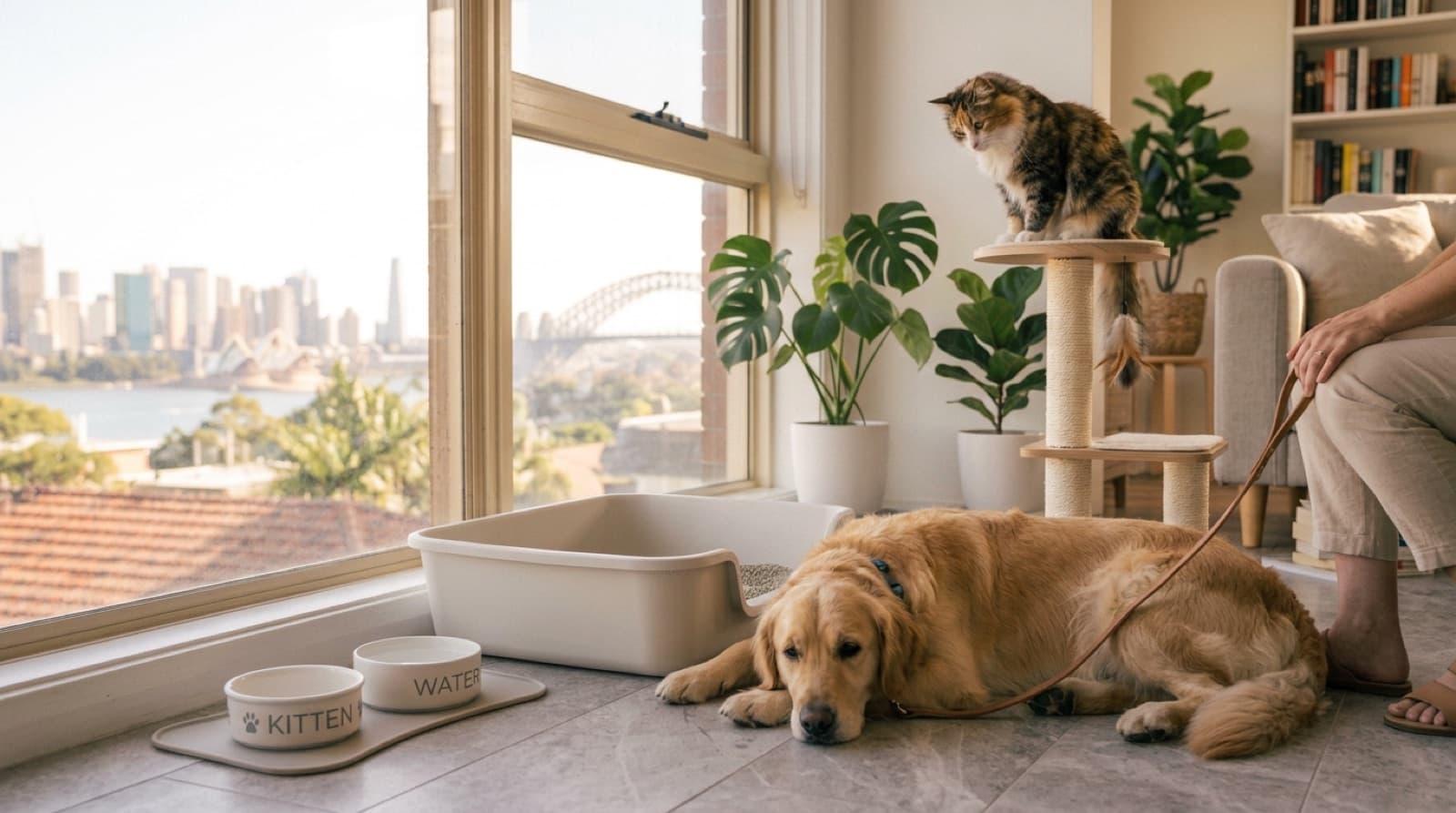
The most important piece is a dog-free safe room for the cat. This is a room the dog never enters, with a door that closes, where the cat has its litter tray, food, water, a bed and somewhere high to sit. A spare room, a bedroom or even a large bathroom works. This is the cat's base for the whole process, and in most homes it stays a permanent cat retreat long after the introduction is done. A cat that always has an escape route stays far calmer than one that feels trapped.
Add vertical space through the rest of the home too: a cat tree, a shelf, the top of a bookcase, anywhere the cat can get up high and watch the dog from safety. Cats feel secure looking down. A baby gate or two lets the animals see and smell each other with a barrier in place, and a tall gate the cat can jump over but the dog cannot is ideal. Finally, your dog needs the basics: a reliable “sit”, “stay” and “leave it”, and comfort being on lead indoors. If those are shaky, spend a week polishing them before the cat comes home.
Stage 1: Scent swapping and separation
For the first few days, the cat and dog do not see each other at all. The cat lives in its safe room while it settles, and the dog has the rest of the home. This gives the new arrival time to decompress, which for a rescue cat can take days on its own before you add another animal to the mix. Our guide to the first week with a rescue cat covers that settling period in detail.
During this stage, you swap scents so each animal learns the other exists before they meet face to face. Rub a soft cloth or sock on the cat, especially the cheeks, and leave it near the dog's bed, and do the same in reverse. Swap bedding between the two spaces. Let the dog sniff under the safe-room door while calm, and reward that calm with treats. You can also feed both animals on either side of the closed door, a little apart at first, so each starts to link the other's smell with good things like dinner. Only move on once both animals are eating and relaxed near the door.
Stage 2: The controlled first meeting
When both animals are calm through the door, arrange a controlled visual meeting. Put the dog on a loose lead and have it sit or lie calmly with you, ideally with a second person helping. Open the barrier or the door so the cat can see the dog from a distance, but leave the cat free to approach or retreat on its own terms. Do not hold or carry the cat toward the dog. A cat that can escape stays calm. A cat that is cornered panics.
Keep it short and calm, a few minutes at most, and end on a good note before either animal gets tense. Reward the dog steadily for staying settled and ignoring the cat. If the dog stays relaxed and the cat is curious or simply indifferent, that is a win. If the dog gets over-excited or the cat hisses hard and bolts, calmly end the session and go back to more door work. Hissing and a bit of caution from the cat is normal early on and not a reason to panic. Repeat these short sessions once or twice a day, keeping the lead loose and the mood boring, until both animals treat the sight of each other as no big deal.
Browse adoptable cats in Sydney
Filter for cats the rescue has assessed as good with dogs, so half the introduction is won before you get home. Browse the live listings from rescues across Sydney and NSW.
See Available Cats →Stage 3: Supervised loose time
Once the short on-lead meetings are consistently calm across several sessions, let the dog move around the room with a lead dragging on the floor instead of held. This keeps a handle within reach if you need to step on it and stop a chase, while giving both animals more normal space. The cat should always have its escape routes: high perches to jump to and a clear path back to the safe room.
Supervise every minute of this, and keep sessions calm. Reward the dog for choosing to settle or look away from the cat rather than following it. If the dog starts to trail the cat with intent, calmly interrupt, ask for a “sit”, and reward. Slowly build up the length of these supervised loose sessions over days or weeks. The pace depends entirely on the two animals, so let their behaviour decide, not the calendar. You are looking for both of them to relax, ignore each other, and get on with normal life in the same room.
Stage 4: Unsupervised time (much later)
Only leave the cat and dog alone together once they have shown weeks of consistently calm behaviour with you present. There is no shortcut here and no reward for rushing it. Start with very short absences, a few minutes, and build up gradually, always leaving the cat with its dog-free safe room and high perches it can reach at any time.
Plenty of Sydney households choose to keep the cat and dog separated whenever no one is home, permanently, and that is a completely sensible call. It is especially wise with a big dog and a small or elderly cat, or any dog whose calm you would not stake the cat's safety on. Separation when unsupervised is not a failure. It is a normal, safe way for a cat and dog to live together for life.
Reading both animals and managing prey drive
Your job through every stage is to watch both animals honestly and act on what you see, not on what you hope. Here is what to look for:
- Dog: stop signals. A locked, unblinking stare at the cat, a low crouch or stalk, stiff body, whining, or trembling with focus are all signs of predatory or over-aroused behaviour. If you see them, calmly separate the animals and slow the whole process right down.
- Dog: good signals. Loose, wiggly body, glancing at the cat then looking away, choosing to sniff or lie down, taking treats easily. This is the dog you want.
- Cat: normal early stress. Hissing, a puffed tail, or backing away is normal in the first meetings and usually settles. It is communication, not a crisis.
- Cat: real danger. A cat that is cornered, blocked from its escape route, frozen, or being chased is in genuine trouble. Never let the dog trap or pursue the cat, even in play.
- Both: over-arousal. If either animal is getting more wound up rather than calmer as a session goes on, end it early. Always finish before things tip over.
Prey drive is the one thing you cannot train away, only manage. A dog with strong prey drive can flip from calm to chase in a heartbeat, which is why the lead, the barriers and the supervision matter so much. Never test a high-drive dog by letting it loose with the cat to “see what happens”. Manage the environment so the wrong thing simply cannot occur.
Give the cat control
A cat that feels in control of its own space stays calm, and a calm cat is a safe cat. Vertical space is the key. Cat trees, shelves, the top of a wardrobe and window perches let the cat get up high, watch the dog from safety, and move around the home along routes the dog cannot follow. Baby gates give the cat a low-stress way to observe the dog with a barrier in place.
The golden rule is never to corner a cat with a dog, and never to force them together. Do not hold the cat while the dog approaches, do not block its exit, and do not shut the two in a small room to “work it out”. Let the cat choose its distance every time. The safe room, the high perches and the freedom to walk away are what turn a tense first week into a calm household. Sydney cats do best living indoors or with contained outdoor access anyway, which we cover in the indoor versus outdoor cats guide, and a well set-up indoor home is exactly what a cat sharing space with a dog needs.
When to get professional help
Some situations are beyond a home introduction, and knowing when to call for help is part of doing this responsibly. Get professional support if your dog shows fixed predatory behaviour toward the cat, if either animal is not settling after weeks of careful work, or if there has ever been a serious lunge, grab or injury. Do not push through predatory fixation on your own.
Look for a qualified force-free trainer experienced with dog and cat households, or a veterinary behaviour service for the harder cases. A vet is the right first call if the behaviour is sudden or severe, and can refer you to a veterinary behaviourist. The Australian Veterinary Association is a good starting point for finding accredited help, and specialty referral hospitals such as SASH in Sydney offer behaviour services. A good professional will give you an honest answer, including the hard one: that a particular dog and cat may never be safe housemates, and lifelong separation or rehoming the wrong-matched animal is sometimes the kindest outcome.
Special cases worth extra care
A few pairings need more caution than the standard process:
- Kitten with a big dog. A tiny kitten and a large dog is a size mismatch where even friendly, clumsy play can injure the kitten. Supervise closely, keep the kitten's safe room genuinely dog-proof, and do not rush loose time. Many people wait until the kitten is bigger and steadier before easing the barriers.
- Senior cat with a bouncy dog. An older, arthritic or set-in-its-ways cat has little patience for a young, high-energy dog. Give the senior cat extra escape routes, keep sessions short, and manage the dog's energy with exercise before any introduction so it arrives calmer.
- High prey-drive dogs. Dogs bred to chase or hunt need the slowest process, the most management, and honest supervision for life. Some do learn to live calmly with a cat. For others, permanent separation when unsupervised is the only safe arrangement, and there is no shame in that.
Whatever the pairing, the principles do not change: adopt for compatibility, go slow, keep the dog on lead early, give the cat control and escape routes, and never leave them alone until you have earned that trust. If you are still choosing your cat, our full Sydney cat adoption guide covers picking the right cat for your home.
Frequently Asked Questions
How do I introduce a new cat to my dog?
Go slowly and keep them apart at first. Set up a dog-free safe room for the cat, then swap scents between the two animals for several days before they ever see each other. When you do a first meeting, keep the dog on lead and calm while the cat is free to approach or retreat, and reward the dog for staying settled. Build up from short, controlled meetings to supervised loose time over days or weeks, and never leave them alone together until they are reliably calm. Rushing is the single biggest cause of a bad first impression that is hard to undo.
How long does it take for a cat and dog to get along?
It varies a lot, from a few days to a few months. A confident cat and a calm, cat-experienced dog can settle in a week or two. A shy cat, a bouncy young dog, or a dog that has never lived with a cat will take longer, sometimes six to twelve weeks of staged introductions. The goal is not instant friendship. Most cats and dogs end up as calm, indifferent housemates rather than cuddle buddies, and that is a perfectly good outcome. Let the animals set the pace and do not skip stages to save time.
Will my dog hurt my new cat?
A dog can seriously injure or kill a cat, which is exactly why every meeting is controlled and supervised. Even a friendly dog can hurt a cat by accident through rough play or a chase reflex, and a dog with strong prey drive can do real harm in seconds. That risk is manageable. Keep the dog on lead for early meetings, give the cat vertical escape routes and a dog-free safe room, and never leave the two alone until you have weeks of calm behaviour to trust. If your dog shows a fixed, predatory stare or tries to stalk the cat, stop and get help from a qualified force-free trainer or a veterinary behaviour service before going further.
How do I know if a rescue dog is safe with cats?
Look for a dog the rescue has already assessed as good with cats. Many Sydney rescue dogs are fostered in homes with cats, and the foster carer notes whether the dog ignores, tolerates, or fixates on them. Those notes are the single most reliable predictor you will get, far better than breed or looks. When you browse listings, filter or ask for dogs flagged as cat-friendly or cat-tested, and tell the rescue you have a cat at home. A dog with an unknown history around cats is not off the table, but it needs a more careful, slower introduction and honest supervision.
Should the dog be on a lead when meeting the cat?
Yes, always, for the early meetings. A lead lets you keep the dog calm and stop a chase before it starts, and it means the cat stays in control of how close things get. Keep the lead loose rather than tight, because a tight lead can build tension and frustration in the dog. Let the cat approach or retreat on its own terms while the dog stays settled beside you. Once the dog is reliably calm on lead across several sessions, you can move to a dragging house-lead for supervised loose time, and only much later to no lead at all.
What if my dog is obsessed with the cat?
A dog that fixates on the cat with a locked stare, stalking, or whining and lunging is showing predatory or over-aroused behaviour, and you should stop and get help. This is not a phase to push through on your own. Keep the animals fully separated for now, with the cat safe behind a closed door, and contact a qualified force-free trainer or a veterinary behaviour service experienced with predatory behaviour. Some dogs learn to settle around cats with the right structured plan. Others never become safe housemates for a cat, and a good professional will tell you honestly which one you have.
Can a cat and dog ever be left alone together?
Only after weeks of consistently calm, supervised behaviour, and even then, cautiously. Do not leave a new cat and dog loose together unsupervised for at least the first several weeks, no matter how well things seem to be going. When you do start leaving them, do it gradually: short absences first, with the cat still having a dog-free safe room and high perches it can reach any time. Many households keep the cat and dog separated whenever no one is home for good, especially with a bigger dog or a small or elderly cat. There is no prize for rushing this step.
Is it easier to adopt a cat already known to be good with dogs?
Much easier, and it is the smartest move if you already have a dog. Rescue cats in foster care are often assessed around dogs, and a cat flagged as good with dogs has already shown it can stay calm rather than panic, which removes most of the guesswork. The same works in reverse: if you have a cat and are adopting a dog, look for a dog tested as cat-friendly. Matching two animals that are each known to cope with the other species is the closest thing to a shortcut there is. Tell the rescue about your existing pet and ask them to help you match.
Keep reading
Adoptable Cats in Sydney
Live listings of kittens, adults and seniors, including cats assessed as good with dogs.
First Week With a Rescue Cat
The safe room, the settling period and the 3-3-3 rule before you introduce another pet.
Cat Adoption Guide for Sydney
Where to adopt, what it costs, NSW law, and how to choose the right rescue cat.
All Cat Adoption Resources
Guides on adopting, settling, indoor living and caring for a rescue cat in Sydney.