The short answer
Set up one quiet room before your cat arrives, with a litter tray, food, water, hiding spots and a scratching post. On arrival, put the carrier down, open it, and let the cat come out on its own. Expect hiding, silence and a small appetite for the first few days. That is decompression, not fear of you. Follow the 3-3-3 rule: 3 days to settle, 3 weeks to learn your routine, 3 months to feel at home. Do not force interaction and do not rush the house. But if your cat eats nothing for more than 24 to 48 hours, or seems lethargic or unwell, call a vet.
The 3-3-3 rule for a new cat
The 3-3-3 rule is the most useful thing to hold in your head in the first month. It is a rough timeline, not a promise, but it sets honest expectations and stops you worrying that a quiet, hiding cat is a mistake. It breaks the settling-in period into three stages.
- The first 3 days: decompression. Your cat has lost every familiar smell and sound. Most cats hide, stay silent and eat little. This is the cat protecting itself in an unknown place, and it is completely normal. Your job is to be calm, quiet and low pressure.
- The first 3 weeks: settling in. The cat starts to learn your routine, when you feed it, when the house is busy, where the litter tray is. It ventures out more, often at night first, and begins to respond to your voice. Confidence grows steadily.
- The first 3 months: bonding. By now most cats show their true personality. You learn whether you have a lap cat or an independent one, where it likes to sleep, and how it plays. This is when the real relationship takes hold.
Shy cats, older cats and cats that came from the street often take longer, and that is fine. A confident cat from a foster home may skip ahead. The RSPCA Australia Knowledgebase has good general guidance on helping a cat settle. The one rule that never changes is to let the cat set the pace.
Before you bring the cat home: the safe room
Set the room up before the cat arrives, not after. Pick one quiet space away from the busiest part of the home, a spare room, a quiet bedroom or a study. A whole house is overwhelming to a cat that knows none of it, but one room is a territory it can learn in a day. Keeping the litter tray close by also means the cat always knows where it is, which prevents early accidents.
A good safe room has all of these:
- A litter tray in a private corner, away from the food and water.
- Food and water bowls at the other end of the room from the tray. Cats dislike eating next to their toilet.
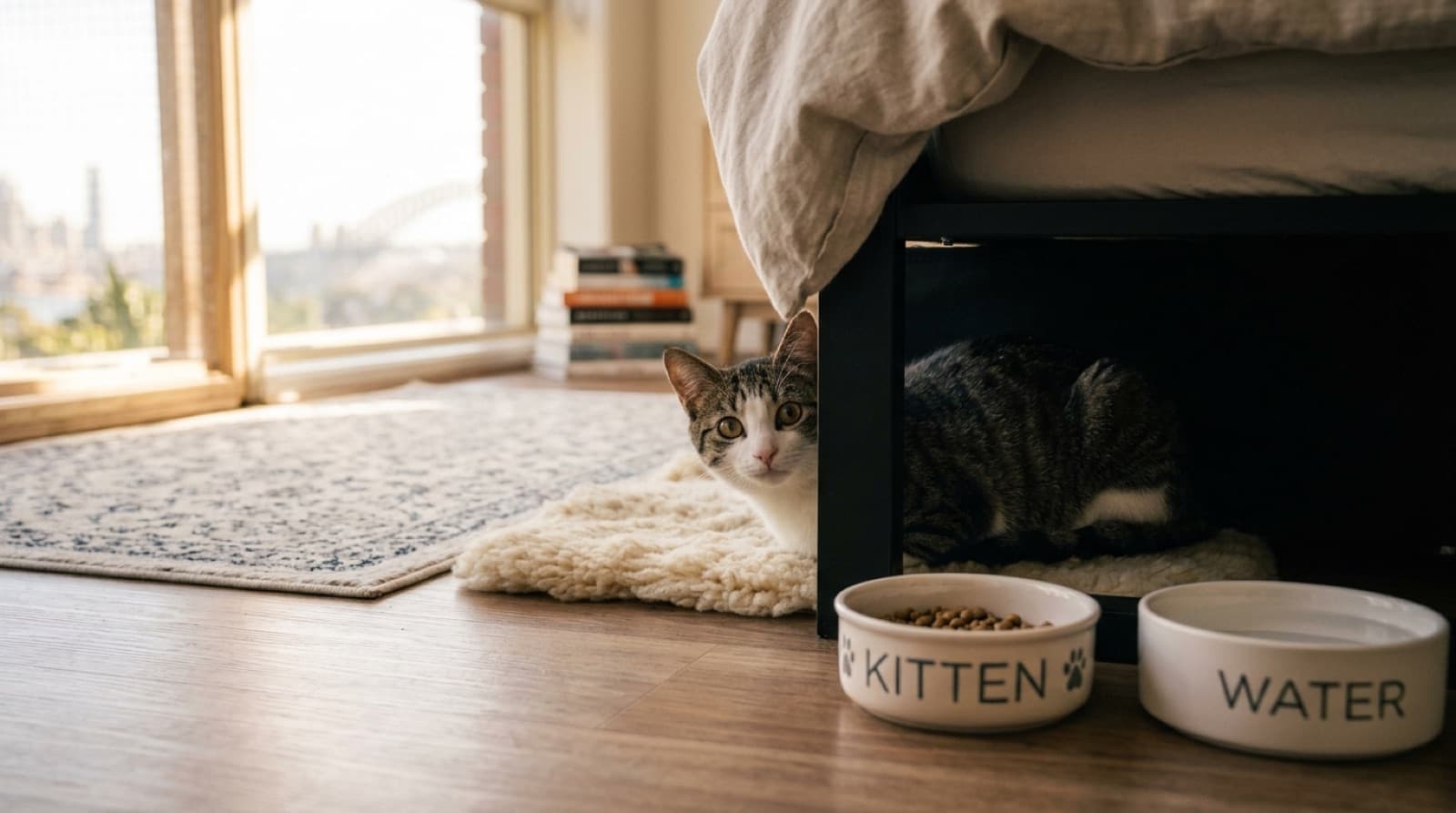
- Hiding spots. A covered bed, a cardboard box on its side, or the gap under a low bed. Hiding is how a cat feels safe, so give it options.
- A scratching post so the cat can mark and stretch, which also protects your furniture.
- A comfortable bed and, if the rescue can give you one, a blanket or toy that already smells of the foster home.
- A window or perch if possible, so the cat can watch the world once it feels braver.
Close off anything risky before the cat explores: gaps behind appliances, open windows without secure screens, toxic pot plants, and dangling cords. A frightened cat will squeeze into the smallest space it can find, so block those it could get stuck in.
The car ride and arrival
Bring your cat home in a secure carrier, never loose in the car. A loose cat can panic, hide under the pedals and cause an accident. Put the carrier on the seat or the floor behind a front seat, drive calmly, and keep the car quiet. In Sydney summer heat, never leave the cat in a parked car even briefly, and run the air conditioning if it is a warm day.
When you get home, take the carrier straight to the safe room and shut the door. Open the carrier door and then step back. Do not tip the cat out or reach in to pull it out. Let it come out on its own, in its own time, even if that takes hours. Some cats bolt straight for a hiding spot, some sit in the carrier for a while working the room out from safety. Both are normal. Sit quietly, talk softly, and let curiosity do the work.
The first 24 to 48 hours: what is normal
The first two days can be quiet to the point of feeling like an anticlimax, and that is a good sign, not a bad one. Here is what is normal and does not need worrying about:
- Hiding all day. Many cats stay tucked away and only move at night when the house is silent. Let them.
- Eating little or nothing on day one. A stressed cat often skips the first meal or two. Leave food out and give it privacy.
- Silence. A cat that was chatty at the shelter may go quiet for days. Its voice comes back with its confidence.
- Using the tray at night. You may not see the cat eat, drink or toilet at first because it waits until you are asleep. Check the tray in the morning for signs it is going.
What not to do in these days: do not force interaction, do not invite visitors, do not carry the cat around, and do not let children or other pets crowd the safe room. Sit on the floor, read or work quietly in the room so the cat gets used to you as a calm, harmless presence. Let it sniff your hand if it chooses to, but do not push.
There is a line where quiet stops being normal, and it matters. A cat that eats nothing for more than about 24 to 48 hours, or that is limp and lethargic rather than simply shy, needs a vet. We cover the warning signs in full below.
Building trust: week one to three
Once the cat is eating and moving around the safe room, you can start building the bond. The tools are simple: routine, patience, food and play. Feed at the same times each day so the cat can predict good things. Spend time in the room without demanding anything, which teaches the cat that you being close is safe and boring rather than a threat.
Play is the fastest way in. A wand toy lets a nervous cat interact with you from a safe distance, and chasing a feather often unlocks a cat that will not yet be touched. Treats build the same trust: toss a few near the cat rather than holding them out, so it does not have to come right up to your hand to win. Talk to it in a soft, steady voice. Let it choose contact. When a cat first head-butts your hand or curls up in view rather than hidden, that is the real turning point.
Expand the territory gradually. When the cat eats in front of you, uses the tray reliably and greets you at the door, open the safe room and let it explore the rest of the house on its own. Keep the safe room set up as its home base so it always has somewhere familiar to retreat to. If the cat seems overwhelmed by the bigger space, scale back and give it more time. There is no prize for rushing.
Introducing other pets and children
If you have another pet or young children, the safe room does double duty: it keeps the new cat separate while everyone gets used to each other slowly. Cats accept each other through smell before sight, so the first few days of introduction happen through a closed door. Let the animals smell each other under the door and feed them on either side of it, so the other animal's scent becomes linked with something good.
When you move to face-to-face meetings, keep them short, calm and supervised, and never leave a new cat alone with a dog early on. With a resident cat, a slow scent-first introduction over a couple of weeks avoids the fights and grudges that a rushed meeting causes. Cat-to-cat introductions have their own finer points that deserve their own guide, so treat this as the general rule: go slow, supervise, and stop if either animal is highly stressed. With children, the golden rule is to let the cat approach them, never the other way around. Teach kids to sit still and let the cat come and sniff, and to leave it alone when it hides.
Indoor living, microchips and ticks in Sydney
Most Sydney rescues adopt cats out to live indoors or with contained outdoor access like a catio or secure yard, and the settling-in period is exactly when you set that up. An indoor cat that has a calm safe room to start from adjusts more easily than one given the run of a house and a cat flap on day one. We make the full case, and cover how to transition an outdoor cat, in the indoor versus outdoor cats guide, so we will not re-argue it here.
Two Sydney practicalities to sort in the first week. First, the microchip. Your rescue cat is already microchipped, but you need the chip details transferred into your name so the cat can be returned to you if it is ever lost. Most rescues start this, and you finalise it through the NSW Pet Registry. Under the NSW Companion Animals Act 1998 your cat must also be lifetime-registered, and the current fees are on the NSW Office of Local Government site.
Second, parasite prevention. The paralysis tick is present in Sydney bushland areas year-round and is fatal to cats if untreated. Even an indoor cat can be exposed, and heat is the other seasonal risk here. Ask your vet for a cat-safe parasite product, because some products made for dogs are toxic to cats. Never guess a product or dose yourself. For general advice on cat care, the Australian Veterinary Association is a reliable starting point, and your adopting rescue such as the groups in our Sydney cat adoption guide can tell you what the cat has already had.
Browse adoptable cats in Sydney
Kittens, adults, seniors, bonded pairs and indoor-only cats from rescues across Sydney and NSW. Find the cat whose foster notes suit your home and give it a calm first week.
See Available Cats →When to call a vet
Most settling-in behaviour needs patience, not a vet. But cats hide illness well, and a few signs mean you should not wait it out. The most important one is appetite. A cat that eats nothing for more than about 24 to 48 hours needs veterinary attention, because cats that stop eating can develop a serious liver condition called hepatic lipidosis. Do not assume a not-eating cat is just shy past that window.
Call a vet, or a 24/7 emergency hospital such as SASH, if your cat shows any of these:
- Not eating for more than about 24 to 48 hours.
- Lethargy or collapse, or hiding in a way that seems unwell rather than simply shy.
- Not drinking, or no urine or faeces in the litter tray after the first day.
- Repeated vomiting, or diarrhoea.
- Difficulty breathing, fast or open-mouthed breathing.
- Any wound, limping, or sign of injury.
- A tick, or any sudden weakness in the back legs, which can be a paralysis tick sign and is an emergency.
A booked settling-in check with your own vet in the first week or two is a good idea anyway. Bring the paperwork the rescue gave you. Do not give your cat any human medication or home remedy to tempt it to eat or to calm it, since many are toxic to cats. If your gut says something is wrong, trust it and ring your vet. That instinct is worth more than any checklist.
Frequently Asked Questions
What is the 3-3-3 rule for a new cat?
The 3-3-3 rule is a rough timeline for how a rescue cat settles: about 3 days to decompress, about 3 weeks to learn your routine, and about 3 months to feel fully at home. In the first 3 days many cats hide, eat little and stay quiet, which is normal. Over the first 3 weeks they start to explore, use their litter tray reliably and respond to your voice. By around 3 months you usually see the cat's true personality: where it likes to sleep, whether it is a lap cat, and how it plays. The numbers are a guide, not a deadline. Shy cats take longer, confident ones settle faster.
Why is my new rescue cat hiding?
Hiding is the single most normal thing a new cat does, so try not to read it as fear of you. A cat that has just moved home has lost every familiar smell, sound and sightline, and its instinct is to find a small, safe spot and watch from there until the world feels predictable. Give it a quiet room with places to tuck away, such as a covered bed, a box on its side or the gap under a low table. Do not pull the cat out or block the hiding spot. Sit nearby, talk softly, leave food and water, and let the cat come to you. Most cats start to venture out within a few days, usually at night first when the house is quiet.
My new cat will not eat. What should I do?
A little reduced appetite for the first day or so is common while a cat decompresses, but a cat that eats nothing for more than about 24 to 48 hours needs a vet. Cats that stop eating can develop a serious liver condition called hepatic lipidosis, so this is not something to wait out. First, make eating easy: put food in the quiet room near the hiding spot, try a strong-smelling wet food, and give the cat privacy rather than watching over the bowl. If it still will not eat within that window, or if it is also lethargic, not drinking or not toileting, contact your vet or a 24/7 emergency hospital. Do not give human food or any medication to tempt it.
How long until a rescue cat settles in?
Most rescue cats are visibly more relaxed within a week and genuinely at home within one to three months. The 3-3-3 rule is the usual shape: a few days of hiding, a few weeks of learning your routine, and up to three months to show full personality. Speed depends on the individual. A confident young cat from a foster home may be on the couch in days, while a shy or older cat, or one that came from the street, can take longer and that is fine. The best thing you can do is keep the routine calm and predictable and let the cat set the pace. Rushing a nervous cat almost always sets it back.
Should I keep my new cat in one room at first?
Yes. One quiet room is the single most useful thing you can do for a new cat. A whole house is overwhelming when every corner is unfamiliar, but one room with a litter tray, food, water, a hiding spot and a scratching post is a manageable territory the cat can learn quickly. It also keeps the litter tray close so the cat always knows where it is, which prevents accidents. Choose a spare room, a quiet bedroom or a study, somewhere away from the busiest part of the home. Keep the door shut and let the cat own that space before you open the rest of the house.
When should I let my new cat explore the whole house?
Open up the house gradually once the cat is comfortable in its safe room, which is usually after several days to a week or two. Good signs of readiness are a cat that eats normally in front of you, uses the litter tray reliably, comes out to greet you and shows curiosity at the door. When you do expand, open the door and let the cat explore on its own terms rather than carrying it around. Keep the safe room set up as its home base, with the litter tray in place, so it always has somewhere familiar to retreat to. If the cat seems overwhelmed, scale back and give it more time in the one room.
How do I introduce a new cat to my other pets?
Go slowly and keep them separated at first, with the new cat in its own room. Animals accept each other through smell before sight, so let them get used to each other's scent under a closed door for several days before any face-to-face meeting. Feed them on opposite sides of the door so good things happen near the other animal's smell. When you do introduce them, keep it short, calm and supervised, and never force contact or leave a new cat alone with a dog or child unsupervised early on. With children, teach them to let the cat approach rather than chase it. A careful, staged introduction over a couple of weeks is far more likely to work than a rushed one.
When should I take my new cat to the vet?
Book a settling-in check within the first week or two as routine, and go sooner if anything is wrong. Call a vet straight away if your cat has not eaten for more than about 24 to 48 hours, is very lethargic or hiding in a way that seems unwell rather than shy, is not drinking, is not producing urine or faeces, is vomiting repeatedly, has diarrhoea, is struggling to breathe, or has any injury. Cats hide illness well, so trust a gut feeling that something is off. For after-hours emergencies in Sydney there are 24/7 hospitals. Do not give any human medication, and do not wait overnight if your cat is clearly unwell.
Keep reading
Adoptable Cats in Sydney
Live listings of kittens, adults and seniors across Sydney and NSW rescues.
Cat Adoption Guide for Sydney
Where to adopt, what it costs, what is included, and the NSW law you need to know.
New Kitten Guide for Sydney
The first month with a rescue kitten: the checklist, kitten-proofing and settling in.
All Cat Adoption Resources
Guides on adopting, settling and caring for a rescue cat in Sydney and NSW.