The short answer
In Sydney, cats should live indoors or with contained outdoor access, meaning a catio, a securely cat-proofed yard, or supervised harness walks. It is the honest rescue recommendation, not a guilt trip. Roaming exposes your cat to cars, year-round paralysis tick, cat fights that spread disease, and snakes in bushland suburbs, and free-roaming cats are a leading pressure on Australia's uniquely vulnerable native wildlife. Contained cats generally live longer, and a growing number of NSW councils now require containment. The transition is harder for a cat used to outside, so do it slowly and add enrichment. A well-set-up indoor cat is safe, and it is not missing out.
Why Sydney is different for cats
Plenty of people grew up with a cat that came and went as it pleased, so the indoor rule can feel like a modern overreaction. It is not. The thinking has moved on for good reasons, and several of them are sharper in Sydney than they were a generation ago.
Sydney packs dense traffic, bushland-fringed suburbs and a lot of apartments into one city. A cat that roams here is crossing busy roads, wandering into tick and snake country, and squaring off with other cats over territory. If you live in a unit, an unscreened balcony or open window adds a fall risk that vets call high-rise syndrome, where a startled or bird-chasing cat goes over the edge. On top of all that sits the wildlife problem, which in Australia is unlike almost anywhere else on earth.
None of this means your cat has to stay behind a closed door for life. It means the outdoors needs to be on your terms: a catio, a cat-proofed backyard, or a harness walk you supervise. The rest of this guide works through each risk, then shows how to give a cat a rich, contained life it actually enjoys.
The wildlife argument, which matters more here
Australia has native fauna found nowhere else, and much of it is small, ground-dwelling and easy prey: native birds, small marsupials, frogs and lizards. Free-roaming and feral cats are a documented, leading threat to that wildlife, which is exactly why Australian welfare bodies and a growing list of councils push cat containment so hard. This is the argument that sets Australia apart from North America or the UK.
Two points are worth being honest about. First, a well-fed pet cat still hunts. The instinct is not tied to hunger, so a full food bowl does not stop a roaming cat catching wildlife. Second, cats are most active at dawn and dusk, the same window when a lot of native animals are moving, which is why night curfews and containment reduce the toll. The RSPCA Australia Knowledgebase sets out the welfare and wildlife case for keeping cats contained.
You do not need a precise body count to act on this. The pattern is clear enough that keeping your own cat contained is one of the simplest things a Sydney household can do for local birdlife, and it costs the cat nothing it cannot get from a catio and a window perch instead.
The safety argument: what actually kills roaming cats
The wildlife case is about the world outside your cat. This one is about your cat. The dangers a roaming Sydney cat faces are the reason contained cats tend to live longer.
Paralysis tick, all year. The paralysis tick (Ixodes holocyclus) is native to the NSW coast and bushland, and Sydney carries a risk year-round, peaking roughly August to February. Its toxin causes a creeping paralysis that is fatal to a cat without prompt veterinary treatment. A cat that hunts through leaf litter and long grass is far more exposed than one kept inside or in a catio. Prevention is essential, and it comes with a warning: many tick and flea products made for dogs are dangerous, even fatal, to cats. Never use a dog product on a cat. Ask your vet for a cat-safe prevention product and the right routine for your suburb.
Cars. Sydney traffic does not mix with a cat crossing a road at night. Vehicle strike is one of the most common and most preventable causes of sudden death in roaming cats, and it is worst after dark, which is exactly when many cats choose to be out.
Cat fights and disease. Roaming cats fight over territory, and those fights spread disease and cause nasty abscesses that need vet care. Bite wounds are the main way cats pass on feline immunodeficiency virus (FIV), and a contained cat simply is not in the fights where it spreads. Fewer fights also means fewer abscesses, fewer emergency vet bills, and less stress for a cat defending a patch it does not need.
Snakes and baits. Bushland-adjacent suburbs across Sydney have snakes in the warmer months, and a curious cat is at real risk. Roaming cats can also reach poison baits and toxic plants they would never meet indoors. A snakebite emergency is exactly the kind of sudden, avoidable crisis containment removes.
Put together, these are the reasons the Australian Veterinary Association supports keeping cats safely contained. It is not about wrapping a cat in cotton wool. It is about removing the handful of things most likely to cut its life short.
NSW councils, curfews and the law
Cat ownership in NSW sits under the Companion Animals Act 1998, administered by the NSW Office of Local Government. Every cat must be microchipped by 12 weeks and registered for life through the NSW Pet Registry. Registration is currently a one-off fee, lower for a desexed cat than an entire one. Verify the exact current fee with your council or the OLG before you rely on a figure, because these are reviewed over time.
There is no single statewide cat curfew, but a growing number of NSW councils have introduced cat containment or night curfew provisions, often to protect local wildlife, and more are moving that way. Because the detail differs from one council to the next, check your own council's current rules rather than assuming. The practical takeaway is the same either way: containing your cat now keeps you ahead of the rules and is the recommendation regardless of what your council has legislated so far.
“But my cat loves being outside”
This is the real objection, and it is a fair one. A cat used to roaming does love it, and moving it to a contained life takes patience. Done badly it feels like a punishment to the cat. Done well it barely registers after a couple of weeks. The goal is contained access, not a locked room, so here is how to get there without cruelty.
Add before you subtract. Set up the enrichment first: a tall cat tree, scratching posts, a window perch, food puzzles, and a daily play routine. Give the cat something better to do inside before you start reducing its time outside, not after.
Move meals and nights indoors first. Feed every meal inside, and bring the cat in overnight, when road, wildlife and fight risks all peak. Many owners start with a strict night curfew and widen it from there. Expect some protest meowing at the door, and try not to reward it by opening up, or you teach the cat that noise works.
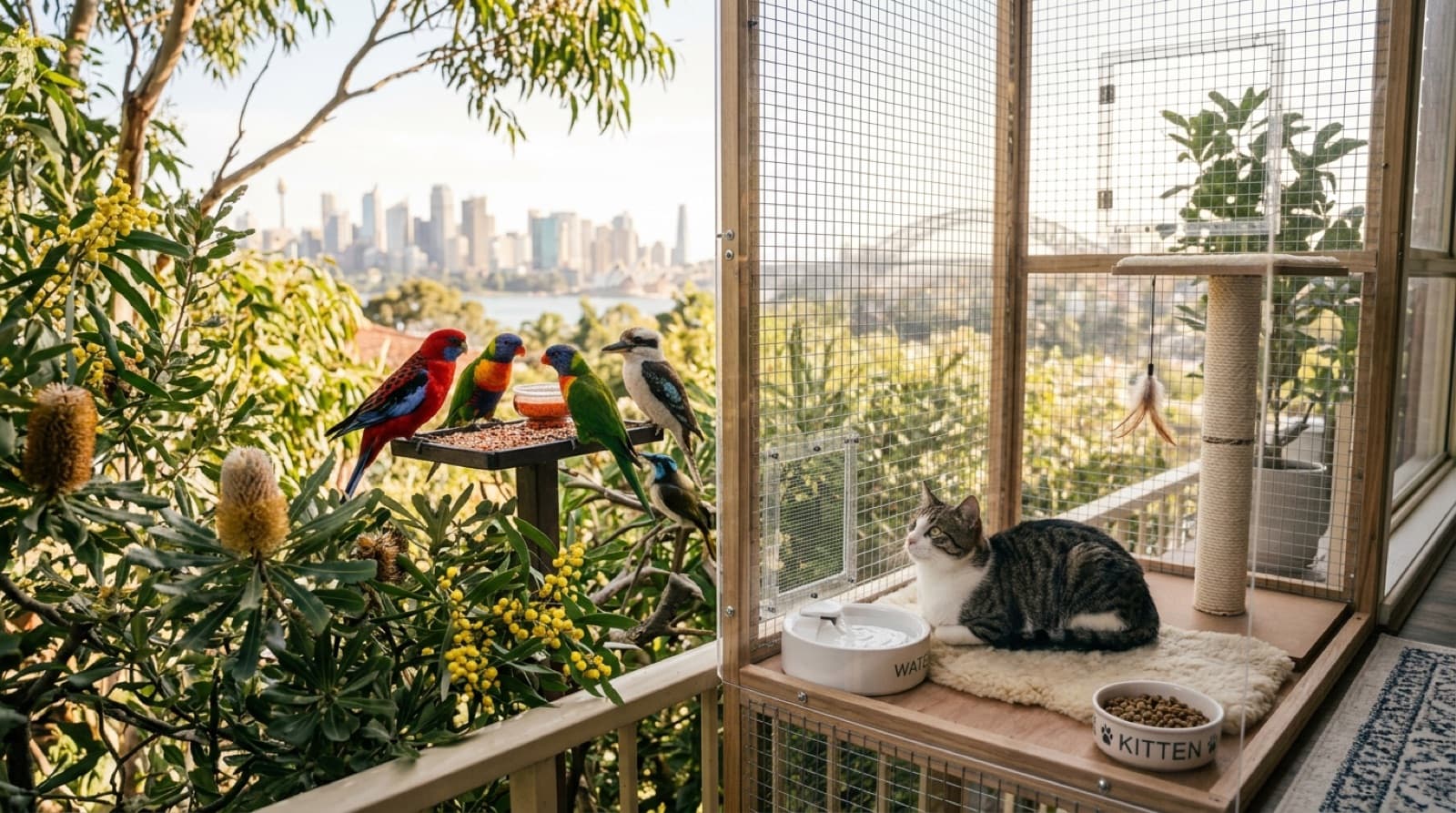
Build a catio or cat-proof the yard. A catio, an enclosed cat patio off a door, window or balcony, gives fresh air, sun and bird-watching with none of the danger. In a backyard, cat-proof fencing with an inward-angled top or roller system can turn the whole space into a safe zone. In an apartment, securely screen or net the balcony, which also removes the fall risk. This is the compromise that satisfies most outdoor-loving cats.
Try harness and lead walks. Plenty of cats learn to walk on a harness with time and patience. Fit the harness indoors, let the cat wear it around the house first, then start with short supervised sessions in the yard. It gives real outdoor time that you control completely.
Give it time. Most cats settle within a couple of weeks once the routine is consistent and the indoor world is interesting. Older cats often adjust faster than owners fear. If your cat is struggling badly, your vet can advise, and a second cat for company solves it for some households.
How to keep an indoor cat happy
An indoor life is only as good as the setup. The aim is to bring the things a cat loves outside, climbing, scratching, hunting and watching, inside where it is safe. None of it is expensive or complicated.
- Vertical space. Cats feel safest up high. A cat tree, a tall shelf or a couple of wall-mounted perches turn a flat room into a three-dimensional territory the cat can own.
- Scratching. Scratching is a need, not a bad habit. Give at least one sturdy vertical post and one horizontal scratcher so the cat has a legal outlet and leaves your couch alone.
- A window perch, the original cat TV. A perch by a window looking onto birds, a garden or the street will keep many cats absorbed for hours. It is the cheapest enrichment there is.
- Daily hunting play. A few short sessions with a wand or feather toy that ends in a food reward satisfies the chase-and-catch instinct far better than a bowl left out. Ten minutes, twice a day, changes a bored cat.
- Food puzzles. Treat balls and puzzle feeders make the cat work for its meal, which is exactly the kind of job an indoor cat needs. Rotate a small set of toys to keep them novel.
- A friend. Many cats are happier with feline company, especially if you are out a lot. Adopting a bonded pair, two cats who already live together, is the easy way to do this without a tricky introduction. See our bonded pairs looking for a home in Sydney.
Add a couple of clean litter trays in quiet spots, fresh water, and scratch-friendly furniture, and you have a home a cat thrives in. Browse cats set up for indoor living on our Sydney indoor cats listings.
Browse adoptable indoor cats in Sydney
Many Sydney rescues rehome cats on an indoor or contained basis, and plenty are perfectly suited to apartment or catio living. Browse current NSW listings and set an alert.
See Available Cats →What Sydney rescues expect from adopters
If you are adopting, it helps to know this going in: most Sydney and NSW rescues now rehome cats on an indoor or contained basis, and many will ask about your setup as part of the application. Cat-focused rescues such as the Cat Protection Society of NSW in Newtown are particularly clear on indoor welfare, and general rescues like RSPCA NSW assess homes with the same lens.
Expect questions about whether you rent or own, whether your balcony or yard can be made secure, and how you plan to keep the cat safe. This is not a hurdle to clear, it is the rescue matching a cat to a home that will keep it alive and well. If you already have a catio plan, a screened balcony or a cat-proofed yard, say so. It makes you a stronger applicant and it tells the rescue you understand the life the cat needs. For the full adoption process, read our Sydney cat adoption guide.
Kittens are the easiest to raise indoors
If you are choosing your cat now, know that a kitten raised indoors from the start never learns to want the outside world, so there is no transition to manage at all. It grows up treating the window perch, the catio and the wand toy as its whole territory, and that is completely normal to it. This is the single easiest path to a happy indoor cat, and it is worth factoring into your decision.
Set the kitten up the same way from day one: vertical space, scratching posts, a window perch, daily play and, ideally, a companion so it grows up sociable. Our new kitten guide for Sydney covers the first weeks in detail, and you can see the kittens available in Sydney right now. Whatever age you adopt, the goal is the same: a cat that lives safely indoors or in contained access, and lives a longer, fuller life for it. Start with the full list of adoptable cats in Sydney.
Frequently Asked Questions
Should I keep my cat indoors in Sydney?
Yes, keep your cat indoors or give it contained outdoor access such as a catio, a cat-proofed yard or harness walks. This is the mainstream welfare recommendation in Australia because Sydney cats face real dangers outside: cars, year-round paralysis tick, cat fights that spread disease, and snakes in bushland suburbs. It also protects native wildlife, which is a bigger deal here than almost anywhere else. Cats that are kept safely contained tend to live longer, healthier lives, and a growing number of NSW councils now have containment or curfew rules. Contained does not mean bored. With climbing space, scratching posts, a window perch and daily play, an indoor cat lives a full and happy life.
Is it cruel to keep a cat inside?
No. A well-set-up indoor life is not cruel, and Australian welfare bodies actively recommend it. What would be unkind is an empty room with a food bowl and nothing to do. Cats need to climb, scratch, hunt and watch the world, so the trick is bringing those things indoors: vertical shelves and cat trees, scratching posts, a window perch for cat TV, food puzzles, and a few minutes of wand-toy hunting play each day. A second cat for company helps many cats too. Done properly, an indoor cat is safer from cars, ticks, fights and disease, and it is not missing out. Free roaming feels like freedom to us, but for the cat it mostly means risk.
Are there cat containment laws in NSW?
There is no single statewide cat curfew in NSW, but a growing number of councils have brought in cat containment or night curfew rules, and the direction of travel is clear. Cat ownership is governed by the Companion Animals Act 1998, which requires every cat to be microchipped by 12 weeks and registered for life, and it lets councils declare local cat provisions. Rules and any fines differ between councils, so check your own council's current requirements directly rather than assuming. Even where containment is not yet required, welfare bodies recommend keeping cats contained. The safest and most future-proof choice is to keep your cat indoors or in a catio from the start.
How do I transition an outdoor cat to indoors?
Go slowly and replace what the cat is giving up outside with things to do inside. Start by feeding all meals indoors and bringing the cat in for longer stretches, especially overnight when the road and wildlife risks are highest. Add enrichment before you cut outdoor time, not after: a tall cat tree, scratching posts, a window perch, food puzzles and daily hunting-style play with a wand toy. A litter tray in a quiet spot matters, because an outdoor cat may not have used one before. Expect some protest meowing at the door for a week or two and try not to reward it by opening up. If you want a middle path, a catio or supervised harness time gives fresh air without the danger. Older cats settle faster than you expect once the routine is set.
What is a catio?
A catio is a cat patio, an enclosed outdoor structure that lets your cat enjoy fresh air, sunshine and bird-watching without being able to roam or hunt. It can be a small window box, a mesh enclosure off a door or balcony, or a walk-in run in the backyard, and it can be bought as a kit or built with timber and cat-proof mesh. The point is that the cat gets the outdoor experience it loves while native wildlife, cars and other cats stay on the other side of the mesh. In apartments, a securely screened or netted balcony does the same job and also removes the high-rise fall risk. A catio is the single best compromise for a Sydney cat that pines for outside.
Do indoor cats live longer?
Generally yes. Cats kept indoors or in contained outdoor access typically live longer than cats that roam freely, and welfare and veterinary bodies point to this as a core reason to contain. The logic is simple: a contained cat is not exposed to cars, cat fights, dog attacks, poison baits, snakebite or the diseases that spread between roaming cats. It still needs the basics, including desexing, vaccination, year-round parasite prevention and vet care, but it avoids most of the sudden, preventable deaths that cut a roaming cat's life short. Longevity is not the only reason to keep a cat safe, but it is a strong one, and it is why most Sydney rescues now rehome cats on an indoor or contained basis.
Can indoor cats still get paralysis ticks?
Yes, though the risk is far lower than for a cat that hunts in the bush. Paralysis ticks can be carried inside on other pets, on washing left outside, or on you, and a cat with any garden or catio access can still pick one up. Because the paralysis tick is native to the NSW coast and bushland and is potentially fatal to cats, year-round prevention matters even for mostly indoor cats, especially in leafy or bushland-adjacent suburbs. Do not reach for a dog tick product: many are dangerous, even fatal, to cats. Ask your vet for a cat-safe prevention product and the right routine for where you live, and check your cat over after any outdoor time.
How do I stop an indoor cat getting bored?
Give it things to climb, scratch, hunt and watch, and make play a daily habit. Cats are hunters, so a few short sessions with a wand or feather toy that ends in a food reward satisfies the chase instinct better than a bowl left out. Add vertical space with a cat tree or wall shelves, a scratching post or two, and a window perch so the cat can watch birds and the street, which many cats will do for hours. Food puzzles and treat balls make mealtimes a job rather than a gift. Rotating a few toys keeps them interesting, and for a lot of cats a compatible second cat is the best boredom cure of all. A tired, occupied cat is a happy indoor cat.
Keep reading
Indoor Cats in Sydney
Live listings of cats suited to indoor and contained living across Sydney and NSW rescues.
Sydney Cat Adoption Guide
Where to adopt, what it costs, the application process, and how to bring a rescue cat home.
New Kitten Guide for Sydney
The first weeks with a new kitten, from setting up an indoor home to litter, play and vet care.
All Sydney Cat Guides
Browse every cat care and adoption guide for bringing home a rescue cat in Sydney.