The short answer
A purebred Devon Rex is one of the rarest cats you will see in Melbourne rescue, because nearly every one is bought from a breeder and kept. Your best odds are a curly or soft-coated cross with the same clingy, playful nature. Watch the main Melbourne cat rescues, set an alert, and expect to pay the normal fee of about $145 to $400 with desexing, vaccination and microchipping included. If you go private instead, check the ad shows a microchip number and a Pet Exchange Register source number. Then plan for warmth and company.
What a Devon Rex actually is
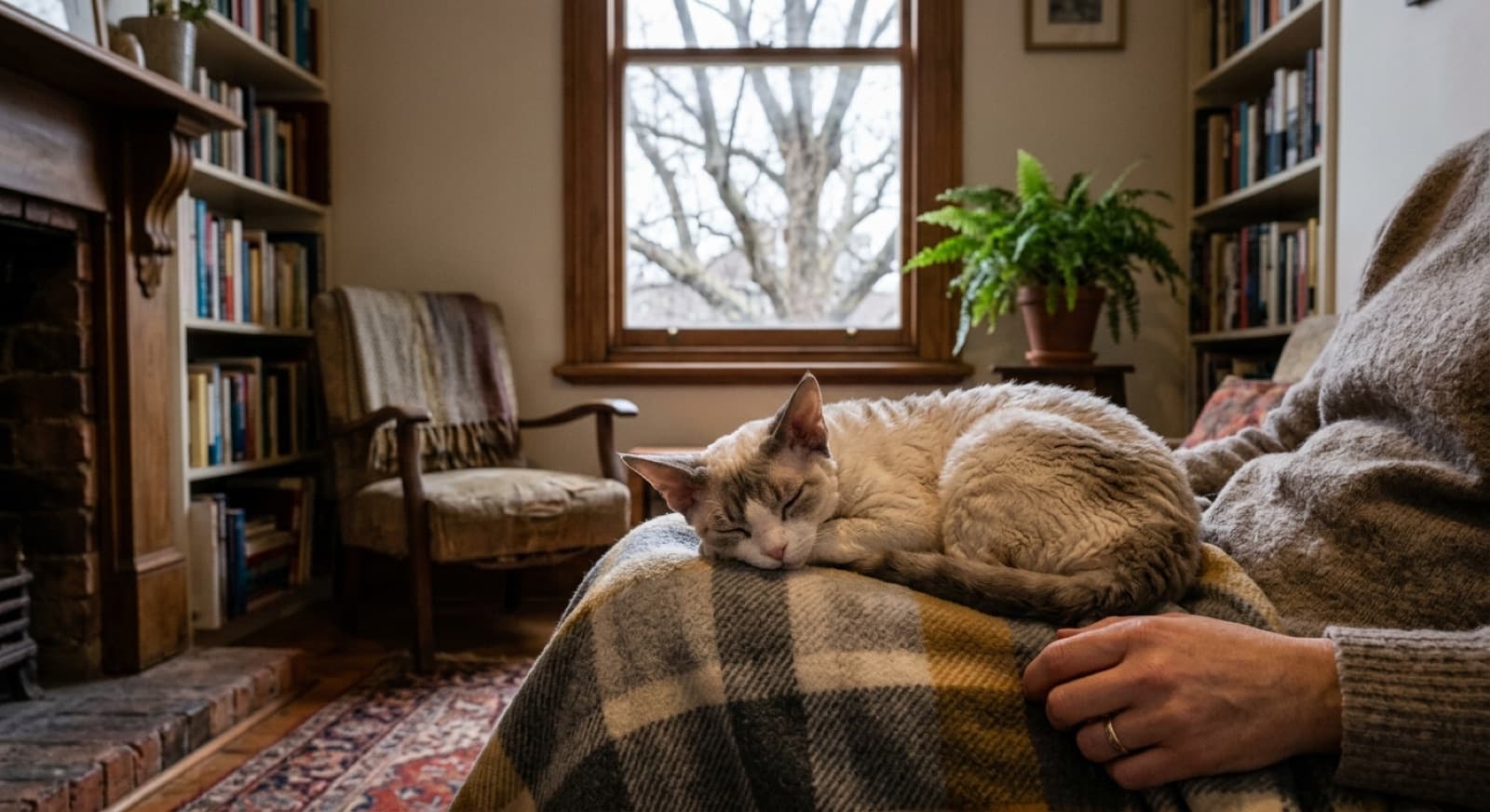
The Devon Rex is a small, slender cat with a short, soft, wavy coat, enormous low-set ears, big eyes and a pixie-like face. The coat comes from a natural mutation, and it is fine and often sparse, especially on the chest and belly. Even the whiskers tend to be curly and brittle. Most adults are light, commonly cited at around 6 to 9 pounds (roughly 2.7 to 4 kilograms), and they feel warm to the touch because there is so little fur between you and the skin.
Temperament is why people go looking for one. A Devon Rex wants to be wherever you are: on your shoulder, in your lap, under the doona at night. Owners often call the breed dog-like, and many Devons learn to fetch. They stay playful and clownish well into adulthood. That devotion is the whole appeal, and it also drives the two big ownership questions in Melbourne: will someone be home, and will the cat be warm enough. For the breed profile and any Devon Rex currently listed, see the Devon Rex breed page.
How rare is a Devon Rex in Melbourne rescue?
Very rare. Across the Melbourne rescues we aggregate, nearly every cat listed is a domestic shorthair or domestic longhair. A purebred Devon Rex essentially never appears, and a cat listed as a Devon cross is an occasional event rather than something you can plan around. That is not a gap in the rescues. It reflects how Devon Rex enter Victorian homes in the first place: almost all of them are bought from breeders, often after a waitlist.
A cat that cost well over a thousand dollars is one an owner tends to keep. When a Devon Rex does need a new home, the owner often rehomes it privately or returns it to the breeder, so it bypasses the shelter system entirely. The ones that do reach rescue usually come in through a life change: a move to a rental that will not take pets, a new baby, a relationship ending, illness, or a busy household that underestimated how much attention the breed wants. None of that reflects on the cat.
The practical takeaway is to widen what you are looking for. If it is the temperament you want rather than the papers, a curly or soft-coated cross, or simply a very affectionate, people-focused domestic cat, can give you most of the Devon experience. Those cats are listed far more often, and a rescue's foster notes will tell you which ones follow their carers from room to room.
Purebred Devon Rex, Devon cross, or Devon type?
Without pedigree papers you often cannot be certain a cat is a purebred Devon Rex. The big ears and soft, wavy coat are strong hints, but some domestic cats have a soft or slightly wavy coat too, so appearance alone proves nothing. Rescues usually describe these cats as a Devon Rex cross or Devon type, and that honesty is a good sign rather than a downgrade.
| What you see listed | What it usually means | How often in Melbourne rescue |
|---|---|---|
| Devon Rex (with papers) | A registered pedigree cat, usually surrendered after a life change | Essentially never |
| Devon Rex cross or Devon type | Some Devon in the line, or the look without paperwork | Occasionally |
| Domestic shorthair with a soft or wavy coat | A domestic cat that may share some of the look | More common |
| Domestic shorthair, very people-focused | No Devon look, but the clingy, playful temperament | Common, if you read foster notes |
If a confirmed pedigree genuinely matters to you, only breeder registration papers give certainty. For a companion, the personality in front of you matters far more than the label.
Where to look for a Devon Rex in Melbourne
There is no shortcut. Because the breed is so scarce in rescue, the strategy is to watch several established Melbourne rescues at once, set an alert, and be ready to apply the day a suitable cat appears. These are the main places that rehome cats across Greater Melbourne:
RSPCA Victoria
The state's largest welfare body, with adoption centres at Burwood East and RSPCA Peninsula in Pearcedale. Its broad intake is where an occasional pedigree or pedigree cross surfaces, and it publishes its cat fees up front. Listings at rspcavic.org.
Lort Smith
An animal hospital in North Melbourne with an adoption centre at Campbellfield. Because Lort Smith is a vet hospital first, it is a good place to ask about a cat's health history. Current cats at lortsmith.com.
The Lost Dogs' Home
Despite the name, this long-established North Melbourne shelter rehomes cats as well as dogs. A large metro intake means a wide mix of cats passes through. Search cats at dogshome.com.
Animal Aid
The Victorian Animal Aid Trust, based at Coldstream on the Yarra Valley fringe, rehomes cats alongside dogs and other animals. Worth a look if you are in the outer east. More at animalaid.org.au.
Second Chance Animal Rescue (SCAR)
A Victorian rescue that rehomes dogs and cats through its network. Rescues like SCAR can describe how an individual cat behaves day to day, which matters for a breed where company is everything. Listings at secondchanceanimalrescue.com.au.
PetRescue
Not a shelter but a national listing site that hundreds of rescue groups use, including many small Victorian foster networks. A useful second net alongside the rescues above, at petrescue.com.au.
A word on searches for a “Devon Rex Rescue Victoria.” People look for one, but we cannot verify a currently active Victorian Devon Rex-specific rescue. Keep your search on the established rescues above and lean on alerts. For the step-by-step on applying and getting approved, see the Melbourne cat adoption guide.
What it costs: adopt versus buy in Melbourne
If a Devon Rex or Devon cross comes through a Melbourne rescue, it costs the same as any rescue cat. The fees below come from RSPCA Victoria's published ranges, and other Melbourne rescues sit in a similar band.
| Path | Typical upfront cost | What is included |
|---|---|---|
| Rescue adult cat | About $145 to $400 | Desexing, vaccination, microchipping, vet check |
| Rescue kitten | About $235 to $400 | As above, plus the early vaccination course started |
| Rescue senior cat | Often reduced or free | As above |
| Breeder Devon Rex kitten | Usually well over $1,000 | Varies by breeder; ask exactly what vet work is done |
The rescue fee is a fraction of a breeder price, and the cat arrives already desexed and microchipped, which also lowers your council registration fee. A breeder price has 10% GST built in if the breeder is GST-registered, and anything not already done (desexing, a second vaccination) is extra.
Budget for the ongoing costs too. A Devon Rex needs quality food, litter, an annual vet check, year-round flea and worm prevention, and a little more than average for warmth (a heated bed, perhaps a cat jumper) and skin care. Take out pet insurance while the cat is young, because pre-existing conditions are usually excluded. For a full Melbourne breakdown, see the cat adoption costs guide.
If you have been searching “Devon Rex for sale Melbourne”
Plenty of people arrive here after searching for a Devon Rex to buy, and that is a reasonable thing to want. But pedigree kittens are one of the most scam-prone corners of the online pet market, because buyers will pay a lot sight unseen. The ACCC's Scamwatch warns about sellers who take a deposit for a pet that does not exist and then disappear. A rare, sought-after breed is exactly what these scams advertise.
Victoria gives buyers a tool most states do not. Under the Domestic Animals Act, anyone advertising a cat or kitten for sale or to give away must show two numbers in the ad: the animal's microchip number and a Pet Exchange Register source number. Before you contact a seller, check both are there, then look up the source number on the Pet Exchange Register. An ad missing either number is a red flag.
- Check the ad shows a microchip number and a PER source number, and look the source number up.
- See the kitten in person, with its mother, before paying anything.
- Never pay a deposit by gift card, crypto or an unusual transfer method.
- Ask about health testing, including the DNA test for the breed's inherited muscle condition.
- Walk away if the seller pushes urgency or will only text.
Adoption removes most of that risk. You deal with an established rescue with a physical location, you meet the cat, and you pay a modest fee for an animal that is already desexed, vaccinated and microchipped. If a curly-coated cross with the Devon temperament is sitting in a Melbourne rescue, it is usually the safer and cheaper choice.
Browse adoptable Devon Rex in Melbourne
A Devon Rex in Melbourne rescue is rare and does not stay listed long. Check what is available now across Melbourne and Victorian rescues, and set an alert so you hear first.
See Available Devon Rex →Melbourne's climate and a thin-coated cat
This is where a Melbourne Devon Rex differs from one in a warmer city. The Bureau of Meteorology describes Melbourne's weather as famously changeable, and winter nights commonly fall to around 6 to 7 degrees with daytime highs near 14. A cat with a normal coat barely notices. A Devon Rex, with its fine, sparse fur, feels it and will go looking for heat.
Before you adopt, look at your home honestly. A Devon Rex does best in a house that stays reasonably warm, with a draught-free sleeping spot, a heated or self-warming bed, and blankets to burrow into. Summer brings the opposite problem: heatwave days above 40 degrees, and strong sun on thinly-coated skin. Keep the cat indoors and out of hot, sunny windows in the middle of the day. The full warmth and sun routine is in the Devon Rex coat and skin care guide.
The other big question: will someone be home?
More than most breeds, a Devon Rex needs company. It bonds hard, wants to be part of everything you do, and can become bored, over-attached or stressed if it spends long days alone. Rescues know this, and many will ask about your hours.
The breed suits a home where someone works from home, a household with people coming and going, or a home with a second friendly cat. If you work full days away, adopting two cats who get on is often the kindest answer. The Melbourne bonded pairs page lists cats who come as a settled duo.
Indoor living and the Victorian rules
A Devon Rex should live indoors, or with contained outdoor access such as a catio or harness walks. Its sparse coat gives little protection from cold nights or summer sun, and a trusting, valuable cat is at risk from theft, traffic and fights. Many Victorian councils also set cat curfews or containment orders, and these differ from council to council, so check yours. We cover indoor setups and catios in the indoor versus outdoor cats guide.
The paperwork sits under the Domestic Animals Act 1994. Cats aged three months and over must be registered with your local council, and registration renews each year by 10 April. A cat must be microchipped before it is registered with a Victorian council for the first time, and a desexed, microchipped cat attracts a substantially reduced fee. Each council sets its own fee, so check yours. For general cat care, the RSPCA Australia Knowledgebase is a reliable starting point.
Choosing the right cat when one appears
An adult is usually the safer bet, especially for a first cat or a busy home, because the rescue or foster carer can tell you exactly how social, playful and needy the cat is. Devon Rex stay playful at every age, so you lose little by skipping the kitten stage. If you do want a kitten, the new kitten guide covers the first weeks.
Read the foster notes over the photos. How the cat copes alone, how it is with children, dogs and other cats, and whether it has any skin or ear issues will predict the fit far better than looks. Ask about the cat's health history too, and read the Devon Rex health guide before you meet it, so you know what questions to ask.
Frequently Asked Questions
Where can I adopt a Devon Rex near me in Melbourne?
Watch several Melbourne cat rescues at once and set an alert, because a Devon Rex in rescue is rare and does not stay listed long. RSPCA Victoria at Burwood East and Pearcedale, Lort Smith's adoption centre at Campbellfield, The Lost Dogs' Home in North Melbourne, Animal Aid at Coldstream and Second Chance Animal Rescue all rehome cats, and PetRescue aggregates listings from rescue groups across Victoria. You are much more likely to meet a short or wavy-coated cross with a Devon-like temperament than a confirmed purebred. Ask each rescue to flag you if a curly-coated cat comes in, and have your application ready so you can move quickly.
Do Devon Rex cats ever come up for adoption in Melbourne?
Occasionally, but very rarely. Across the Melbourne rescues we aggregate, nearly every cat listed is a domestic shorthair or longhair, and a purebred Devon Rex essentially never appears. Almost every Devon Rex in Victoria is bought from a breeder, and an owner who paid well over a thousand dollars for a cat tends to keep it or rehome it privately. When one does reach rescue it is usually because of a life change such as a move, a new baby or illness. Setting an alert on the Devon Rex page is the realistic way to catch one.
How much does it cost to adopt a Devon Rex in Melbourne?
If a Devon Rex or curly-coated cross comes through a Melbourne rescue, expect the standard cat adoption fee: commonly about $145 to $400 for an adult and $235 to $400 for a kitten, based on RSPCA Victoria's published fees. That fee already covers desexing, vaccination, microchipping and a vet check, and senior cats are often discounted or free. A purebred kitten from a breeder costs far more, usually well over a thousand dollars, and the desexing and vaccination costs may or may not be included, so ask before comparing prices.
Is there a Devon Rex rescue in Victoria?
People search for a dedicated Devon Rex rescue in Victoria, but we cannot verify a currently active Victorian Devon Rex-specific rescue. The practical path is the general Melbourne cat rescues and the PetRescue aggregator, plus an alert so you hear when a Devon Rex or curly cross is listed. Because the breed so rarely enters rescue, a single specialist group would seldom have a cat available. Spreading your search across established rescues gives you a far better chance.
How do I check a Devon Rex for sale ad in Victoria is legitimate?
Check the ad for two numbers. Under Victorian law, anyone advertising a cat or kitten for sale or to give away must display the animal's microchip number and a Pet Exchange Register source number. You can look up the source number on the Pet Exchange Register website before you pay anything. An ad missing either number is a red flag. Pair that check with the ACCC Scamwatch advice: never pay a deposit for a kitten you have not seen in person, and be wary of a seller who will only communicate by text or asks for payment by gift card or crypto.
How can I tell a Devon Rex from an ordinary cat?
Often you cannot be certain without pedigree papers, and most rescue cats with the look are best called Devon Rex type or a curly-coated cross. The traits people look for are a short, soft, wavy coat that is often sparse on the chest and belly, very large low-set ears, big eyes, prominent cheekbones, a pixie-like face and curly, brittle whiskers. Some domestic cats have a soft or wavy coat, so the look alone proves nothing. A rescue that calls a cat a cross when there are no papers is being honest, and that is a good sign.
Is a Devon Rex hypoallergenic?
No cat is truly hypoallergenic, including the Devon Rex. The breed sheds less loose hair than many cats, so some people with mild allergies find it easier to live with, but the allergens that cause reactions come from saliva and skin as well as fur. If anyone in your home has a cat allergy, spend real time with the specific cat before committing, and talk to a doctor if the allergy is significant. Melbourne rescues generally welcome a proper meet-and-greet for exactly this reason.
Do Devon Rex cats cope with Melbourne winters?
They cope well indoors, but they need help staying warm. The Devon Rex coat is fine and sparse, so it insulates far less than a normal cat's coat. Melbourne winter nights commonly drop to around 6 to 7 degrees, and a Devon Rex will hunt out heaters, laps and bedding. Give it a heated or self-warming bed in a draught-free spot, blankets it can burrow into, and a home kept comfortably warm. A cold, draughty house is the one Melbourne home this breed should not go to.
Can a Devon Rex be left alone while I work?
Not for long stretches day after day. Devon Rex are among the most people-oriented cats there are, and a lonely one can become bored, clingy or stressed. The breed suits a home where someone is around for much of the day, or a home with a second friendly cat for company. If you work long office hours, consider adopting a bonded pair or choosing a more independent cat. Ask the rescue how the individual cat copes alone, because foster notes are the best guide.
Should a Devon Rex be kept indoors in Melbourne?
Yes. An indoor life, with contained outdoor access such as a catio, suits a Devon Rex best. Its sparse coat gives little protection from cold nights or strong summer sun, and its trusting nature makes it vulnerable to theft, traffic and fights. Many Victorian councils also set cat curfews or containment rules, which vary by council, so check yours. Most Melbourne rescues adopt cats out on an indoor or contained basis anyway.
Do I need to register a Devon Rex in Victoria?
Yes. Under the Domestic Animals Act 1994, cats aged three months and over must be registered with your local council, and registration renews every year by 10 April. A cat must be microchipped before it is registered with a Victorian council for the first time, and desexed, microchipped cats attract a substantially reduced fee. Fees are set by each council, so check yours for the exact amount. A rescue cat is already desexed and microchipped, so you mainly register it and update the microchip details.
Is a Devon Rex a good first cat?
It can be, if your household fits the breed. Devon Rex are friendly, playful and easy to handle, and their coat needs very little brushing. The challenges are elsewhere: they need company, warmth, gentle skin and ear care, and regular vet checks. A first-time owner who is home often and keeps a warm house will usually find one a delight. An adult cat with known foster notes is the safest choice for a first cat.
Keep reading
Adoptable Devon Rex in Melbourne
The Devon Rex breed profile and any Devon Rex or curly-coated crosses currently listed across Melbourne rescues.
Devon Rex Coat & Skin Care
The delicate coat, greasy skin and waxy ears, and keeping a thin-coated cat warm through a Melbourne winter.
Devon Rex Health Issues
The inherited muscle condition and its DNA test, HCM, kneecaps, blood type, skin and dental care.
Cat Adoption Costs in Melbourne
The adoption fee, setup gear, yearly costs and Victorian council registration, line by line.