The short answer
Staffies are generally healthy and live well into their teens. The five things worth planning for: skin allergies (atopic dermatitis is common in the breed), joint issues including hip and elbow dysplasia in some lines, three named genetic conditions detectable by DNA test, the year-round paralysis tick (the big Queensland risk), and heat and humidity management in the SEQ summer. Pet insurance is a sensible buy; sign up while the dog is young, before any condition is on record. Your local Gold Coast GP vet handles the day-to-day, and the region's 24/7 emergency and specialty hospitals at Robina, Varsity Lakes and Carrara handle anything that needs referral or an after-hours emergency.
How healthy is a Staffy, overall?
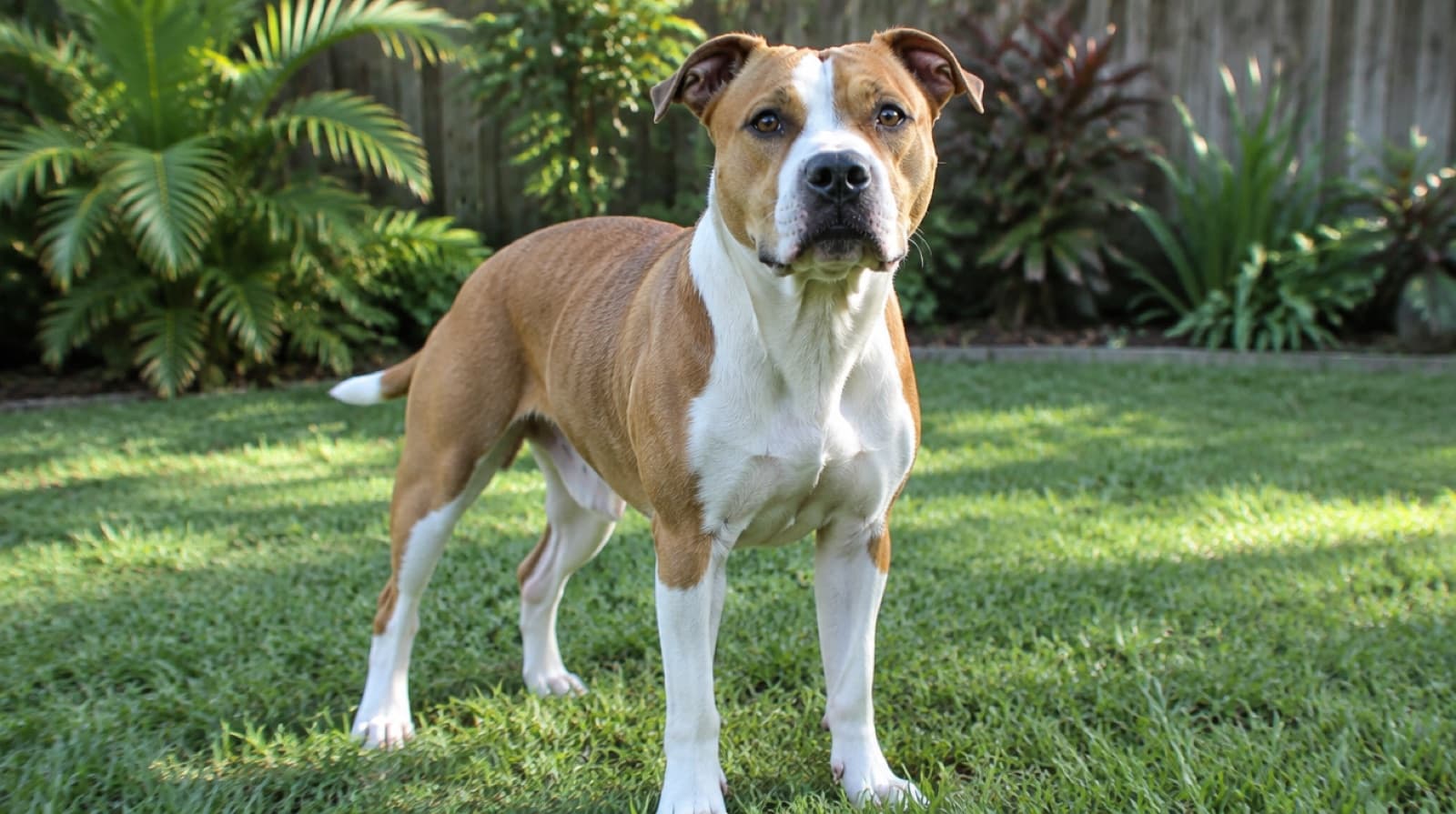
As a breed, Staffordshire Bull Terriers are above average for medium-sized dogs. Lifespan averages 12 to 14 years. They are muscular and active well into their senior years, and most do not develop the chronic mobility issues that affect larger breeds. The American Staffordshire Terrier, a separate and larger breed often grouped under “Staffy” in rescue listings, has a similar span and a similar overall profile.
The reason this article exists is not that Staffies are unhealthy. It is that a small number of breed-specific issues are common enough to plan for. Knowing the names of the conditions helps you spot them early, ask the right questions of your vet, and make insurance decisions before a problem becomes a pre-existing condition.
Skin allergies (atopic dermatitis)
Skin allergies are the most common chronic problem in Staffies, and the warm, humid SEQ climate can make them worse. The veterinary term is atopic dermatitis, an inherited tendency to react to environmental allergens such as pollens, grasses and dust mites. Signs are mostly visible: itchy paws that the dog licks constantly, redness in the ears, recurrent ear infections, hair loss in patches around the feet, belly and groin, and a smell that comes back no matter how often you bathe the dog. Humidity-driven ear and skin infections are a known SEQ issue, so warmth and moisture can compound an existing allergy.
Two things matter for getting on top of skin allergies early. First, do not assume it is fleas. Flea allergy looks similar at first and is worth ruling out, but if the dog is on monthly flea prevention and the itching continues, allergies become the working diagnosis. Second, see your vet sooner rather than later. Dermatology is not a wait-and-see problem. The longer the skin barrier breaks down, the harder it is to settle.
Treatment in 2026 has come a long way from the steroids-only era. Modern options include immunotherapy (allergy desensitisation), targeted medications, dietary trials, and ongoing skin barrier care. Your vet will recommend the right step based on the specific dog. The RSPCA Knowledgebase has an introductory overview of atopic dermatitis in dogs.
Paralysis ticks: the big Queensland risk
The Australian paralysis tick (Ixodes holocyclus) is native to the eastern seaboard, and the Gold Coast sits squarely in its endemic range, including the bushland-fringe and coastal suburbs. This is the single most important difference between owning a dog here and owning one in a cooler state. Because SEQ winters are mild, the risk runs close to year-round rather than switching off in the cold, so “tick season” is effectively the whole year here.
The tick injects a neurotoxin when attached. Within hours to days, the dog can develop ascending paralysis. Untreated, paralysis ticks kill. Treatment is intensive and expensive. Prevention is cheap and effective.
The prevention picture for Gold Coast Staffies:
- A year-round vet-recommended preventive. Several well-established products on the Australian market cover paralysis ticks. Ask your vet which registered product suits your dog and keep it going every month of the year, not just in summer.
- A hands-on tick search after any bushland, creek or long-grass outing. Run your hands over the dog from head to tail, checking the ears, neck, around the jaw and between the toes. A tick attached for less than 24 hours is much easier to treat than one attached longer.
- If you find a tick, remove it carefully and call your vet immediately, even if the dog seems fine. Signs such as wobbliness, a changed or weaker bark, vomiting or breathing trouble are an emergency and can appear after the tick is removed.
The RSPCA Knowledgebase and the Australian Veterinary Association are the standard references for current tick guidance. Read one, then book the prevention.
Browse adoptable Staffies on the Gold Coast
Live listings from Queensland rescues. Each profile notes any known health flags, so you can plan ahead.
See Available Staffies →Three breed-specific genetic conditions
Three inherited conditions are recognised in Staffordshire Bull Terriers, each caused by a single recessive gene, and each detectable by a saliva DNA test. Reputable breeders test their breeding stock. Rescue Staffies usually have not been tested, but the underlying disease rate in the general Staffy population is relatively low.
L-2-hydroxyglutaric aciduria (L-2-HGA). A metabolic disease affecting the brain. Affected dogs typically show signs between six months and one year: tremors, behavioural changes, sometimes seizures, sometimes exercise intolerance. There is no cure, but management is possible. The DNA test identifies affected dogs and carriers.
Hereditary cataracts (HC). A specific cataract pattern that develops in young dogs, usually visible by 12 to 18 months. The dog gradually loses vision in the affected eye. Surgical removal is possible. The DNA test identifies it before symptoms.
Persistent hyperplastic primary vitreous (PHPV). A developmental eye abnormality that ranges from mild (cosmetic) to severe (blindness). Diagnosed by veterinary ophthalmology examination. A DNA test is also available.
For an adopted Staffy, DNA testing is optional. A full panel from a reputable provider costs around $100 to $200 and covers the Staffy-specific markers plus breed parentage. The test is more useful if you want certainty than if you want a clinical decision; the result usually informs lifestyle planning rather than active treatment.
Hip, elbow and joint issues
Hip and elbow dysplasia are less common in Staffies than in larger breeds, but they do occur. The breed has heavy musculature on a stocky frame, which puts load on the joints. Signs to watch for: stiffness after rest, reluctance to climb stairs, an abnormal gait (“bunny-hopping” with the back legs is a classic dysplasia sign), slowing down on walks earlier than expected.
If you notice any of those signs, your vet can order an orthopaedic examination and X-rays. Early intervention matters. Treatment depends on the severity, ranging from weight management and joint supplements at the mild end through to surgical intervention at the severe end.
For a healthy adult Staffy, joint protection is mostly preventive: keep the dog at a lean weight, avoid extreme jumping off high furniture or out of vehicles, and build muscle support with regular but not extreme exercise. The heritable hip and elbow screening schemes that responsible breeders use are described by the Orthopedic Foundation for Animals, and the Australian Veterinary Association has general guidance on canine joint health.
Heat and humidity management in SEQ summers
Staffies are not flat-faced to the extent that Bulldogs and Pugs are, so their heat tolerance is reasonable. They still feel the SEQ summer, and Gold Coast humidity makes any given temperature harder on a dog because it blunts the panting a dog relies on to cool. On hot, humid days the basic rules apply:
- Walk early morning or after sundown. Skip the middle of the day.
- Test the footpath with the back of your hand. If you cannot hold it there comfortably for seven seconds, the bitumen is too hot for the dog's paws.
- Carry water on any walk over 20 minutes.
- Never leave the dog in a parked car. Even on a mild day the interior reaches dangerous temperatures within minutes; on a hot Gold Coast day it is lethal within five.
- Watch for heavy panting that does not settle, drooling more than usual, weakness or stumbling. Those are heat-stress signs. Cool the dog with tepid (not iced) water and get to a vet.
A Staffy that lives entirely outside through a SEQ summer needs constant shade and water access, and even then the breed is not suited to spending all day outside in the heat. One more SEQ hazard worth knowing: the cane toad is toxic when a dog mouths it, a real risk for a curious dog on warm, wet nights. Teach a firm leave-it, and if your dog mouths a toad, wipe the gums forward (not back toward the throat) with a damp cloth and contact a vet immediately.
Gold Coast vet care: who handles what
Day-to-day care: any Gold Coast GP vet. Staffies do not need a breed specialist. Find a vet you trust, take the dog for an introductory check within a couple of weeks of adoption, and establish the relationship.
Specialist referrals (skin, surgery, oncology, internal medicine) and after-hours emergencies: the Gold Coast is well covered. SASH Gold Coast at Robina is a 24/7 emergency and specialist hospital, and AEC Gold Coast at Varsity Lakes is a 24/7 emergency hospital. The Animal Emergency Service and its co-located specialist partner Veterinary Specialist Services run a site at Carrara as well. Your GP vet refers when a case needs specialist input, and 24/7 emergency cover matters for paralysis-tick cases that come in overnight.
For ongoing skin allergy management, a referral to a veterinary dermatologist is sometimes worth the visit, especially for a dog that has not responded to first-line treatment. Know your nearest emergency hospital before you need it, not during a crisis.
Pet insurance: is it worth it for a Staffy?
For a Staffy, in most circumstances yes. The breed's most common chronic condition, skin allergies, can run to real money in dermatology costs over a year. A paralysis-tick admission, or orthopaedic surgery on a joint, can be a large single bill. Top-tier cover for a healthy adult Staffy in 2026 runs around $50 to $90 a month.
The key with pet insurance is timing. Sign up while the dog is young and healthy. Insurers exclude pre-existing conditions, which means anything noted on the vet record before the policy starts is not covered later. The earlier you sign up after adoption, the broader the cover.
Major Australian providers all cover Staffies: PetSure (the underwriter behind many brand-name policies), Bow Wow Meow, Petplan Australia, and RSPCA Pet Insurance. Read the product disclosure statement before committing; the difference between basic and top-tier cover on each provider is significant, particularly for joint cover and chronic-condition rules.
Frequently Asked Questions
Are Staffies a healthy breed overall?
Yes, broadly. Staffordshire Bull Terriers have a 12 to 14 year lifespan, which is solid for a medium-sized breed, and they stay sturdy and active well into their senior years. The conditions to plan for are skin allergies, hip and elbow joint issues in some lines, three named genetic conditions detectable by DNA test (L-2-HGA, hereditary cataracts, and persistent hyperplastic primary vitreous), and the big Queensland risk: the year-round paralysis tick. None of those are inevitable, and most are manageable when caught early.
What is L-2-HGA in Staffies?
L-2-hydroxyglutaric aciduria (L-2-HGA) is a hereditary metabolic disease that affects Staffordshire Bull Terriers specifically. Affected dogs typically show neurological signs such as tremors, seizures or behavioural changes between six months and one year. It is caused by a single recessive gene, so a DNA test can identify carriers and affected dogs before symptoms appear. Most reputable Staffy breeders test their breeding lines. Rescue Staffies usually have not been tested, but the disease is relatively rare in the general Staffy population. If you want certainty for your adopted Staffy, a saliva DNA test from a reputable provider costs around $100 to $200.
How worried should I be about paralysis ticks for my Gold Coast Staffy?
Worried enough to keep the dog on prevention every month of the year. The Gold Coast sits squarely in the range of the Australian paralysis tick, and because SEQ winters are mild the risk runs close to year-round rather than being a summer-only problem. Without prevention, a tick attachment can paralyse and kill a dog within days. Prevention is a year-round vet-recommended product plus a hands-on tick search through the coat after any bushland, creek or long-grass walk. Treat wobbliness, a changed bark, vomiting or breathing trouble as an emergency.
Do Staffies overheat in the Gold Coast heat?
Staffies handle the heat better than flat-faced breeds like Bulldogs or Pugs because their muzzle is longer and they cool more efficiently. But SEQ summers are hot and humid, and humidity blunts the panting a dog relies on to cool down, so a Staffy can still overheat on a bad day. Walk early morning or after sundown, use the back-of-the-hand footpath test before any midday walk, always carry water, provide a cool indoor space, and never leave the dog in a parked car. Watch for heavy panting that does not settle.
How much does pet insurance for a Gold Coast Staffy cost?
Mainstream Australian pet insurance for a healthy adult Staffy runs roughly $50 to $90 a month for a top-tier policy in 2026, depending on the level of cover, the excess you choose, and the dog's age at sign-up. The Staffy-specific conditions where insurance pays off most are skin allergies, which can need ongoing dermatology care, joint issues in older dogs, and any unexpected accident or illness including a paralysis-tick admission. Sign up while the dog is young and healthy, because insurers exclude pre-existing conditions.
Where on the Gold Coast can I get specialist veterinary care for my Staffy?
The Gold Coast has good specialty and emergency coverage. There are 24/7 emergency hospitals at Robina and Varsity Lakes, and multi-disciplinary specialist services (dermatology, surgery, oncology, internal medicine) are available through the region's referral hospitals, with your regular GP vet making the referral. For routine care, any standard Gold Coast GP vet handles a Staffy without issue. For ongoing skin allergy management, a referral to a veterinary dermatologist is sometimes worth it, especially for a dog that has not responded to first-line treatment.
Keep reading
Adoptable Staffies on the Gold Coast
Live listings. Each profile notes any known health flags.
Staffy Adoption on the Gold Coast
The rescues, what each costs, what comes with the fee, and the process.
Staffy Housing: Restricted Breeds & QLD Law
The restricted-breed myth in detail, council declarations, renting and body corporate rules.
Gold Coast Adoption Resources
Guides on adopting, costs, council rules and settling a rescue dog on the Gold Coast.