The short answer
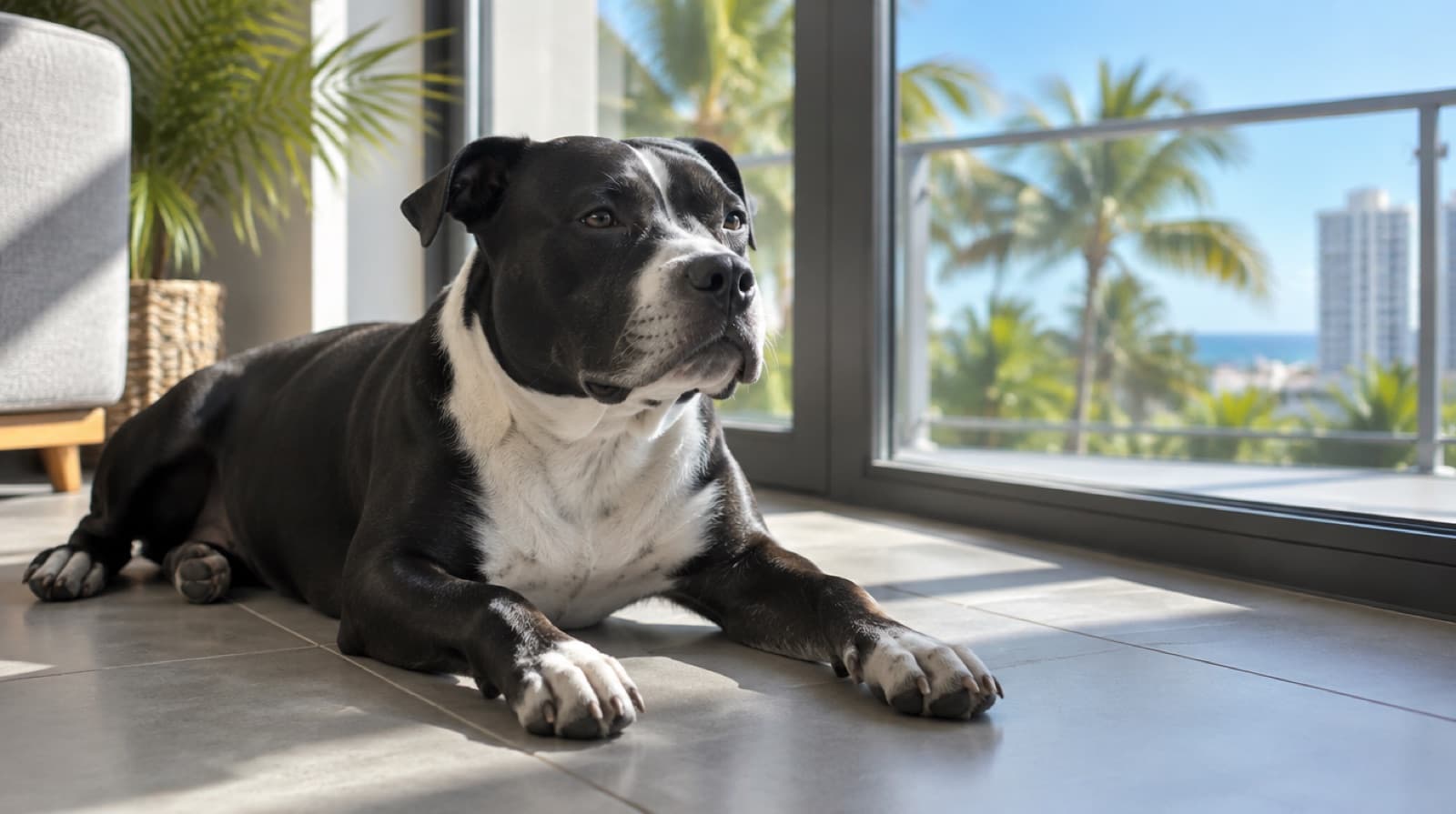
Staffies are legal in Queensland. Body corporate by-laws and rental restrictions are still the practical hurdles you might hit. Recent Queensland reform has limited blanket pet bans by body corporates and limited a lessor's ability to refuse a pet without a proper ground, so the legal footing for owners is stronger than it was a few years ago. If a council or a neighbour mistakes your Staffy for a restricted breed, you can challenge that, and a challenge supported by rescue paperwork and vet records is often successful. Below: the actual law, what body corporates can and cannot do, what landlords can and cannot do, and the review path if a council declares your dog a restricted breed.
The Queensland restricted-breed list: who's actually on it
The legal foundation for restricted breeds in Queensland is the Animal Management (Cats and Dogs) Act 2008, with the state summary on the Queensland Government's regulated dogs page. Queensland groups the strictly-controlled dogs under the umbrella term “regulated dogs”, which covers three categories: a dangerous dog and a menacing dog (any breed, declared by a council after an attack or threatening act) and a restricted dog (a breed prohibited from import into Australia). The five restricted breeds are:
- American Pit Bull Terrier (also called Pit Bull Terrier)
- Dogo Argentino
- Fila Brasileiro
- Japanese Tosa
- Perro de Presa Canario (also called Presa Canario)
That is the full list, and it is the same five breeds as in New South Wales and Victoria. The difference is procedural: Queensland governs them under the Animal Management (Cats and Dogs) Act 2008, and a restricted dog must be desexed, muzzled and leashed in public, kept in an approved enclosure, and carry a council permit. Breeding, selling and giving away a restricted breed is prohibited.
The Staffordshire Bull Terrier and the American Staffordshire Terrier are SEPARATE breeds from the American Pit Bull Terrier. They are not on the restricted list. They are subject to ordinary Queensland dog law: microchipping before 12 weeks of age or before sale or transfer, and council registration from 12 weeks of age. Nothing extra.
The name confusion that causes the problem
A big chunk of the discrimination Staffy owners face on the Gold Coast comes down to the casual word “pit bull”. In everyday Australian conversation, “pit bull” is often used loosely to mean any muscular, short-coated, blocky-headed dog. That is not how the law works.
The American Pit Bull Terrier is a specific breed with its own history, breed standard and import status in Australia, which is to say it is heavily restricted at the border. Most dogs casually called “pit bulls” in Australia are not American Pit Bull Terriers at all. They are Staffordshire Bull Terriers, American Staffordshire Terriers, or crosses of those.
The practical effect: a body corporate, landlord or neighbour says “no pit bulls” meaning the dog they imagine, while pointing at a Staffy. The dog is not a pit bull. The owner has to know that, and has to be able to prove it.
Body corporate by-laws: can your building ban your Staffy?
The Gold Coast has a high proportion of high-rise and body-corporate housing, from Surfers Paradise towers to Robina townhouse complexes. For dog owners, the scheme's pet by-laws matter a lot.
Queensland body corporate by-laws that impose a blanket ban on pets have come under legal pressure, and the general direction is that a by-law or a refusal should be reasonable rather than an outright prohibition. “The dog will be a nuisance” or “the breed is dangerous” on their own are weak grounds, particularly for a breed that is not on the restricted list.
What that means in practice for a Staffy owner:
- The committee can ask for information about the dog (size, age, behavioural history).
- The committee can attach reasonable conditions (the dog on lead in common areas, the owner liable for damage, no excessive barking).
- A refusal based purely on breed, where the breed is legal under state law, is on shaky ground.
- Queensland has a dispute-resolution pathway for body corporate matters if the committee's position is unreasonable.
Because body corporate rules turn on your specific scheme's by-laws, read those by-laws and the current Queensland Government body corporate guidance before you commit to an apartment or townhouse with a Staffy.
Renting with a Staffy in Queensland: what landlords can and cannot do
Queensland residential tenancy law was reformed to give renters more scope to keep a pet. The headline change: a tenant can request to keep a pet, and a lessor can only refuse on prescribed grounds. The grounds have to be specific and proper, not a personal preference.
Broadly, a reasonable refusal tends to turn on the property genuinely not suiting the animal, or keeping the pet breaching another law (for example a council containment order on a declared dangerous dog, which does not apply to an ordinary Staffy). What does NOT hold up as a proper ground:
- The landlord personally dislikes the breed.
- The breed is muscular or short-coated and the landlord assumes it is dangerous.
- Other tenants have been told they cannot have pets, so by extension you cannot either.
If a Gold Coast lessor refuses, ask for the refusal in writing with the reasons stated. If the reasons do not amount to a proper ground, Queensland has a tenancy dispute-resolution pathway. Because the exact grounds and process are set out in the current Queensland renting rules, check the state's tenancy information before you sign anything new rather than relying on what a landlord or agent tells you.
Browse adoptable Staffies on the Gold Coast
Live listings from Animal Welfare League Queensland, RSPCA Queensland and Gold Coast foster-based rescues. Apply with confidence; the housing facts are above.
See Available Staffies →If your dog is mistaken for a restricted breed
A council can move to declare a dog a regulated dog, including a restricted breed, under the Animal Management (Cats and Dogs) Act 2008. It usually starts with an inspection by a council officer after a complaint, often from a neighbour, and the officer forms a view based on the dog's appearance. If the officer thinks the dog matches the look of one of the five restricted breeds, the council can begin the process.
You have review and appeal rights. You can seek an internal review by the council and, if needed, an external appeal through Queensland's civil and administrative tribunal (QCAT). The kind of evidence that supports a challenge:
- The rescue's adoption paperwork describing the dog as a Staffordshire Bull Terrier or American Staffordshire Terrier, or a cross of one of those
- Veterinary records consistent with that breed description
- A breed-parentage DNA test from a reputable provider
- Photographs and measurements showing the dog's actual physical characteristics against the published breed standards
The key point: identifying a dog's breed from appearance alone is unreliable. Research has repeatedly found that even experienced staff get visual breed identification wrong more often than people expect. A well-prepared challenge with the documentation above often succeeds. If you are facing a declaration, get the documentation in order and consider engaging a lawyer who handles companion-animal matters in Queensland.
Council registration: what a Gold Coast Staffy owner needs to do
The standard Queensland process applies. Staffies do not carry any extra requirement beyond ordinary dog ownership.
- Microchipping. Mandatory before 12 weeks of age, or before sale or transfer, whichever is first. Rescue dogs arrive microchipped.
- Council registration. Required from 12 weeks of age with the City of Gold Coast, which charges a substantially reduced rate for a desexed and microchipped dog and offers 1-year and 3-year terms. Rescue adoptions always come desexed. Check the current figure on the City of Gold Coast page.
- Updating ownership. When you adopt, the rescue updates the microchip record to you. Confirm your contact details and address are correct.
- Permits. Ordinary dogs do not need a permit. Permits, muzzles, enclosures and mandatory desexing apply only to regulated dogs (dangerous, menacing or restricted). Neither applies to an ordinary Staffy.
One thing worth knowing for Queensland: there is no Pet Exchange Register here, unlike Victoria. Queensland runs a dog-only breeder scheme, where any dog born on or after 26 May 2017 that is sold, given away or advertised must display a breeder supply number from the Queensland Dog Breeder Register. That rule is about breeder origin, not about owning a Staffy, so it does not add anything for someone adopting one.
Insurance: pet, home and liability
Pet insurance: every major Australian provider covers Staffordshire Bull Terriers and American Staffordshire Terriers under standard policies. PetSure underwrites the majority of named brands; Bow Wow Meow, Petplan Australia and RSPCA Pet Insurance are the other widely held options. The breeds typically excluded are the restricted breeds, not Staffies.
Home and contents insurance: most Queensland home policies have a third-party liability section that covers harm caused by your dog to other people or property. Some policies carry a “dangerous breed” exclusion. Read the product disclosure statement on your specific policy. If the exclusion is generic (“pit bulls and similar”), ask the insurer in writing whether Staffordshire Bull Terriers fall under it. Most do not, but it is worth confirming before an incident, not after.
Frequently Asked Questions
Is a Staffordshire Bull Terrier a restricted breed in Queensland?
No. The Staffordshire Bull Terrier and the American Staffordshire Terrier are not restricted breeds in Queensland. Under the Animal Management (Cats and Dogs) Act 2008, the five restricted breeds are the American Pit Bull Terrier (or Pit Bull Terrier), Dogo Argentino, Fila Brasileiro, Japanese Tosa and Perro de Presa Canario. Staffies are ordinary dogs in the eyes of the law and are rehomed normally across Queensland.
Can a Gold Coast body corporate refuse to let me keep my Staffy?
Not as easily as many owners assume. Queensland body corporate by-laws that ban pets outright have come under legal pressure, and a by-law or refusal generally has to be reasonable rather than a blanket ban. If your body corporate refuses without a real reason, you can ask the committee to reconsider, and Queensland has a dispute-resolution pathway for body corporate matters. Check your scheme's current by-laws and the Queensland Government's body corporate information before you commit.
Can a Gold Coast landlord refuse to rent to me because I own a Staffy?
It depends on the reason. Queensland reformed its renting laws so a tenant can request to keep a pet and a lessor can only refuse on prescribed grounds, such as the property being unsuitable for the animal. Personally disliking the breed is not, on its own, a valid ground. If you have been refused and you think the refusal is not based on a proper ground, Queensland has a tenancy dispute pathway. Check the current Queensland renting rules before you sign anything new.
What happens if council or a neighbour says my Staffy is a restricted breed?
A council can move to declare a dog a regulated dog, including a restricted breed, usually after an inspection prompted by a complaint. You have review and appeal rights. The standard approach is to provide breed-identification evidence: the rescue's adoption paperwork describing the dog as a Staffordshire Bull Terrier or American Staffordshire Terrier, the vet record, and optionally a DNA test from a reputable provider. Staffies look superficially similar to restricted breeds, and assessments based on appearance alone are unreliable, so a well-documented challenge is often successful.
Do I need a special permit to own a Staffy in Queensland?
No special permit. Standard Queensland rules apply: microchip the dog before 12 weeks of age or before it is sold or given away, and register it with your local council from 12 weeks of age. On the Gold Coast, the City of Gold Coast charges a reduced registration rate for a desexed and microchipped dog. Permits and the muzzle, enclosure and desexing conditions apply only to regulated dogs (dangerous, menacing or restricted), and Staffies are not on that list.
What documentation should I keep to prove my Staffy is not a restricted breed?
Three things help. First, the rescue's adoption paperwork describing the dog as a Staffordshire Bull Terrier or American Staffordshire Terrier, or a cross of one of those. Second, the vet record from your first own-vet check, which usually records the breed as the rescue described it. Third, optional but useful, a breed-parentage DNA test from a reputable provider. Together these are a strong defence if a council ever questions the breed.
Keep reading
Adoptable Staffies on the Gold Coast
Live listings from Queensland rescues. Apply with the housing facts above in hand.
Staffy Adoption on the Gold Coast
The rescues, what each one costs, what comes with the adoption fee, and the application process.
Staffy Health Issues to Plan For
Skin, joints, genetic conditions, the year-round paralysis tick and SEQ heat.
Gold Coast Adoption Resources
Guides on adopting, costs, council rules and settling a rescue dog on the Gold Coast.