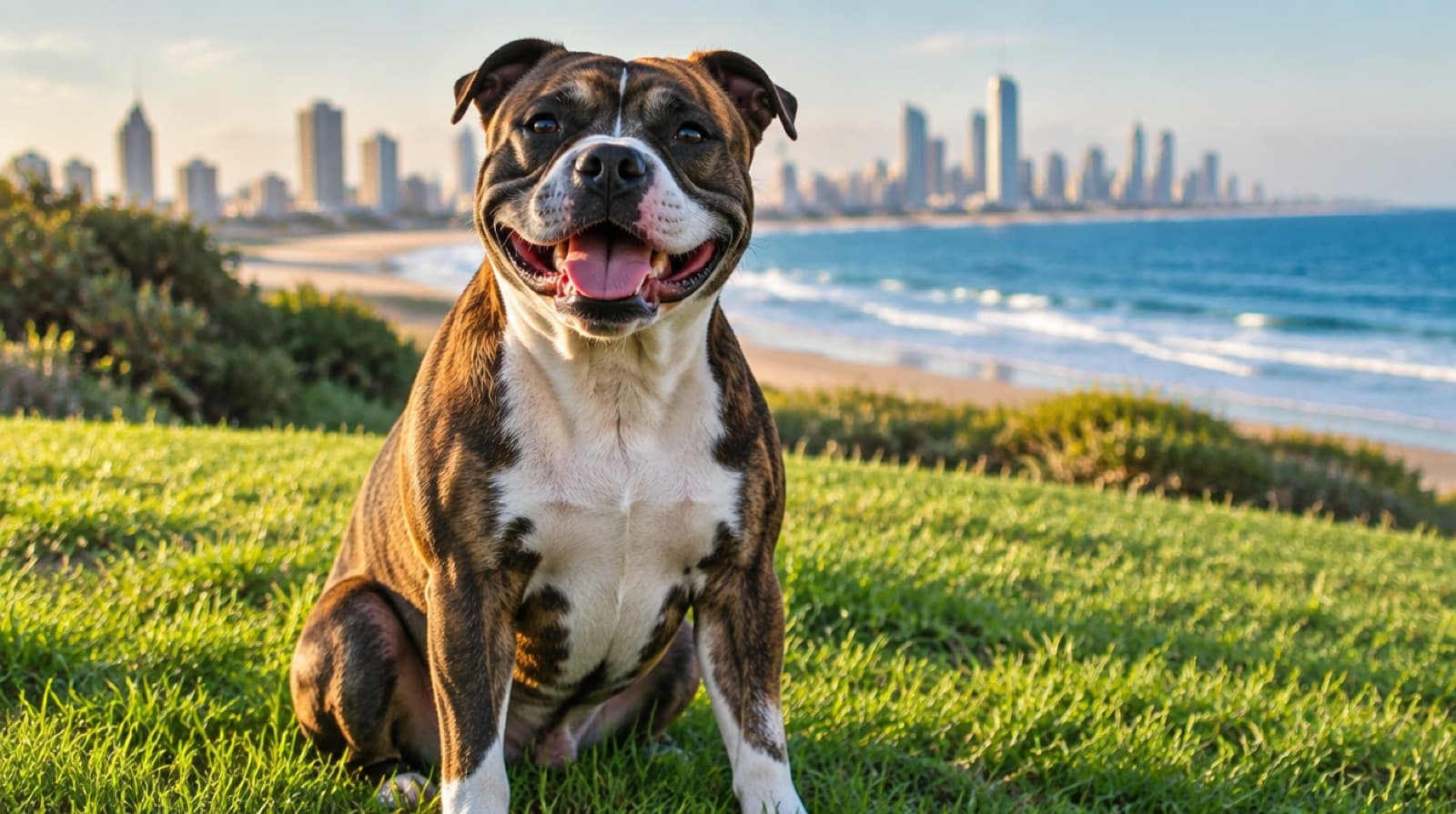
The short answer
Staffies are the most common dog in Gold Coast rescue, and adopting one is cheap and easy. Fees are $300 to $600 for an adult across the main Queensland rescues, and that already covers desexing, vaccination, microchipping and a vet check. They come through Animal Welfare League Queensland, whose flagship Gold Coast rehoming centre is at Coombabah, RSPCA Queensland, foster-based rescues and PetRescue. The thing that scares off many would-be adopters is the worry that Staffies are restricted under Queensland law. They are not. The American Pit Bull Terrier is restricted, the Staffordshire Bull Terrier and American Staffordshire Terrier are not. Different breeds, different laws. Plan for about an hour of daily exercise, mostly in the cool of the day, and year-round paralysis-tick prevention, which is essential in South East Queensland.
“Pit Bull” vs “Staffy”: what the words actually mean
The Staffordshire Bull Terrier (SBT, often just “Staffy”) is a small to medium English breed, 11 to 17 kg, that originated in the Black Country in the 1800s. The American Staffordshire Terrier (AmStaff) is a larger American breed, 18 to 32 kg. Both are legal in Queensland under the Animal Management (Cats and Dogs) Act 2008 and both are rehomed by Queensland rescues without restriction.
Queensland uses the umbrella term “regulated dogs”, which covers three things: a dangerous or menacing dog (any breed, declared by a council after an attack) and a restricted dog (a breed prohibited from import into Australia). The five restricted breeds, listed on the Queensland Government's regulated dogs page, are:
- American Pit Bull Terrier (also called Pit Bull Terrier)
- Dogo Argentino
- Fila Brasileiro
- Japanese Tosa
- Perro de Presa Canario (Presa Canario)
A restricted-breed dog in Queensland cannot legally be sold, given away or rehomed. That is the legal reason you will never see one of those five breeds on a rescue's adoption list in Queensland. It is also why rescues are careful with breed labels, and why some “Staffy” listings note that the breed identification is the foster carer's best judgement.
In Gold Coast rescue practice, “Staffy” almost always means a Staffordshire Bull Terrier or an SBT cross. American Staffordshire Terriers turn up too. Both are legal, both are routinely rehomed. If you want the full legal picture, including what happens if a neighbour or council mistakes your dog for a restricted breed, read our companion guide (linked lower on this page).
Why do Staffies end up in Queensland rescue so often?
The honest answer is that they are bred too much and surrendered too easily. Across the Queensland rescues we aggregate, Staffies are listed year-round and are consistently the most common dog in the system. Three patterns repeat.
Housing restrictions. Body corporate by-laws and private landlords still push back on Staffy-type dogs in 2026, even though Queensland tenancy law now gives renters more scope to keep a pet. The Gold Coast's high proportion of high-rise and body-corporate housing makes this common. Owners who move into a place that will not take the dog often surrender out of necessity, not choice.
Mistaken expectation about exercise needs. Staffies look stocky and easygoing. They are not low-energy dogs. A young adult Staffy wants an hour of real activity a day, split between a walk and active play. Without it, the dog turns into a chewing, jumping, fence-running problem and gets surrendered.
Owner life changes. Relationship breakdowns, new babies, interstate moves. Staffies bond hard to their people. When the home changes, the dog is often the casualty. This is the single most common surrender story across breeds, but it shows up disproportionately with Staffies because the breed is so common in the system to begin with.
The dogs themselves are almost always sound. What rescue volunteers say about adult Staffies in foster is consistent: lovely natured, want to be near you, sleep on the couch, easy company once you understand their exercise need.
Where to actually look on the Gold Coast
- Animal Welfare League Queensland (AWLQ). AWLQ's Gold Coast rehoming centre at Coombabah is the main Gold Coast shelter, and this long-running South East Queensland no-kill charity has Staffies and Staffy crosses as its single most common breed group. Every adoption includes desexing, vaccination, microchipping, a vet workup and a behavioural assessment. Listings at awlq.org.au.
- RSPCA Queensland. The state body handles Gold Coast adoptions through its statewide network, including a Gold Coast Adoption Centre, with its main Animal Care Campus at Wacol in Brisbane. Staffy-type dogs come through regularly. Every adoption includes desexing, vaccination, microchipping, a vet workup and a behavioural assessment. Browse at rspcaqld.org.au.
- Foster-based rescues. Gold Coast and wider South East Queensland volunteer and foster-network rescues run slower, more matched processes and see plenty of Staffies and Staffy crosses. A foster carer who has lived with the dog for weeks can tell you exactly how it is with children, other pets and being left alone, which is the single most useful thing to know before you commit.
- PetRescue. A national aggregator that lists Staffies and Staffy crosses from many smaller Queensland rescues in one searchable place, at petrescue.com.au. The single most efficient way to browse every available Staffy at once.
- Council pounds. Some Staffies come through council facilities directly. Most rescues monitor pound listings and pull dogs before public adoption, but it is worth checking your local council pound too.
If you want a foster-based option with a slower, more matched process, start with the foster-network rescues and PetRescue. If you want a shelter-based option with a full on-site behavioural assessment, AWLQ at Coombabah or RSPCA Queensland are the larger choices.
How much does Staffy adoption cost on the Gold Coast?
Adoption fees run $300 to $600 for an adult Staffy and $400 to $800 for a Staffy puppy. Some shelter promotions drop adult fees lower; specialised foster rescues can sit at the higher end because their dogs come with more vet history.
Every Queensland rescue adoption fee includes:
- Desexing
- C5 vaccination
- Microchipping
- Worm and flea treatment
- A vet check, plus a behavioural assessment in shelter-based rescues
Buying those things yourself after a private purchase costs far more, so the rescue fee is not a price tag on the dog. It is a contribution to the cost of getting the dog ready for its new home. A breeder or backyard Staffy, by contrast, arrives with none of it done.
Setup and running costs after the fee:
- Council registration: the City of Gold Coast charges a substantially reduced rate for a desexed and microchipped dog, with 1-year and 3-year terms. A rescue Staffy always registers at the lower amount. Check the current figure on the City of Gold Coast page.
- Bed, bowls, lead, harness, crate: around $200 total from a chain pet store
- First month of food and treats: around $50
- An optional own-vet introductory check: around $80
- Year-round parasite prevention (paralysis tick, flea, worm, heartworm): budget for this from day one, because in SEQ it is not seasonal
Budget roughly $700 to $1,000 for the first month all-in, including the adoption fee itself. Ongoing yearly costs for a healthy adult Staffy on the Gold Coast sit in the low thousands once food, vet care, grooming, insurance, registration and year-round parasite prevention are counted.
Browse adoptable Staffies on the Gold Coast
Live listings from Gold Coast shelters and Queensland rescues. Foster carer notes describe each dog's energy level and household fit before you apply.
See Available Staffies →Are Staffies good with kids and other pets?
Well-socialised Staffies are excellent with kids, and they are sometimes called the “nanny dog”, though that nickname is a modern myth rather than real breed history. As with any breed, very young children need adult supervision and need to learn how to interact safely with a dog.
With other dogs the answer is more individual. Many Staffies live happily with another dog of similar temperament and energy. Some prefer to be the only dog. Every Queensland rescue evaluates this in foster, and the dog's profile will note whether they have lived with other dogs and how it went.
With cats and small animals it is also individual. A Staffy raised with cats is usually fine with cats. One with a strong prey drive is not. Reputable rescues do a cat assessment before listing, and the result is in the profile. If the listing says “not tested with cats”, ask the rescue what their read is before you commit.
Should I get a Staffy puppy or an adult?
Adopt an adult if you possibly can. Three reasons.
Their personality is already visible. A foster carer who has lived with the adult Staffy for a few weeks can tell you exactly what you are getting. Energy level, recall, prey drive, comfort with kids, tolerance of being left alone. With a puppy you are guessing, and breed alone does not predict adult temperament reliably.
Adults are often already trained. Many adult Staffies arrive at rescue knowing sit, lead-walking, house-training and basic boundaries. A puppy needs months of consistent work to get to that point.
Adult Staffies wait longer than puppies for homes. Adopting an adult frees a foster placement for the next dog, and the whole rescue pipeline benefits.
Staffy puppies do come through Queensland rescues, usually a minority of the Staffies available at any time. If you specifically want a puppy and have the time for the early socialisation work, the rescue puppy option is still cheaper and safer than buying from an unverified seller. Be wary of cheap Staffy listings on Gumtree and Facebook Marketplace; that is where the surrender pipeline often starts.
Queensland rules and staying safe from scams
Queensland's companion-animal law is the Animal Management (Cats and Dogs) Act 2008. Dogs must be microchipped before 12 weeks of age or before they are sold or given away, whichever comes first, and registered with your local council from 12 weeks of age. On the Gold Coast, the City of Gold Coast requires a dog to be registered and microchipped, and charges the reduced rate for a desexed dog. A rescue Staffy already meets all of that. Check the current requirements on the City of Gold Coast page.
Queensland does not have a Pet Exchange Register. What it does have is a dog-only breeder scheme: any dog born on or after 26 May 2017 that is sold, given away or advertised must display a breeder supply number from the Queensland Dog Breeder Register, and every dog must be microchipped before it changes hands. So a private Staffy listing with no supply number and no microchip number is a red flag. A cheap or free Staffy with a story about the dog being interstate, a deposit or a transport fee is the classic setup Scamwatch warns about. Adopting through a verified Queensland rescue avoids the problem entirely.
The SEQ heat and the year-round tick risk
South East Queensland is where a Gold Coast Staffy guide parts company with a southern-states one. Two things matter from day one.
Paralysis ticks are a genuine, effectively year-round danger in SEQ. The Australian paralysis tick lives along the eastern seaboard, and the Gold Coast sits squarely in its range. It is worst in the warmer, wetter months, but because Gold Coast winters stay mild, the risk never fully switches off the way it does in colder states. Keep a year-round vet-recommended tick-prevention product in place, and run a hands-on search through the coat after any bushland, creek or long-grass outing, checking the head, ears, neck and between the toes. Tick paralysis is potentially fatal, so treat wobbliness, a changed bark, vomiting or breathing trouble as an emergency and get to a vet immediately. See the RSPCA Knowledgebase for current tick guidance.
Heat and humidity. A Staffy has a longer muzzle than a flat-faced breed, so it handles heat better than a Pug or Bulldog, but SEQ summers are hot and humid and a Staffy will still overheat on a bad day. Walk in the cool of the early morning or evening, use the back-of-the-hand footpath test before any midday walk, always carry water, and give the dog a cool indoor space. Fleas, intestinal worms and mosquito-borne heartworm all stay active close to year-round here, so keep prevention continuous rather than seasonal.
The body corporate and rental question
Staffies are not on the Queensland restricted-breed list, but you can still hit problems if your housing is under a body corporate or rented. Some buildings restrict dogs, and the word “pit bull” gets used loosely to knock back Staffies that are nothing of the sort. Queensland reformed its renting laws so a tenant can request to keep a pet and a lessor must have a proper ground to refuse, and body corporate by-laws that ban pets outright have come under legal pressure, so the ground for owners is stronger than it was. It is still the thing to sort before you apply.
We have a dedicated guide that covers the Queensland restricted-breed law in full, what to do if your dog is mistaken for a restricted breed by a neighbour or council, and where renting and body corporate rules sit. If you rent or live under a body corporate on the Gold Coast, read it before you commit: Staffy Housing on the Gold Coast: Restricted Breeds, Renting & Queensland Law.
Frequently Asked Questions
Is a Staffordshire Bull Terrier a Pit Bull?
No. They are different breeds. The Staffordshire Bull Terrier is a smaller English breed of 11 to 17 kg that came out of the Black Country in the 1800s, while the American Pit Bull Terrier is a larger American breed. Queensland law treats them very differently. The American Pit Bull Terrier is one of five restricted breeds under the Animal Management (Cats and Dogs) Act 2008, which cannot be sold or given away, so you will never see one on a rescue adoption list. The Staffordshire Bull Terrier and the American Staffordshire Terrier are not restricted and are rehomed normally across Queensland.
Can I adopt an American Staffordshire Terrier in Queensland?
Yes. The American Staffordshire Terrier is a separate breed from the American Pit Bull Terrier and is legal in Queensland. Many Staffy rescue listings on the Gold Coast are American Staffordshire Terriers or AmStaff crosses, and they are rehomed normally by rescues like Animal Welfare League Queensland and RSPCA Queensland.
How long does Gold Coast Staffy adoption take from application to take-home?
Usually two to four weeks. The application form takes about 20 minutes. A reference check and phone interview come next, then a home check at foster-based rescues. Most rescues require a meet-and-greet before approval, and some run a short trial period as part of the adoption so the match can be confirmed in the home before it is final.
Can I adopt a Staffy on the Gold Coast if I live in an apartment?
Yes, if the body corporate by-laws allow dogs and the home has enough space for a 15 kg dog plus the daily exercise that has to happen outside. The Gold Coast has a lot of high-rise and body-corporate housing, so this is the first thing to check, along with your lease if you rent. Many Staffies live well in apartments, but the exercise still has to happen, in the cool of the day given the SEQ heat. Most rescues will ask about your housing.
What if a Gold Coast rescue rejects my application?
It usually comes down to housing (a renter without approval, or a body corporate that bans dogs) or experience (a particularly high-drive Staffy may be assessed as needing an experienced home). Sort out whatever the rescue flagged and re-apply, or try another rescue. The dog you saw might be perfect for someone else, and there will be more Staffies on the next intake.
How much should I budget in total for the first month after adoption?
Around $700 to $1,000. That covers the rescue adoption fee ($300 to $600), council registration at the substantially reduced rate the City of Gold Coast charges for a desexed and microchipped dog, basic setup like a bed, bowls, lead and harness (around $200), the first month of food and treats (around $50), and an optional first vet visit (around $80). Rescues already cover desexing, vaccination, microchipping and the initial vet workup.
Keep reading
Adoptable Staffies on the Gold Coast
Live listings from Queensland rescues, with filters for age, size and household compatibility.
Staffy Housing: Restricted Breeds & QLD Law
The restricted-breed myth in detail, council declarations, renting and body corporate rules.
Staffy Health Issues to Plan For
Skin, joints, genetic conditions, the year-round paralysis tick and SEQ heat.
Gold Coast Adoption Resources
Guides on adopting, costs, council rules and settling a rescue dog on the Gold Coast.