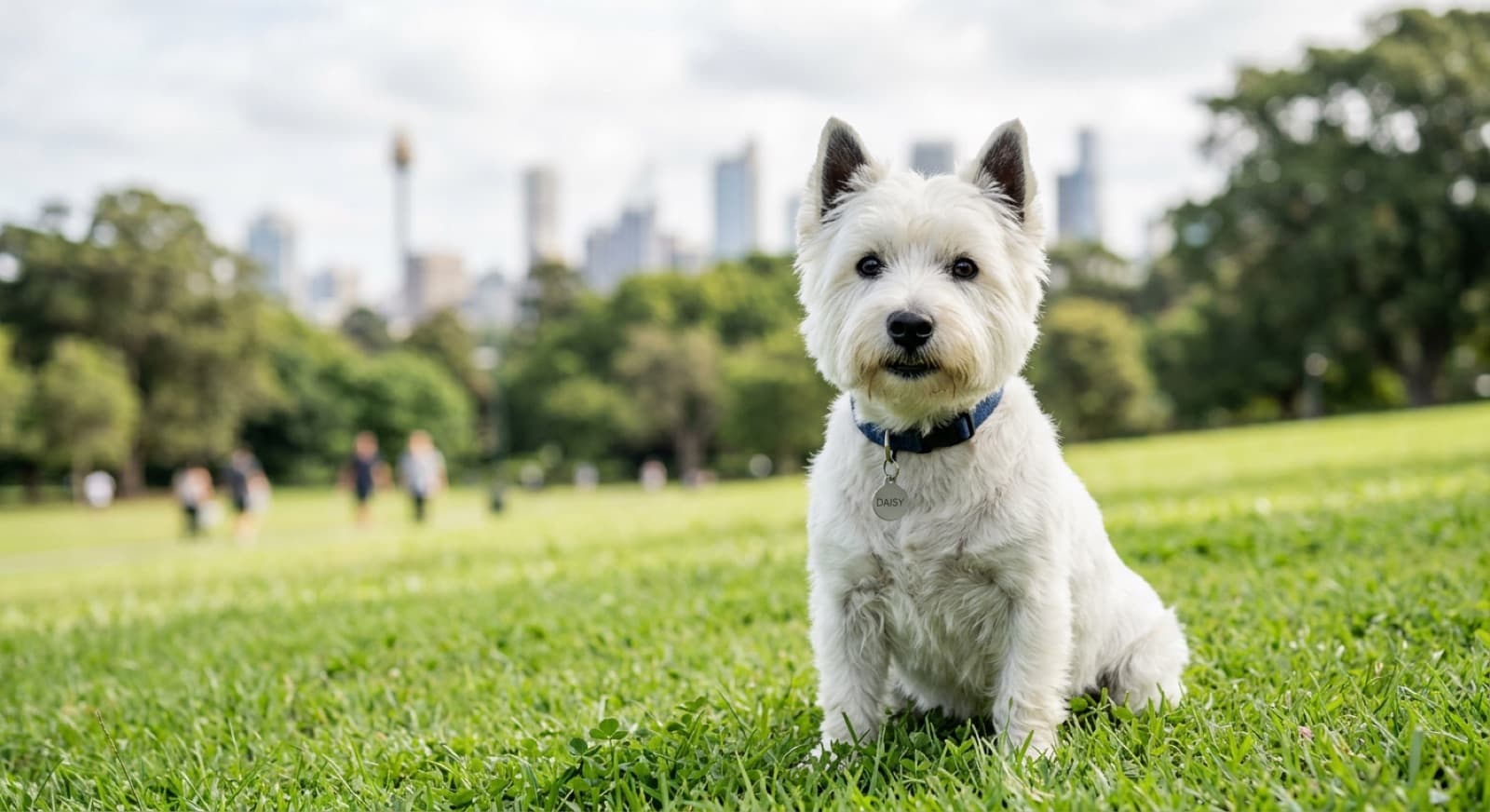
The short answer
The West Highland White Terrier is a purebred with one health issue that stands above the rest: itchy, allergic skin, known as Westie itch or atopic dermatitis. It is a lifelong condition you manage with your vet, and Sydney's humidity and pollens make it harder work. Beyond the skin, watch for a slipping kneecap, dental disease, and eye conditions, and in older dogs be alert to Westie lung, a serious progressive lung disease. Learn the emergency signs, above all any dog struggling to breathe, because breathing distress needs a vet immediately.
Westie itch: allergic skin is the one to understand
If you understand one thing about Westie health, make it the skin. The West Highland White Terrier is one of the breeds most prone to atopic dermatitis, an allergic, inflamed skin condition. It is so tied to the breed that it has a nickname, Westie itch. The dog overreacts to ordinary things in the environment, grasses, pollens, dust mites and moulds, and the skin turns red, itchy and sore.
The itch is the engine of the problem. A Westie with atopic skin scratches, licks and chews, and it tends to target the same places: the paws, the face and muzzle, the ears, the armpits and the belly. Paw-licking that stains the white fur a rusty brown is a classic sign. All that scratching and licking breaks the skin barrier and leaves it damp, and damp broken skin gets secondary infections with bacteria or yeast. Those infections itch and smell, so the dog scratches more, and you get a spiral. Recurrent ear infections go hand in hand with it, since the ears are lined with the same allergic skin.
Sydney makes this harder than a cooler, drier place would. The warm, humid climate suits yeast and keeps skin damp, and the long grass-and-pollen seasons keep the environmental triggers high for much of the year. A Westie that seems settled in winter can flare badly through the warmer months.
What helps. This is a condition you manage for life, not one you cure, and the plan starts with your vet rather than the chemist or the internet. Broadly, good management works on three fronts: finding and reducing the triggers where you can, caring for the skin barrier and coat so it copes better, and settling flare-ups and clearing any secondary skin or ear infection quickly before it spirals. Your vet builds the specific plan, because what an individual Westie needs varies, and human medicines can be unsafe for dogs. Keeping your dog lean helps too, since a healthy weight supports the whole body. The RSPCA Australia Knowledgebase has general guidance on itchy skin and when to see a vet. Our Westie grooming and skin care guide covers the day-to-day coat and bathing routine in more detail.
Emergency: respiratory distress (struggling to breathe)
A dog that cannot breathe properly is a life-threatening emergency, and it matters in this breed because Westies are prone to a serious lung disease. Get to a vet immediately, day or night, if your Westie is struggling to breathe, breathing fast or with obvious effort at rest, has blue, grey or pale gums, is stretching its neck out to breathe, or has collapsed. Do not wait to see if it settles. Keep the dog calm and cool, do not stress it further, phone ahead so the team is ready, and if it is out of hours head straight to a 24/7 hospital such as SASH, which offers round-the-clock emergency care in Sydney.
Westie lung: idiopathic pulmonary fibrosis
The condition nicknamed Westie lung is idiopathic pulmonary fibrosis, a serious, progressive lung disease the breed is predisposed to, mostly in middle-aged and older dogs. The lung tissue slowly scars and stiffens, which makes it harder for the dog to move air and take up oxygen. Idiopathic simply means the underlying cause is not understood.
The signs to know. It creeps in, so it is easy to put down to age at first. Watch an older Westie for a persistent dry cough, tiring or slowing down on walks it used to manage, and breathing that becomes faster or more laboured, sometimes with a crackly quality. If you notice any of that, book a vet visit, because the same signs can point to heart disease or other lung problems, and it needs sorting out properly. There is no cure, but a vet can confirm what is going on and focus on comfort and quality of life. If breathing ever tips into obvious distress, treat it as the emergency described above and get to a vet at once.
Luxating patella: the slipping kneecap
Like most small breeds, Westies can get a luxating patella, where the kneecap slips out of its groove and then slides back. The tell-tale sign is a quick skip or hop on a back leg. The dog will hold the leg up for a step or two, often with a little hitch in its stride, then carry on as if nothing happened.
Some dogs do this occasionally and are barely troubled, while others are more affected, which over time can lead to arthritis or, in the worst cases, need surgery. If you notice your Westie skipping on a back leg, favouring a leg, or stiff after rest, mention it to your vet, who can feel the knee and grade how loose it is. The single most useful thing you can do is keep your dog lean, because extra weight loads the joints and makes any knee problem worse. Sensible exercise that builds muscle without pounding the joints helps as well.
Eyes: dry eye and cataracts
The Westie has a few eye conditions worth knowing. One is keratoconjunctivitis sicca, usually called dry eye, where the eye does not make enough tears. The eye looks sore and red, often with a thick, sticky discharge, and the dog may squint. Untreated it is uncomfortable and can damage the surface of the eye, but it is diagnosed with a simple tear test and managed well, so a Westie with a persistently goopy, red or sore eye should see a vet.
Cataracts, a clouding of the lens that gives the pupil a milky look and fades vision, also turn up in the breed. The general rule with eyes is simple: any red, painful, cloudy or squinting eye should be seen by a vet, and a red painful eye treated as urgent, because some eye problems can cost the sight quickly.
Teeth, liver and hearing
Dental disease. Like most small breeds, Westies are prone to dental disease, because a small mouth crowds the teeth and traps plaque. Left alone it causes pain, tooth loss and infection that can affect the whole body. Regular tooth brushing, dental chews and professional cleans when your vet advises keep it in check, and it is one of the easiest problems to stay ahead of.
Liver conditions. The breed can be affected by a couple of liver problems. One is a portosystemic shunt, a liver shunt, an abnormal blood vessel that lets blood bypass the liver so toxins are not filtered out properly, which tends to show in young dogs as poor growth, vague digestive upset or dull behaviour after meals. Westies can also be affected by a copper-related liver condition, where copper builds up in the liver over time. Both are things a vet diagnoses with blood tests and imaging. A young Westie that fails to thrive, or an older one that is off colour, losing weight or drinking oddly, is worth a vet check.
Deafness. Some lines carry congenital deafness, meaning a dog can be born deaf in one or both ears. A deaf dog lives a full, happy life once you adjust, using hand signals and keeping it safe near roads and off-lead areas. If you are unsure whether a dog hears well, a vet can advise, and a rescue foster carer will usually have a good sense of it from living with the dog.
Why adopting a Westie is not a health disadvantage
People sometimes worry that a rescue dog is a health gamble compared with a breeder puppy. For a Westie the picture is more balanced than that. A Westie adopted through a reputable Sydney rescue arrives desexed, vaccinated, microchipped, treated for parasites and vet-checked, with all of it included in the fee. You are not taking on an unassessed animal.
Adopting also means the condition that matters most in this breed is often already known and being managed. A skin or allergy history, the thing you would most want to know about a Westie, is usually noted on the listing or shared by the foster carer, and a dog already on a skin routine comes to you with a plan rather than a mystery. A foster carer who has lived with the dog can tell you how the skin has been through the seasons, which is real information a puppy cannot offer. If you are weighing it up, our Westie adoption guide for Sydney covers where to look and what it costs. Sydney rescues worth watching include RSPCA NSW, AWL NSW, Sydney Dogs and Cats Home, Monika's Doggie Rescue and Maggie's Rescue.
Keeping a Westie healthy: the checklist
Most of what keeps a Westie well is routine, and skin care sits at the centre of it. The habits below do the heavy lifting.
- Care for the skin and coat. Build a bathing and skin routine with your vet, watch for the early signs of a flare, and treat itchy ears and skin infections quickly before they spiral. This is the single most important habit in the breed.
- Keep the dog lean. Measure meals to a visible waist and go easy on treats. A lean Westie loads its knees less and copes better all round.
- Look after the teeth. Regular tooth brushing and dental checks prevent painful disease in a small, crowded mouth.
- Watch the eyes. Look for redness, a sticky discharge, cloudiness or squinting, and treat any red, painful or cloudy eye as urgent.
- Mind the knees. Note any skipping or hopping on a back leg and mention it to your vet, and favour joint-friendly exercise.
- Watch an older dog's breathing. Take any persistent cough or exercise intolerance in a senior Westie to the vet in case it is early Westie lung.
- Book regular vet checks. Annually while adult, then twice yearly for a senior, so issues get caught early.
- Stay on year-round tick prevention. Use a vet-recommended product every month without a gap, because the paralysis tick on the NSW coast is a fatal risk.
The Sydney paralysis tick point
One health risk has nothing to do with the breed and everything to do with where you live. The paralysis tick is native to the east coast of Australia, including the coastal and bushland areas around Sydney, and its bite releases a toxin that causes an ascending paralysis which is fatal without veterinary treatment. It is a year-round risk here, not just a summer one. Sydney summer heat brings its own separate risk, so walk your Westie in the cooler hours and carry water.
The response is straightforward. Keep your Westie on a vet-recommended tick prevention product every single month with no gaps, and after any walk through bush or long grass run your hands slowly over the whole dog, feeling for a lump. A Westie's dense white coat hides ticks well, so check carefully, under and inside the ear flaps, around the face, under the collar, in the armpits and between the toes. If your dog develops a wobbly back end, a changed or weak bark, gagging, retching or heavy or laboured breathing, treat it as an emergency and get to a vet at once. Your own vet can advise on the right prevention product for your dog.
Browse adoptable Westies in Sydney
Adopting an adult lets you learn a dog's health history directly, including any skin or allergy background, with a vet check already done and a management plan often in place. Browse live NSW listings and set an alert so you hear the moment a Westie comes in.
See Available Westies →When to see the vet urgently
Most Westie health issues are managed at a normal appointment. A few need a faster response. Get to a vet immediately, including out of hours, if you see any of these:
- Any struggle to breathe: fast or laboured breathing at rest, blue, grey or pale gums, a stretched-out neck to breathe, or collapse (respiratory distress, which is life-threatening).
- A wobbly back end together with a changed or weak bark, gagging, retching or heavy breathing (possible paralysis tick).
- A red, painful or cloudy eye, or squinting and holding an eye shut (some eye problems can cost the eye quickly).
- A young puppy with a swollen, painful jaw, unable to eat, drooling or feverish (possible craniomandibular osteopathy).
For the everyday things, such as itchy skin or ears, a skip in a back leg, a cloudy or goopy eye coming on slowly, or a senior with an occasional cough, book a normal vet visit soon rather than waiting. Catching those early gives your Westie the best outcome. When in doubt, phone your vet or a 24/7 hospital and describe what you are seeing. They would far rather you called and it was nothing than the other way around. For a broader look at the breed before you commit, browse the full Sydney adoption resources hub, or talk to your own vet, whom the Australian Veterinary Association can help you find.
Frequently Asked Questions
Why does my Westie itch or have skin problems?
The most common reason a Westie itches is atopic dermatitis, an allergic, inflamed skin condition the breed is famously prone to, so much so that people call it Westie itch. The dog reacts to everyday things in the environment such as grass, pollens, dust mites and moulds, and the skin becomes red, itchy and irritated. In Sydney the warm, humid climate and the long grass-and-pollen seasons tend to make it worse. The itch drives scratching, licking and chewing, especially at the paws, face, ears, armpits and belly, and that broken, damp skin then gets secondary bacterial or yeast infections that make everything itchier again. It is a lifelong condition you manage rather than cure. The starting point is a vet visit, because the vet can confirm the cause, treat any infection, and help you build a long-term plan around avoiding triggers, caring for the skin barrier and settling flare-ups. Do not reach for human medicines, which can be unsafe for dogs. See your vet for the right approach.
Are Westies prone to allergies?
Yes, the West Highland White Terrier is one of the breeds most associated with allergic skin disease. The main one is atopic dermatitis, a reaction to environmental allergens like pollens, grasses, dust mites and moulds that leaves the skin itchy and inflamed. Some Westies also react to something in their food, which shows up as itchy skin or an upset gut. Sydney is a demanding place for an allergic dog, because the humidity and the grass and pollen loads keep the triggers high for much of the year. The result is a dog that scratches, licks its paws, shakes its head from itchy ears, and picks up recurrent skin and ear infections. None of it means you did anything wrong, it is how the breed is wired. The good news is that a vet-guided plan around trigger control, skin care and treating flare-ups keeps most allergic Westies comfortable. Start with your vet rather than guessing, especially before changing a diet or trying anything from the chemist.
What is Westie lung?
Westie lung is the nickname for idiopathic pulmonary fibrosis, a serious lung disease the West Highland White Terrier is predisposed to, usually in older dogs. The lung tissue gradually scars and stiffens, so the dog cannot move air and oxygen as well as it should. The word idiopathic means the exact cause is not known. The signs come on slowly and are easy to miss at first: a persistent dry cough, tiring quickly on walks, and faster or more laboured breathing, sometimes with a crackly sound. If you notice an older Westie coughing on and off or running out of puff sooner than usual, book a vet visit, because these signs also overlap with heart and other lung problems that need sorting out. There is no cure, but a vet can confirm what is going on and help with comfort and quality of life. A Westie that is in obvious respiratory distress, struggling to breathe or with blue or grey gums, is a life-threatening emergency and needs a vet at once.
Do Westies have knee problems?
Yes, luxating patella, a slipping kneecap, is a common issue in Westies as it is in many small breeds. The kneecap pops out of its normal groove, usually towards the inside of the leg, then slides back. The classic sign is an odd little skip or hop on a back leg, where the dog holds the leg up for a step or two and then carries on as normal. Some dogs do it now and then and are barely bothered, others are more affected and it can lead to arthritis over time or, in bad cases, need surgery. If you see your Westie skipping on a back leg, favouring a leg, or seeming stiff after rest, mention it to your vet, who can feel the knee and grade how loose it is. Keeping your dog lean takes load off the joints and is one of the most useful things you can do, since extra weight makes any knee problem worse.
How long do Westies live?
West Highland White Terriers often live around 12 to 16 years, a good long life for a small dog. A lot of what they get is about comfort and management rather than being automatically life-shortening, and much of it sits in your hands. The skin needs lifelong care, the teeth need attention, and an older dog needs watching for the early signs of Westie lung. A Westie kept lean, with its skin and ears looked after, its teeth cared for, good tick prevention and regular vet checks, has every chance of a comfortable, active old age. When you adopt, ask the rescue about the dog's health history, especially any skin or allergy background, and learn the emergency signs so you can act fast if they ever appear.
What is craniomandibular osteopathy in Westies?
Craniomandibular osteopathy, sometimes called lion jaw, is a bone condition of puppyhood that the Westie is one of the breeds associated with. Extra bone grows around the jaw and skull, which is painful and can make it hard for the puppy to open its mouth and eat, often with swelling around the jaw, drooling and bouts of fever. It usually appears in the first few months of life and, in most dogs, settles and stops progressing as the puppy reaches adulthood, though some are left with a bit of stiffness. Because it is a puppy condition, a Westie adopted as an adult from a Sydney rescue is generally well past it. It is worth knowing about mainly so that, if you ever raise a Westie puppy or hear the term, you understand what it means. Any young dog in pain, off its food or with a swollen, painful jaw needs a vet.
Do rescue Westies come health checked?
Yes. A West Highland White Terrier adopted through a reputable Sydney rescue arrives desexed, vaccinated, microchipped, treated for worms and fleas, and given a vet check before it is listed, with all of that included in the fee. Any known health issues, and in this breed that most often means a skin or allergy history, are usually noted on the listing or shared by the foster carer, and a dog already being managed for its skin comes to you with a plan in place rather than a mystery. That is a real advantage in a breed whose signature issue is a lifelong skin condition, because you adopt knowing what you are taking on. A foster carer who has lived with the dog can tell you how the skin has been day to day, which is information a puppy from a listing cannot offer.
How do I keep my Westie healthy?
Look after the skin, keep the dog lean, care for the teeth and ears, watch an older dog's breathing, and stay on top of vet care and tick prevention. The skin is the centrepiece in this breed, so build a coat and skin routine with your vet, watch for the early signs of an itchy flare, and get on top of ear and skin infections quickly before they spiral. Keep your Westie at a lean weight to protect the knees and joints, brush the teeth and book dental checks, and once your dog is older, take any persistent cough or exercise intolerance to the vet in case it is early Westie lung. Book annual vet checks that become twice-yearly for a senior, and keep up year-round paralysis tick prevention with a vet-recommended product, since the tick on the NSW coast is a fatal risk. Learn the emergency signs, above all breathing distress, so you can act fast.
Keep reading
Adoptable Westies in Sydney
Live listings of West Highland White Terriers across Sydney and NSW rescues.
West Highland White Terrier Adoption in Sydney
Where to adopt a Westie, why they end up in rescue, and what adoption costs against a breeder.
Westie Grooming & Skin Care
The coat, bathing and skin routine that keeps an allergy-prone Westie comfortable.
All Sydney Adoption Guides
Browse every breed and how-to guide for adopting a rescue dog in Sydney.