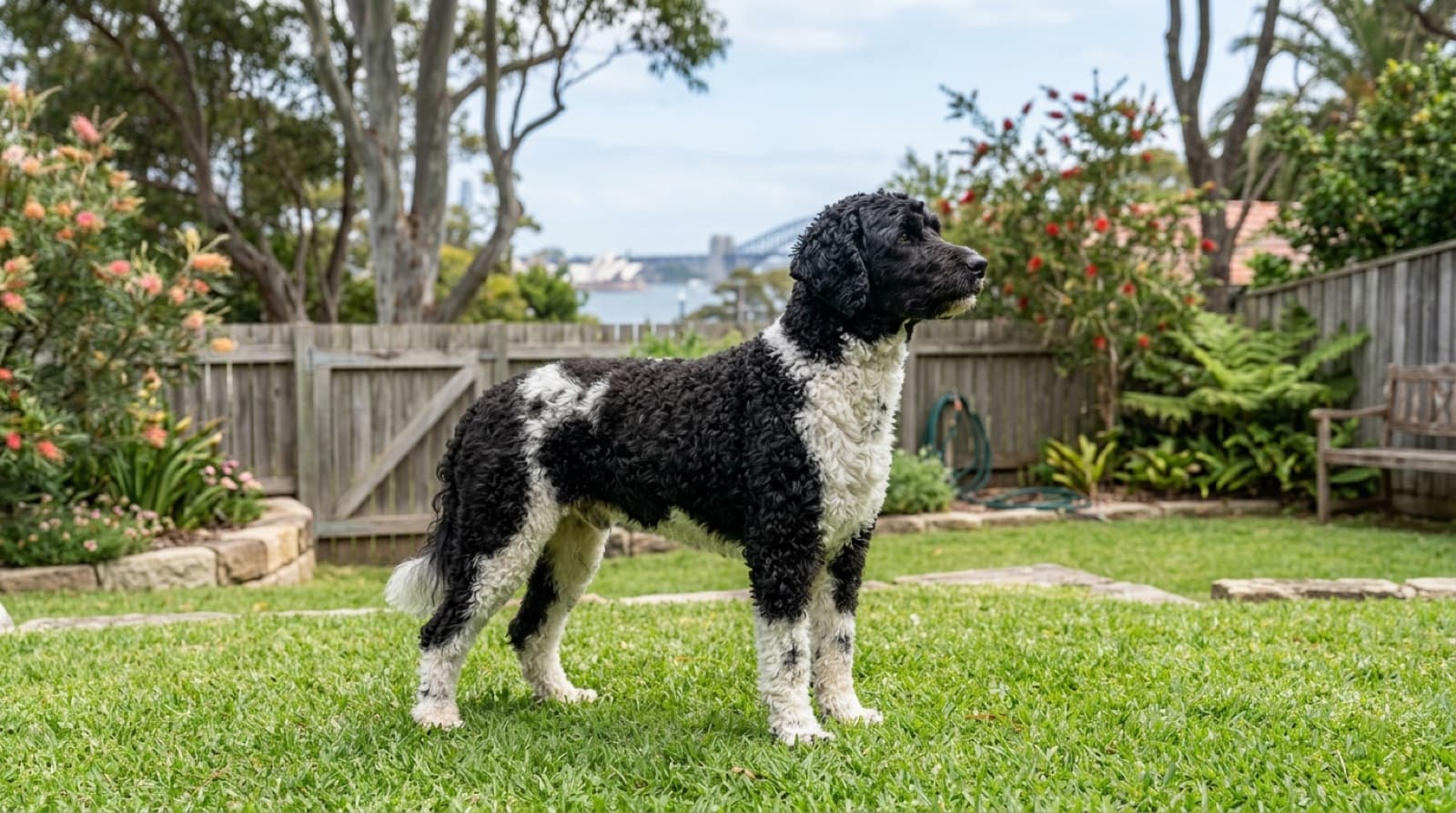
The short answer
The Portuguese Water Dog is a genuinely athletic, robust breed that often lives 11 to 14 years, so start from a place of reassurance. The conditions worth understanding are hip dysplasia, an inherited eye disease called PRA, and two breed-specific genetic problems a simple DNA test can screen for: GM1 gangliosidosis, once fatal in puppies but now largely controlled by testing, and juvenile dilated cardiomyopathy, a sudden heart condition of young dogs. The breed can also carry Addisons disease, coat conditions and, as a drop-eared water dog, ear infections. Keep the dog lean, keep the ears dry and clean, stay on year-round paralysis tick prevention, and learn the emergency signs, because a young dog collapsing or a wobbly back end both mean act now.
A hardy, athletic breed first
Before the list of conditions, the honest headline is a good one. The Portuguese Water Dog is a genuinely sound, athletic breed. It was developed along the coast of Portugal to work alongside fishermen, herding fish into nets, retrieving lost gear and carrying messages between boats, so it spent centuries being bred for stamina, strength and long days in cold water. A fragile dog was no use in that work. What came out of it is a robust, powerful, medium-sized dog with real endurance and, for a purebred of its popularity, a reasonably clean health record. Most Porties live around 11 to 14 years.
So this article is a plan, not a warning label. The conditions below are worth knowing so you can spot them early and act, but most Porties will only ever brush against one or two, and much of what keeps the breed well is ordinary care: a lean weight, real daily exercise, clean dry ears, and steady tick prevention. This is a working dog that needs a job and a good outlet, and a well-exercised Portie is generally a healthy one. Our Portuguese Water Dog exercise and drive guide for Sydney covers how to meet that need. The RSPCA Australia Knowledgebase has good general guidance on preventative care and healthy weight that applies to any dog.
Hip dysplasia: the most common inherited issue
The most common inherited orthopaedic problem in the breed is hip dysplasia, where the ball and socket of the hip do not form snugly together. That looseness lets the joint move abnormally, and over time it can wear down and lead to arthritis, pain and reduced mobility. It is not unique to Porties, it shows up across many medium and large breeds, but it is the joint condition most worth knowing here.
What to watch for. Signs include stiffness after rest that eases with movement, a reluctance to jump into the car or climb stairs, a bunny-hopping run where both back legs move together, slowing down or tiring quickly on walks, and swaying or looseness in the hindquarters. Some dogs show it young, others not until arthritis sets in with age. Responsible breeders screen breeding dogs' hips with x-rays to lower the risk, which is one reason a dog's background matters, though with a rescue you often will not have those records.
What helps. Keeping the dog lean is the single most powerful thing you can do, because every extra kilo loads the joints on every step. Sensible, regular exercise that builds muscle without pounding the joints, and swimming in particular suits this water-loving breed, all help. A Portie showing hip pain or stiffness should be seen by a vet, since there is a great deal that can be done across weight management, exercise, medical care and, in some cases, surgery.
Progressive retinal atrophy: the inherited eye disease
Progressive retinal atrophy, usually shortened to PRA, is an inherited eye disease found in the breed, in which the retina, the light-sensing layer at the back of the eye, slowly deteriorates and the dog gradually loses vision, typically ending in blindness. It is not painful, and it comes on so slowly that many owners do not notice at first, because dogs are very good at coping with fading sight in familiar surroundings.
The early sign is usually night vision. Because the light-sensing cells for dim conditions tend to go first, the first thing owners notice is often a dog that becomes hesitant, clumsy or reluctant in low light, bumping into things at dusk or in a dark room while still coping fine in daylight. Later the difficulty extends to bright conditions too. There is a DNA test for some forms of PRA, so responsible breeders screen to avoid producing affected pups, and a vet can also pick up retinal changes on an eye exam. PRA itself has no cure, but the reassuring reality is that a blind dog can still live a happy, full life with a settled home, consistent furniture layout and a bit of thought about safety. If your Portie becomes hesitant in the dark, have the eyes checked.
The two DNA-testable conditions: GM1 and JDCM
Two conditions are distinctive enough to the Portuguese Water Dog that responsible breeders DNA-test for both. This is genuinely good news, because a test that identifies carriers lets a breeder avoid ever producing an affected puppy, and both conditions have become far less common in well-bred lines as a result.
GM1 gangliosidosis is a rare inherited storage disease that affected young puppies. In an affected pup the body cannot break down certain substances properly, so they build up in nerve cells and cause worsening neurological signs, and it is fatal early in life. The important part is that this one is largely a solved problem. A DNA test identifies carriers, and by testing breeding dogs and never pairing two carriers, breeders simply do not produce affected puppies. For anyone adopting an adult Portie who is well and behaving normally, GM1 is not a day-to-day worry, because an affected dog would not have reached adulthood. It matters mainly as a reason to value DNA-tested breeding.
Juvenile dilated cardiomyopathy, or JDCM, is the more sobering of the two. It is a serious inherited heart condition of young Porties in which the heart muscle weakens and enlarges so it cannot pump effectively. The frightening feature is that it can cause sudden collapse or death in a puppy that appeared perfectly healthy, usually within the first few months to around a year of age. As with GM1, a simple DNA test exists for the gene involved, so responsible breeders test their breeding dogs and pair them to avoid producing affected puppies.
What this means for adopters. If you take on a rescue Portie, you often will not know the breeding background or whether the parents were DNA-tested. That is not a reason to panic, but it is a reason to be sensible. Ask the rescue what is known of the dog's history and age, and have any young dog vet-checked, including a proper listen to the heart. An adult dog who is well is past the highest-risk window for JDCM and well past GM1. Any fainting, collapse, sudden weakness or laboured breathing in a young dog is an emergency, covered in the box below.
Emergency: tick paralysis or a sudden collapse
Two situations mean get to an emergency vet straight away, do not wait to see if they settle. First, paralysis tick: a wobbly or weak back end, a changed, weaker or altered bark, gagging or retching, vomiting, or heavy or laboured breathing, especially after time in bush, coastal scrub, long grass or around water. Second, a sudden collapse, fainting or laboured breathing at rest, which in a young Portie can signal a heart problem such as JDCM, and in a dog of any age can be an Addisonian crisis, where a dog with Addisons disease becomes acutely and severely unwell. In all of these, phone ahead so the team is ready and head to a vet or a 24/7 hospital such as SASH, which offers round-the-clock emergency care in Sydney. With paralysis and with the heart, minutes matter.
Addisons disease: the great pretender
Addisons disease, properly called hypoadrenocorticism, is a hormone condition the Portuguese Water Dog is one of the breeds prone to. The adrenal glands stop making enough of certain hormones the body relies on, and because those hormones touch so many systems, the illness shows up in vague, shifting ways. It is often nicknamed the great pretender for exactly that reason.
What to watch for. The signs are frustratingly non-specific: on-and-off lethargy, a poor or picky appetite, tummy upset such as vomiting or diarrhoea, weakness, weight loss, and generally seeming not quite right, often waxing and waning over weeks. Because each of those points at a dozen other things, Addisons can be missed for a while. If your dog has repeated vague off-colour spells that come and go, it is worth raising Addisons with your vet by name.
The reassuring part. It is diagnosed with blood tests, and once identified it is very manageable with a vet's ongoing care, with most dogs going on to live full, normal lives. The one thing to take seriously is the sudden severe form, an Addisonian crisis, where a dog collapses and becomes acutely unwell, which is the emergency flagged above. Catch the condition early and the crisis is far less likely.
Coat and skin: follicular dysplasia and allergies
The Portuguese Water Dog's signature is its coat, either tight curls or loose waves, and that low-shedding coat is part of why people seek the breed out. It does come with a couple of things to watch. Follicular dysplasia is a condition where hair follicles do not develop or function normally, and it can show as patchy hair loss, thinning, a dull or brittle coat, or areas of changed texture, sometimes appearing as a dog matures. It is not painful, but it is worth a vet check to confirm the cause and rule out other reasons for coat change, such as the thyroid or a skin infection.
Like many breeds, Porties can also develop allergic skin disease, reacting to things in the environment such as pollens, grasses or dust mites, which shows as itching, licking and chewing, often at the feet, face, ears and belly, and can flare with the seasons. In a Sydney climate with a long warm growing season, environmental allergies are common across many breeds. Scratching leads to skin infections if left, so itchy skin deserves a vet's guidance rather than waiting it out. Regular grooming keeps the coat healthy and gives you a routine chance to spot skin changes early.
Ear infections: the water dog trade-off
Here is a health point that comes straight from what makes a Portie a Portie. This is a water dog with drop ears and hair that grows in the ear canal, which is a perfect recipe for trapped moisture. Add a warm, humid Sydney summer and a dog that wants to swim at every opportunity, and ear infections become one of the more common everyday problems in the breed.
What to watch for. Head shaking, scratching or pawing at an ear, a bad smell, redness or discharge, or a dog that flinches when you touch near the ear. Caught early, an ear infection is a quick vet fix. Left alone it becomes painful and can turn chronic. The prevention is simple and worth building into routine: after every swim or bath, dry the ears gently, and check them regularly for the signs above. Ask your vet whether a suitable ear cleaner is worth using and how to use it, because over-cleaning or the wrong product can cause problems of its own. Keeping ear hair managed as part of grooming helps air get in and moisture out.
Teeth, weight and the Sydney paralysis tick
Dental disease. As with any dog, dental disease creeps up quietly and, left alone, causes pain, tooth loss and infection that can affect the rest of the body. Regular tooth brushing, dental chews and professional cleans when your vet advises keep it in check, and it is one of the easiest problems to stay ahead of.
Weight. An athletic breed that is under-exercised will gain weight, and extra weight is a set-up for hip strain, a harder-working heart and a shorter, less comfortable life. This is a dog built for stamina, so give it the real daily exercise it needs, measure meals to a visible waist rather than free-feeding, and, in a Sydney summer, walk in the cooler hours of early morning or evening and carry water, because heat, not cold, is the local dog-safety risk.
Paralysis tick. One risk has nothing to do with the breed and everything to do with where you live. The paralysis tick is native to the east coast of Australia, including the coastal and bushland areas around Sydney, and its bite releases a toxin that causes an ascending paralysis that is fatal without veterinary treatment. It is a year-round risk here, not just a summer one, and it matters especially for an active dog that loves bush, coast and water. Keep your Portie on a vet-recommended tick prevention product every single month with no gaps, and after any walk through bush, scrub, long grass or a swim, run your hands slowly over the whole dog feeling for a lump, checking inside the ear flaps, around the face and muzzle, under the collar, in the armpits and between the toes. A thick curly coat gives a tick good cover, so check carefully. If your dog develops a wobbly back end, a changed or weak bark, gagging, vomiting or heavy breathing, treat it as an emergency and get to a vet at once. Ask your own vet which product suits your dog.
Is pet insurance worth it for a Portuguese Water Dog?
For a breed whose more serious conditions, hip surgery, heart care, and the ongoing management of something like Addisons disease, can run into real money, pet insurance is worth thinking about early. The reason to sort it out when the dog is young and well is that insurers do not cover pre-existing conditions, so anything diagnosed before you take a policy out is generally excluded. Signing up before any problem appears keeps the widest range of conditions covered.
Compare a few Australian providers on what they cover, their annual limits, and how they handle chronic conditions that need lifelong management, which is exactly the sort of cost that makes cover pay off. Names to compare include Bow Wow Meow Pet Insurance and Petplan Australia, noting that many Australian policies sit behind a single large underwriter, PetSure, so read the product disclosure statement rather than the brand name. Whatever you choose, a lean weight and steady preventative care remain the best insurance of all.
Browse adoptable Portuguese Water Dogs in Sydney
Adopting an adult lets you learn a dog's known history directly, with a vet check already done and the puppy conditions like GM1 and the earliest JDCM window well behind it. Porties reach rescue less often than mainstream breeds, so browse live NSW listings and set an alert to hear the moment one comes in.
See Available Portuguese Water Dogs →Why adopting a Portuguese Water Dog is not a health disadvantage
People sometimes worry that a rescue dog is a health gamble next to a breeder puppy. For a hardy breed like the Portuguese Water Dog the picture is more balanced than that. A Portie adopted through a reputable Sydney rescue arrives desexed, vaccinated, microchipped, treated for parasites and vet-checked, with all of it included in the fee. You are not taking on an unassessed animal.
Adopting an adult also means the puppy conditions are behind you and the day-to-day picture is often known upfront. A foster carer who has lived with the dog can tell you whether it has any skin or ear issues, how it copes on walks, and how it has gone day to day, which is real information a puppy cannot offer. You will often not have DNA-test records for a rescue dog, so ask what is known of its history, but an adult who is well has already cleared the ages at which GM1 and early JDCM appear. If you are weighing it up, our Portuguese Water Dog adoption guide for Sydney covers where to look and what it costs. Sydney rescues worth watching include RSPCA NSW, AWL NSW, Sydney Dogs and Cats Home, Monika's Doggie Rescue and Maggie's Rescue.
Keeping a Portuguese Water Dog healthy: the checklist
Most of what keeps a Portie well is routine. This is a robust breed, so the habits below do the heavy lifting.
- Give it real exercise. A good daily workout, ideally including swimming, keeps a working dog fit and holds a healthy weight, which protects hips and heart alike.
- Keep the dog lean. Measure meals to a visible waist and go easy on treats. A lean Portie carries far less risk of hip trouble and tends to live longer.
- Dry and check the ears. After every swim or bath, dry the ears, and watch for head shaking, smell or redness so an ear infection is caught early.
- Mind the eyes. Any new hesitancy in dim light deserves an eye check for PRA, and any red or painful eye earns an urgent one.
- Watch for vague off-colour spells. Repeated on-and-off lethargy, tummy upset and weakness are worth mentioning to your vet, with Addisons in mind.
- Look after the teeth. Regular tooth brushing and dental checks prevent painful disease.
- Book regular vet checks. Annually while adult, then twice yearly for a senior, so hips, heart, thyroid or an early joint issue are caught early.
- Stay on year-round tick prevention. Use a vet-recommended product every month without a gap, because the paralysis tick on the NSW coast is a fatal risk.
When to see the vet urgently
Most Portuguese Water Dog health issues are handled at a normal appointment. A few need a faster response. Get to a vet immediately, including out of hours, if you see any of these:
- A wobbly back end together with a changed or weak bark, gagging, vomiting or heavy breathing (possible paralysis tick).
- Sudden collapse, fainting or laboured breathing at rest, especially in a young dog (possible heart problem such as JDCM).
- A dog that collapses and becomes acutely, severely unwell after a run of vague off-colour spells (possible Addisonian crisis).
- A red, painful or bulging eye, or seizures.
For the everyday things, such as stiffness or a bunny-hopping run, hesitancy in the dark, an itchy or smelly ear, patchy coat changes, or steady weight gain, book a normal vet visit soon rather than waiting. Catching those early gives your Portie the best outcome. When in doubt, phone your vet or a 24/7 hospital and describe what you are seeing. They would far rather you called and it was nothing than the other way around. For a broader look at the breed before you commit, browse the full Sydney adoption resources hub, or talk to your own vet, whom the Australian Veterinary Association can help you find.
Frequently Asked Questions
Are Portuguese Water Dogs healthy?
Yes, on the whole. The Portuguese Water Dog is a hardy, athletic working breed built for long days in the water off the Portuguese coast, and that soundness is a big part of its appeal. It is generally robust and often lives around 11 to 14 years. That said, no breed is free of inherited problems, and the Portie has a few worth knowing. The main ones are hip dysplasia and an eye condition called progressive retinal atrophy, plus two breed-specific genetic conditions that a simple DNA test can screen for, GM1 gangliosidosis and juvenile dilated cardiomyopathy. It can also carry Addisons disease, coat and skin conditions, and, being a drop-eared water dog, ear infections. Most of it is manageable with routine vet care, a lean weight and year-round tick prevention.
What health problems do Portuguese Water Dogs have?
The Portuguese Water Dog is generally hardy, but the breed is associated with a handful of inherited conditions. Hip dysplasia is the most common, a joint problem where the hip does not form properly and can lead to arthritis. Progressive retinal atrophy, or PRA, is an inherited eye disease that slowly causes blindness. Two conditions are specific enough that responsible breeders DNA-test for them: GM1 gangliosidosis, a fatal storage disease of puppies now largely controlled by testing, and juvenile dilated cardiomyopathy, a serious heart condition of young dogs. The breed can also develop Addisons disease, a hormone condition with vague signs, along with follicular dysplasia and other coat issues, and ear infections. Learning the early signs of each lets you act quickly, and much of the risk is reduced by adopting a vet-checked adult.
What is JDCM in Portuguese Water Dogs?
JDCM stands for juvenile dilated cardiomyopathy, a serious inherited heart condition seen in young Portuguese Water Dogs. In an affected puppy the heart muscle weakens and enlarges so it cannot pump properly, and it can cause sudden collapse or death in a puppy that seemed healthy, usually in the first few months to around a year of age. The important and reassuring part is that a simple DNA test exists for the gene involved, so responsible breeders test their breeding dogs and pair them to avoid producing affected puppies. If you are adopting a rescue Portie, you often will not know the breeding background, so the practical steps are to ask what is known of the dog's history and to have any young dog vet-checked, including listening to the heart. Any collapse, fainting or laboured breathing in a young dog is an emergency.
What is GM1 gangliosidosis in a Portuguese Water Dog?
GM1 gangliosidosis is a rare inherited storage disease that affected Portuguese Water Dog puppies, in which the body cannot break down certain substances so they build up in nerve cells, causing worsening neurological signs and, sadly, early death. The good news is that this one is largely a solved problem in the breed. A DNA test identifies carriers, and by testing breeding dogs and never pairing two carriers, responsible breeders simply do not produce affected puppies anymore. For anyone adopting an adult Portie who is well and behaving normally, GM1 is not a day-to-day worry, because an affected dog would not have reached adulthood. It matters mainly as a reason to value DNA-tested breeding and to ask what is known of a rescue dog's background.
How long do Portuguese Water Dogs live?
Portuguese Water Dogs often live around 11 to 14 years, a good span for a medium-sized athletic dog. As a robust working breed, a Portie has every chance of a long, active life with sensible care. The things that most affect longevity are within your control: keeping the dog lean and fit, staying on top of dental care and ear care, keeping up year-round paralysis tick prevention, and booking regular vet checks that become twice-yearly for a senior. When you adopt, ask what is known of the dog's health history and learn the early signs of the breed's inherited conditions, particularly the heart and eye ones, so you can act early if anything shows.
Do Portuguese Water Dogs get hip problems?
Some do. Hip dysplasia is the most common inherited orthopaedic problem in the breed, where the hip joint does not form snugly and, over time, that looseness can lead to arthritis, pain and reduced mobility. Signs include stiffness after rest, a reluctance to jump or climb stairs, a bunny-hopping run, or slowing down on walks. Responsible breeders screen breeding dogs' hips with x-rays to reduce the risk, which is one reason a dog's background matters. For any Portie, keeping the dog lean is the single most powerful thing you can do, because every extra kilo loads the joints. A dog showing hip pain or stiffness should be seen by a vet, since there is a lot that can be done, from weight and exercise management through to medical and surgical options.
What is Addisons disease and how would I spot it?
Addisons disease, properly called hypoadrenocorticism, is a hormone condition in which the adrenal glands do not make enough of certain hormones, and the Portuguese Water Dog is one of the breeds it turns up in. It is often called the great pretender because its signs are so vague: on-and-off lethargy, a poor appetite, tummy upset such as vomiting or diarrhoea, and general weakness or just seeming not quite right, often waxing and waning. Because it mimics so many other things it can be missed for a while. It is diagnosed with blood tests and, once identified, is very manageable with a vet's ongoing care. The danger is a sudden severe episode called an Addisonian crisis, where a dog collapses and becomes seriously unwell, which is an emergency. If your dog has repeated vague off-colour spells, mention Addisons to your vet.
Do rescue Portuguese Water Dogs come health checked?
Yes. A Portuguese Water Dog adopted through a reputable Sydney rescue arrives desexed, vaccinated, microchipped, treated for worms and fleas, and vet-checked before it is listed, with all of that included in the adoption fee. Any known issue, such as a heart murmur, a skin or ear problem, or a joint concern, is usually noted on the listing or shared by the foster carer. A foster carer who has lived with the dog can tell you how it has been day to day, which a puppy from a listing cannot offer, and an adult dog is well past the puppy conditions like GM1 and the earliest JDCM window. You often will not know the DNA-test background of a rescue dog, so ask what is known of its history and keep up routine vet care. Porties reach rescue less often than mainstream breeds, so set an alert to hear when one comes in.
Keep reading
Adoptable Portuguese Water Dogs in Sydney
Live listings of Portuguese Water Dogs and Portie crosses across Sydney and NSW rescues.
Portuguese Water Dog Adoption in Sydney
Where to adopt a Portie or Portie cross, the real costs, and the working drive people underestimate.
Portuguese Water Dog Exercise & Drive
How much exercise a Portie really needs, water work, and keeping an athletic working dog satisfied in Sydney.
All Sydney Adoption Guides
Browse every breed and how-to guide for adopting a rescue dog in Sydney.