The short answer
The Portuguese Water Dog is a genuine working breed that needs well over an hour of hard physical exercise a day plus separate mental work. Think a proper walk or run, a swim or a game of fetch, and a training session, most days. Swimming is the ideal outlet: high-energy, low-impact, and perfect for a Sydney summer. An under-exercised Portie does not switch off, it invents its own job, which usually means chewing, digging, barking and destruction, and that boredom is the number one reason the breed reaches rescue. Channel the drive with dog sports, reward-based training and daily brain games, give the dog a securely fenced yard, and teach it to settle. A Portie is not suited to apartment living or to being left home alone all day. In an active home that can meet the needs, it is one of the most rewarding dogs you can own.
How much exercise a Portuguese Water Dog really needs
Let us be clear up front, because this is the fact that decides whether the breed is right for you. A Portuguese Water Dog needs well over an hour of genuine physical exercise every day, plus separate mental work on top of it. That is a working minimum, not a stretch goal. This breed was developed along the coast of Portugal to labour alongside fishermen for a full day at sea, herding fish into nets, retrieving lost tackle and swimming messages between boats. You cannot switch off centuries of that breeding with a gentle stroll around the block.
A realistic day for a well-run Portie looks like a solid walk or run in the morning, a second burst of hard exercise such as a swim or a game of fetch later on, and a training session or a puzzle woven in between. The aim is a dog that is tired in body and in brain by the evening, because a Portie that is physically run but mentally bored is still a restless dog. Weekends are your chance to go bigger with a long bushwalk, a beach session or a proper swim. If your honest weekly schedule cannot fit that most days, this is not the breed for you, and choosing a calmer dog now saves everyone heartache later.
It is worth saying this is a lifelong commitment rather than a puppy phase. A Portie does not mellow into a couch dog at three. This is an athletic, energetic breed that stays busy and demanding well into adulthood, so the exercise routine you build has to be one you can sustain for a decade or more, through Sydney summers, winter dark mornings, and the weeks when work is flat out.
The working water-dog drive: why a Portie needs a job
Exercise alone is only half the story. What really defines a Portuguese Water Dog is drive, the deep-seated need to work, to use its intelligence, and to do a job with its person. This is a breed that loves to swim, to retrieve, to carry things in its mouth and to solve problems, and all of that instinct is still very much switched on in a modern pet Portie. A dog like this is not looking to laze around. It is looking for a task.
The high intelligence is the double-edged part. A clever, biddable dog learns fast and works with you beautifully when you give it direction, and it teaches itself all manner of unwanted habits when you do not. That intelligence needs channelling. If you do not give a Portie a job, it will choose one, and the job it chooses is rarely one you would have picked. This is why the practical answer for the breed is never simply “walk it more”, it is “give it purposeful work”: swimming, retrieving games, scent work, training, a dog sport, anything that lets the dog think and do rather than just burn calories.
Understanding the drive also reframes how you see the breed's behaviour. When a Portie is mouthy, or carries your shoes around, or will not stop offering to retrieve, that is not misbehaviour, it is a working dog doing what it was built to do without an outlet. Point that energy at a real job and the same instincts become the reason the breed is such a delight to train and live with.
Why an under-exercised Portie becomes destructive
This is the single most important section for anyone considering the breed, because it explains the number one reason Portuguese Water Dogs land in Sydney and NSW rescue. A Portie that does not get enough exercise and mental stimulation does not become calm. It becomes bored, busy, mouthy and destructive. The dog is not being spiteful. It is a high-drive working animal with nowhere to put its energy, and that energy always finds an outlet.
In practice that looks like a dog that chews furniture and skirting, digs up the garden, barks and howls, raids bins, and cannot settle indoors. Owners who pictured an easy family pet meet a whirlwind that dismantles the yard, and many reach the point where they feel they cannot cope. That mismatch, a working dog in a home that underestimated its needs, is a story rescues hear again and again. The dog usually arrives with its temperament and its affection fully intact. What it lacked was a job.
The fix is almost never more discipline or a bigger crate. It is more genuine exercise, more mental work, and a real outlet for the drive. When you meet those needs, the destructive behaviour typically evaporates, because the underlying cause, an unstimulated working brain, has been resolved. This is exactly why we spend so much of this guide on swimming, sports and training. They are not extras for the enthusiast. For this breed they are the difference between a settled companion and a surrendered one. If you are weighing up the breed, read our companion Portuguese Water Dog adoption guide for the full honesty on why Porties end up needing new homes.
Swimming: the ideal outlet for a Sydney water dog
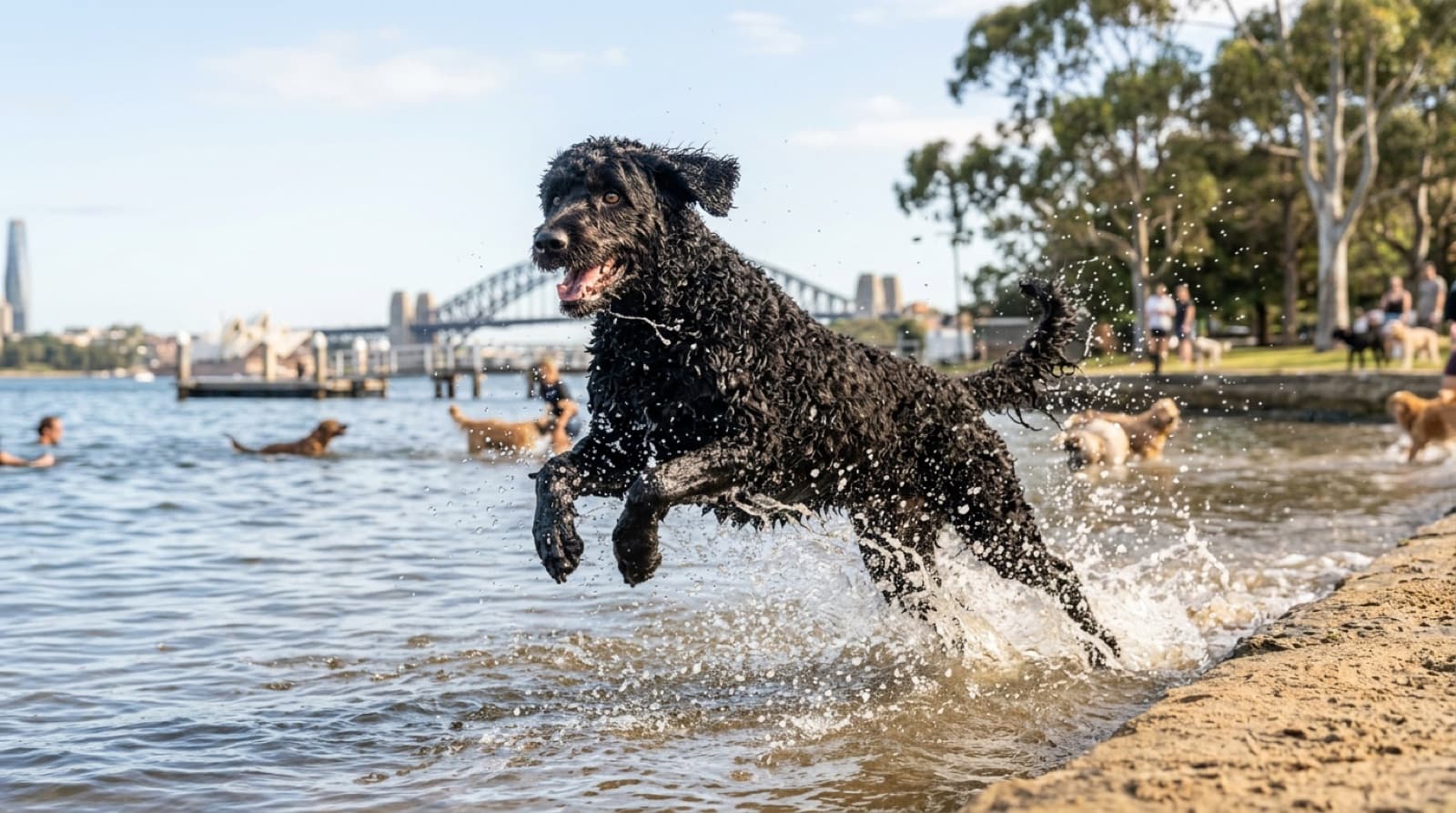
If there is one activity built for this breed, it is swimming, and Sydney is a genuinely good city for it. The clue is in the name. Porties have webbed feet, a waterproof curly coat and a love of water bred into them over centuries of coastal work, so most take to swimming naturally and enthusiastically. Beyond the joy of it, swimming is excellent low-impact exercise. It burns a huge amount of energy while sparing the joints, which makes it perfect for a growing dog, an older dog, or any Portie you want to tire out without pounding its legs on hard ground.
Sydney gives you options. There are dedicated dog-friendly beaches such as the off-leash area at Sirius Cove Reserve in Mosman, and calm harbour and river spots like Rowland Reserve at Bayview on the Northern Beaches, where dogs can swim in relatively sheltered water. Always put safety first: choose calm, clean water away from strong currents and boat traffic, watch a less confident dog closely, and never assume even a natural swimmer can handle surf or a rip. Introduce a nervous dog gradually in shallow, still water rather than throwing it in.
Aftercare matters as much as the swim itself. Rinse salt or river water out of the coat, dry the curly coat thoroughly, and pay particular attention to drying the ears, because water dogs are prone to ear infections when moisture is left to sit in a warm, humid climate. A quick dry with a towel and a gentle ear check after every swim heads off most problems. For the full coat-and-ear routine and the breed's medical picture, see the Portuguese Water Dog health guide.
Swimming also happens to be the best answer to the Sydney heat problem, which we come back to below. On a hot, humid summer day when hard land exercise is genuinely risky, a swim keeps the dog cool while it works off energy. It is the single most useful activity in a Portie owner's Sydney toolkit.
Dog sports and positive outlets for the drive
Swimming is the flagship, but a Portie thrives on variety, and dog sports are one of the best ways to give a working brain a structured job. You do not need to compete. The value is in the training and the focus, which tire the mind as much as the body. The breed's athleticism and biddability make it a natural at a wide range of activities:
- Agility gives a fast, clever dog a physical and mental challenge, running a course of obstacles on your cues.
- Dock diving and water-retrieve games play straight to the breed's instincts, combining swimming, retrieving and drive in one activity.
- Retrieving and gundog-style games, from formal retrieve work to a simple structured game of fetch with rules, satisfy the urge to carry and return.
- Scent and nose work asks the dog to find hidden items using its nose, which is surprisingly tiring and can be done in the backyard or the lounge room.
- Obedience and rally build focus and teamwork through reward-based training, and suit a dog that loves working with its person.
- Canicross, running with your dog attached by a harness and line, is a great fit for the physically driven owner and dog.
The best part is that you can do backyard versions of all of these without a club membership. A homemade agility set-up, a scent game hiding treats around the yard, a structured retrieve routine, or a puzzle feeder at mealtimes all give a Portie something to think about. If you want structured coaching, look for a reward-based Sydney trainer or a local obedience or agility club. Rotate a few of these through the week and you keep the dog engaged rather than letting any one activity go stale.
Reward-based training for a smart, biddable dog
Training is not a separate hobby for this breed, it is one of your core tools for managing the drive, and the good news is that a Portie is a joy to teach. This is a highly intelligent, sensitive, people-focused dog that responds best to reward-based training: short, positive sessions built on praise, food and play rather than force or heavy correction. A Portie will pick up new skills fast and genuinely enjoys the process, which is why the breed does so well at obedience and sport.
Because the mind needs a job as much as the body does, daily training and mental games should be a fixed part of the routine, not an occasional extra. Even ten minutes of concentrated brain work, a new trick, a recall drill, a scent game, can tire a clever dog as much as a longer walk. Build these in from the day the dog arrives, keep the sessions fair and rewarding, and you shape the drive into cooperation instead of chaos. A sensitive breed like this does not respond well to harsh handling, so if you want extra support, a reward-based Sydney trainer or an obedience club will steer you right. The Australian Veterinary Association and the RSPCA both recommend positive-reinforcement methods for exactly this reason.
Secure fencing and teaching an off-switch
Two practical pieces round out the picture. The first is a securely fenced yard. A Portie is athletic, driven and clever enough to find the weak point in a boundary, especially a bored one, so solid, escape-proof fencing is not optional. A dog that gets out to chase or explore is a real risk to itself on Sydney roads, and under the NSW Companion Animals Act 1998 your dog must be under effective control in public and on a lead in most public places, so containment at home and leash discipline out of the house both matter.
The second, and the one owners most often overlook, is teaching a genuine off-switch. A high-drive dog does not automatically know how to relax, and if every interaction is high-arousal exercise and games, you can accidentally raise a dog that never settles. Deliberately teach calm: reward the dog for lying quietly on a mat, use a settled routine after exercise, and give the dog structured downtime rather than constant stimulation. A Portie that has had its needs met and has learned to switch off is a wonderfully easy dog to live with indoors. The combination of real daily exercise, mental work, a job for the drive, and a taught ability to relax is the whole recipe for a happy Portie.
Browse adoptable Portuguese Water Dogs in Sydney
A Portie thrives with an active owner who can meet the exercise and drive. Browse live NSW listings and set an alert so you hear the moment one comes into rescue.
See Available Portuguese Water Dogs →Exercising a Portie safely in the Sydney climate
Exercising a high-energy breed in Sydney means planning around the heat rather than the cold. Summer daytime maximums sit around the mid-twenties with regular hot, humid days pushing past 35 degrees, and that is the real safety risk for an active dog, not winter. Hard land exercise in the middle of a hot day can tip a working dog into heat stress fast, so shift the serious exercise to the cool of the early morning or the evening, carry water, and back off on humid days. Hot pavement burns paws too, so use the back-of-the-hand test before you set out.
This is exactly where swimming earns its place. On a day too hot for a run, a swim in safe, calm water keeps the dog cool while it burns energy, which is why it is the best hot-weather exercise you can give a Portie. Between swims, top up the mental side indoors with training and puzzle games so the dog stays satisfied on the days the weather rules out a big outing.
Two other Sydney essentials for an active outdoor dog. First, use secure off-leash areas for the free running a Portie loves, and keep the dog leashed elsewhere as the Companion Animals Act requires. Sydney has good options, from the fenced dog area at Sydney Park in St Peters to the timed off-leash zones in Centennial Parklands. Second, keep year-round paralysis tick prevention up to date, without fail. The paralysis tick is native to coastal and bushland NSW and its bite can be fatal, and any Portie you are exercising in bush, scrub or coastal areas is at risk in every season. Use a vet-recommended monthly preventive and do a physical tick check after bushwalks. The RSPCA Australia Knowledgebase has plain-language guidance on both exercise and tick prevention, and you can confirm your council registration through the NSW Pet Registry.
Not for apartment life or people out all day
It would be dishonest to end without saying plainly who this breed is not for. A Portuguese Water Dog is not suited to apartment living, and it is not suited to a home where everyone is out all day. Everything above explains why. This is a working dog that needs well over an hour of hard exercise plus mental work daily, room to move, ideally regular swimming, and a securely fenced yard. A unit rarely provides that, and a dog left alone for long stretches with no outlet is precisely the recipe for the boredom-driven destruction that fills rescue kennels.
None of this means the breed is difficult. In the right home, an active owner or family who genuinely enjoys getting out with a dog, a Portie is one of the most rewarding companions you can have: affectionate, clever, biddable and endlessly game. The whole question is whether your life has room for a real working dog. If it does, and you can commit to the exercise, the drive and the coat care for the long haul, adopting a Portie is a wonderful decision. If your honest answer is that the dog would be alone all day or living in a small space with a token walk, a calmer breed is the kinder choice, both for you and for the dog. When you are ready, browse the Porties and crosses currently listed on the Sydney Portuguese Water Dog listings, or start with our full Sydney adoption resources hub.
Frequently Asked Questions
How much exercise does a Portuguese Water Dog need?
Plan on well over an hour of genuine physical exercise every day, plus separate mental work, and treat that as a floor rather than a target. This is a working water dog bred to labour alongside Portuguese fishermen all day, so a token walk around the block will not touch its needs. A good day for a Portie looks like a proper walk or run in the morning, a swim or a game of fetch, and a training session or a puzzle in between, so the dog is genuinely tired in body and brain by evening. In a Sydney summer, do the hard physical work in the cool of the early morning or after sunset, carry water, and never push a dog in the middle of a hot, humid day. A Portie that gets this most days settles beautifully at home. One that does not becomes a problem.
Do Portuguese Water Dogs like to swim?
Yes, swimming is in the breed's DNA and most Porties are natural, enthusiastic swimmers. The breed was developed on the coast of Portugal to work in the water, herding fish into nets, retrieving lost gear and carrying messages between boats, so the webbed feet, the waterproof coat and the love of water are all part of the working package. Swimming is also excellent low-impact exercise that burns a huge amount of energy while sparing the joints, which makes it one of the best outlets you can give a Portie in Sydney. Always pick safe, calm water, watch for currents and cold, rinse the coat afterwards and dry the ears well, since water dogs are prone to ear infections if left damp.
Can a Portuguese Water Dog live in an apartment?
Honestly, an apartment is a poor fit for this breed and it is not a set-up we would recommend. A Portuguese Water Dog is a high-energy working dog that needs well over an hour of hard exercise plus mental work every day, room to move, and ideally regular swimming, and none of that comes easily from a unit. The bigger problem is what happens when the needs are not met: an under-exercised, under-stimulated Portie in a small space becomes noisy, destructive and frustrated, which is hard on the dog and on close neighbours. It is not strictly impossible with an exceptionally committed owner who exercises the dog hard twice a day, but for most people a Portie belongs in a home with a securely fenced yard and an active daily routine. If you are in an apartment, a calmer, lower-energy breed is a kinder choice for everyone.
What dog sports suit a Portuguese Water Dog?
Almost any active, water-friendly or brain-heavy dog sport suits a Portie, because the breed is athletic, biddable and loves working with its person. Good matches include agility, dock diving and other water-retrieving games that play straight to the breed's swimming instincts, plus scent or nose work, obedience and rally, and canicross or running alongside a bike for the physically driven dog. The point of a sport is not competition, it is a structured job that channels the drive and tires the brain as well as the body, which is exactly what this breed needs. Describe what you want and start with reward-based foundations. Even backyard versions, a retrieve routine, a scent game hiding treats around the yard, or a homemade agility set-up, do the same job of giving a clever working dog something to think about.
Why does an under-exercised Portuguese Water Dog become destructive?
Because a working dog with nothing to do will invent its own job, and a Portie's version of that involves chewing, digging, barking and mischief. This is the single most common reason the breed lands in rescue. The dog is not being naughty or spiteful, it is a high-drive animal built to work all day, and when the exercise and mental stimulation are missing, all that energy has to go somewhere. Owners who pictured a calm family pet meet a bored, busy dog that dismantles the yard and cannot settle, and the mismatch becomes a surrender. The fix is rarely more discipline. It is more genuine exercise, more mental work, a real job like swimming or a sport, and teaching the dog to switch off. Meet the needs and the destructive behaviour usually disappears.
Are Portuguese Water Dogs easy to train?
Yes, a Portie is highly intelligent, eager to please and very trainable, which is a big part of the appeal, but that cleverness cuts both ways. This is a sensitive, people-focused breed that thrives on reward-based training, short positive sessions and a clear job to do, and it will pick things up fast. The flip side is that a smart dog with too little to think about will teach itself unwanted habits just as quickly, so training is not optional with this breed, it is one of your main tools for channelling the drive. Build daily training and mental games into the routine from day one, keep it fair and rewarding, and you have a genuinely joyful working partner. If you want structured help, look for a Sydney reward-based trainer or an obedience club.
Does a Portuguese Water Dog need mental stimulation as well as physical exercise?
Yes, and this is the part people miss. Physical exercise alone will not satisfy a working breed like the Portie, because the brain needs a job as much as the body does. A dog that is run hard but never asked to think is still an under-stimulated dog, and it will find its own entertainment. Build in training sessions, puzzle feeders, scent games, trick work and structured activities like a retrieve or a swim, so the dog is using its mind alongside its legs. A useful rule of thumb is that ten minutes of concentrated brain work can tire a clever dog as much as a longer walk. Combine solid physical exercise with daily mental work and you get a settled, contented Portie rather than a restless one.
What is the best hot-weather exercise for a Portuguese Water Dog in Sydney?
Swimming is the best hot-weather exercise for this breed, hands down. It burns serious energy, spares the joints and keeps the dog cool at the same time, which is ideal in a Sydney summer where midday heat and humidity make hard land exercise risky. Use safe, calm water, choose a dog-friendly beach or a quiet stretch of river, and go in the cool of the early morning or evening rather than the peak of the day. Away from water, shift walks and runs to dawn or after sunset, carry water, and watch for signs of overheating on humid days. Whatever the activity, rinse the coat, dry the ears well, and keep year-round paralysis tick prevention up to date if you exercise anywhere near bushland or the coast.
Keep reading
Adoptable Portuguese Water Dogs in Sydney
Live listings of Portuguese Water Dogs and crosses across Sydney and NSW rescues.
Portuguese Water Dog Adoption in Sydney
Where to adopt a Portie, the real costs, and why the breed ends up needing new homes.
Portuguese Water Dog Health Issues
Inherited conditions, the DNA tests to know about, coat and ear care, and Sydney tick prevention.
All Sydney Adoption Guides
Browse every breed and how-to guide for adopting a rescue dog in Sydney.