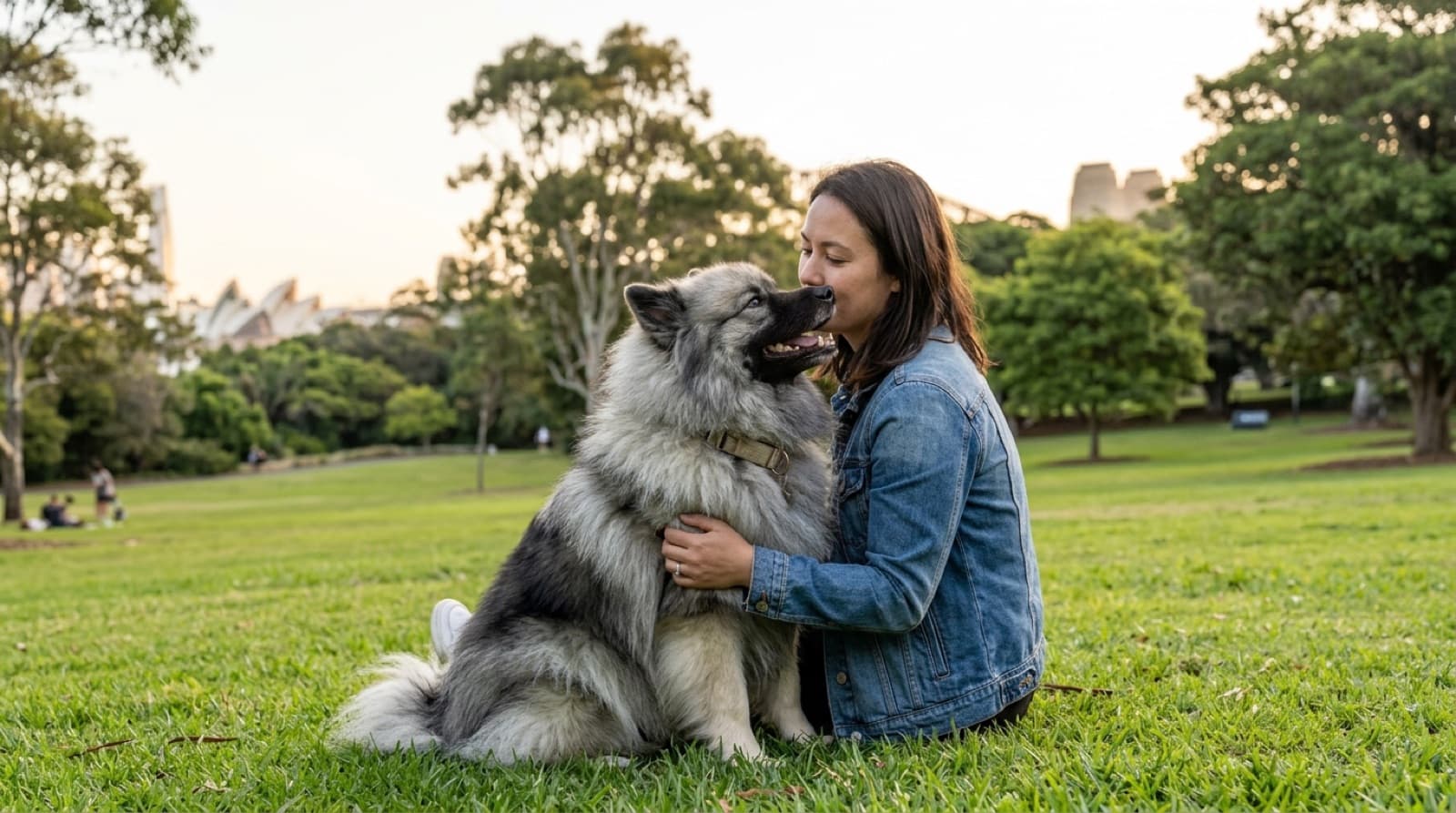
The short answer
A Keeshond is a friendly, affectionate, medium-sized spitz that lives to be with its family. The defining trait is closeness. This is a velcro dog that bonds hard and does not suit being left alone for long days, so plan for company or it is prone to separation-related behaviour. It is a natural alert barker, so manage the noise early with exercise, company and a trained quiet cue, which matters in close-neighbour Sydney homes. It is sociable with children and other pets when well socialised, needs a moderate amount of exercise plus mental work, and is a pleasure to train with reward-based methods. The plush double coat needs brushing several times a week, blows heavily once or twice a year, and must never be shaved.
The velcro-spitz temperament
If you understand one thing about the Keeshond before you bring one home, make it this: the breed was developed as a companion, not a worker. The Keeshond is the national dog of the Netherlands, where it spent generations aboard river barges and on farms as a watchdog and family friend rather than a hunter or a livestock guardian. That history shaped a dog whose whole purpose is people. A Keeshond is affectionate, gentle, cheerful and endlessly interested in whatever its family is doing, and it wants to be right there in the middle of it.
Owners often call the breed a velcro dog, and it is an accurate label. A Keeshond will follow you from room to room, settle at your feet, lean into you and generally treat your company as the best part of its day. This is a lovely quality if you want a devoted, deeply bonded companion. It is a genuine liability if the dog is going to spend most of its life alone. The same closeness that makes a Keeshond such good company is the same closeness that makes it struggle with isolation, and the two cannot be separated. You are choosing both.
Temperament-wise, this is one of the more even, stable spitz breeds. Keeshonden are typically friendly with strangers once the initial alert bark is over, sociable with other dogs, tolerant and gentle with children, and rarely aggressive. They are sensitive dogs that read your mood and respond to it, which is part of their charm and part of why harsh handling does not suit them. What they are not is aloof or independent. A person who wants a dog that is happy to do its own thing for hours will find the Keeshond too needy. A person who wants a companion in the fullest sense will find it close to ideal.
Being left alone: the honest limitation
Because the Keeshond bonds so tightly, being left alone for long stretches is the single hardest part of the breed for many households, and it is worth being honest about before you adopt. A Keeshond that is isolated for a full working day, most days, is at real risk of separation-related behaviour: persistent barking and howling, pacing, destructiveness, house soiling and genuine distress. This is not stubbornness or spite. It is a companion breed doing badly at the one thing it was never built to do.
None of this makes a Keeshond impossible for a busy household, but it does mean you need a plan rather than a hope. Build alone time up gradually from short absences so the dog learns that you always come back. Keep departures and returns calm and low-key rather than emotional. Leave safe chews, food puzzles and enrichment so there is something to do. For a full working day, arrange a dog walker, doggy day care, a trusted neighbour or a canine companion so the dog is not isolated for nine hours straight. If separation-related behaviour is already entrenched in a rescue dog, work with your vet and, if needed, a qualified force-free behaviourist rather than trying to punish the symptoms.
The upshot for a Sydney adopter is simple. A home where someone works from home, is retired, has flexible hours, or can bring the dog along to much of daily life is a wonderful fit for a Keeshond. A home where the dog will be alone from morning until evening is not, and adopting one into that life sets up both of you to fail. If your circumstances are the second kind, it is kinder to choose a more independent breed, or to build a real support plan first. The RSPCA Australia Knowledgebase has practical guidance on preventing and managing separation-related behaviour.
The alert barking, and how to live with it
The other trait that defines daily life with a Keeshond is the barking. This is a watchdog breed at heart. Aboard the Dutch barges the Keeshond earned its keep by sounding the alarm at anyone approaching, and that alert instinct is still very much switched on. A Keeshond will bark to announce visitors, delivery drivers, other dogs, unfamiliar noises and things moving past the window. It is not an aggressive dog and it is not trying to be difficult. It is telling you something is happening, because that is the job it was bred for.
For a Sydney owner this is the trait to plan around most carefully, particularly in a unit, a townhouse or any home with close neighbours. Alert barking that goes unmanaged is one of the most common sources of neighbour complaints and strata issues, and it is far easier to shape a young or newly adopted dog than to undo a barking habit that has been rehearsed for years. The barking also gets worse, not better, when a Keeshond is bored, under-exercised or left alone too much, so the barking and the two sections above are all connected.
Managing it is very doable. Give the dog enough daily exercise and mental work that it is not barking out of boredom. Make sure it has company rather than being left to bark at the world alone all day. Teach a reliable quiet cue with calm, reward-based training, rewarding the pause after a bark rather than shouting, which a Keeshond just reads as you joining in. Reduce triggers where you can, for example by managing what the dog can see out the front window. Done consistently, this turns an alert barker into a dog that gives you a couple of announcements and then settles. What you cannot do is expect a Keeshond to be a naturally silent breed. Go in accepting that it is vocal, and manage it well, rather than being surprised by it later.
With children and other pets
Here the Keeshond shines. As a companion breed with a gentle, even temperament, a well-socialised Keeshond generally does very well with children, and its sturdy medium build means it is less fragile than a toy breed around active kids. They tend to be patient and affectionate family dogs that enjoy being part of a busy household. As with any dog, supervise interactions with young children, teach children to be respectful and to leave the dog alone when it rests, and give the dog a quiet space of its own, but the raw temperament is about as family-friendly as spitz breeds get.
With other animals the Keeshond is also one of the easier spitz breeds. It was not bred to hunt, so it lacks the intense prey drive of a working terrier, and most Keeshonden get on well with other dogs and can share a home happily with cats, especially when raised alongside them or introduced with care. They are sociable and non-confrontational by nature. That said, the individual dog always matters more than the breed label, so if you already have a cat or another dog, the safe path is to adopt a specific Keeshond that a rescue or foster carer has actually watched being calm and appropriate around other animals, and to manage the first introductions slowly and positively. Good early socialisation, exposing a young dog to a wide range of people, dogs, sounds and situations, is what brings out the confident, easygoing side of the breed.
Exercise, brains and training
The Keeshond needs a moderate amount of exercise. That means more than a token walk around the block, but far less than a high-drive working breed. A solid daily walk plus some active play usually covers the physical side, and because the breed is so people-oriented it would always rather do that with you than be turned out into the yard to entertain itself. The part owners underestimate is the mental side. Keeshonden are clever, quick-learning dogs, and they need something to think about. Training games, puzzle feeders, scent games and having a little job to do keep a Keeshond genuinely content, and mental work tires the dog as effectively as a longer walk.
On trainability, this is one of the breed's strengths. A Keeshond is intelligent, eager to please and closely bonded to its handler, which is the exact recipe for a dog that enjoys learning. The breed has a genuine history in obedience and dog sports, and most Keeshonden take to reward-based training readily. The important caveat is sensitivity. Because these dogs are so tuned in to their people, harsh or heavy-handed correction does not just fail, it can make a sensitive Keeshond anxious or withdrawn. Keep training upbeat, generous with rewards, short and consistent. Given the barking and the closeness, the two most valuable things to teach early are a reliable quiet cue and calm, confident time alone, and both respond well to patient, positive training. If you would like hands-on help, a Sydney force-free trainer or a reward-based group class is money well spent for a first-time owner.
The plush double coat: brush, never shave
The Keeshond's magnificent coat is the other headline of ownership. It is a true double coat: a dense, soft, woolly undercoat under a longer, harsher, stand-off outer coat, complete with the ruff around the neck, the trousers on the hind legs and the plumed tail curled over the back. It is a beautiful coat, and it is a real commitment. Expect to brush thoroughly two or three times a week to work through the undercoat, prevent matting behind the ears and under the legs, and keep the skin healthy. A Keeshond is not a wash-and-go dog.
Shedding comes in two forms. There is steady year-round shedding, which regular brushing keeps manageable, and then there is the seasonal coat blow, when the dog drops its undercoat in dramatic tufts once or twice a year. During those weeks the fur is everywhere and you will be brushing daily to stay ahead of it. This is normal and healthy, and the brush is the tool for it. A good deshedding session, or a professional groom to help blow the coat out, makes those periods far easier.
The single most important rule, and it matters even more in the Australian climate, is never shave a Keeshond. It is tempting to think a heavy coat must make the dog hotter and that clipping it down would be kind, but the opposite is true. The double coat insulates against heat as well as cold and shields the skin from the sun, and shaving it can permanently damage how the coat regrows, remove that sun protection, and leave the dog more vulnerable, not less. The correct way to keep a Keeshond comfortable in summer is to keep the undercoat brushed out so air can move through the coat, not to remove the coat. If you are ever unsure, talk to a groomer experienced with double-coated breeds or your vet, and read the coat-care detail in the cluster sibling linked below.
Keeping a heavily coated spitz cool in Sydney
The Keeshond is a northern European breed wearing a coat built for cold barges and Dutch winters, so a Sydney summer asks more of it than its homeland ever did. Heat, not cold, is the health risk to plan for here. On hot and humid days a heavily coated dog overheats faster than a short-coated one, so shift the routine around the weather. Walk in the cooler parts of the day, early morning and evening, and skip the midday heat entirely on hot days. Always carry water, stick to shaded routes and grass rather than hot bitumen that can burn paw pads, and never leave a dog in a parked car even for a few minutes.
At home, give a Keeshond constant access to shade, cool water and, on the worst days, an air-conditioned or well-ventilated room and perhaps a cooling mat. Keep exertion light when it is hot, and lean on indoor training games and puzzles to burn mental energy without the heat load. Learn the early signs of heat stress, which include heavy panting, drooling, bright red gums, weakness and distress, and treat it as the emergency it is by cooling the dog with cool (not icy) water and getting to a vet immediately. Keeping the undercoat brushed out through the warmer months genuinely helps the coat breathe. The core message is the same as the grooming one: manage the heat with shade, timing, water and brushing, never by shaving the coat.
One more year-round Sydney essential applies to a Keeshond as much as any dog. Coastal and bushland NSW is paralysis tick country, and a thick coat can hide a tick, so keep the dog on a vet-recommended year-round tick and parasite prevention and run your fingers through the coat to the skin after any bushwalk. The Australian Veterinary Association and your local vet can advise on the right product. There is more on tick prevention and the breed-specific health risks to watch in the Keeshond health guide.
Browse adoptable Keeshonden in Sydney
The Keeshond is uncommon in Australian rescue, so crosses and older dogs turn up more often than purebred puppies. Browse live NSW listings and set an alert so you hear the moment one comes in.
See Available Keeshonden →Is a Keeshond the right fit for your home?
A Keeshond is a wonderful match for a home that wants a genuine companion and can give it company, gentle exercise and coat care. If someone is around much of the day, if you enjoy a dog that is affectionate and involved rather than aloof, if you are happy to brush a plush coat a few times a week and live with a natural alert barker, and if you can walk in the cooler hours through summer, this is a delightful, devoted, family-friendly breed that adapts well to a house or, with company and coat care, to a unit.
The honest counter-case is short but firm. If the dog will be alone all day, most days, a Keeshond is the wrong breed, because the closeness that makes it such good company is the same closeness that makes isolation so hard on it. If barking would be a serious problem where you live and you are not prepared to manage it from the start, think carefully. And if heavy seasonal shedding and regular brushing are dealbreakers, this is not your coat. Everything else about the breed is forgiving and family-friendly. As always, let the specific dog in front of you and the foster carer's honest notes guide the decision rather than the breed name alone. To see why one might be in rescue and how to adopt, read the Keeshond adoption guide, and browse everything in our Sydney adoption resources hub. You can also register or check the details of a dog you adopt through the NSW Pet Registry.
Frequently Asked Questions
Are Keeshonden good family dogs?
Yes, the Keeshond is one of the better family dogs among the spitz breeds. They were bred as companions rather than hunters or guardians, so they are friendly, affectionate and people-focused by nature, and a well-socialised Keeshond usually does beautifully with respectful children and settles happily into a busy household. They are sturdy without being large, gentle in temperament, and famously fond of being in the middle of family life. The one honest catch is that this closeness is the whole point of the breed. A Keeshond wants to be with its people, so it suits a home where someone is around a good part of the day rather than one where the dog is left alone for long stretches. Meet that need and you have a devoted, even-tempered family dog.
Do Keeshonden bark a lot?
Yes, the Keeshond is a naturally vocal breed and will bark to alert you, because it was developed as a watchdog on Dutch barges and farms and that watchful, sound-the-alarm instinct is hardwired. A Keeshond is not an aggressive dog, but it will announce visitors, noises and movement, and a bored or under-exercised one, or one left alone too long, tends to bark more. The good news is the barking is very manageable. Plenty of exercise and mental work, company during the day, teaching a reliable quiet cue with reward-based training, and not accidentally rewarding the barking all help enormously. In a Sydney home with close neighbours or in a strata building, take the barking seriously from day one rather than waiting for a complaint, and be honest that this is an alert breed, not a silent one.
Can a Keeshond be left alone?
Not for long days on a regular basis, because the Keeshond is a true velcro dog that forms a very close bond with its family and does not cope well with being left by itself for hours on end. A Keeshond left alone too much is prone to separation-related behaviour: barking, howling, pacing, destructiveness and distress. That does not mean the breed is impossible for a working household, but it does mean you need a plan. Build up alone time gradually, keep departures and returns low-key, leave enrichment and safe chews, and consider a dog walker, day care or a companion so the dog is not isolated for a full working day. A home where someone is around much of the time, or where the dog can come along to plenty of things, is a far better fit than one where it is alone nine hours a day.
Do Keeshonden shed a lot?
Yes, a great deal, especially during the seasonal coat blow. The Keeshond has a thick double coat, a dense woolly undercoat under a long harsh outer coat, and it sheds steadily year-round and then heavily once or twice a year when it drops the undercoat in big tufts. During those weeks you will find fur everywhere and will be brushing daily to keep on top of it. The rest of the year, a thorough brush two or three times a week keeps the coat healthy and the shedding under control. The one thing you must not do to reduce shedding is shave the coat. The double coat insulates against both heat and cold and protects the skin, and shaving it can ruin the coat and leave the dog worse off in the sun. Manage the shedding with the brush, not the clippers.
How much exercise does a Keeshond need?
A Keeshond needs a moderate amount of exercise, less than a working breed like a border collie but more than a token stroll. A good daily walk plus some active play and, importantly, some mental engagement usually keeps a Keeshond happy and settled. They are intelligent, people-focused dogs that thrive on training games, puzzle feeders and having a job to do with you, and mental work tires them out as much as physical exercise. Because they are so bonded to their people, they would much rather do things with you than be left to exercise themselves in the yard. In Sydney, walk in the cooler parts of the day through summer, since a heavily coated spitz feels the heat, and lean more on shaded morning and evening outings and indoor training games when the weather is hot.
Are Keeshonden easy to train?
Yes, relatively, because the Keeshond is intelligent, eager to please and closely bonded to its people, which is exactly the combination that makes a dog a pleasure to train. They respond very well to positive, reward-based methods and they pick things up quickly, which is part of why the breed has a history in dog sports and obedience. The flip side of that sensitivity is that harsh, heavy-handed correction backfires with a Keeshond and can make a sensitive dog anxious or shut down, so keep training upbeat and reward-based. Because they are alert and vocal, the most valuable things to train early are a reliable quiet cue and calm, confident alone time. Start socialisation and gentle training young, keep sessions short and fun, and a Keeshond will happily learn.
Are Keeshonden good with other dogs and cats?
Generally yes, when they are well socialised. The Keeshond was bred as a companion rather than a hunter, so it does not carry the strong prey drive of a working terrier, and most Keeshonden get along well with other dogs and can live happily with cats, particularly when raised alongside them or introduced carefully. They tend to be sociable, even-tempered and non-confrontational by nature. As always, the individual dog matters more than the breed average, so if you have a cat or another dog, adopt a specific Keeshond that a rescue or foster carer has actually seen behaving calmly around other animals, and manage early introductions carefully. Good early socialisation with a range of dogs, people and situations brings out the sociable, easygoing side of the breed.
Can a Keeshond live in an apartment or unit in Sydney?
Yes, a Keeshond can adapt to unit or apartment living, but on two conditions. The first is company. This is a velcro breed that needs its people around and does not suit being left alone all day, which is a bigger issue for many apartment households than the size of the space. The second is the barking. A Keeshond is an alert, vocal dog, and in a building with close neighbours you need to manage that from the start with exercise, company and training a quiet cue, and confirm that dogs are actually permitted under your strata rules. Their moderate exercise needs and even temperament otherwise suit indoor living fine, provided you get them out for daily walks and keep their coat and shedding under control indoors. A Keeshond given company, exercise and coat care can be a lovely unit dog.
Keep reading
Adoptable Keeshonden in Sydney
Live listings of Keeshonden and Keeshond crosses across Sydney and NSW rescues.
Keeshond Adoption in Sydney
Where to adopt, why they reach rescue, and adopt versus buy cost for this uncommon spitz.
Keeshond Health Issues in Sydney
The health risks the breed is prone to, plus Sydney heat and year-round paralysis tick prevention.
All Sydney Adoption Guides
Browse every breed and how-to guide for adopting a rescue dog in Sydney.