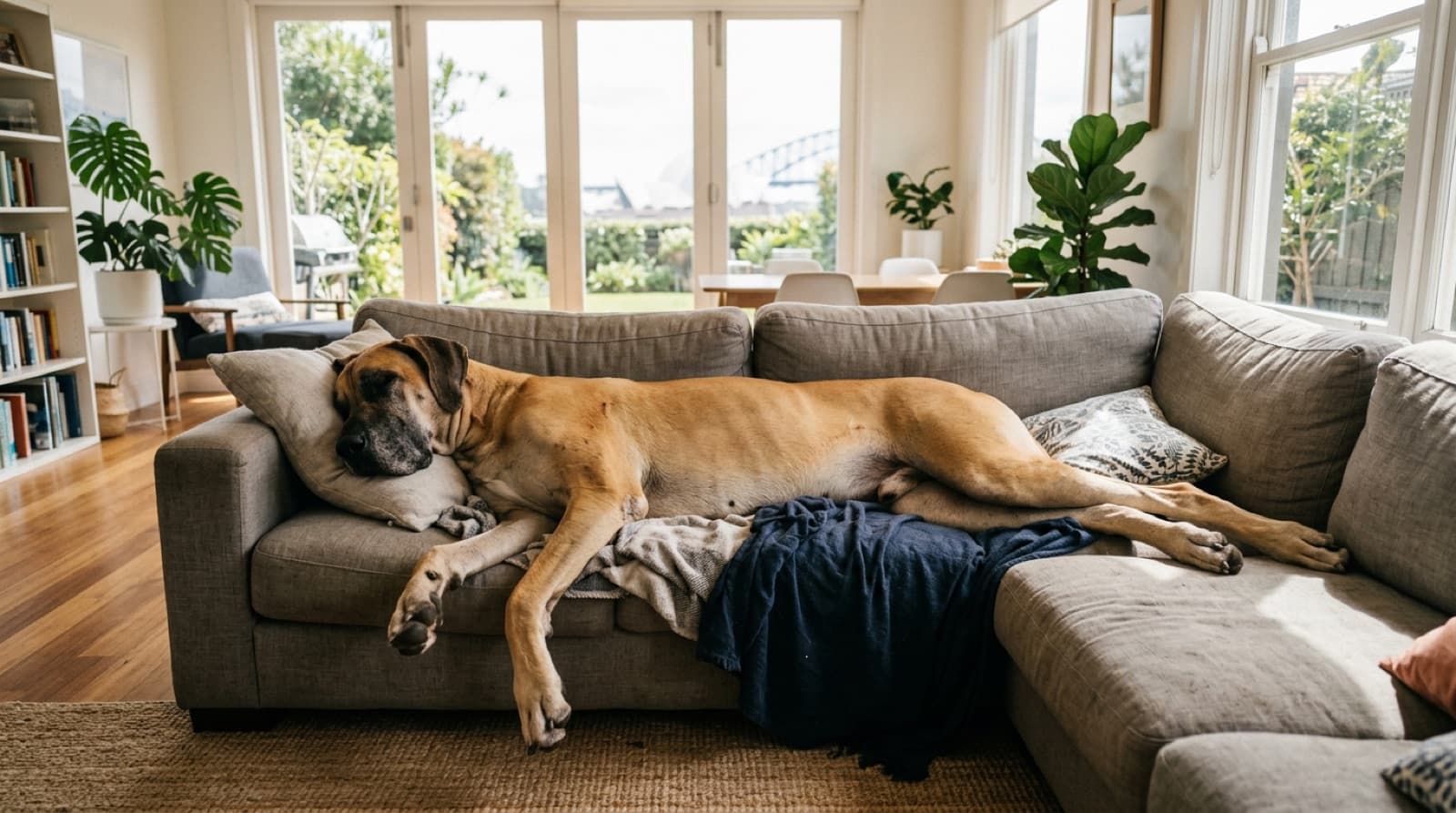
The short answer
A Great Dane is a wonderful gentle giant, but owning one is a genuine commitment: everything costs more, needs more space, and the lifespan is short. They are calm and quiet indoors and can even manage a large apartment with daily exercise, but a giant dog eats a lot, and its meds, surgery and gear all cost more because they scale with size. A grown Dane can outweigh you, so lead manners matter and it is not a dog for a frail owner. And at roughly 7 to 10 years, the short lifespan is worth planning for, both emotionally and with insurance taken young.
The real cost of a giant breed
The first thing to understand about owning a Great Dane is that nearly every cost scales with the dog. This is not an average dog with a slightly bigger appetite. It is a giant animal, and almost everything you spend money on gets bigger and dearer to match. If you only budget for what a medium dog costs, you will get a nasty surprise in the first month.
Food is the obvious one. A Great Dane eats a large amount every day, and a good-quality diet across a dog this size adds up to a serious monthly bill that dwarfs what a smaller dog costs to feed. That cost never goes away for the life of the dog, so it belongs at the centre of your budget, not the edge of it.
Then there is the medical side, which catches people out because it is less visible. A lot of dog care is dosed by body weight. Worming treatments, flea and paralysis tick prevention, and many medications all cost more for a giant dog simply because it takes more product to treat one. Anaesthesia and surgery cost more too, because the doses, the theatre time and any overnight stay all scale up. If a Dane ever needs an operation or an emergency vet visit, expect a bigger bill than you would for a smaller dog with the same problem.
Even the everyday gear is a giant-sized expense. Beds, crates, harnesses, ramps and travel restraints all have to be built for the dog, and the extra-large versions cost more than standard kit. None of this is a reason to avoid the breed. It is simply a reason to go in with a realistic budget. As a rough guide, treat the ongoing cost of a Great Dane as well above an average dog, and see the figures you find online as directional estimates rather than exact totals. One honest point in adoption's favour: adopting saves you the purchase price of a puppy, but it does not change the ongoing cost. A rescued Dane eats and needs the vet exactly like a bought one.
Space and living with a giant dog
Here is the part that surprises people. Despite the size, a Great Dane is calm and quiet indoors. They are famous couch potatoes who spend a big chunk of the day sleeping, and they do not tear around the house the way a bouncy working breed does. That means a Dane can genuinely manage in a large apartment, as long as you give it daily exercise and enough room to stretch out. This is not a dog that needs acres to burn off energy.
The catch is the sheer physical presence of the dog. A Great Dane leans on you, and a leaning Dane is a lot of weight against your leg. It will take up most of the couch if you let it, and its tail is at coffee-table height, so a happy wag can clear a table of cups and remotes. You need furniture and a home that can cope with a dog that big moving through it. A tiny one-bedroom flat is a poor fit, not because the dog is hyperactive, but because there is nowhere for a giant animal to simply be.
So the honest version is this: a Dane needs room, but it needs the right kind of room. Space to lie down and stretch out fully, doorways and hallways it can pass through without a squeeze, and a decent bed of its own. Outdoors, daily walks and access to open space matter more than the size of your yard. A Sydney backyard helps, and nearby parks help more. Fenced off-leash spots such as Sydney Park at St Peters and the timed off-leash zones at Centennial Parklands give a Dane room to move safely.
Strength and training
A grown Great Dane can easily outweigh its owner. That single fact shapes everything about handling one. A dog this strong that pulls on the lead, jumps up in greeting, or bolts after something is genuinely hard to control by strength alone, and trying to muscle a giant dog is a losing game. The answer is training, and starting it early.
Lead manners are not optional with this breed, they are a safety issue. Teach loose-lead walking so the dog is not dragging you down the footpath, a solid recall so you can call it back, and a calm four-on-the-floor greeting so it is not launching its full weight at visitors. Use reward-based, force-free methods and be consistent across the whole household. The goal is a dog that chooses to co-operate because good behaviour pays, not a dog you are physically wrestling. A well-mannered Dane on a lead is a joy. An untrained one is a genuine handful.
This is also why a Great Dane is not the right dog for a frail or unsteady owner. Even a friendly, well-meaning Dane can knock someone over with a lean or an excited turn, and if the dog does pull, you need to be able to hold it. If your balance or strength is not up to a very large dog, a giant breed is a hard choice no matter how gentle the temperament. Reward-based training is the approach best supported by welfare evidence, which is why bodies like the Australian Veterinary Association back it.
The short lifespan reality
The hardest truth about giant breeds is that they do not live long. A Great Dane commonly lives around 7 to 10 years, well short of the twelve to sixteen years a small dog might reach. Big dogs age faster, and a Dane packs a full life into fewer years. There is no way to sugar-coat it, and you deserve to know it before you fall in love with one.
This matters in two practical ways. Emotionally, it means preparing yourself and your family for a shorter time together, and making the years you do get count. Many Dane owners will tell you the trade is worth it, that the dog gives so much in the time it has, but it is still a grief you want to see coming rather than have blindside you. Financially, the short lifespan and the higher risk of age-related problems in giant breeds are a strong argument for taking out pet insurance while the dog is young and healthy, before any condition appears and gets excluded. It is far cheaper and simpler to insure a young Dane than to try to cover an older one after a problem shows up.
Giant-breed puppy growth
A Great Dane puppy grows at a staggering rate, from a large pup into a giant dog in a matter of months. That fast growth is exactly why the puppy stage needs care. Growing joints and growth plates are still soft and developing, and pushing too hard on them can cause lasting damage to the frame the dog has to carry for life.
The practical rules are slow and steady. Avoid over-exercising a young Dane: no long runs, no repetitive jumping, no forced marches, and let the pup set an easy pace until it matures. Feeding is just as important, because a giant-breed puppy needs a diet formulated to grow the frame slowly and steadily rather than as fast as possible. Overfeeding or the wrong balance of nutrients can push growth too quickly and stress those developing joints. The specifics of what and how much to feed a giant-breed puppy are a conversation for your vet, who can guide you on an appropriate growth diet for your individual dog. We go into the breed's joints and other medical issues in more detail in the Great Dane health issues guide.
Sydney-specific logistics
Living with a Dane in Sydney adds a few practical wrinkles worth planning for. Heat is the big one. The short coat helps a little, but a giant dog still generates a lot of body heat and can overheat on a hot, humid Sydney day. Do the walks and any harder exercise in the cool of early morning or the evening, go easy in the middle of a summer day, and never leave the dog in a parked car. Heat, not cold, is the real dog-safety risk here. Paralysis ticks are also a year-round danger across the whole Sydney region and can be fatal, so keep your Dane on a vet-recommended tick prevention product all year and check the coat after any bushwalk. Ask your vet which product suits your dog.
Then there is the simple logistics of moving a giant dog around a city. Fitting a Great Dane in a car takes planning: many owners need a wagon, an SUV or a ute setup, plus a ramp to save both the dog's joints and their own back. Vet visits mean getting that dog through a door and onto a table, which is easier if the dog is trained to be handled calmly from a young age. And rentals are the other Sydney reality. Finding a pet-friendly rental in Sydney is competitive at the best of times, and a giant breed narrows the field further, especially in strata apartments where by-laws can limit the number or size of pets. If you rent, sort out written permission and know your building's rules before you bring a Dane home.
The legal basics apply to a Dane like any dog. In NSW your dog must be microchipped and registered with your council, and registration is done through the NSW Pet Registry. The rules sit under the Companion Animals Act, administered by the NSW Office of Local Government. Registration fees vary and change over time, so check the current figure before you budget for it. The good news is that the Great Dane is not a restricted breed, so there are no special containment or permit rules to deal with, just the standard microchip and registration steps every dog owner follows.
Is a giant breed right for you?
Put it all together and the question comes down to four things: space, budget, strength and the short lifespan. If you have room for a giant dog to live comfortably, a budget that can carry a large feeding bill and giant-sized vet care, the physical ability to handle a dog that can outweigh you, and the emotional readiness for a shorter life together, a Great Dane can be one of the most rewarding dogs you will ever share your home with. The calm, affectionate, gentle-giant temperament is genuinely special.
If any of those four is shaky, be honest with yourself. A tiny flat, a tight budget, a frail owner or someone who could not cope emotionally with losing a dog young are all real reasons the breed might not fit, and there is no shame in choosing a dog that suits your life better. A giant breed asks a lot.
For many people, an adopted adult Dane is the sensible first giant dog. An adult is finished growing, so you skip the delicate puppy stage. Its temperament is already known, so there are fewer surprises. And a good rescue can match you with a dog that suits your experience and your home rather than leaving you to guess. Rescues like RSPCA NSW, AWL NSW, Sydney Dogs and Cats Home, Monika's Doggie Rescue and Maggie's Rescue take in dogs of all sizes and can be straight with you about a particular dog. For where to look and what adoption involves, our Great Dane adoption guide covers it.
Browse adoptable Great Danes in Sydney
A calm adult Dane from a rescue is often the sensible first giant dog, with a known temperament and no delicate puppy stage. Browse live NSW listings and set an alert so you hear the moment one comes in.
See Available Great Danes →Insurance and planning
Because a Great Dane costs more to treat and carries a higher risk of age-related issues, planning for the money side is a real part of owning one well. Pet insurance is worth serious thought, and the single best move is to take it out while the dog is young and healthy. Insurers exclude pre-existing conditions, so a policy taken before any problem appears covers far more than one bought after the fact. Compare cover from Australian providers such as PetSure, Bow Wow Meow and RSPCA Pet Insurance, and read the exclusions carefully.
Beyond insurance, an emergency fund is sensible for a breed where a single surgery can run into serious money. Build a buffer so a giant-sized vet bill is a shock you can absorb rather than a crisis. And plan for the ordinary costs too: the monthly food budget, year-round tick and parasite prevention, and replacing giant-sized gear as it wears out. None of this is glamorous, but it is what separates an owner who can give a Dane the care it deserves from one caught short. For general advice on caring for a dog well, the RSPCA Australia Knowledgebase is a good reference. If you would like a starting point on rescues and adoption in Sydney, the full Sydney resources hub is a good next read.
Frequently Asked Questions
How much does it cost to own a Great Dane?
A Great Dane costs a lot more to own than an average dog because nearly every cost scales with size. Food is the obvious one: a giant dog eats a large amount and a good-quality diet adds up to a serious monthly bill. Less obvious but just as real are the medical costs. Worming, flea and tick prevention and many medications are dosed by body weight, so a dog this size sits at the top of the price band. Anaesthesia, surgery and any overnight vet stay also cost more for a big dog. On top of that, beds, crates, ramps, harnesses and travel gear all have to be giant-sized, which is dearer than standard kit. Adopting saves you the purchase price, but the ongoing cost of feeding and caring for a giant breed is the same whether the dog came from a rescue or a breeder. Treat these as directional estimates and plan a generous budget.
Can a Great Dane live in an apartment?
Yes, a Great Dane can live in a large apartment, but only if you give it daily exercise and enough space to stretch out, and it is not suited to a tiny flat. This surprises people, but Danes are calm and quiet indoors and spend a lot of the day sleeping, so they do not need a big yard the way a bouncy working breed does. The catch is the sheer size. This is a dog that leans on you, sprawls across the couch, and has a tail that can sweep a coffee table clear. A cramped one-bedroom flat is a poor fit. A roomy apartment with daily walks and access to parks can genuinely work. A house with a secure yard is easier again.
How much space does a Great Dane need?
A Great Dane needs enough room to move around comfortably and a decent-sized spot to lie down and stretch out fully, plus daily access to open space for exercise. Indoors they are calm and do not tear around, so it is less about square metres and more about not being cramped. You want space for a giant bed, room for the dog to pass through doorways and hallways without a squeeze, and furniture that can survive a leaning, sprawling dog. Outdoors, regular walks and a nearby park or off-leash area matter more than the size of your own yard. A Sydney backyard is a bonus, not a substitute for daily exercise.
Are Great Danes hard to handle because of their size?
They can be, which is exactly why lead training and manners matter so much with this breed. A grown Great Dane can easily outweigh its owner, so a dog that pulls, jumps up or bolts is genuinely difficult to control by strength alone. The answer is not muscle, it is training. Teach loose-lead walking, a solid recall and a calm greeting from early on, using reward-based methods, so the dog chooses to co-operate rather than being physically managed. A well-mannered Dane is a pleasure to walk. An untrained one is a lot of dog on the end of a lead. For the same reason, a Great Dane is not a sensible choice for a frail or unsteady owner.
How long do Great Danes live?
Great Danes have a short lifespan for a dog, commonly around 7 to 10 years, which is one of the hardest realities of owning a giant breed. Big dogs simply do not live as long as small ones, and a Dane packs a full life into fewer years. This is worth thinking about honestly before you commit, both emotionally and financially. It means the years you do get are precious and worth investing in, and it is a strong argument for taking out pet insurance while the dog is young and healthy, before any age-related issues appear. It is not a reason to avoid the breed, but it is a reason to go in clear-eyed.
Do Great Danes need a lot of exercise?
Great Danes need regular daily exercise, but less high-intensity running than many people expect for such a big dog. A couple of good walks a day and some room to move usually suits an adult well, because they are calm, laid-back dogs rather than tireless working breeds. Puppies and young Danes are a special case: their joints and growth plates are still developing, so hard exercise, long runs and lots of jumping should be avoided until they mature, to protect their growing frame. In Sydney, timing matters more than distance. Walk in the cool of early morning or evening, because a large short-coated dog can still overheat on a hot, humid day.
Is a Great Dane a good first dog?
A Great Dane can work for a first-time owner, but only one who has genuinely thought through the size, cost and short lifespan and is ready for all three. The calm temperament is beginner-friendly. The logistics are not: the strength, the giant-sized expenses, the space and the difficulty of physically managing a dog that outweighs you all raise the stakes. If you are set on the breed as a first dog, adopting a calm adult from a rescue is often the sensible path, because an adult is done growing, its temperament is known, and a good rescue can match you with a dog that suits your experience. Lean on a force-free trainer and go in with a realistic budget.
What do I need to buy for a Great Dane?
Everything you buy for a Great Dane needs to be giant-sized, which is the first budget shock. Start with a very large bed with proper support, a crate big enough for an adult to stand and turn in, and raised or generous food and water bowls. Add a well-fitted harness and a strong lead for training and control, and a car barrier or a large restraint so travel is safe. Many owners also invest in a ramp to help the dog in and out of the car or up steps, which protects both the dog's joints and your back. Then there is the ongoing cost: a large volume of good-quality food every month. Buying the gear once is manageable. The feeding bill is forever.
Keep reading
Adoptable Great Danes in Sydney
Live listings of Great Danes and Dane crosses across Sydney and NSW rescues.
Great Dane Adoption in Sydney
Where to adopt, why Danes end up in rescue, and what adoption costs against a breeder.
Great Dane Health Issues in Sydney
Bloat, joints and the heart, plus Sydney heat and year-round paralysis tick prevention.
All Sydney Adoption Guides
Browse every breed and how-to guide for adopting a rescue dog in Sydney.