The short answer
The defining thing about a Dalmatian is stamina. It was bred as a coach dog to trot alongside carriages for miles, so it has endurance, not just a short burst of energy, and a quick walk around the block is nowhere near enough. Plan on well over an hour of real activity a day, ideally more, split across the day, made up of long walks or runs, off-lead running where it is safe, and genuine mental work like training, scent games and puzzle feeders. Skimp on that and a Dalmatian becomes anxious, vocal and destructive, and that boredom is the number one reason they land in Sydney rescue. In Sydney you also have to manage the heat: exercise in the cool hours, carry water, and watch for overheating. Adopt one only if you can meet the exercise, the enrichment and the company it needs.
The coach dog behind the spots
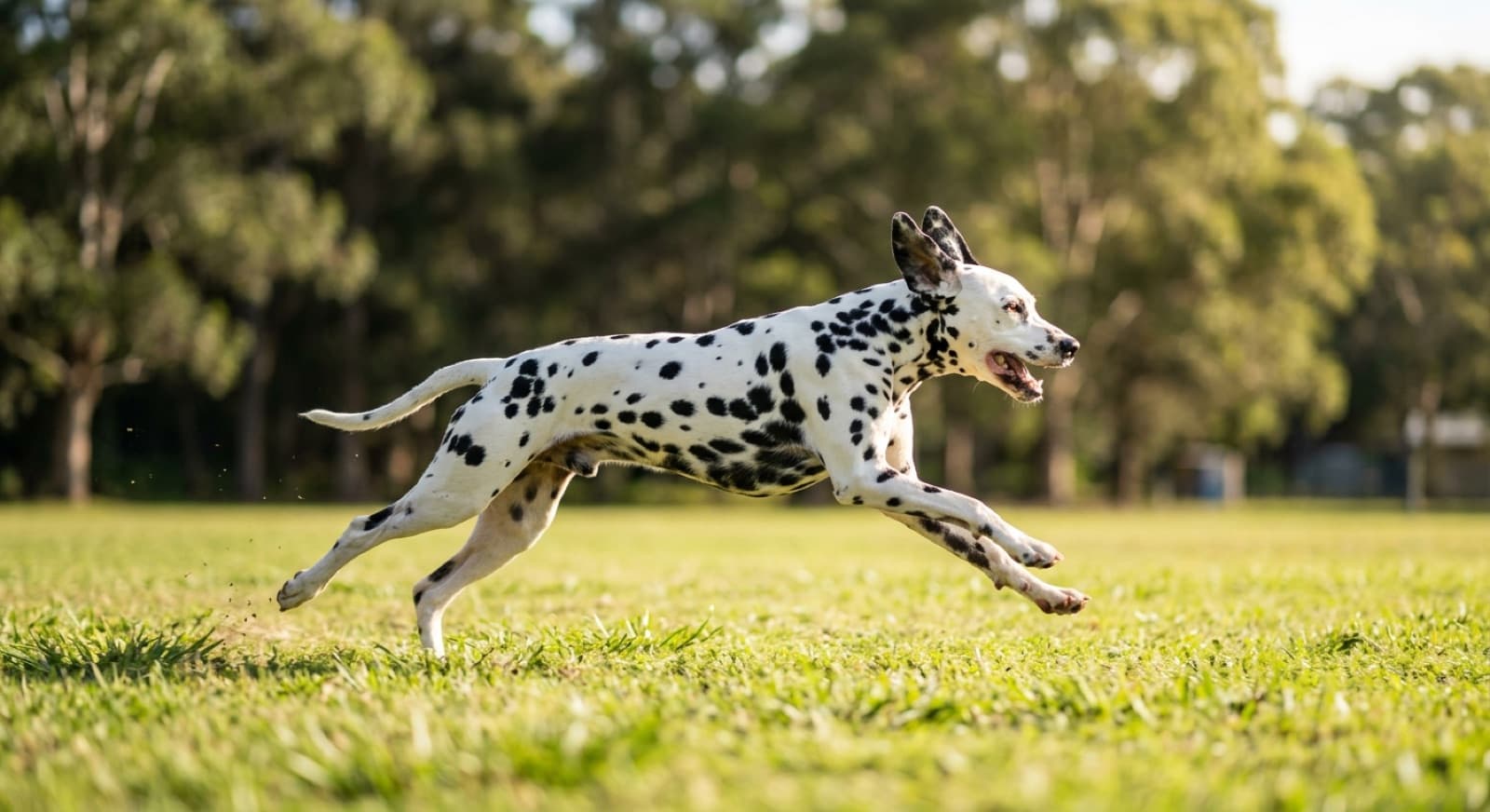
To understand a Dalmatian's energy you have to understand what the breed was for. Dalmatians are coach dogs. For generations their job was to run alongside horse-drawn carriages, trotting for mile after mile, clearing the road ahead, guarding the horses and the load, and covering serious distance every day. That is a very specific kind of athlete. It is not a sprinter that goes flat out for two minutes and flops. It is an endurance dog built to keep moving at a steady pace for hours.
That history is still in every Dalmatian you meet, spots or not. It is why the breed has such deep stamina, why it needs so much more than a gentle stroll, and why it settles so poorly when it is under-exercised. When people describe a Dalmatian as “too much” or “crazy,” what they usually mean is a coach dog that is not getting a coach dog's worth of exercise. Give the same dog a proper outlet and the picture changes completely.
This is also the trap that lands Dalmatians in rescue. They are striking, and plenty of people buy them for the look without reading the working temperament underneath. The Dalmatian breed page notes that the energy is the most underestimated thing about the breed, and it is exactly that mismatch, a high-endurance dog in a low-activity home, that fills foster carers' spare rooms.
How much exercise a Dalmatian really needs
For a healthy adult Dalmatian, plan on well over an hour of real activity a day, and be happy to give more. Ideally split it across the day rather than doing it all in one hit, so the dog gets a proper outlet morning and evening rather than sitting flat for twenty-three hours and exploding for one. “Real activity” is the key phrase. A slow amble on lead where the dog stops at every lamppost is not the same as sustained trotting, running or free play that actually gets the heart and legs working.
A good weekly routine for a Sydney Dalmatian usually looks something like this:
- Two proper daily walks or runs. Not around-the-block strolls. Long, brisk walks, jogs, or a run alongside a bike once the dog is mature.
- Off-lead running where it is safe. A securely fenced off-lead area lets a Dalmatian open up and burn energy in a way lead walking never will. Check your council for where and when off-lead is allowed.
- Daily mental work. Training, scent games, puzzle feeders and trick sessions. A thinking dog is a calmer dog.
- Extra on top for a young adult in its prime, which needs more than an older dog winding down.
The number matters less than the honesty behind it. If reading that list makes your heart sink, a Dalmatian is probably not your breed, and that is a completely fair conclusion to reach before you adopt rather than after. The RSPCA Australia Knowledgebase has sensible general guidance on how much exercise dogs need and why it matters for behaviour.
The best running partner, once it is grown
If you are a runner, a cyclist or a hiker, a fit adult Dalmatian is close to the ideal dog for it. Trotting long distances is the thing the breed was literally bred to do, so a mature Dalmatian will happily keep pace and love every minute. Plenty of active Sydney owners take theirs for morning runs along the harbour foreshore or long weekend bushwalks, and the dog comes home content rather than wired.
There is one firm rule though: not a puppy. A young, still-growing Dalmatian should not be doing distance running or hard, repetitive, sustained exercise, because its joints and growth plates are still forming and that kind of pounding can cause lasting damage. While a Dalmatian is growing, its exercise should be free play, normal walks, training and games where the dog sets its own pace and stops when it is tired. Large breeds take a good while to finish growing, usually past a year of age, so build up to real running slowly and ask your vet when your individual dog is ready. There is no rush, and protecting the joints early gives you a sounder adult dog.
Whatever the distance, in Sydney you run in the cool hours and carry water. A large dog working hard in summer heat overheats fast, which is a whole safety topic on its own further down this guide.
Boredom, anxiety and destruction
This is the honest part, and it is the reason so many Dalmatians end up needing new homes. When a coach dog does not get enough exercise and mental work, the energy does not vanish. It comes out sideways. An under-exercised, bored, or lonely Dalmatian will chew furniture and skirting boards, dig up the garden, pace, bark non-stop, and try to escape the yard. Owners often read this as the dog being naughty or spiteful. It almost never is. It is a working animal with nothing to work on.
Two things make it worse in Dalmatians specifically. First, they are people-focused and sensitive, and they genuinely hate being left out of family life. A Dalmatian shut in the yard alone all day, away from its people, is a recipe for trouble, and isolation can tip into real separation anxiety where the dog panics when left. Second, the destruction and the barking then get punished, which does nothing about the actual cause and damages the trust between dog and owner.
The fix is rarely more discipline. It is more of the right stuff: more physical exercise, more enrichment, more company, and a predictable daily routine so the dog knows when its needs will be met. Get that right and the vast majority of the “behaviour problems” melt away, because they were never really behaviour problems, they were unmet needs. If your Dalmatian is destroying things specifically when it is left alone, or working itself into a state as you head for the door, treat that as separation distress and work through it with your vet or a qualified force-free trainer rather than punishing it.
Enrichment: it is not just walks
A walk tires the legs. It does not tire the brain, and a Dalmatian's brain needs a job too. Mental work is one of the most powerful and most overlooked tools for settling a high-energy dog, and it is easy to build into a normal day.
- Reward-based training. Dalmatians are clever and eager to please, but also sensitive, so keep it positive. Harsh, heavy-handed methods backfire with this breed and damage the bond. Short daily sessions teaching new skills work far better.
- Scent games. Hide food or a favourite toy around the house or yard and let the dog sniff it out. Using the nose is deeply satisfying work for a dog and tires it out.
- Puzzle feeders and food toys. Feed part of the daily meal out of a puzzle or a slow feeder so the dog has to work for it.
- A routine and a job. Dalmatians thrive on structure and on feeling part of the household. Company and involvement are enrichment in themselves for this breed.
A dog that has run and thought and been part of the family day is a dog that lies down and sleeps in the evening. That is the goal, and it is very achievable with a Dalmatian in the right home. The temperament side, including what to expect from a rescued Dalmatian settling in, is covered in the Dalmatian adoption guide.
Exercising a Dalmatian in the Sydney heat
Sydney gives you a large, athletic dog that wants to work hard, and summers that can hit the mid-thirties with real humidity. That combination needs managing, because heat, not cold, is the genuine dog-safety risk here. A Dalmatian pushing itself on a hot, humid afternoon can go from fine to in trouble quickly.
The practical rules are simple. Do the hard exercise in the cool of early morning and the evening, not the middle of a hot day. Carry water and offer it often. Never leave your dog in a parked car, not even for a couple of minutes. On the hottest days, swap the run for a shorter walk plus indoor mental work, and let a swim do some of the load. Watch the footpath temperature too, because hot bitumen burns paw pads.
Learn the warning signs of heat stress and take them seriously: heavy, frantic panting, drooling, bright red gums, wobbliness, weakness or collapse. If you see them, stop immediately, move the dog into shade, offer water, and cool it with cool (not icy) water over the body, especially the belly and paws. If the dog does not settle quickly, get to a vet straight away, because heatstroke is a true emergency that can kill. For after-hours emergencies, Sydney has 24/7 specialty and emergency services such as the Small Animal Specialist Hospital (SASH). The Australian Veterinary Association also has general guidance on keeping dogs safe in hot weather.
One more Sydney fact tied to all that outdoor exercise: paralysis ticks are a year-round danger across the region and can be fatal, so keep your Dalmatian on a vet-recommended tick prevention product all year and do a physical tick check after any bushwalk. The short white coat helps here, because ticks are easier to spot than on a shaggy dog, but still part the coat and feel down to the skin.
Off-lead running, and the deaf-Dalmatian caveat
Off-lead running is some of the best exercise a Dalmatian can get, because it lets the dog open up and move at its own pace in a way lead walking never allows. Many Sydney councils have off-lead parks and some off-lead beach areas, but the rules, the boundaries and the allowed times vary a lot between councils, so check your council before you unclip the lead, and only let a Dalmatian off in a genuinely secure area once it has a reliable recall.
There is one important exception for this breed. Congenital deafness is more common in Dalmatians than in almost any other breed, and a dog can be deaf in one or both ears. A deaf dog cannot hear traffic, and it cannot hear you call it back, so a deaf Dalmatian should not be off-lead near roads or in open, unfenced spaces. For a deaf dog, use a long-line and fully fenced off-lead areas, and train recall and cues with hand signals and body language instead of voice. Deaf Dalmatians live full, happy, active lives with the right management, and we cover deafness, hearing tests and hand-signal training in the Dalmatian health issues guide.
Browse adoptable Dalmatians in Sydney
A Dalmatian rewards an active owner who can meet the exercise and the enrichment it needs. Browse live NSW listings and set an alert so you hear the moment one comes into rescue.
See Available Dalmatians →Is a Dalmatian's energy right for you?
Put it together and the honest picture is clear. A Dalmatian is a coach dog with deep stamina, and it needs well over an hour of real exercise a day plus daily mental work and plenty of company. Meet that and you get one of the most loyal, fun, athletic companions going, a brilliant match for a runner, a hiker, an active family or anyone whose life already involves a lot of getting outside. Miss it and you get a stressed, destructive, barking dog and, all too often, another Dalmatian in rescue.
So the question to ask yourself is not whether you like how a Dalmatian looks. It is whether your actual daily life has room for that much dog. If it does, a Dalmatian is a wonderful adoption. If it does not, a calmer breed will make both of you happier. Sydney and NSW rescues such as RSPCA NSW, AWL NSW, Sydney Dogs and Cats Home, Monika's Doggie Rescue and Maggie's Rescue assess their dogs in foster and shelter care, and can tell you honestly how much a particular Dalmatian or Dalmatian cross needs and whether it suits your home. If you go ahead, register your adopted dog with your council through the NSW Pet Registry as required under the Companion Animals Act.
Frequently Asked Questions
How much exercise does a Dalmatian need?
Plan on well over an hour of real activity a day for a healthy adult Dalmatian, ideally more, split across the day rather than crammed into one session. This is a coach dog bred to trot for miles beside a carriage, so it has genuine endurance and a quick walk around the block does not touch it. A good routine is a couple of proper walks or runs, plus off-lead running in a secure area where you can, plus mental work like training, scent games or a puzzle feeder. The mental side matters as much as the physical: a Dalmatian that gets a long walk but no thinking to do is still a restless dog. Match the amount to your individual dog, because a young adult in its prime needs more than an older dog winding down, but assume a big daily commitment before you adopt one.
Are Dalmatians good running partners?
Yes, a fit adult Dalmatian is one of the best running and jogging companions among the common breeds, because trotting long distances is exactly what the breed was built to do. Once a Dalmatian is fully mature it can happily keep pace with a runner or a cyclist and will love the job. The important caveat is age: do not take a young, still-growing Dalmatian on distance runs or hard sustained exercise, because the joints and growth plates are still developing and repetitive pounding can do lasting damage. Build up gradually with a young dog, stick to free play and normal walks while it grows, and ask your vet when your particular dog is ready for real distance work. In Sydney, run in the cool of early morning or evening and carry water, because a large dog working hard in summer heat overheats fast.
Why is my Dalmatian destructive?
A destructive Dalmatian is almost always a bored, under-exercised or lonely one, not a badly behaved one. When a high-energy coach dog does not get enough physical exercise and mental work, that energy has to go somewhere, and it comes out as chewing, digging, pacing, escaping and non-stop barking. Dalmatians are also very people-focused and hate being shut out of family life, so long stretches alone make it worse and can tip into real separation anxiety. The fix is rarely more discipline. It is more exercise, more enrichment, more company and a proper routine, and often a job for the dog to do. Get the outlet right and most of the destruction disappears. If your dog is destroying things specifically when left alone, or panicking as you leave, that is separation distress and worth working through with your vet or a qualified force-free trainer rather than punishing.
Can Dalmatians live in an apartment?
It can work, but only if you are genuinely committed to getting the dog out and exercised every single day, and honestly a Dalmatian is a hard apartment dog for most people. The size of the home matters far less than the exercise and enrichment the dog gets, so a dedicated owner in a flat who runs their dog every morning and evening can do better than a distracted owner with a big yard who never walks it. That said, a Dalmatian is large, active, sheds heavily and can be barky when under-stimulated, all of which are harder in a small strata unit with neighbours close by. If you are set on a Dalmatian in an apartment, be realistic about the daily commitment, check your building and strata rules on pets first, and register your dog with your council. For most first-time or time-poor owners a calmer, lower-energy breed is a kinder match than a coach dog in a flat.
How do I exercise a Dalmatian in the Sydney heat?
Shift the hard exercise to the cool of early morning and the evening, carry water, and never leave your dog in a parked car. Heat, not cold, is the real dog-safety risk in Sydney, and a large dog working hard on a hot, humid day can overheat quickly. Watch for heavy panting, drooling, bright red gums, wobbliness or collapse, which are signs of heat stress. If you see them, stop, get the dog into shade, offer water and cool it with cool (not icy) water over the body, and if it does not settle quickly get to a vet straight away, because heatstroke is a genuine emergency. On the hottest days, swap the run for a shorter walk plus indoor mental work like training or a puzzle feeder, and let a swim do some of the work. Keep year-round paralysis tick prevention up too, as ticks are a serious risk across Sydney.
When can I start running with my Dalmatian puppy?
Wait until your Dalmatian is fully grown, which is usually somewhere past a year of age for a large breed, and check with your vet about your individual dog before you start distance running. A puppy or adolescent still has open growth plates and developing joints, and hard, repetitive, sustained exercise like road running can cause lasting joint damage while the skeleton is still forming. That does not mean keep a young Dalmatian still, because it needs plenty of activity, but the right kind is free play, normal walks, training and games where the dog sets its own pace and stops when it is tired. Build up to structured running slowly once your vet gives the go-ahead. There is no rush, and protecting the joints early pays off with a sounder, more comfortable adult dog.
What mental stimulation does a Dalmatian need?
A Dalmatian needs real daily brain work on top of physical exercise, because it is an intelligent, sensitive working breed that gets bored and frustrated without a job. Good options are short reward-based training sessions, scent games where you hide food or a toy and let the dog sniff it out, puzzle feeders and food-dispensing toys, and learning new tricks or skills. Dalmatians are clever and eager to please but also sensitive, so keep training positive and reward-based, because harsh or heavy-handed methods backfire badly with this breed and damage the bond. A tired brain settles a Dalmatian as much as a tired body, and mixing enrichment into the day is one of the best ways to prevent the boredom-driven barking and destruction the breed is known for.
Can I let my Dalmatian off-lead in Sydney?
Only in a securely fenced off-lead area, once your dog has a reliable recall, and never a deaf Dalmatian near roads or open spaces. Off-lead running is great exercise for a Dalmatian, so use designated off-lead areas where the rules allow it, and always check your council, because off-lead rules and times vary between councils and parks across Sydney. The big exception is hearing. Deafness is more common in Dalmatians than most breeds, and a deaf dog cannot hear traffic or a called recall, so a deaf Dalmatian should be kept on lead or a long-line and only run free inside a fully fenced area. We cover deafness, hearing tests and hand-signal training in the health guide. Whatever your dog, build the recall first and pick genuinely secure spaces before you unclip the lead.
Keep reading
Adoptable Dalmatians in Sydney
Live listings of Dalmatians and Dalmatian crosses across Sydney and NSW rescues.
Dalmatian Adoption in Sydney
Where to adopt, why Dalmatians end up in rescue, and what adoption costs against a breeder.
Dalmatian Health Issues in Sydney
Congenital deafness and BAER testing, urate bladder stones and the low-purine diet, plus year-round tick prevention.
All Sydney Adoption Guides
Browse every breed and how-to guide for adopting a rescue dog in Sydney.