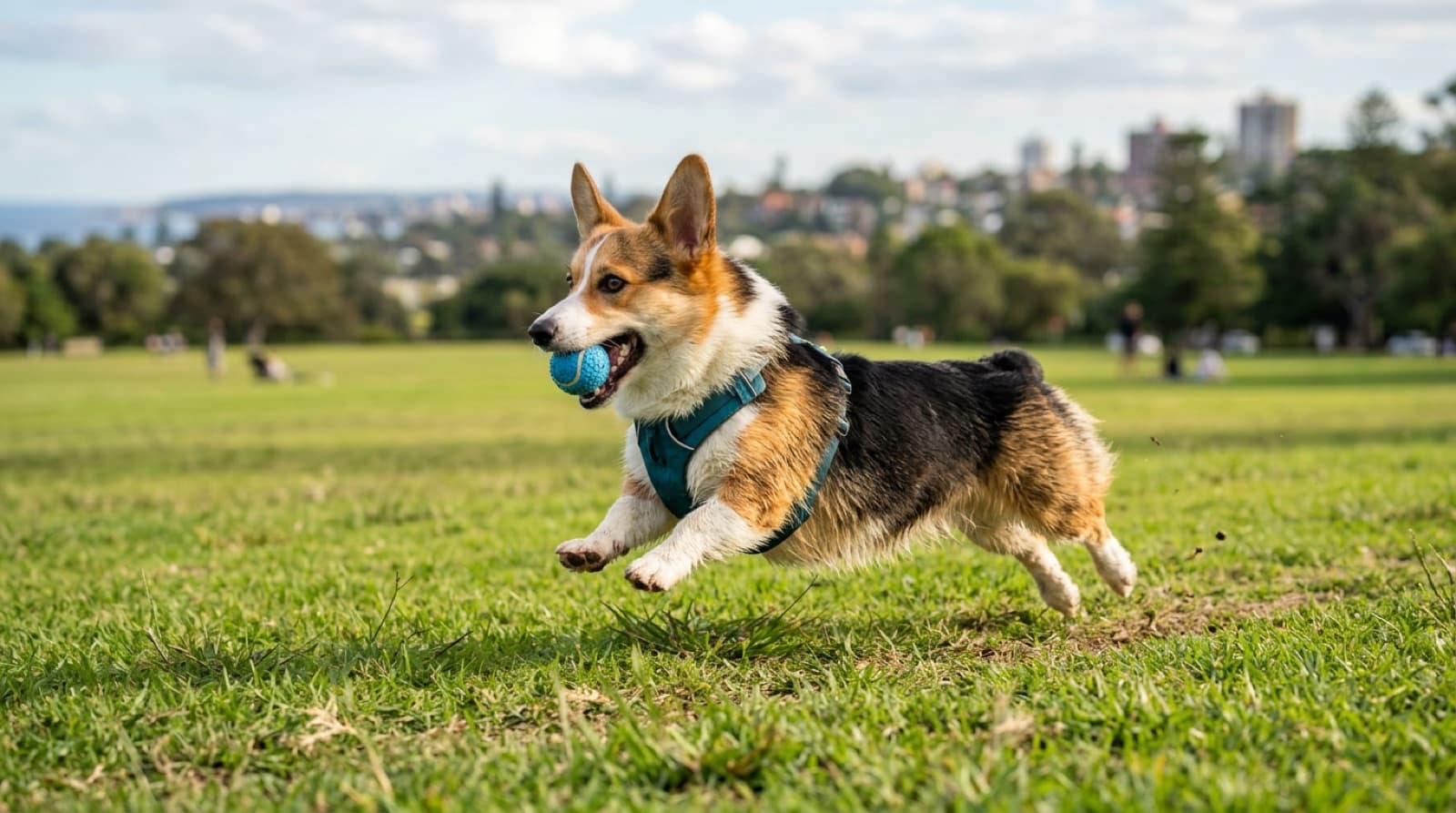
The short answer
A Corgi is a big herding dog on short legs: it needs real daily exercise plus mental work, or the energy comes out as barking and nipping. Pembroke and Cardigan Welsh Corgis were bred to drove cattle by nipping heels, so despite the stumpy legs they are high-energy, very clever and quick to invent their own jobs when bored. Give a Corgi about an hour of exercise a day, split morning and evening around Sydney's heat, plus training, puzzles and scent games. Redirect the herding-and-nip instinct with calm, reward-based training rather than punishment, and keep the dog lean to protect the long back.
The herding breed reality: a working dog in a small body
The single most useful thing to understand about a Corgi is that it is a herding breed. Both the Pembroke and the Cardigan Welsh Corgi were bred to work cattle in Wales, moving stock across paddocks by darting in, nipping at the heels and ducking the kick. That job shaped everything: the stamina, the sharp problem-solving brain, the alert bark and the instinct to chase and control movement.
The short legs hide all of it. People see a small, round, cheerful dog and expect a relaxed companion, then bring home a busy, driven working dog with the energy of a much bigger breed. A Corgi is happiest with a job to do and a brain that is being used, and it is one of the more intelligent breeds you can own.
That intelligence and drive are wonderful in an owner who plans for them, and a real problem in one who does not. A Corgi that gets proper exercise and mental work is a calm, funny, deeply affectionate dog. A Corgi with nothing to do does not switch off. It finds its own work instead, and that work usually looks like barking at everything that moves, herding the children, digging up the garden and nipping at ankles. None of that is a fault in the dog. It is a working breed doing what it was built to do, in a home that has not given it a legal outlet.
How much exercise does a Corgi need?
A healthy adult Corgi needs about an hour of real activity a day. Split it into a morning session and an evening session rather than one big block, which suits the dog and suits the Sydney climate. A good day looks like a proper on-lead walk with plenty of sniffing time, some off-lead running in a secure fenced area, and a bit of play or training on top.
Sydney heat changes the timing. A low-slung dog with a thick double coat overheats faster than a leggy, short-coated breed, so do the harder exercise in the cool of early morning or the evening and go gentle in the middle of a hot day. Heat, not cold, is the dog-safety risk in Sydney, and it is easy to underestimate on a humid summer day. Fenced off-leash spots like Sydney Park at St Peters, the timed off-leash zones at Centennial Parklands, or Rowland Reserve at Bayview give a Corgi room to open up safely. The RSPCA Australia Knowledgebase is a good general reference on meeting a dog's daily exercise and enrichment needs.
Two cautions. First, a Corgi puppy should not do long walks, forced running or repeated jumping while the joints and the long spine are still developing, so keep young dogs to short, frequent, gentle play and build up slowly. Second, exercise alone is not enough. The other half of a Corgi's needs is mental, and a dog that is run ragged but never made to think is still a restless dog.
Mental work matters as much as physical exercise
With a clever herding breed, the brain gets tired before the legs do, and a bored Corgi is the one that barks and nips. Mental work is not a nice extra. It is half the job, and it is often the piece that fixes the behaviour problems people blame on energy.
The good part is that mental work is cheap and easy to fit into a Sydney routine. Try these:
- Daily training. Two short, upbeat sessions a day of cues and tricks. A Corgi loves learning and shows off happily.
- Puzzle feeders and food toys. Feed part of the daily food through a puzzle or a food-dispensing toy so the dog has to work for it instead of gulping a bowl in ten seconds.
- Scent games. Hide food around the yard or the living room and let the dog hunt it out. Sniffing is calming and satisfying for a working breed.
- Dog sports. Rally, trick training and other low-impact activities suit the Corgi brain. Keep jumping heights low or skip the jumps to protect the back, and choose activities that reward thinking over hard landings.
Even ten minutes of structured thinking twice a day changes the dog. Owners who add mental work almost always report a calmer, more settled Corgi than exercise alone ever gave them.
The herding-and-nip instinct, and how to redirect it
Heel-nipping is the behaviour that surprises new Corgi owners most, and it is the breed doing exactly what it was made for. Corgis moved cattle by nipping at the heels, so the instinct to chase and nip at fast-moving things is hard-wired. In a home that shows up as chasing and nipping at running children, ankles, bikes, joggers, skateboards and other pets.
The first thing to be clear on is that this is normal herding behaviour, not aggression, and it is manageable. The second is that you manage it with force-free, reward-based training, never with punishment. Punishing a dog for a hard-wired instinct tends to make a clever breed anxious or sneaky, and it does not remove the drive. Redirection does.
The practical approach has three parts. Stop the dog rehearsing it: interrupt the chase early, before the circling and nipping build up, and manage the environment so the dog is not constantly triggered by movement. Give the drive a legal outlet: a chase-and-fetch game with rules, a flirt pole, or a trained behaviour the dog can do instead. And reward the alternative heavily: teach a solid recall and a settle, and pay the dog well for calm around movement. Teaching children not to run and shriek around the dog helps a lot, because the high-pitched, fast movement is the exact trigger.
Barking and strata living
Corgis are vocal. The alert bark is part of the herding-and-guarding job they were bred for, so a Corgi announces visitors, movement, other dogs and anything out of place. It is one of the breed's defining traits, and it matters most for anyone in a unit or close to neighbours.
In NSW this is not only a neighbour-relations issue, it can become a legal one. Persistent barking is a recognised nuisance under NSW companion-animal law, and a neighbour can raise a complaint with the local council, which the council can act on. The NSW Office of Local Government covers how councils handle nuisance-dog and barking matters. The point is not to scare you off the breed. It is to be honest that a barky dog in strata needs active management, not hope.
Managing it starts with the cause. A bored, under-exercised, lonely Corgi barks far more, so exercise, mental work and not being left alone all day are your first and best tools. On top of that, reward-based training to teach a quiet cue, and to reward the dog for staying calm at the window or the front door, makes a real difference over time. If barking is severe or driven by distress at being left alone, that points to a separate problem worth getting proper help with rather than only training the noise.
Protecting the long back while keeping the dog active
The Corgi's long body on short legs is charming and it is also the breed's weak point. That build puts the spine under more load than a normally proportioned dog, so how you exercise a Corgi matters as much as how much. The goal is an active, fit dog that is not doing the things that strain the back.
A few habits protect the spine for life. Keep the dog lean, because extra weight loads the back and joints and is the single biggest thing you control. Limit repetitive high-impact jumping, especially on and off the couch, the bed and out of the car, and use ramps or steps for those instead. Skip or lower the jumps in dog sports. Go easy on stairs where you can. And build fitness gradually rather than with sudden bursts of hard exercise. Swimming and flat, steady walks are back-friendly ways to keep a Corgi fit.
The back deserves its own conversation, because disc disease is a real concern in the breed and there is more to know about prevention and warning signs than fits here. We cover it in full in the Corgi health issues guide. Weight management is the thread that ties exercise, the back and long-term vet bills together, so it is worth getting right from day one.
Browse adoptable Corgis in Sydney
Corgis are a working herding breed that thrives with active owners who plan for the exercise and the brain. Browse live NSW listings and set an alert so you hear the moment one comes in.
See Available Corgis →Training a smart, stubborn dog
Corgis are very trainable and very stubborn at the same time. They are among the smarter breeds, they learn fast, and they enjoy the work. But the working history left them with an independent streak, so a Corgi will often weigh up whether your request is worth doing rather than just obeying. That is not defiance for its own sake. It is a dog that was bred to make its own decisions out in a paddock.
The training that works follows from that. Keep sessions short, upbeat and reward-based, and use things the dog genuinely wants, like high-value food and play. Force and endless repetition just make a clever dog switch off. Start socialisation and basic manners early, so a young Corgi meets a wide range of people, dogs, sights and sounds while it is still forming its view of the world. Stay consistent across the household, because a Corgi will happily exploit the gap when one person enforces a rule and another does not. The Australian Veterinary Association supports reward-based, force-free training as the approach best backed by welfare evidence.
A rescue Corgi deserves extra patience. It may arrive with gaps in its training, some rehearsed habits like barking or nipping, or a wariness that takes time to soften. The intelligence is still there and still on your side. Go at the dog's pace, build a routine, and reward the behaviour you want. Remember too that every NSW dog must be microchipped and registered with the council through the NSW Pet Registry, which a rescue will usually have started for you.
When behaviour needs a professional
Most Corgi behaviour is normal herding energy that the right routine and training settle down. But some things are worth getting help with rather than pushing through alone. Get a professional involved if the nipping is intense, breaks skin or is aimed at hurting people, if barking is constant or driven by distress at being left, or if you see genuine reactivity to other dogs or people that is getting worse rather than better.
Two rules make this safer. First, rule out pain before you treat any behaviour as purely behavioural. A sudden change in temper, a dog that snaps when touched, or reluctance to move can all be a sore back or another medical problem talking, and in a long-backed breed that is worth a vet check first. Second, choose the right kind of help. Look for a qualified force-free or reward-based trainer for training and manners, and a veterinary behaviour service for serious anxiety, fear or aggression. Avoid anyone who leans on punishment, prong or shock tools, which tend to make a clever, sensitive breed worse. If you would like a starting point on rescues, training support and adoption in Sydney, our Corgi adoption guide and the full Sydney resources hub are good next reads.
Frequently Asked Questions
How much exercise does a Corgi need?
A healthy adult Corgi needs roughly an hour of real activity a day, split into a morning and an evening session. That means a proper on-lead walk with time to sniff, some off-lead running in a secure fenced area, and a bit of play or training on top. In Sydney, do the harder exercise early morning or in the cooler evening and keep it gentle in the heat of the day, because a low-slung dog with a heavy coat overheats faster than you expect. Just as important, half of a Corgi's needs are mental. Add training, puzzle feeders or scent games and you will get a calmer dog than exercise alone can produce. Under-exercise a Corgi and it will bark, nip and dig to burn the energy itself.
Are Corgis high energy?
Yes. The short legs fool a lot of people, but a Corgi is a working herding breed with real stamina and drive, not a lap dog. Pembroke and Cardigan Welsh Corgis were bred to move cattle over paddocks all day, so they come with the energy and the busy, problem-solving brain that goes with that job. A Corgi that gets a proper walk, a run and some mental work will happily settle on the couch in the evening. A Corgi left with nothing to do invents its own work, and that usually looks like barking at the window, herding the kids or chewing the furniture. Plan for a genuinely active dog and you will not be caught out.
Why does my Corgi nip at heels and ankles?
Because heel-nipping is literally what the breed was made to do. Corgis droved cattle by darting in, nipping at the heels to move them along, then ducking the kick. That instinct is hard-wired, so a Corgi will often chase and nip at fast-moving things: running children, ankles, bikes, joggers and other pets. It is normal herding behaviour, not aggression, and it responds well to training rather than punishment. Manage it by not letting the dog practise it: interrupt the chase early, redirect onto a toy or a trained behaviour, reward calm, and teach children not to run and squeal around the dog. Plenty of exercise and a real outlet for the herding drive, like a chase-and-fetch game with rules, takes a lot of the pressure off. If nipping is intense, breaks skin or is aimed at people, get a force-free trainer or a veterinary behaviour service involved.
Do Corgis bark a lot?
Corgis are one of the more vocal breeds, yes, and it is worth knowing before you commit, especially in a unit. Barking is part of the herding-and-alarm job they were bred for: they announce visitors, movement, other dogs and anything that seems out of place. A bored or under-exercised Corgi barks more, so exercise, mental work and not being left alone all day are your first tools. On top of that, reward-based training to teach a quiet cue and to reward calm at the window makes a real difference. If you live in strata or close to neighbours, factor the voice in honestly, because persistent barking is a common source of neighbour complaints and can become a council matter in NSW.
Are Corgis easy to train?
Corgis are very trainable and very stubborn at the same time, which is a funny combination to live with. They are one of the smarter breeds and they learn fast, so they pick up cues, tricks and dog sports quickly when you make it worth their while. The catch is the independent streak from their working history: a Corgi will often decide whether your request is worth doing. That means short, upbeat, reward-based sessions work far better than repetition or force, which just makes a clever dog tune out. Start socialisation and basic training early, stay consistent, use high-value food and play, and keep it fun. A rescue Corgi may arrive with gaps or bad habits and need patience, but the intelligence is on your side.
Are Corgis good apartment dogs in Sydney?
They can be, but only if you meet the exercise, mental work and barking needs, and check the strata rules first. A Corgi does not need a big yard, so a unit can work, and plenty of Sydney Corgis live happily in apartments. The two honest catches are the voice and the stairs. Corgis are vocal, so barking can become a neighbour and strata issue in close quarters, and it needs active management rather than hoping the dog grows out of it. The long back also means you want to limit repeated stair-climbing and jumping, so a lift or ground-floor access helps. If you can commit to twice-daily exercise, training and company, and dogs are allowed in your building, a Corgi suits apartment life better than its energy level suggests.
How do I stop my Corgi herding the kids?
Manage the environment first, then train an alternative, and never punish the instinct out of the dog. Herding children is normal for the breed: fast movement and high-pitched voices switch on the same chase-and-nip drive that once moved cattle. Start by not letting it rehearse. Supervise dog-and-child play, step in before the circling and nipping start, and teach the kids not to run and shriek around the dog. Then give the drive a legal outlet: teach a solid recall and a settle, redirect the chase onto a toy or a fetch game with rules, and reward the dog heavily for calm around movement. Tire the dog out with real exercise and mental work so it has less fuel for herding. If the nipping is hard, persistent or aimed to hurt, bring in a force-free trainer or a veterinary behaviour service rather than trying to push through it.
Do Corgis need a job?
Yes, in the sense that a Corgi needs a regular outlet for its brain and drive, not that it needs livestock. This is a working breed built to think and problem-solve all day, so a Corgi with nothing to do gets bored, and a bored Corgi barks, nips, digs and herds the household. The good news is the job can be small and fun. Daily training, puzzle feeders, scent games where the dog hunts for hidden food, a food-dispensing toy, or a dog sport like rally or trick training all count. Even ten minutes of structured thinking twice a day changes the dog. Treat mental work as essential rather than optional and you will have a calmer, more settled Corgi.
Keep reading
Adoptable Corgis in Sydney
Live listings of Corgis and Corgi crosses across Sydney and NSW rescues.
Corgi Adoption in Sydney
Where to adopt, why Corgis end up in rescue, and what adoption costs against a breeder.
Corgi Health Issues in Sydney
Back and disc disease, weight management, plus Sydney heat and year-round paralysis tick prevention.
All Sydney Adoption Guides
Browse every breed and how-to guide for adopting a rescue dog in Sydney.