The short answer
The defining thing about a Catahoula is drive. It was developed as a herding and hunting dog to work hard over rough terrain, so it has both physical stamina and a busy, problem-solving brain that needs a job. Plan on well over an hour of real activity a day, ideally more, plus daily mental work like training, scent games or a dog sport. Skimp on that and a Catahoula becomes frustrated, vocal and destructive, digging, escaping and fence-jumping, and that boredom is the number one reason they land in Sydney rescue. It is an intelligent, independent, protective breed that needs an experienced, active owner and secure fencing, so it is honestly not a suburban-couch dog or a first-time-owner dog. Adopt one only if you can meet the exercise, the enrichment and the training it needs.
The working dog behind the coat
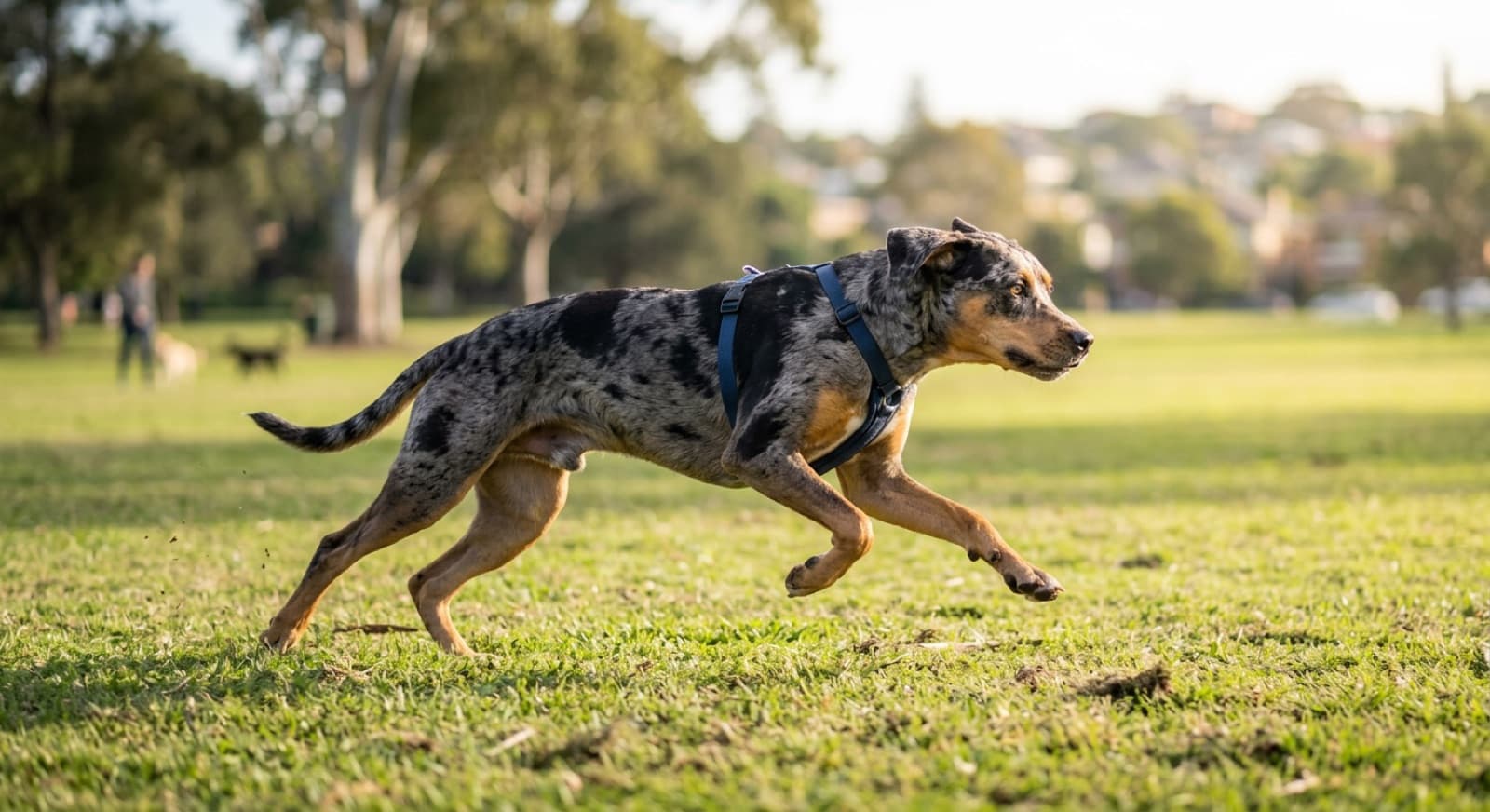
To understand a Catahoula's energy you have to understand what the breed was for. The Catahoula Leopard Dog is a genuine working breed, developed to herd cattle and pigs and to hunt across tough, wild country. That is a specific kind of athlete. It is not a dog bred to lounge and go for a gentle stroll. It is a dog bred to cover ground, make its own decisions in the field, and work hard from dawn to dusk. The striking merle coat and pale eyes get all the attention, but underneath the look is a serious working temperament.
That history is still in every Catahoula you meet. It is why the breed has such deep stamina, why it needs so much more than a walk, why it is so smart and so independent, and why it settles so poorly when it is under-worked. When people describe a Catahoula as “too much” or “difficult,” what they usually mean is a working dog that is not getting a working dog's life. Give the same dog a proper outlet and the picture changes completely.
This is also the trap that lands Catahoulas in rescue. They are eye-catching, and plenty of people take one on for the look without reading the working drive underneath. The Catahoula breed page is honest that this is a high-needs working breed, not a low-key family pet, and it is exactly that mismatch, a hard-wired working dog in a low-activity home, that fills foster carers' spare rooms across Sydney.
How much exercise a Catahoula really needs
For a healthy adult Catahoula, plan on well over an hour of real physical activity a day, and be happy to give more. Split it across the day rather than doing it all in one hit, so the dog gets a proper outlet morning and evening rather than sitting flat for hours and then boiling over. “Real activity” is the key phrase. A slow amble on lead where the dog stops at every post is not the same as sustained walking, running or free play that actually works the body. And with this breed, the physical side is only half the job.
A good daily routine for a Sydney Catahoula usually looks something like this:
- Two proper daily walks or runs. Not around-the-block strolls. Long, brisk walks, jogs, or a run alongside a bike once the dog is fully mature.
- Off-lead running where it is safe. A securely fenced off-lead area lets a Catahoula open up and burn energy in a way lead walking never will. Check your council for where and when off-lead is allowed.
- Daily mental work. Training, scent and nose games, a dog sport, puzzle feeders and problem-solving toys. A thinking dog is a calmer dog, and this breed needs it.
- A real job or purpose. Catahoulas excel when they have something structured to do, whether that is advanced obedience, tracking or canine sports.
The number matters less than the honesty behind it. If reading that list makes your heart sink, a Catahoula is probably not your breed, and that is a completely fair conclusion to reach before you adopt rather than after. The RSPCA Australia Knowledgebase has sensible general guidance on how much exercise dogs need and why it matters for behaviour.
Why a Catahoula needs a job, not just a walk
A walk tires the legs. It does not tire the brain, and a Catahoula's brain is the part that gets it into trouble. This is a smart, driven breed that was built to work and problem-solve, so it needs real mental work every day on top of the physical exercise. Mental stimulation is one of the most powerful and most overlooked tools for settling a high-drive dog, and the good news is you do not need livestock to provide it.
Good outlets for a Sydney Catahoula include structured, reward-based obedience training, scent and nose work where the dog uses its nose to find hidden food or toys, dog sports such as agility, tracking and canine sports, advanced trick training, and food-dispensing puzzle toys woven through the day. The theme is the same across all of them: the dog has to think and work for the outcome. A Catahoula that has run hard and used its brain hard is a dog that lies down and sleeps in the evening. A Catahoula with a bored brain is where the barking, digging and escaping come from.
Boredom, frustration and destruction
This is the honest part, and it is the reason so many Catahoulas end up needing new homes. When a working dog does not get enough exercise and mental work, the energy and the drive do not vanish. They come out sideways. An under-worked, bored or frustrated Catahoula will chew furniture and skirting boards, dig up the garden, bark non-stop, and work relentlessly at escaping, climbing, jumping and digging out of the yard. Owners often read this as the dog being naughty or difficult. It almost never is. It is a working animal with nothing to work on.
Two things make it worse in Catahoulas specifically. First, the breed is independent and easily frustrated, so a dog with no outlet will not just wait patiently, it will make its own entertainment, usually something you will not enjoy. Second, the protectiveness and the watchfulness that make a Catahoula a good guardian can curdle into problem barking and reactivity when the dog is stressed and under-stimulated, so an unmet dog is often a noisier, edgier dog with the neighbours as well.
The fix is rarely more discipline. It is more of the right stuff: more physical exercise, more enrichment, a real job, and a predictable daily routine so the dog knows when its needs will be met. Get that right and the vast majority of the “behaviour problems” melt away, because they were never really behaviour problems, they were unmet working needs. If your Catahoula is destroying things specifically when it is left alone, treat that as possible separation distress and work through it with your vet or a qualified force-free trainer rather than punishing it.
Training an intelligent, independent dog
Catahoulas are highly intelligent, which sounds like it should make training easy. It does not, quite, because they are also independent and strong-willed. They were bred to think for themselves out in the field, so they will happily question a request that seems pointless rather than obey on autopilot. That makes them rewarding to train for an experienced handler and frustrating for a first-timer who expects instant compliance.
What works is firm, fair and consistent leadership paired with reward-based, force-free methods that keep the dog choosing to work with you. Harsh or heavy-handed training backfires with this breed. Punishment-based methods can make a naturally protective, sensitive dog defensive or reactive, which is the opposite of what you want in a guardian breed. Keep sessions positive, short and interesting, and reward generously for the behaviour you want.
Two priorities matter above all. The first is early and ongoing socialisation. Catahoulas are naturally reserved and watchful with strangers, and good socialisation from the start is what keeps that watchfulness balanced rather than tipping into over-guarding of the home and family. The second is impulse control and a reliable recall, both of which you will lean on hard given the prey drive and the strength of the dog. The Australian Veterinary Association and the RSPCA Australia Knowledgebase both support reward-based training as the safe, effective standard, and for a driven guardian breed a Sydney force-free trainer experienced with working dogs is a worthwhile investment.
Prey drive, secure fencing and off-lead
A Catahoula has a strong prey drive. This is a hunting breed, so chasing cats, birds and wildlife is instinct, and once a dog has locked on, calling it back is genuinely hard. That shapes two big practical decisions: fencing and off-lead.
On fencing, a Catahoula needs secure, high fencing, because a bored or under-stimulated one is an accomplished escape artist that will climb, jump and dig its way out to go and find something to do. A low suburban fence that holds a placid family dog will not necessarily hold a driven working dog. Sort the containment before the dog comes home, not after the first escape.
On off-lead, use securely fenced off-lead areas only, and never let a Catahoula off-lead in unfenced spaces near roads. Many Sydney councils have off-lead parks and some off-lead beach areas, but the rules, boundaries and allowed times vary between councils, so always check your council first. In open, unfenced spaces, keep the dog on a long-line until the recall is genuinely bombproof, and even then treat traffic and wildlife as reasons to stay cautious. Around cats and small pets, be careful and manage introductions slowly, and be aware that some Catahoulas are same-sex dog-selective, so assess the individual dog rather than assuming.
A note on deaf Catahoulas
Some Catahoulas are deaf, in one or both ears. It is linked to the merle coat colour, and it changes the safety picture in important ways. A deaf dog cannot hear traffic and cannot hear a called recall, so a deaf Catahoula should be kept on lead or a long-line in any open space and only run free inside fully fenced areas. The training approach shifts too: you teach cues with hand signals, body language and vibration rather than voice. Deaf Catahoulas live full, active, happy lives with the right management, and none of the exercise and enrichment advice in this guide changes, but the how of communicating and the where of off-lead do. We cover deafness, hearing and the health side in more detail in the Catahoula health issues guide.
With children and the family
A Catahoula is devoted and protective of its own people, and in a respectful, active household it can be a wonderful family dog. That loyalty is a big part of the breed's appeal. It does come with things to manage, though. The herding instinct can show up as nipping or chasing at running, shrieking children, so supervise play and teach the dog an alternative. The natural guarding tendency needs managing around visitors so that a watchful dog does not become an over-protective one. As with everything about this breed, the individual dog matters more than the label, which is why a foster carer who has watched the actual dog around kids, cats and other dogs is worth their weight in gold.
Exercising a Catahoula in the Sydney heat
Sydney gives you an athletic dog that wants to work hard, and summers that can hit the mid-thirties with real humidity. That combination needs managing, because heat, not cold, is the genuine dog-safety risk here. A Catahoula pushing itself on a hot, humid afternoon can go from fine to in trouble quickly.
The practical rules are simple. Do the hard exercise in the cool of early morning and the evening, not the middle of a hot day. Carry water and offer it often. Never leave your dog in a parked car, not even for a couple of minutes. On the hottest days, swap the run for a shorter walk plus indoor mental work, and let a swim do some of the load. Watch the footpath temperature too, because hot bitumen burns paw pads. Learn the warning signs of heat stress and take them seriously: heavy, frantic panting, drooling, bright red gums, wobbliness, weakness or collapse. If you see them, stop immediately, move the dog into shade, offer water, and cool it with cool (not icy) water over the body. If the dog does not settle quickly, get to a vet straight away, because heatstroke is a true emergency.
One more Sydney fact tied to all that outdoor exercise: paralysis ticks are a year-round danger across the region and can be fatal, so keep your Catahoula on a vet-recommended tick prevention product all year and do a physical tick check after any bushwalk. Ask your vet for the right product for your dog rather than guessing.
Browse adoptable Catahoulas in Sydney
A Catahoula rewards an active, experienced owner who can meet the exercise, the training and the job it needs. Browse live NSW listings and set an alert so you hear the moment one comes into rescue.
See Available Catahoulas →Is a Catahoula's drive right for you?
Put it together and the honest picture is clear. A Catahoula is a serious working breed with deep drive, and it needs well over an hour of real exercise a day plus daily mental work, a job to do, secure fencing and consistent, experienced training. Meet that and you get one of the most loyal, capable, characterful dogs going, a brilliant match for an active, experienced owner whose life already involves a lot of getting outside and doing things with a dog. Miss it and you get a frustrated, destructive, escaping dog and, all too often, another Catahoula in rescue.
So the question to ask yourself is not whether you like how a Catahoula looks. It is whether your actual daily life has room for that much dog. If it does, a Catahoula is a wonderful adoption. If it does not, a calmer, lower-drive breed will make both of you happier. Sydney and NSW rescues such as RSPCA NSW, AWL NSW, Sydney Dogs and Cats Home, Monika's Doggie Rescue and Maggie's Rescue assess their dogs in foster and shelter care, and can tell you honestly how much drive a particular Catahoula or Catahoula cross has and whether it suits your home. If you go ahead, register your adopted dog with your council through the NSW Pet Registry as required under the Companion Animals Act. The NSW Office of Local Government sets out the ownership rules that apply.
Frequently Asked Questions
How much exercise does a Catahoula need?
Plan on well over an hour of real physical activity a day for a healthy adult Catahoula, and be ready to give more, plus daily mental work on top of that. This is a serious working breed developed to herd and hunt over rough country, so it has genuine stamina and a short walk around the block does not come close. A good day is a couple of proper walks or runs, plus off-lead running in a securely fenced area where you can, plus training, scent games or a real job to think about. The mental side matters as much as the legs: a Catahoula that gets a long walk but no thinking to do is still a restless, frustrated dog. Match the amount to your individual dog, but assume a big daily commitment before you adopt one. This is not a breed you can under-exercise and expect to settle.
Are Catahoulas easy to train?
No, Catahoulas are not an easy first dog to train, because they are highly intelligent but also independent and strong-willed, which is a demanding combination. They learn fast, but they were bred to think and make decisions on their own out in the field, so they will question a request that seems pointless rather than obey on autopilot. They need firm, fair and consistent leadership from an experienced owner, and reward-based, force-free training that keeps the dog working with you. Harsh or heavy-handed methods backfire badly with this breed and can make a naturally protective dog defensive or reactive. Early and ongoing socialisation is essential because Catahoulas are naturally reserved with strangers, and you want that watchfulness to stay balanced rather than tip into over-guarding. Build a reliable recall and solid impulse control from day one. With the right handler a Catahoula is superb; with an inexperienced or inconsistent one it is a lot of dog.
Why is my Catahoula destructive?
A destructive Catahoula is almost always a bored, under-worked or frustrated one, not a badly behaved one. When a high-drive working dog does not get enough physical exercise and mental stimulation, that energy has to go somewhere, and it comes out as chewing, digging, escaping, fence-jumping and non-stop barking. Catahoulas are also independent and easily frustrated, so a dog left with nothing to do and no outlet for its brain will invent its own job, usually a destructive one. The fix is rarely more discipline. It is more real exercise, more enrichment, a proper routine and often an actual job for the dog to do, whether that is training, a dog sport or structured problem-solving. Get the outlet right and most of the destruction disappears, because it was never bad behaviour, it was an unmet working need. If the destruction happens specifically when the dog is left alone, that can be separation distress and is worth working through with your vet or a qualified force-free trainer.
Do Catahoulas need a job?
Yes, a Catahoula genuinely needs a job or a job-like outlet to be happy and manageable, more so than most breeds. It was developed as a working dog to herd stock and hunt, so it is wired to have a purpose and to use its brain and body hard every day. That job does not have to be livestock. In a Sydney home it can be structured obedience, scent and nose work, a dog sport like agility, tracking or canine sports, advanced trick training, or problem-solving toys and puzzle feeders woven through the day. The point is that the dog has real work for its mind, not just physical exercise. A Catahoula with a job and a tired brain is a calm, settled companion. A Catahoula with nothing to do is where the barking, digging, escaping and general chaos come from, and it is the single biggest reason the breed ends up in rescue.
Can I let my Catahoula off-lead in Sydney?
Only in a securely fenced off-lead area, and only once your dog has a genuinely reliable recall, because Catahoulas have a strong prey drive and will chase. Off-lead running is excellent exercise, so use designated fenced off-lead areas where the rules allow, and always check your council first, because off-lead rules and times vary between councils and parks across Sydney. The catch is the prey drive. A Catahoula that locks onto a cat, a bird or wildlife can be very hard to call back, and near roads that is dangerous. In open, unfenced spaces near traffic, keep the dog on a long-line rather than fully off-lead until you are certain of the recall. Some Catahoulas are also deaf, which changes the safety picture completely and means hand signals and on-lead management. Build the recall properly and pick genuinely secure spaces before you unclip the lead.
Are Catahoulas good with children and other pets?
A Catahoula can be a devoted, protective family dog with a respectful, active household, but it needs supervision and management, and it is not an automatic yes with kids or other animals. The breed is loyal and protective of its own people, which is lovely, but the herding instinct can show up as nipping or chasing at running children, and the natural guarding tendency needs managing around visitors so it does not become over-protective. With other animals, the strong prey drive means caution around cats and small pets, and some Catahoulas are same-sex dog-selective and do better as the only dog or with a carefully matched companion. None of this is a dealbreaker in the right home, but it is why individual assessment matters so much. A good foster carer or rescue will have watched the actual dog around kids, cats and other dogs and can tell you honestly what that particular Catahoula suits.
How do I exercise a Catahoula in the Sydney heat?
Shift the hard exercise to the cool of early morning and evening, carry water, and never leave your dog in a parked car. Heat, not cold, is the real dog-safety risk in Sydney, and a large working dog pushing itself on a hot, humid day can overheat quickly. Watch for heavy panting, drooling, bright red gums, wobbliness or collapse, which are signs of heat stress. If you see them, stop, move the dog into shade, offer water and cool it with cool (not icy) water over the body, and if it does not settle quickly get to a vet straight away, because heatstroke is a genuine emergency. On the hottest days, swap the run for a shorter walk plus indoor mental work like training or a puzzle feeder, and let a swim do some of the load. Keep year-round paralysis tick prevention going as well, since ticks are a serious risk across Sydney, and ask your vet for the right product.
Is a Catahoula a good first dog?
For most first-time owners, no, a Catahoula is not a good first dog, and an honest rescue will tell you the same. This is a serious working breed with very high exercise needs, a strong independent streak, real prey drive and a protective, watchful nature, and all of that takes experience and time to channel well. In the right home, an active, experienced owner who can commit to well over an hour of daily exercise plus real mental work, secure fencing and consistent training, a Catahoula is a magnificent, loyal companion. In the wrong home, a suburban dog left in a yard without enough to do, it becomes frustrated, destructive and difficult, and that is exactly the story behind most Catahoulas in rescue. If you are set on the breed and it is your first dog, be brutally honest about your lifestyle first and lean hard on the rescue to match you with a dog that suits your experience.
Keep reading
Adoptable Catahoulas in Sydney
Live listings of Catahoulas and Catahoula crosses across Sydney and NSW rescues.
Catahoula Adoption in Sydney
Where to adopt, why Catahoulas end up in rescue, and what adoption costs against a breeder.
Catahoula Health Issues in Sydney
Deafness and the merle link, hip and joint health, eye conditions, and year-round tick prevention.
All Sydney Adoption Guides
Browse every breed and how-to guide for adopting a rescue dog in Sydney.