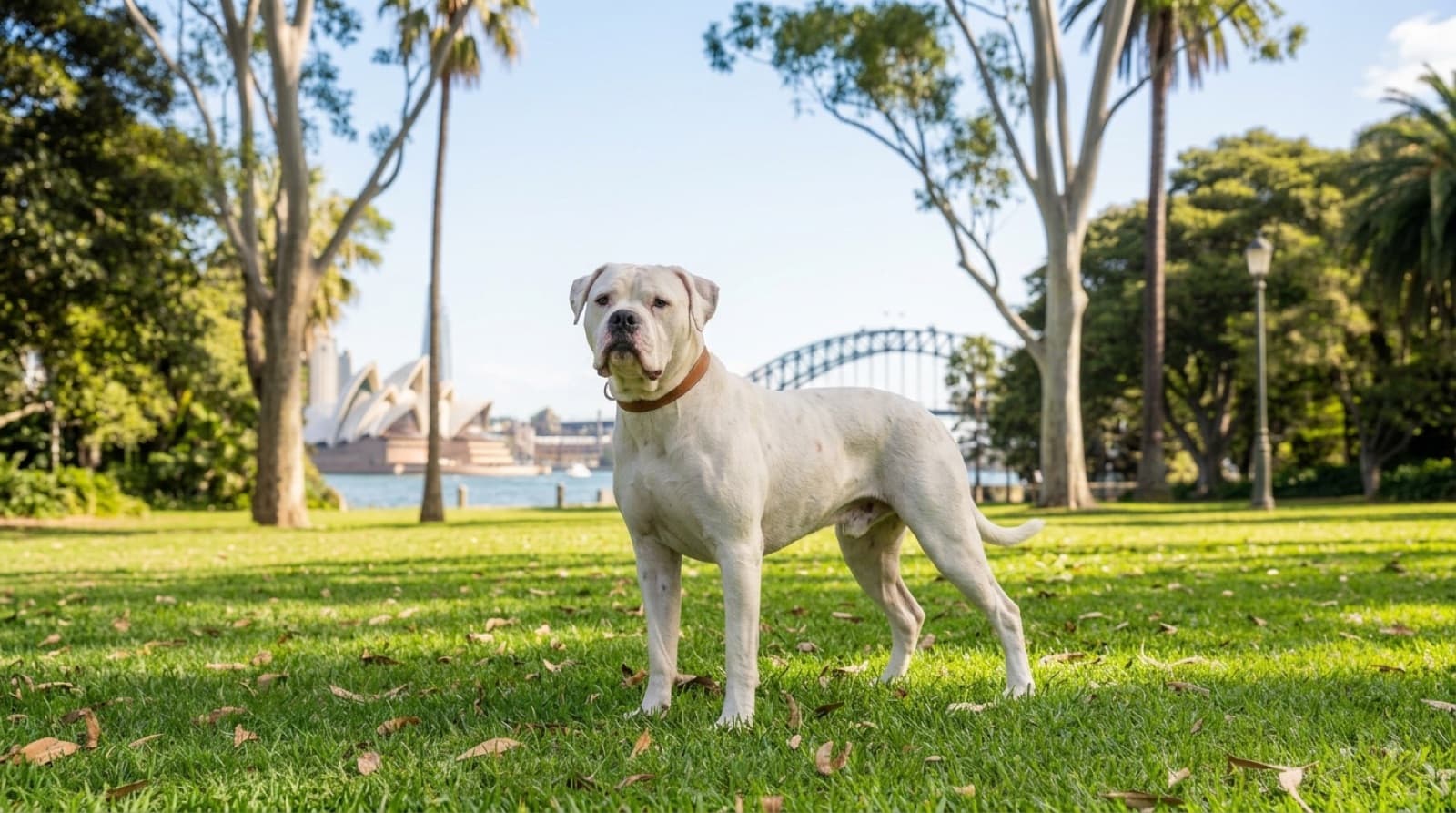
The short answer
The American Bulldog is a hardy breed with a handful of predictable risks. The joints come first: hip and elbow dysplasia and cruciate ligament injury are the common concerns in a large, athletic dog. Bloat is a genuine emergency in this deep-chested breed, so learn the signs. Two conditions are strongly linked to the breed: ichthyosis, an inherited skin condition, and NCL, a rare inherited neurological disease, both with DNA tests. Add cherry eye and entropion, skin allergies and demodectic mange, hypothyroidism, and deafness in some lines. Lifespan is commonly around 10 to 13 years. Keep the dog lean and fit, feed sensibly, manage the Sydney heat and ticks, insure early, and treat problems fast. This is general information, not veterinary advice; for your dog, always talk to your vet.
A note on this guide: this is general educational information for prospective and current American Bulldog owners, not veterinary advice. Every dog is an individual. For diagnosis, treatment or advice about your specific dog, always consult a registered veterinarian, and never medicate a dog based on an article. Sources include the Australian Veterinary Association, the RSPCA Knowledgebase and Small Animal Specialist Hospital (SASH).
Joints: hips, elbows and the cruciate
The joints are the first thing to plan for in a large, heavy, athletic breed. Hip and elbow dysplasia are developmental conditions where the joint does not form or fit correctly, leading to pain, stiffness and arthritis over time. Responsible breeders screen for them, and databases like the Orthopedic Foundation for Animals track hip and elbow scores, but you rarely know a rescue dog's breeding history.
Cruciate ligament injury is the other big joint risk. It is the dog version of the ACL tear people get in the knee, and in a strong, fast dog it often happens on a hard turn, a sprint or a jump. It shows as a sudden hind-leg lameness, and in a dog this size the repair is often surgical and costly. What you control matters most day to day:
- Keep the dog lean, because every extra kilo loads the joints.
- Avoid forced high-impact exercise in a growing puppy (under about 18 months) to protect developing joints.
- Warm the dog up before hard running rather than launching straight into a sprint.
- See your vet for any limping, stiffness after rest, or reluctance to jump or climb stairs.
Bloat: the emergency every owner must know
Bloat, or gastric dilatation-volvulus (GDV), is a sudden, life-threatening emergency where the stomach fills with gas and can twist on itself, cutting off its own blood supply. Deep-chested breeds like the American Bulldog are at higher risk, and a dog can go from healthy to critical within an hour or two. This is the one health issue where knowing the signs in advance genuinely saves lives.
The signs to memorise: a swollen or distended belly, unproductive retching (trying to vomit but bringing nothing up), heavy drooling, restlessness, pacing and obvious distress. If you see these, treat it as a true emergency and get to a vet immediately, at any hour, because surgery within the first few hours is what saves these dogs. Sydney has 24-hour specialty and emergency hospitals, including SASH, so know your nearest before you ever need it. As sensible precautions, feed smaller meals rather than one large daily feed, and avoid hard exercise right around mealtimes.
Ichthyosis and NCL: the breed-linked conditions
Ichthyosis is an inherited skin condition strongly associated with the American Bulldog. In affected dogs the skin does not shed its outer layer normally, so it becomes dry, flaky and scaly, sometimes with a rough or greasy coat. It is not contagious and is not usually painful in itself, but affected skin is more prone to secondary infection and needs lifelong management, usually with medicated shampoos and moisturising treatments guided by a vet. A DNA test exists for the form linked to the breed. If you adopt an American Bulldog with persistently flaky, scaly skin, have your vet assess it rather than assuming it is ordinary dandruff.
Neuronal ceroid lipofuscinosis (NCL) is a rare but serious inherited neurological disease documented in the breed. It is a storage disorder, where waste material builds up in nerve cells over time, and in affected dogs it causes a progressive loss of coordination, balance and behaviour changes, usually appearing in young adulthood. It is uncommon, and responsible breeders use a DNA test to avoid producing affected dogs. For an adopter, the practical point is simple: if a young American Bulldog develops unexplained wobbliness, changes in coordination, vision problems or behaviour changes, see a vet promptly for a proper neurological work-up rather than assuming it is a training issue.
Meet an adoptable American Bulldog in Sydney
Rescue American Bulldogs arrive already desexed, vaccinated, microchipped and vet-checked, often with a known health history. Browse live listings across Sydney and NSW.
See Available American Bulldogs →Eyes, skin, thyroid and hearing
Eyes. Cherry eye (a red lump in the inner corner from a prolapsed third-eyelid gland) and entropion (where the eyelid rolls inward and the lashes rub the eye) both occur in the breed, and both are usually corrected with minor surgery. Any squinting, redness, discharge, pawing at the eye or a visible lump is a same-day vet visit.
Skin and allergies. Beyond ichthyosis, American Bulldogs are prone to environmental and food allergies that show as itchy, inflamed skin and recurrent ear infections, and to demodectic mange, a mite-related skin condition that tends to flare when the immune system is stressed, especially in young dogs. Persistent itching, hair loss or sore skin needs a vet, because the underlying cause usually has to be managed rather than just the flare. The RSPCA Knowledgebase has sound general guidance on skin and allergy care.
Thyroid. Hypothyroidism, an underactive thyroid, occurs in the breed and can show as weight gain, lethargy, a poor or thinning coat and recurrent skin problems. It is straightforward to diagnose with a blood test and manage with daily medication once identified, so mention any of those signs to your vet.
Hearing. Congenital deafness is linked to the genes that produce a lot of white coat, and it occurs in some American Bulldog lines, in one or both ears. A deaf or partly deaf dog can live a full, happy life with an owner who trains using hand signals and manages the dog safely near roads, but it is worth knowing, and a vet can arrange a hearing test if there is any doubt.
Heat, ticks and the Sydney climate
Heat management for an American Bulldog is about big-active-dog sense, not the severe airway crisis that flat-faced breeds face. The breed has a moderate muzzle, not the extreme flat face of an English or French Bulldog, so it cools far more effectively than those dogs. That said, a heavy, muscular, sometimes dark-coated dog working hard on a humid Sydney summer day can still overheat. Exercise in the cool of the early morning or evening, keep sessions sensible on hot days, provide constant shade and water, and never leave the dog in a car or a hot yard. Learn the signs of heat stress: heavy laboured panting, drooling, weakness, bright red gums and collapse. Treat overheating as an emergency, cool the dog and get to a vet. A lean, fit dog copes better than an overweight one.
The paralysis tick is the other Sydney essential. It lives along the NSW coast and bushland, including the Sydney region, and its neurotoxin causes an ascending paralysis that is fatal without treatment. Keep your dog on a vet-recommended monthly tick-prevention product without gaps, and physically check the coat down to the skin after every outing to a bush or coastal area. If you find a tick, or your dog develops wobbly back legs, a changed bark or trouble swallowing, see a vet immediately.
Budgeting and insurance
An American Bulldog is a large dog with large-dog vet bills. The routine costs (quality food in the volume a big dog eats, an annual check, skin and ear care, dental care, year-round tick and parasite prevention, registration) are manageable, but the breed carries a real risk of larger one-offs: cruciate surgery, treatment for bloat, joint management, and lifelong skin care can each run into four figures at a Sydney referral hospital.
That is why pet insurance is a sensible decision with this breed. Enrol while the dog is young and healthy, before anything becomes a pre-existing exclusion, and compare a few Australian providers on chronic and hereditary cover, the annual limit and the excess. It is not a substitute for an emergency fund, but for a large breed with predictable, sometimes expensive problems it usually pays for itself. We cover the full cost of adopting and keeping the breed in our American Bulldog adoption guide, and the ownership side (rentals, strata, insurance and fencing) in our ownership and housing guide.
Frequently Asked Questions
What health problems are American Bulldogs prone to?
American Bulldogs are a generally hardy working breed, but as a large, powerful, deep-chested dog they carry some predictable risks worth knowing before you adopt. The main ones are joint conditions (hip and elbow dysplasia and cruciate ligament injury), bloat or gastric torsion because of the deep chest, and two conditions that are strongly associated with the breed: ichthyosis, an inherited skin condition, and neuronal ceroid lipofuscinosis (NCL), a rare inherited neurological disease. They can also develop cherry eye and entropion, skin allergies and demodectic mange, hypothyroidism, and some lines carry a risk of deafness. Lifespan is commonly around 10 to 13 years. None of this should scare you off, but it is a reason to insure early, keep the dog lean and fit, and build a good relationship with a vet. This is general information, not veterinary advice.
Do American Bulldogs get hip and elbow dysplasia?
Yes, joint problems are one of the main health concerns for the breed. Hip and elbow dysplasia are developmental conditions where the joint does not form or fit correctly, which leads to pain, stiffness and arthritis over time, and they are common in large, heavy, fast-growing breeds like this one. Responsible breeders screen their dogs, and screening databases such as the Orthopedic Foundation for Animals track these conditions, but you rarely know the breeding history of a rescue dog. What you can do matters more day to day: keep the dog lean because every extra kilo loads the joints, avoid forced high-impact exercise in a growing puppy under about 18 months, and see your vet if you notice limping, stiffness after rest, or reluctance to jump or climb stairs. Treatment ranges from weight and activity management to medication and, in some cases, surgery.
Are American Bulldogs prone to cruciate ligament injuries?
Yes. As a large, muscular, athletic breed, American Bulldogs are prone to cruciate ligament injury, the dog equivalent of the ACL tear people get in the knee. It often happens during hard running, sudden turns or jumping, and it shows as a sudden hind-leg lameness, sometimes with the dog holding the leg up or toe-touching. A partial or full cruciate rupture usually needs veterinary assessment and, in a dog this size, surgical repair is often recommended, which is a significant cost. Keeping the dog lean and well-muscled, warming up before hard exercise rather than launching straight into a sprint, and avoiding repetitive high-impact jumping all reduce the risk. If your dog suddenly goes lame on a back leg, see your vet rather than waiting it out, because early assessment gives the best outcome.
What is bloat and why is it an emergency in American Bulldogs?
Bloat, or gastric dilatation-volvulus (GDV), is a sudden, life-threatening emergency where the stomach fills with gas and can twist on itself, cutting off its own blood supply. Deep-chested breeds like the American Bulldog are at higher risk, and a dog can go from healthy to critical within an hour or two, so it kills quickly if not treated. Learn the signs: a swollen or distended belly, unproductive retching or trying to vomit without bringing anything up, drooling, restlessness, pacing and obvious distress. If you see these, treat it as a true emergency and get to a vet immediately, at any hour, because surgery within the first few hours is what saves these dogs. Sydney has 24-hour options including specialty and emergency hospitals such as SASH, so know your nearest before you ever need it. As a precaution, feed smaller meals rather than one large one and avoid hard exercise right around meals.
What is ichthyosis in American Bulldogs?
Ichthyosis is an inherited skin condition that is strongly associated with the American Bulldog. In affected dogs the skin does not shed its outer layer normally, so it becomes dry, flaky and scaly, sometimes with a rough, greasy or discoloured coat, and it can be mild or more troublesome depending on the dog. It is not contagious and it is not usually painful in itself, but affected skin can be more prone to secondary infection and needs ongoing management. A DNA test exists for the form linked to the breed, and a vet or dermatologist can confirm a diagnosis. Management is lifelong and usually centres on medicated shampoos, moisturising treatments and keeping secondary infections in check, all guided by your vet. If you adopt an American Bulldog with persistently flaky, scaly skin, have your vet assess it rather than assuming it is just dandruff.
What is NCL and should I worry about it?
Neuronal ceroid lipofuscinosis (NCL) is a rare, serious inherited neurological disease that has been documented in American Bulldogs. It is a storage disorder, meaning waste material builds up in nerve cells over time, and in affected dogs it causes a progressive loss of coordination, balance and behaviour changes that typically appear in young adulthood. It is uncommon, but it is worth being aware of because it is specific to the breed and there is a DNA test that responsible breeders use to avoid producing affected dogs. For an adopter, the practical point is simple: if a young American Bulldog develops unexplained wobbliness, changes in coordination, vision problems or behaviour changes, see a vet promptly for a proper neurological work-up rather than assuming it is a training issue. This is general information, not a diagnosis; your vet is the person to assess any individual dog.
What eye and skin conditions do American Bulldogs get?
A few are worth watching for. On the eyes, cherry eye (a red lump in the inner corner from a prolapsed third-eyelid gland) and entropion (where the eyelid rolls inward and the lashes rub the eye) both occur in the breed, and both are usually corrected with minor surgery. Any squinting, redness, discharge, pawing at the eye or a visible lump is a same-day vet visit, because eye problems can worsen fast. On the skin, beyond ichthyosis the breed is prone to environmental and food allergies that show as itchy, inflamed skin and recurrent ear infections, and to demodectic mange, a mite-related skin condition that tends to flare when the immune system is stressed, especially in young dogs. Persistent itching, hair loss, sore skin or recurring ear trouble needs a vet, because the underlying cause usually has to be managed rather than just the flare.
How do I keep an American Bulldog safe in the Sydney heat and from ticks?
The American Bulldog is a large, muscular, active dog, so heat management is about big-active-dog sense rather than the severe airway risk that flat-faced breeds face. It has a moderate muzzle, not the extreme flat face of an English or French Bulldog, so it cools more effectively than those breeds, but a heavy, dark-coated dog working hard on a humid Sydney summer day can still overheat. Exercise in the cool of the early morning or evening, keep sessions sensible in the heat, provide constant shade and water, never leave the dog in a car or a hot yard, and watch for heavy laboured panting, drooling, weakness or bright red gums, which are signs of heat stress to treat as an emergency. Separately, the paralysis tick is a year-round risk across the Sydney region and is fatal without treatment, so keep your dog on a vet-recommended monthly tick-prevention product without gaps and check the coat down to the skin after any bush or coastal outing.
Can American Bulldogs be deaf, and how long do they live?
Some can. Congenital deafness is linked to the genes that produce a lot of white coat in a number of breeds, and it does occur in some American Bulldog lines, in one or both ears. A deaf or partly deaf dog can live a full, happy life with an owner who trains with hand signals and manages the dog safely around roads, but it is worth knowing if you are adopting, and a vet can arrange a hearing test if there is any doubt. On lifespan, American Bulldogs commonly live around 10 to 13 years, and good care makes a real difference to both the length and the quality of that time: keeping the dog lean, protecting the joints, feeding sensibly to reduce bloat risk, managing skin and eyes, avoiding heat stress and treating problems early all count. A rescue American Bulldog arrives already desexed, vaccinated, microchipped and vet-checked.
Keep reading
Adoptable American Bulldogs in Sydney
Live listings of American Bulldogs and AB crosses across Sydney and NSW rescues.
American Bulldog Adoption in Sydney
Where to adopt, why they end up in rescue, and what it costs against a breeder.
American Bulldog Ownership & Housing
Why the breed is mistaken for a restricted one, plus rentals, strata, insurance, fencing and training.
All Sydney Adoption Guides
Browse every breed and how-to guide for adopting a rescue dog in Sydney.