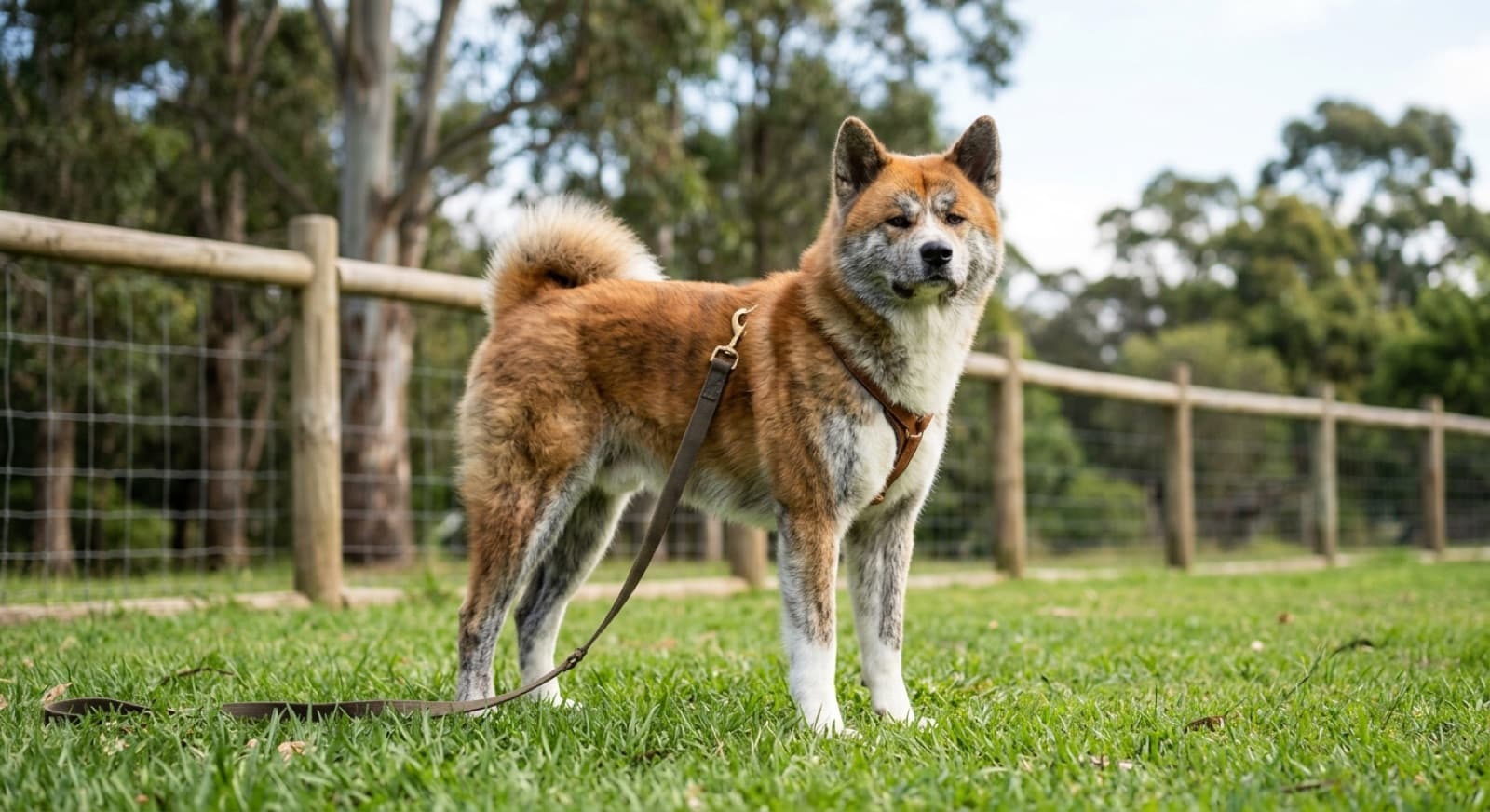
The short answer
The defining thing about an Akita is its guardian temperament. At home it is calm, quiet, dignified and profoundly loyal to its own people. With strangers it is naturally reserved and watchful, and with other dogs it is often intolerant, especially of the same sex, on top of a strong prey drive around cats and small animals. This is a large, powerful, independent, strong-willed breed, not an eager-to-please beginner's dog. It needs an experienced owner, secure fencing, careful handling in public, early and ongoing socialisation, and calm reward-based training. Dog parks are generally not for Akitas. Get the socialisation and management right and you have a magnificent, devoted companion. Get it wrong and the guarding and dog aggression become a real problem, which is why so many Akitas land in Sydney rescue.
A guardian breed, not a Labrador in a fur coat
To live well with an Akita you have to start with what the breed actually is. Akitas are ancient guardian dogs. For generations their job was to guard people, property and livestock, to work independently, and to make their own decisions about what was a threat. That history is not a footnote. It is the whole temperament, and it is still there in every Akita you meet.
At home, with its own family, a well-raised Akita is often a quiet, calm, dignified dog. It is not a bouncy, in-your-face breed. It tends to be deeply devoted and affectionate with its people while being fairly undemanding and self-contained. Many owners describe a settled Akita as almost cat-like in the house: clean, composed, and content to be near you without needing constant fuss.
The other side of the same coin is the guarding. An Akita is naturally reserved and aloof with strangers, watchful of its home and territory, and slow to trust people it does not know. It is also intelligent, independent and strong-willed, tending towards dominance rather than towards the eager-to-please biddability of a working gundog. None of that makes it a bad dog. It makes it a serious one. The Akita breed page is blunt that this is not a first-time owner's breed, and the temperament is exactly why.
The centrepiece: dog aggression and prey drive
If you take one thing from this guide, take this. Akitas are frequently intolerant of other dogs, and they are especially likely to clash with dogs of the same sex. On top of that they carry a strong prey drive, which means real caution is needed around cats, smaller dogs and small animals. This is not every single Akita, and it is not a moral failing of the breed. It is a well-known, well-documented tendency you have to plan around, not hope away.
What that means in practice for a Sydney home:
- Many Akitas do best as the only dog. Where a second dog works, it is usually one carefully matched dog of the opposite sex, introduced slowly with expert help.
- Dog parks are generally out. A crowded, high-arousal, off-lead free-for-all is close to the worst possible environment for a dog-intolerant guardian breed.
- Secure high fencing is non-negotiable. An Akita must not be able to get out, and strange dogs must not be able to get in.
- Careful lead handling in public. Walk in quiet places at quiet times, keep space from unknown dogs, and stay calm and matter-of-fact so your dog takes the cue from you.
- Never left alone with an unfamiliar dog. Not at a friend's house, not at the beach, not ever, no matter how friendly the other dog seems.
Frame all of this as management and safety, not as a reason to feel bad about the breed. Plenty of Akitas live rich, happy lives with exactly this setup. The dogs that get into trouble, and too often into rescue or worse, are usually the ones whose owners assumed a friendly puppy meant a dog-park dog for life. A good rescue assesses each Akita in foster care and can tell you what that individual can and cannot safely live with, which is far more reliable than the breed label alone.
Socialisation: start early, never stop
Socialisation is the single biggest lever you have with an Akita, and it is a lifelong project, not a puppy-class box to tick. Good socialisation means calm, controlled, rewarding exposure to a wide range of people, places, sounds, surfaces and everyday situations from as young an age as possible, so the dog learns that the normal world is safe and there is no need to guard against all of it. The earlier that starts and the more consistently it continues, the more relaxed and confident the adult dog tends to be.
The word ongoing matters. An Akita is not a breed you socialise for a few months and then coast on. Its watchfulness and its opinions about strangers and other dogs need topping up throughout its life, with regular calm exposure and continued training. Let that slide and a previously settled Akita can become more reactive and more guarding over time.
If you adopt an adult Akita with an unknown history, the same principle applies but you go at the dog's pace. Some rescued Akitas have had good early socialisation and slot in beautifully. Others have had none, and need patient, gradual, positive work to build their confidence. Either way, lean on the rescue's assessment and, where needed, work with a force-free trainer or behaviourist experienced with guardian breeds rather than trying to fast-track it. The Akita adoption guide covers what to expect from a rescued Akita settling into a new home.
Training: reward-based only, because force backfires
Here is a hard rule for this breed: reward-based, force-free methods only. Akitas are intelligent and capable of excellent manners, but they are independent and strong-willed, and they do not respond well to being bullied. Heavy-handed, dominance-style, confrontational training backfires badly with a powerful guarding dog. Instead of producing obedience it tends to produce defensiveness, mistrust and, in the worst cases, a dog that decides it needs to defend itself. That is the last thing you want in an animal of this size and strength.
What works is calm, clear, consistent, motivating training that the dog wants to take part in. The goals to prioritise with an Akita are:
- Rock-solid basic obedience. A reliable sit, down, stay, and above all a dependable recall and loose-lead walking, so you can manage the dog calmly in public.
- Impulse control and calm handling. Teaching the dog to settle, to wait, and to be handled and examined without fuss makes daily life and vet visits far easier.
- Early management of resource guarding. Guarding food, toys or space can show up in this breed, so build good habits around trading and sharing early, with help from a good trainer if it appears.
- A confident, consistent handler. An Akita reads its owner. Calm, fair leadership and predictable rules give the dog security and reduce the pressure it feels to make its own decisions.
For behaviour work, or if any dog-directed reactivity or guarding shows up, choose a Sydney force-free trainer or a qualified behaviourist with genuine experience of guardian breeds. The Australian Veterinary Association supports reward-based training and can help you find appropriately qualified behaviour support, and the RSPCA Australia Knowledgebase has sound general guidance on humane, effective training methods.
Akitas with children and family
An Akita is devoted to its own family, and one raised in a family home can be gentle and protective with respectful children it knows and lives with. That loyalty is one of the loveliest things about the breed. It comes with real responsibilities though, because this is a large, strong, naturally guarding dog rather than an easygoing, anything-goes family pet.
Supervision is essential, and it is not optional with any powerful breed. Teach children to respect the dog: to leave it alone when it is eating, sleeping or resting, to be gentle, and never to corner it or take its things. Extra caution is needed around visiting children and around other people's dogs, because the same guarding instinct that makes an Akita watchful and protective at home can misfire with unfamiliar kids and unfamiliar pets it has no relationship with.
Whether a particular Akita suits your household depends far more on the individual dog than on the breed name. This is where adopting through a rescue is a genuine advantage. A dog assessed in foster care comes with a real read on how it behaves around children, strangers and other animals, which matters enormously for a guardian breed. Be honest with the rescue about your family and your experience, and let their assessment guide you. And as with any dog, never leave a young child and a dog together unsupervised.
Responsible ownership of a powerful guardian breed
Owning a large, strong guardian breed like an Akita is a real responsibility, and taking that seriously is part of what makes the breed a joy rather than a worry. The basics are secure containment so the dog cannot get out and strange dogs cannot get in, proper control in public on a good lead and harness, and a calm, managed approach to other dogs, strangers and unfamiliar situations.
It helps to know the law, without being alarmed by it. The Akita is not a restricted breed in NSW. The restricted breeds under the NSW Companion Animals Act 1998 are the American Pit Bull Terrier, Dogo Argentino, Japanese Tosa, Fila Brasileiro and Perro de Presa Canario, and the Akita is not among them, so it is legal to own and adopt normally. What does apply to every dog is that a council can declare any individual dog, of any breed, menacing or dangerous based on its behaviour. That is a straightforward reason to socialise, train and manage your Akita properly, so it never gets into a situation that could earn such a declaration. It is accurate to know, not a cause for panic.
Practical ownership in NSW also means the legal basics that apply to any dog: microchipping and lifetime council registration through the NSW Pet Registry. We go into council registration, the legal side and the rest of responsible Akita ownership in the Akita adoption guide, and cover the breed's health, including the demands of the heavy double coat in Sydney's heat, in the Akita health issues guide.
Browse adoptable Akitas in Sydney
An Akita rewards an experienced owner who respects the guardian temperament and commits to the socialisation and management it needs. Browse live NSW listings and set an alert so you hear when one comes into rescue.
See Available Akitas →Is an Akita's temperament right for you?
Put it together and the honest picture is clear. An Akita is a calm, dignified, deeply loyal dog that is quiet and undemanding at home, and a serious guardian breed that is reserved with strangers, often intolerant of other dogs, strong-willed, and powerful. It needs an experienced owner who understands guardian breeds, secure fencing, careful handling in public, early and lifelong socialisation, and calm reward-based training. It is generally not a dog-park dog, and it is not a good first dog.
Meet all that and you get one of the most loyal, striking and rewarding companions there is, a dog that will bond to you completely. Fall short and you get a stressed, guarding, dog-reactive animal that becomes a liability, and, all too often, another Akita in rescue. So the question is not whether you love how an Akita looks. It is whether your experience, your home and your daily life genuinely suit a powerful guardian breed. If they do, adopting one is a wonderful thing to do.
Sydney and NSW rescues such as RSPCA NSW, AWL NSW, Sydney Dogs and Cats Home, Monika's Doggie Rescue and Maggie's Rescue assess their dogs in foster and shelter care, and can tell you honestly how a particular Akita or Akita cross behaves around people, dogs and other animals, and whether it suits your home. Adopting an assessed adult takes a lot of the guesswork out of a breed where temperament and management matter this much.
Frequently Asked Questions
Are Akitas aggressive?
Akitas are not mindlessly aggressive, but they are a serious guardian breed with strong protective and territorial instincts, and they are often intolerant of other dogs, especially of the same sex. With their own family a well-raised Akita is typically calm, affectionate and gentle. The behaviour people call aggression is usually the breed being what it was bred to be: naturally reserved and watchful with strangers, quick to guard its home and people, and unwilling to back down from another dog. That is not a temperament to take lightly. It is a big, powerful, strong-willed dog that needs an experienced owner, careful lifelong socialisation, reward-based training and sensible management to be a safe, happy family member. Handled well, an Akita is a wonderful, loyal companion. Handled carelessly, the guarding and dog-directed side can become a real problem, which is exactly why so many end up in rescue.
Are Akitas good with other dogs?
Often not, and this is the single most important thing to understand about the breed. Akitas are frequently intolerant of other dogs and are especially likely to clash with dogs of the same sex, and they also have a strong prey drive that makes them a risk around cats and small animals. Many Akitas are happiest as the only dog in the home, or living with one carefully matched dog of the opposite sex. This is a management position, not a judgement of the breed, and plenty of Akitas live perfectly good lives with the right setup. It does mean secure high fencing, careful handling on lead in public, never leaving an Akita alone with an unfamiliar dog, and being honest that dog parks and off-lead free-for-alls are generally not for this breed. A good rescue assesses each Akita in foster care and will tell you what that individual dog can and cannot live with.
Can Akitas go to dog parks?
Generally no, and most experienced Akita owners avoid busy off-lead dog parks entirely. Akitas are often intolerant of unfamiliar dogs and do not enjoy the crowded, high-arousal, anything-goes environment of a typical dog park, where a scuffle can turn serious fast given the size and strength of the breed. A much better plan is exercise on lead, in quiet places, at quiet times, plus off-lead running only in a securely fenced private area where no strange dogs can get in. Off-lead rules and areas vary between councils across Sydney, so check your council, but for an Akita the safer default is to skip the shared dog park. This is not about the breed being bad. It is about setting a powerful guardian dog up to succeed rather than putting it in a situation that plays straight to its weakest point.
Are Akitas good with children?
An Akita raised with a family can be devoted and gentle with respectful children it knows, but it is not an easygoing breed you can leave unsupervised, and it needs sensible management around kids. Akitas are loyal and protective of their own people, which includes the children they live with, but they are also large, strong and naturally guarding, so supervision is essential and children must be taught to respect the dog and leave it in peace when it is resting or eating. Extra care is needed around visiting children and other people's dogs, because the guarding instinct that makes an Akita watchful at home can misfire with unfamiliar kids and pets. Whether a particular Akita suits a home with children depends heavily on the individual dog, so lean on the rescue's foster assessment rather than the breed label alone, and never leave any dog and young child together unsupervised.
Do Akitas need an experienced owner?
Yes. An Akita is not a good choice for a first-time dog owner, and most rescues will say so plainly. This is a large, powerful, intelligent and independent guardian breed that tends towards dominance, is naturally reserved with strangers, and is often intolerant of other dogs. It is not the eager-to-please, biddable type that forgives beginner mistakes. An Akita needs an owner who understands guardian breeds, can read canine body language, will commit to early and ongoing socialisation, uses calm reward-based training, and can manage a strong dog confidently and consistently without resorting to force. In the right experienced hands an Akita is a magnificent, deeply loyal companion. In the wrong hands the guarding, the dog aggression and the sheer strength become a serious liability. Be honest with yourself about your experience before you take one on.
How do I socialise an Akita?
Start early, keep it positive, and never stop. Good socialisation for an Akita means calm, controlled, rewarding exposure to lots of different people, places, sounds and situations from as young as possible, so the dog learns the world is normal and it does not need to guard against everything. Use reward-based methods only. Heavy-handed or dominance-style training backfires badly with a powerful guarding breed and can create defensiveness rather than confidence. Build rock-solid basic obedience, calm handling, impulse control and a reliable recall, and manage any resource guarding early with the help of a good trainer. Socialisation is not a box you tick in puppyhood and forget. An Akita needs its good manners and its exposure topped up throughout its life. If you have adopted an adult Akita with an unknown history, work with a force-free trainer or behaviourist experienced with guardian breeds and go at the dog's pace.
Are Akitas good with cats and small animals?
Often not, because Akitas have a strong prey drive, so caution around cats and small animals is essential. Some Akitas raised alongside a cat from a young age learn to live with that particular cat, but many will chase and potentially harm cats, smaller dogs and other small pets, and an Akita that is fine with the family cat indoors may still chase an unfamiliar cat in the yard. Never assume an Akita is safe with a small animal, and never leave them together unsupervised. If you already have a cat or small pet, be upfront about it with the rescue so they can tell you honestly whether a particular Akita has been assessed as safe to live with one. For many Akitas, a home without other small animals is simply the safest and least stressful setup for everyone.
Are Akitas a restricted breed in NSW?
No, the Akita is not a restricted breed in New South Wales. The restricted breeds under the Companion Animals Act 1998 are the American Pit Bull Terrier, Dogo Argentino, Japanese Tosa, Fila Brasileiro and Perro de Presa Canario, and the Akita is not on that list, so it can be legally owned and adopted normally. That said, owning a large, powerful guardian breed carries real responsibility. You need secure containment, proper control in public, and an awareness that under the Act any dog, of any breed, can be declared menacing or dangerous by a council based on its behaviour, not its breed. That is a reason to socialise, train and manage an Akita properly, not a reason to be alarmed. We cover the legal side, council registration and responsible ownership in more detail in the Akita adoption guide.
Keep reading
Adoptable Akitas in Sydney
Live listings of Akitas and Akita crosses across Sydney and NSW rescues.
Akita Adoption in Sydney
Where to adopt, why Akitas end up in rescue, the legal side, and what adoption costs against a breeder.
Akita Health Issues in Sydney
The heavy double coat in Sydney's heat, joint and autoimmune conditions to know, and year-round tick prevention.
All Sydney Adoption Guides
Browse every breed and how-to guide for adopting a rescue dog in Sydney.