The short answer
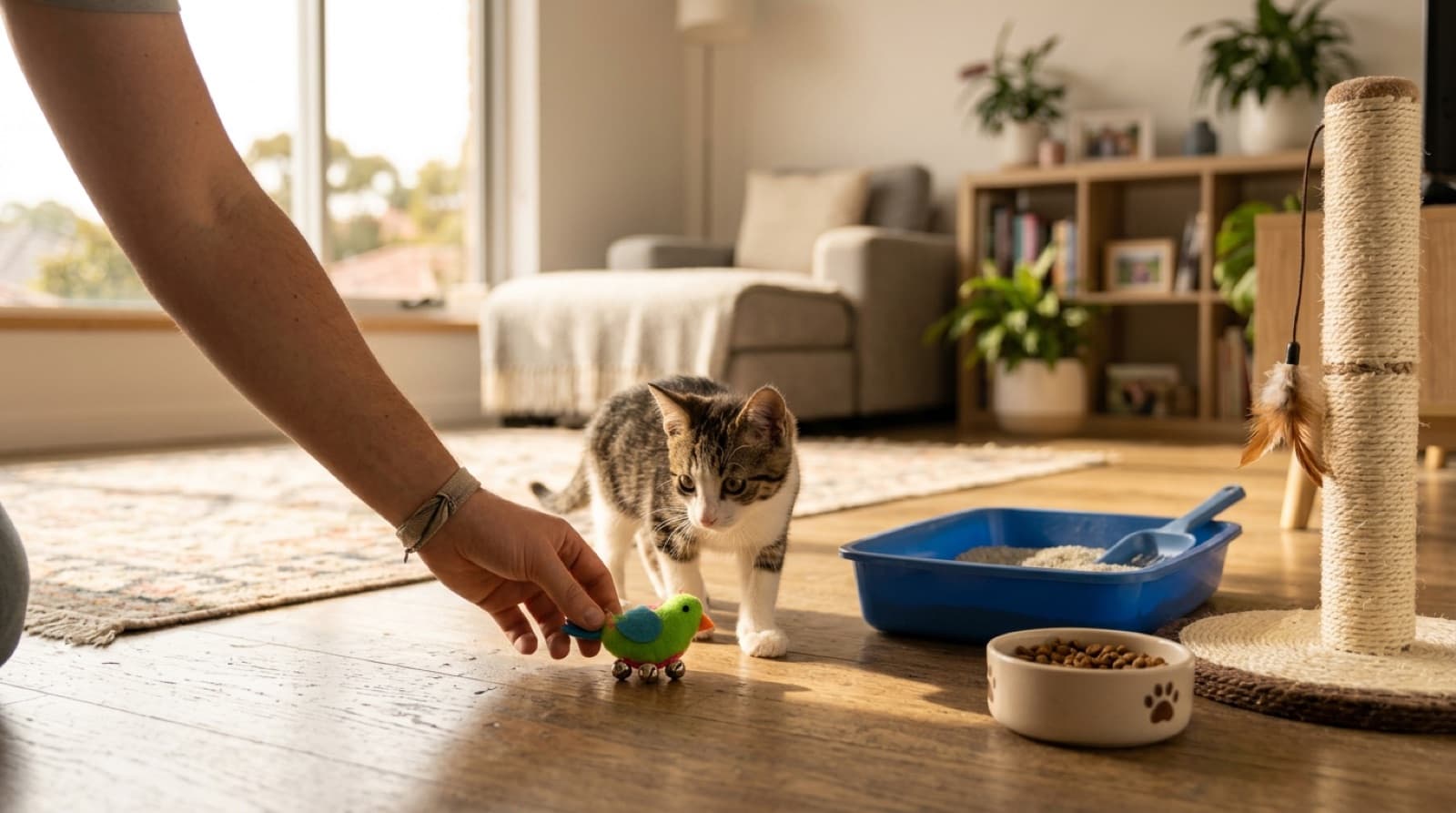
Before your kitten comes home, set up one quiet room with a litter tray, food and water, a bed, a scratching post and a hiding spot. Keep the kitten in that room for the first few days, then open the house gradually as it grows confident. Feed a kitten-formula food, let the kitten come to you, and book a first vet visit to finish the booster series and start a cat-safe flea and worming schedule. Your Perth rescue has already desexed, vaccinated (first F3), microchipped and FIV-checked the kitten, so most of the medical work is done. Keep it indoors or contained, protect it from summer heat, and register it with your council.
What to buy before your kitten comes home
Get everything set up in one room before the kitten arrives, not on the drive home. Kittens are easy to shop for, and none of it needs to be expensive. Here is the practical starter list.
- A litter tray and litter. One open tray to start, a little larger than the kitten needs, with low sides so a small kitten can climb in. A clumping or paper-based litter is easy to keep clean.
- Food and water bowls. Shallow, wide bowls keep whiskers comfortable. Keep the water bowl well away from the food and the tray, and in a Perth summer keep more than one water spot topped up.
- Kitten food. A kitten-formula wet or dry food (kittens have different needs to adult cats). Ask the rescue what the kitten is already eating and start with the same food to avoid an upset tummy.
- A scratching post. A sturdy, tall-enough post the kitten cannot topple. Scratching is a need, not a habit to train out, so give it a legitimate target from day one.
- A bed and a hiding spot. A soft bed plus somewhere enclosed to hide (even a cardboard box on its side works). Hiding is how a nervous kitten feels safe.
- A carrier. A hard, top-opening carrier. Your rescue sends the kitten home in one, and you will need it for every vet visit. Leaving it out as a bed makes future trips far less stressful.
- A few safe toys. A wand toy for interactive play plus a couple of small toys with no loose parts. Play is how kittens burn energy and bond with you.
That is the full kit. Litter tray, bowls, food, post, bed, carrier and toys will cost roughly $150 to $300 depending on how fancy you go, and most of it lasts years. Skip anything with cords, small detachable parts or dangling strings a kitten could swallow.
Kitten-proofing a Perth home
Kittens climb, chew and squeeze into gaps you would never expect. A quick sweep of the home before the kitten arrives prevents the most common accidents, and a couple of these matter more in the Perth climate.
Heat and hot surfaces. Perth summers regularly top 40 degrees, and a kitten will seek out the coolest floor it can find. Make sure it can always reach shade and cool tiles, keep it out of unshaded sunrooms and closed-up rooms that bake in the afternoon, and never leave it on a hot balcony. A closed car heats to lethal temperatures within minutes, so a kitten never goes in one, not even for a quick errand.
Balconies and windows. Cats fall from balconies and open windows more often than people think, and vets even have a name for the pattern of injuries: high-rise syndrome. A kitten does not understand height. Fit secure screens or netting on windows and balconies, or keep them closed, and never rely on a cat to judge a ledge. If you want your kitten to have outdoor time, a fully enclosed balcony or a catio is the safe way to do it.
Cords and cables. Blind cords, phone chargers and power leads are a chewing and strangling risk. Tie blind cords up out of reach and bundle or hide cables. Kittens genuinely chew on this stuff.
Toxic plants, especially lilies. Lilies are extremely dangerous to cats. Every part of the plant is toxic, and even a small nibble or licking pollen off the fur can cause fatal kidney failure. Get lilies out of the house entirely. Other common houseplants can also be toxic, so check any plant a kitten can reach against the RSPCA Australia Knowledgebase before you trust it near a cat.
Gaps, appliances and small objects. Block gaps behind cupboards and appliances where a kitten could vanish or get stuck. Keep washing machine and dryer doors shut (kittens love a warm drum). Pick up hair ties, rubber bands, string, needles and anything small enough to swallow, since these cause serious gut blockages.
The first 24 hours: the one-room settle-in method
Do not give a new kitten the run of the house on day one. A whole home is overwhelming, and a frightened kitten will bolt for the hardest-to-reach hiding place it can find. The gentler and more reliable approach is a single quiet room.
Set up one room (a spare bedroom or a quiet study works well) with the litter tray in one corner, food and water in another, a bed, and a hiding spot. In summer, pick a room that stays cool through the afternoon rather than one that bakes. Put the carrier down, open the door, and let the kitten come out in its own time. Do not tip it out or drag it into the open. Sit on the floor, keep your voice low, and let the kitten explore when it is ready. Some kittens are out and purring within minutes. Others hide under the bed for a day. Both are normal.
Keep the first day calm. Limit visitors, keep any other pets out of that room for now, and give children short, quiet, supervised visits rather than a crowd. The kitten needs to learn that this room is safe and that you are the source of food and gentle company. Once it is eating well, using the tray, and coming out to greet you, you can start widening its world.
The settling timeline: what three, three and three looks like
Many carers describe cat settling in a rough pattern of threes. It is a guide, not a rule, but it sets sensible expectations for the first month.
- The first three days. Overwhelm and caution. The kitten may hide, eat little, and stay quiet. Keep the room calm and do not force contact. The goal is simply that it eats and uses the tray.
- The first three weeks. Learning the routine. The kitten works out feeding times, where things are, and who you are. Its real personality starts to show, and this is when you open more of the house.
- The first three months. Feeling at home. By now most kittens are confident, bonded and fully part of the household. The bond you build in these early weeks lasts.
A bold kitten might compress this whole arc into a week. A shy or under-socialised one can take longer, and patience is the only thing that speeds it up. Let the kitten come to you.
Feeding a new kitten
Kittens grow fast and need a kitten-formula food, which has more energy and protein than adult cat food. Start with whatever the rescue was feeding and keep it the same for the first week or two, because a sudden food change on top of a house move often causes a runny tummy. If you want to switch foods later, do it slowly over several days by mixing the new in with the old.
Young kittens eat little and often, so several small meals a day suits them better than one big bowl, and many owners leave dry food available while feeding wet food at set times. The right amount and schedule depends on the kitten's age and weight, so treat the pack guide as a starting point and confirm the plan at your first vet visit. Fresh water should always be available, and in a hot Perth summer it is worth keeping a second bowl topped up in another room. Do not give cow's milk, which upsets most cats. If the kitten is very young, ask the rescue and your vet about the right feeding routine for its stage.
Litter training a kitten
Good news: litter training is mostly instinctive. Kittens want to bury their faeces, so your job is to make the tray easy to find and pleasant to use, not to teach the idea from scratch. Most kittens that came from a foster home already know exactly what a tray is for.
Put the tray somewhere quiet and easy to reach, away from the food and water and away from busy foot traffic. Keep it clean, scooping daily, because cats will avoid a dirty tray and may go elsewhere instead. The standard rule is one tray per cat plus one spare, so a single kitten does well with two trays, especially while it is learning the layout of a larger home. If the kitten has an accident, clean it with an enzyme cleaner (not an ammonia-based one, which smells like urine and draws them back) and consider whether the tray was too far away, too dirty, or in too busy a spot.
The first vet visit: what the rescue did and what is left
Perth rescue kittens arrive with a lot of the medical work already done, which is a big part of what your adoption fee pays for. Typically that means the kitten is already desexed, has had its first F3 vaccination, is microchipped, has been FIV-checked, and has had worming and flea treatment. Under WA law a cat must be desexed and microchipped by six months anyway, so rescues handle both before rehoming and you do not arrange them yourself.
Book a first check-up with a Perth vet within the first week or two, and take the paperwork from the rescue with you. The vet will confirm what has been done and finish the kitten booster series on a schedule that suits the kitten's age. This visit is also when you set up parasite prevention.
For a Perth kitten that means a routine flea and intestinal-worm schedule, which are a year-round concern here. Ask your vet for a cat-safe product and follow their timing, because some parasite products made for dogs are toxic to cats and must never be used on one. Unlike cats on the eastern seaboard, a Perth kitten does not need year-round paralysis-tick prevention, since that tick is not established in WA. The only time it matters is if you plan to travel east into tick country with your cat, in which case ask your vet about a cat-safe preventative first.
Socialisation and gentle handling
Kittens have an early window when calm, positive experiences shape how confident they become as adults. Gentle handling in the first weeks pays off for life. Pick the kitten up softly and briefly, let it get used to being touched on the paws, ears and mouth (useful later for nail trims and vet checks), and pair handling with treats and play so it links people with good things. The RSPCA Australia Knowledgebase has practical guidance on socialising kittens.
Play is central to a kitten, so give it daily wand-toy sessions that let it stalk, chase and pounce, then wind down. Never use your hands as a toy, because a cute biting kitten becomes an adult cat that bites hands. Keep introductions to other pets slow and supervised, and give children short, calm, seated visits rather than chasing games. A kitten that learns the world is gentle grows into an easy, confident cat.
Indoor or outdoor in Perth?
Perth rescues overwhelmingly rehome kittens as indoor or contained cats, and it is the safer choice by a wide margin. Indoor cats live longer because they avoid cars, cat fights and disease, and they do not hunt native wildlife, which is why a growing number of WA councils now have cat containment local laws. The rules vary from council to council, so it is worth checking what applies where you live. Raising a kitten indoors or contained from the start is far easier than trying to keep an older outdoor cat in later.
Indoor does not mean bored. Give the kitten vertical space to climb, scratching posts, window perches to watch the world, daily interactive play, and a secure balcony or a catio if you want safe fresh air. It also sidesteps the Perth summer, since a contained cat is never stuck outside in the heat. We make the full case, including how to enrich an indoor home and how councils treat containment, in our guide to indoor versus outdoor cats in Perth. You can also browse cats and kittens across Perth rescues on our Perth cat adoption listings.
Browse adoptable kittens in Perth
Kitten season peaks over spring and summer, so supply is highest then. Browse live WA listings and set an alert so you hear the moment the right kitten comes in.
See Available Kittens →Where to adopt a kitten in Perth
Kitten season in Perth runs mainly through spring and summer, when litters arrive and rescues fill up, so that is the best time to look and the busiest time for applications. Set alerts across the rescues you would consider and have your details ready. For the full walk-through of the adoption process, see our Perth cat adoption guide.
Cat Haven
Western Australia's largest cat shelter, based in Shenton Park, rehoming thousands of cats and kittens a year. Being cat specialists, the staff are a strong source of kitten advice, and every adoption includes desexing, vaccination, microchipping and an FIV check. See current kittens at cathaven.com.au.
RSPCA WA
The RSPCA's WA shelter at Malaga rehomes kittens and cats, common through the warmer months, with an all-inclusive adoption fee that covers desexing, vaccination and microchipping. Apply at rspcawa.org.au.
SAFE
Saving Animals From Euthanasia is a foster-based network with branches across WA. Because kittens live in foster homes, the notes on temperament and how a kitten is with people and other pets tend to be detailed. Listings at safe.org.au.
You can also browse every adoptable kitten and cat across these rescues on our main Perth cat adoption listings. Be wary of any seller or group that asks for money before you have met the kitten or confirmed a real, registered rescue.
Microchipping, desexing and registration law in WA
Western Australia has clear, non-negotiable rules for owning a cat under the Cat Act 2011. By six months of age a cat must be microchipped, sterilised (desexed) and registered with your local council. These are legal requirements, not optional extras, so plan for all three from the start. The good news for anyone adopting is that a Perth rescue almost always sends the kitten home already microchipped and desexed, which handles the two big ones before you get through the door.
What is left for you is council registration. Unlike some states, WA cat registration is run by your local council rather than a single state register, so the fee and the form vary depending on where you live. A sterilised cat pays less than an entire one, and because rescue kittens come desexed you get the lower rate. Check your local council's website for the current fee and to register. You can read more about WA's cat laws through the Western Australian Government, and our Perth cat adoption costs guide covers where registration fits into the total.
When to call a vet
A little quiet caution in the first days is normal. Some signs are not, and a young kitten can go downhill fast, so do not wait and see with these. Call a vet promptly if your kitten:
- Is not eating or drinking for more than about 24 hours, or is a very young kitten refusing food for even a few hours.
- Is unusually flat, weak or lethargic and will not rouse to play or food.
- Has ongoing diarrhoea or vomiting, or any blood in either.
- Is struggling to breathe, breathing fast, or breathing with an open mouth.
- Shows heat stress on a hot Perth day: heavy panting, drooling, a very red mouth or collapse (move it somewhere cool and call a vet at once).
- Has swallowed string, a needle, a plant like lily, or any small object, or you suspect a poison.
If something serious happens after hours, keep the number of your nearest Perth emergency vet somewhere easy to find, alongside your regular vet for daytime care. When in doubt with a young kitten, phone your vet and describe what you are seeing. It is always better to ask early.
Frequently Asked Questions
What do I need before bringing a kitten home?
The core kit is a litter tray plus litter, a food and water bowl, kitten food, a scratching post, a bed, a carrier, and a couple of safe toys. Get all of it set up in one quiet room before the kitten arrives so the space is ready and calm. A carrier matters most on day one, because your rescue will send the kitten home in one and you will need it for every vet visit after. Everything else can be cheap and simple. Kittens care far more about a warm hiding spot and a clean tray than about anything expensive. Budget roughly $150 to $300 for the full starter set, less if you already have some of it.
How much does it cost to adopt a kitten in Perth?
A kitten adoption fee through a Perth rescue commonly runs about $150 to $300, and an adult cat about $100 to $250. That fee is not just for the kitten. It covers desexing, an F3 vaccination, microchipping, an FIV check, and worming and flea treatment, which would cost far more if you paid for each separately at a clinic. Cat Haven in Shenton Park, WA's largest cat shelter, and RSPCA WA both list all-inclusive fees along these lines. On top of the fee, plan for the starter gear (about $150 to $300) and ongoing costs like food, litter, vet-recommended parasite prevention and council registration. Our Perth cat adoption costs guide breaks the numbers down further.
Should my Perth kitten be indoor or outdoor?
Perth rescues overwhelmingly rehome kittens as indoor or contained cats, and it is the safer choice. Indoor cats avoid cars, cat fights and disease, and they do not hunt native wildlife, which is why many WA councils now have cat containment local laws. An indoor kitten still needs enrichment: vertical space, scratching posts, window perches, daily play, and a secure balcony or a catio if you want safe outdoor time. Raising a kitten indoors or contained from the start is far easier than converting an older outdoor cat later. We cover the full case in our guide to indoor versus outdoor cats in Perth, and you can browse cats already assessed as indoor-suited on our listings.
When can I let my new kitten explore the whole house?
Give it a few days to a week in one room first, then open the house gradually once the kitten is eating, using the tray, and coming to you willingly. The settling pattern many carers describe runs in threes: roughly three days to stop hiding and feel less overwhelmed, about three weeks to learn your routine and show real personality, and around three months to feel fully at home. A single quiet room with the tray, food, water, a bed and a hiding spot lets a kitten build confidence without being swamped by a whole house. Rushing this is the most common early mistake. Let the kitten set the pace and widen its world one room at a time.
When must I desex and microchip my kitten in WA?
In Western Australia both are the law, not optional extras. Under the Cat Act 2011, a cat must be microchipped, sterilised (desexed) and registered with your local council by six months of age. A kitten adopted from a Perth rescue almost always arrives already microchipped and desexed, so the rescue has handled the two big ones for you before you get home. What is left for you is council registration, which is done through your local council rather than a state office. Fees vary by council and a sterilised cat pays less than an entire one. Check your local council for the current figure and to register.
What vaccinations does my rescue kitten need?
Most Perth rescue kittens leave already desexed, microchipped, FIV-checked, wormed and flea-treated, and with at least one F3 vaccination done. The F3 protects against three common cat diseases. What is usually left is finishing the kitten booster series, which your own vet completes on a schedule based on the kitten's age and what the rescue has already given. Take the paperwork from your rescue to your first vet visit so the vet can see exactly what has been done and plan the rest. That first check-up is also when you set up a worming and flea schedule. Ask your vet for a cat-safe product, because some parasite products made for dogs are toxic to cats.
Do Perth kittens need paralysis-tick prevention?
Generally no. The paralysis tick is an eastern-seaboard species and is not established in Western Australia, so it is not the constant threat for a Perth kitten that it is for cats in New South Wales or coastal Queensland. What your Perth kitten does need is routine flea and intestinal-worm prevention every month of the year, so start a schedule with your vet at the first visit. The one time paralysis ticks become relevant is if you plan to travel east with your cat, into tick country. If that is on the cards, ask your vet about a cat-safe preventative before you go, and never use a dog tick product on a cat.
How do I keep my kitten safe through a Perth summer?
Perth summers are hot and dry, often topping 40 degrees, and a kitten cannot cool itself the way we do. Keep it indoors during the heat of the day, make sure it always has shade and cool spots to lie on (tiles and bathroom floors are favourites), and keep fresh water available in more than one spot. Never leave a kitten in a parked car, even briefly, and never in an enclosed sunroom or on a hot balcony. Watch for heat stress: panting, drooling, lethargy or a very red mouth need a vet straight away. In the cooler winter nights, swing the other way and give the kitten a warm, draught-free bed. An indoor or contained kitten rides out both extremes far more easily.
How long until my kitten settles in?
Most kittens settle over roughly three months, and the change is gradual rather than sudden. A useful rule of thumb runs in threes: about three days to stop hiding and start eating and using the tray with confidence, about three weeks to learn the household routine and let its real personality show, and around three months to feel genuinely at home and bonded to you. A confident kitten might race through the first stage in a day, while a shy or under-socialised one takes longer, and both are normal. Keep the early days calm, quiet and predictable. Let the kitten come to you rather than chasing it, and the settling looks after itself.
Keep reading
Adoptable Kittens in Perth
Live listings of kittens across Perth and WA cat rescues. Set an alert for kitten season.
Perth Cat Adoption Guide
The full process: where to adopt, fees, applications, and what to expect when you bring a cat home.
Indoor vs Outdoor Cats in Perth
Why Perth rescues rehome indoor, WA council containment rules, wildlife, and how to enrich an indoor home.
Perth Cat Adoption Costs
Adoption fees, starter gear, council registration and the ongoing cost of a cat in Perth.