The short answer
Yes, a working Kelpie can live happily on a suburban Melbourne block, but the condition is non-negotiable: enough physical exercise AND daily mental work, every day. That means 90 minutes or more of real exercise, around 30 minutes of thinking work, a weekly dog sport or job-equivalent, and escape-proof 1.8 metre fencing with no climbable features. Meet the exercise half but skip the mental half and you still get a bored, destructive dog. Melbourne's summer heat means running the dog early and late and giving it indoor brain work on 40C days. Working Kelpies turn up in Victorian rescue in numbers because of the state's farming heritage, and most of the ones that struggled in a home did not have a bad home, just half the routine.
The one thing that decides it: a body run AND a brain job
The Australian Kelpie was bred to muster stock across large properties for hours at a stretch, making constant decisions about where to go and what to push. That is two needs braided together: a huge physical engine, and a working brain that expects a task. The single most common mistake Melbourne owners make is treating the Kelpie like a high-energy dog that simply needs a big walk. A long run tires the body and leaves the brain switched on, still looking for a job. Half-met, the drive redirects onto whatever is available: the fence, the couch, the neighbour's cat, the gate latch.
So the honest test of whether the suburbs suit a Kelpie is not the size of the yard. It is whether the household can reliably deliver both halves. Working Kelpies are common in Victorian rescue precisely because the state's farming heritage produces more of them than farms can keep, and a dog bred to work all day rarely settles onto a quiet block by itself. Give it a genuine job, though, and it becomes one of the most rewarding dogs you can own in the city.
What counts as a job? Anything structured that the dog repeats and gets better at: agility, flyball, scent work, obedience, a dog-sport class, trick training built into the week, or a household task with rules attached. A Kelpie does not need to muster sheep in Brunswick. It needs to use its problem-solving, and it needs to feel useful. That is the difference between a Kelpie that naps contentedly by six in the evening and one that paces the hallway at nine.
What under-stimulation actually looks like
Most “behaviour problems” in a suburban Kelpie are one problem wearing different clothes: an unmet working brain. Before you reach for a training fix, learn to recognise the pattern, because the cause and the cure are usually the same.
- Fence-running and boundary barking. The dog patrols the perimeter and barks at everything that passes. It is self-rewarding: the trigger leaves, and the dog credits its own barking.
- Escaping. Digging under, climbing over, testing the gate. Under-exercised Kelpies escape far more than well-worked ones.
- Destruction. Chewed skirting boards, dug-up garden, shredded bedding, usually while the owner is out.
- Cannot settle. Even after a big walk the dog is restless indoors, following you, nudging, unable to switch off, because the run tired the legs and not the mind.
- Barking when alone. Often reported by a neighbour before the owner ever hears it.
The diagnostic tell is simple: add real exercise and daily mental work for a few weeks, and watch the behaviour ease. If it does, it was under-stimulation. The RSPCA Knowledgebase takes the same line on canine behaviour generally, that a dog's needs for exercise and mental enrichment have to be met before you can fairly expect calm behaviour. You can read its guidance in the RSPCA Knowledgebase.
How to meet the need: the daily routine that works
The routine below genuinely works for full-time Melbourne households, provided midday coverage is sorted. It is built to deliver both halves, body and brain, on repeat.
Morning (before work):
- 45 to 60 minute walk, including off-lead time at a verified off-lead area where the dog can genuinely run
- 15 minutes of training: recall practice, trick work, or a short obedience session
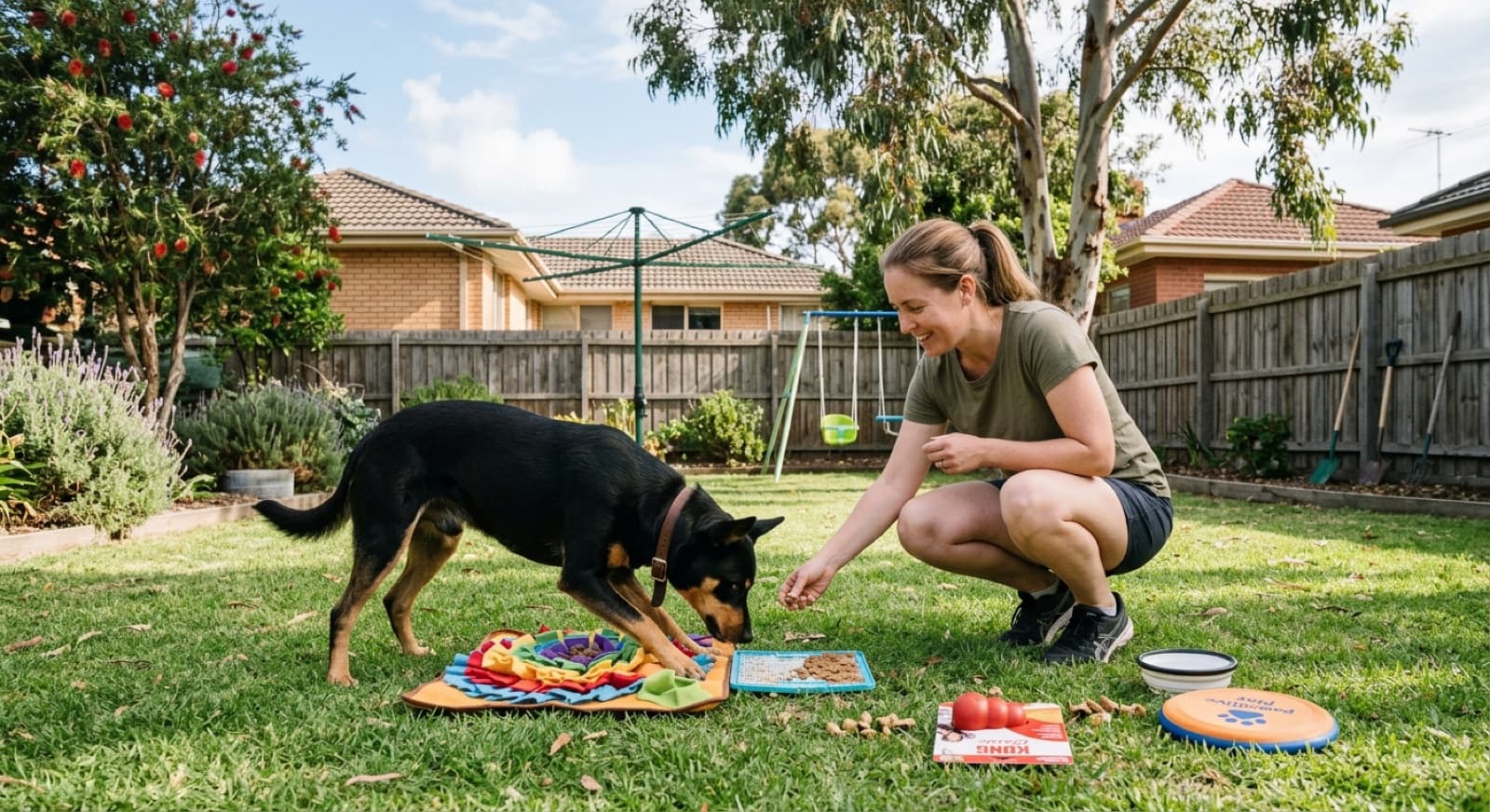
- A frozen puzzle feeder or long-lasting chew as you leave
- Secure the dog inside the house if nobody is home; do not leave a young Kelpie alone in the yard through the work day
Midday:
- Working from home: a 15 to 30 minute training session, scent game, or short walk break
- In the office: doggy daycare two or three days a week (genuinely useful for the breed), or a midday dog walker
- The midday break is not optional for a young Kelpie. Owners who skip it commonly come home to destruction.
Evening:
- 45 to 60 minute walk or an off-lead run
- 15 minutes of training or an interactive brain game
- Structured family activity: fetch with rules, a flirt pole, a food-search game around the yard
- A bedtime puzzle feeder or chew for the wind-down
Weekly addition (the job):
- One dog-sport class: agility, scent work, flyball or obedience. This is the formal job.
- One longer outing: a bushwalk, a beach trip, a big off-lead session at a quieter time
- One fresh mental challenge: a new trick to build, a new scent puzzle, a new route with new smells
- A five-minute fence-line inspection
If you cannot see where the job and the mental work fit into your week, that is the real question to answer before adopting, not the size of the backyard. A Kelpie with a job in a small yard does far better than a Kelpie with a big yard and nothing to do.
Browse Kelpies available in Melbourne rescue
Across the Victorian rescues we aggregate, listing notes describe each dog's drive level and how it has settled into a home. That detail is exactly what you need to match a Kelpie to your routine.
See Available Kelpies →Where to run a high-drive Kelpie around Melbourne
A Kelpie needs space to open up, not just structured on-lead walks. Melbourne's inner suburbs are short on big off-lead options, so it pays to know the reliable ones and to verify anything else before you unclip the lead. Off-lead status differs park to park and changes over time, so treat the Parks Victoria dog-friendly parks index as your source of truth.
- Royal Park, Parkville. Large inner-city parkland with designated off-leash areas, good for a real run close to the CBD.
- Yarra Bend Park, Kew. Largely off-lead bushland along the Yarra, with on-lead sections near Dights Falls. Space to move plus scent-rich terrain, which suits a working brain.
- Any other park. Check the Parks Victoria index first. Do not assume a park is off-lead because you have seen dogs there; the rules and the boundaries within a park both matter.
Councils also set their own off-lead areas and time-of-day orders under a Domestic Animal Management Plan, so “check your local council” is the right habit for anything close to home. A reliable off-lead spot near you, used daily, is worth more to a Kelpie than an occasional big adventure.
Exercising a Kelpie through the Melbourne climate
Melbourne's weather shapes when, not whether, you exercise a Kelpie. The seasonal factor for a hard-running dog here is heat, not parasites. Paralysis ticks are a low risk in metro Melbourne, and only become a genuine concern if you travel to the New South Wales coast or East Gippsland, so plan for those trips separately and do not let tick worry drive your everyday routine.
Summer: run early and late, never in the heat of the day.
On 40C and heatwave days, shift the hard exercise to early morning and late evening and cancel the midday session entirely. A Kelpie will keep running well past the point that is safe for it, so you have to manage the heat on its behalf. Feel the footpath with the back of your hand before you set out, because hot bitumen burns pads; carry water; use shaded routes; and on extreme days replace the run with indoor brain work, scent games, training, or a puzzle feeder. Mental work tires a Kelpie surprisingly hard, which makes it the perfect heat-day substitute.
Winter: cool and changeable, not a barrier.
Melbourne's cool, variable winters are easy on a working dog. A Kelpie's coat handles the cold well, and the biggest adjustment is simply your own willingness to get out in changeable weather. A wet day is a good day for indoor mental work plus a shorter walk, not a day off. The dog's needs do not pause because the forecast is grim.
When suburban life genuinely does not work
Honesty matters here. Most Kelpies that struggle in the suburbs are struggling because half the need went unmet, and the fix is the routine above. But a small number of intense working-line Kelpies never fully settle into suburban life even with a committed owner. The signs that a dog needs a different setup:
- Persistent restlessness and pacing despite a full exercise and mental-work routine
- Continuing escape attempts after fencing upgrades and routine changes
- Reactivity that does not reduce with reward-based training
- Destruction that persists at the six-month mark despite consistency
- Separation distress that does not respond to enrichment and conditioning
When several of these persist at six months, the honest conclusion is that the dog needs a working or rural-style home where the drive has an outlet, not a suburban block. Across the Victorian rescues we aggregate, foster assessment usually flags these intense working-line dogs before adoption, which is one more reason to adopt through a rescue that has lived with the dog rather than an anonymous online listing. Rehoming a mismatched Kelpie to a working home is not a failure; it is matching the dog to the life it was built for. For welfare-grounded guidance on a dog's exercise and enrichment needs, the Australian Veterinary Association is a sound reference.
Frequently Asked Questions
Can a working-line Kelpie really be happy on a suburban Melbourne block?
Yes, but only when two needs are met together: enough physical exercise AND real daily mental work. Give a Kelpie a long run and a genuine job, a dog sport, scent game, or task it repeats each day, and it settles well into a suburban home. Give it just one of the two, or neither, and the breed unravels into fence-running, escaping, barking and destruction. The dogs that fail suburban life almost never had the wrong home; they had an owner who met half the need. Meet both halves and the suburban Kelpie works.
How much exercise and mental work does a suburban Kelpie need each day?
Aim for 90 minutes of physical exercise minimum, plus about 30 minutes of mental work, plus a weekly job such as a dog sport class or a structured scent outing. Working-line Kelpies push the physical end towards two hours a day. The mental half is not optional filler; a Kelpie that runs hard but never has to think is still a bored Kelpie. Split the exercise across a morning and evening session and add a longer weekend outing. Senior Kelpies (8 and over) need less intensity but still want twice-daily walks; shorten the sessions rather than dropping them.
What does an under-stimulated Kelpie actually look like?
The signs are consistent: pacing and fence-running, barking at anything that moves past the property, digging, chewing skirting boards or furniture, escape attempts, and an inability to settle indoors even in the evening. Owners often read this as a bad or anxious dog. Far more often it is a working brain with nothing to do. The tell is that the behaviour eases within a few weeks once real exercise and daily mental work go in. If the behaviour is destruction or escaping specifically, under-stimulation is the first thing to rule out.
Where can I safely exercise a high-drive Kelpie in Melbourne?
Use the Parks Victoria dog-friendly parks index as your source of truth, because off-lead rules differ park to park and change over time. Two reliable inner options are Royal Park in Parkville, which has designated off-leash areas, and Yarra Bend Park in Kew, which is largely off-lead with on-lead sections near Dights Falls. For any other park, check the Parks Victoria index before you assume it is off-lead, and check your local council too, since councils set their own off-lead areas and orders under a Domestic Animal Management Plan.
How do I exercise a Kelpie through a Melbourne summer?
Shift the hard exercise to early morning and late evening and skip the middle of the day on 40C and heatwave days. Kelpies are built to run and will keep going past the point that is safe in heat, so you have to manage it for them. Carry water, use shaded routes, feel the footpath with your hand before a walk because hot bitumen burns pads, and on extreme-heat days replace the run with indoor mental work, scent games, training, or a puzzle feeder. Paralysis ticks are a low risk in metro Melbourne, so heat, not ticks, is the seasonal factor for a hard-running dog here. Ticks only become a real concern if you travel to the New South Wales coast or East Gippsland.
How high does the fence need to be for a Kelpie?
1.8 metres minimum. The standard 1.5 metre suburban fence does not hold a Kelpie; many clear that height from a standing start. Just as important is no climbable feature near the fence line: a woodpile, shed roof, air-conditioning unit or garden furniture turns a tall fence into a low one. Some particularly athletic Kelpies need 2 metres, and some dig rather than jump, so bury mesh or add a footing along the base. Walk the perimeter once a week for new dig spots, loose palings or fresh climbing points. Escaping is far more common in under-exercised Kelpies, so the routine and the fence work together.
Can a Kelpie be left alone while I work full-time?
Not all day, every day, without a plan. A young Kelpie alone for nine or ten hours with no break commonly develops destruction or escape behaviour. Workable patterns include doggy daycare two or three days a week, a midday dog walker, a work-from-home arrangement that breaks up the day, or a household whose hours overlap so the dog is rarely alone the full stretch. Pair that with a proper morning run and mental work before you leave, and a puzzle feeder as you go. Senior Kelpies tolerate alone time better than adolescents but still do best with a midday break.
Keep reading
Adoptable Kelpies in Melbourne
Live listings with notes on each dog's drive and how it has settled into a home.
Kelpie Adoption in Melbourne
Where to find one, working vs show lines, and the real cost versus a breeder.
Kelpie Health Issues
The genetic conditions, joint and eye issues, and insurance ROI Melbourne owners should plan for.
How to Adopt a Dog in Melbourne
The full Melbourne adoption process, paperwork, vet questions and home-check tips.