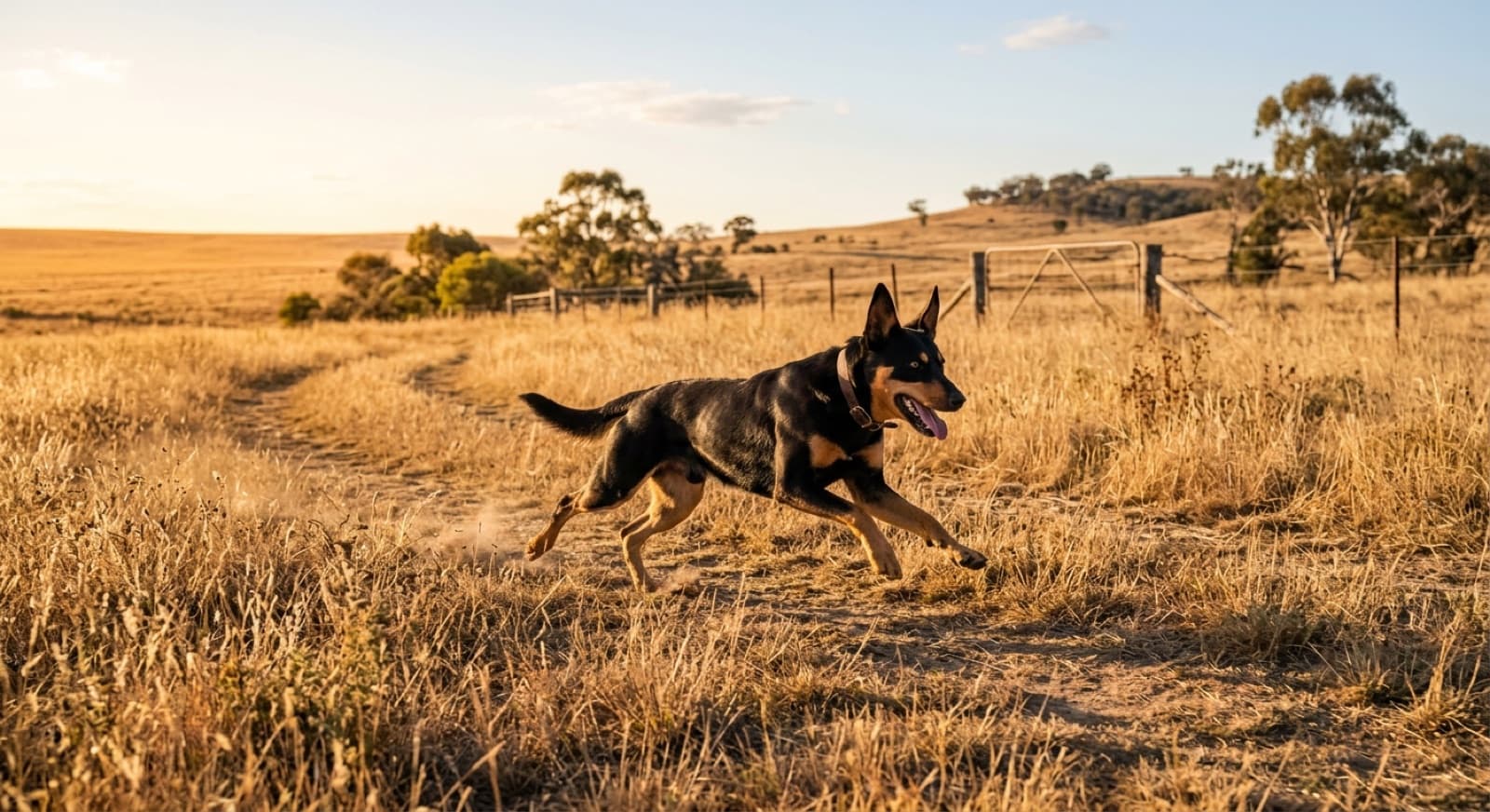
The short answer
Kelpies are genuinely healthy and long-lived (12 to 15 years, often more in working homes). The breed-core things worth planning for: cerebellar abiotrophy (a progressive neurological disease that is DNA-testable and fatal when it strikes), hip dysplasia (lower than most working breeds thanks to working-line selection, but present), Progressive Retinal Atrophy (an inherited eye disease), and working-dog joint injuries such as cruciate ligament tears from high-impact exercise. The Melbourne seasonal layer is summer heat, and for a Kelpie the danger is a high-drive dog that keeps running flat out on a heatwave day. Add year-round fleas, intestinal worms and mosquito-borne heartworm. Paralysis ticks, the headline risk on the NSW coast, are low risk in metro Melbourne and mainly matter if you travel. The best early-care move is cerebellar abiotrophy DNA testing for unknown-background dogs, and pet insurance while the dog is young. A Melbourne GP vet handles the day-to-day, and the Animal Referral Hospital runs 24/7 emergency and specialist care when it is needed (Lort Smith's emergency department is open every day, but only 8am to 10pm).
Emergency: exertional heatstroke on a hot Melbourne day
Heatstroke is the seasonal emergency for a high-drive Kelpie, and the trigger is usually not a hot day alone but a hot day plus a dog running flat out on it. Signs: heavy panting and distress that does not settle, drooling, weakness or stumbling, collapse, and bright-red gums. If you see them, act fast. Stop the activity, move the dog into shade or air conditioning, offer small amounts of water, and cool the body with cool (not icy) water over the belly, groin and paws. Do not use ice water, which can make the surface blood vessels constrict and slow cooling. Then go straight to a vet, calling ahead so they are ready. Heatstroke can be fatal and needs veterinary treatment even if the dog seems to recover.
For emergency care (24/7 unless noted), Melbourne options include Lort Smith (North Melbourne, 8am to 10pm daily), the Animal Referral Hospital at Essendon Fields, the Animal Emergency Centre at Mount Waverley, Advanced Vetcare (Kensington), and the University of Melbourne teaching hospital at Werribee.
Why Kelpies are healthier than many working breeds
Working Kelpies have been under strong selective pressure for more than a century. A Kelpie that cannot do a full day's stock work has little breeding value to a station owner, so the dog is desexed and the genes do not propagate. Over generations this has driven heritable conditions down in the working population. ANKC show-line Kelpies have slightly higher rates because the selection pressure is for appearance rather than working ability, but even ANKC dogs are generally healthier than many show breeds.
The result is that working-line Kelpies are among the healthiest medium-sized dogs in Australia. Many reach 14 to 16 years in active homes, and some reach 17 or 18. The breed's longevity is one of its less-talked-about advantages, and it is a genuine point in favour of adopting one rather than a shorter-lived larger breed.
The most authoritative references on Kelpie health for Australian owners are the Australian Veterinary Association and the RSPCA Knowledgebase, alongside the health-screening registries maintained by the Orthopedic Foundation for Animals for hips, elbows and eyes. If you are still weighing up the breed itself, our Kelpie adoption guide for Melbourne covers the rescues, the costs and the process.
1. Cerebellar abiotrophy (the defining genetic risk)
Cerebellar abiotrophy (CA) is a progressive neurological disease where the cerebellum, the brain region controlling balance, coordination and fine motor control, degenerates over time. Affected Kelpies appear normal at birth but develop worsening incoordination as the disease progresses. It is genetic and recessive, so both parents must be carriers for a puppy to be affected.
Signs in affected Kelpies:
- Wide-based stance and an “ataxic” walking pattern
- Head tremors, particularly when concentrating on a task or eating
- Loss of balance, falling sideways or backwards
- Difficulty navigating stairs or jumping
- A high-stepping, exaggerated gait
- Onset typically six weeks to three years of age, progressing slowly
- Cognition stays normal; the disease affects only motor coordination
Diagnosis and management.
Clinical diagnosis is by veterinary examination of gait, balance and reflexes, with DNA testing confirming the genetic basis and MRI able to confirm cerebellar degeneration in advanced cases. There is no treatment that slows or reverses the degeneration. Management is supportive: non-slip flooring, ramps instead of stairs, and quality-of-life monitoring. Most affected dogs are euthanised when quality of life declines significantly, usually within one to three years of clear onset. The condition is genuinely hard on a family, because the dog stays mentally engaged throughout the physical decline. Your vet guides every step of this.
DNA testing for CA.
Testing is available through major Australian laboratories and direct-to-owner providers such as Embark and Wisdom Panel. Reputable working and ANKC breeders test parent dogs and avoid pairing two carriers. An adopted Kelpie of unknown breeding benefits most from the test, because knowing whether the dog is clear, a carrier or at risk informs care for life. A breed panel typically costs around 100 to 200 dollars.
2. Hip dysplasia (lower rates than most working breeds)
Working Kelpies have significantly lower hip dysplasia rates than many similar breeds, for the selection reasons above. ANKC show-line Kelpies have slightly higher rates. Responsible breeders in both registries score parent hips before breeding, and international screening bodies such as the Orthopedic Foundation for Animals maintain the registries that track the trait.
Signs to watch for:
- Reluctance to run or jump in a young Kelpie
- A “bunny-hopping” gait, both back legs moving together
- Stiffness after rest, particularly in the morning
- Progressive lameness in middle age
- Reduced muscle mass in the back legs
Treatment depends on severity, and your vet decides the path. It ranges from weight control, joint support and controlled exercise for mild cases through to surgery for severe ones. Surgical options at a Melbourne specialty hospital run into several thousand dollars per hip, so this is where insurance earns its keep. The single most preventable contributor to joint problems is body weight: a lean Kelpie copes with mild dysplasia far better than an overweight dog of any breed.
Browse adoptable Kelpies in Melbourne
Live listings from Victorian rescues, each with a baseline vet check. Cerebellar abiotrophy DNA testing is worth considering at the first vet visit for a dog of unknown background.
See Available Kelpies →3. Progressive Retinal Atrophy and eye conditions
Progressive Retinal Atrophy (PRA) is less common in Kelpies than in some other working breeds, such as Border Collies and Cattle Dogs, but it does appear. It causes gradual vision loss that starts with night blindness and progresses to full blindness over months to years.
Signs to watch for:
- Reluctance to move around in low light
- Bumping into furniture in dim conditions
- Dilated pupils in normal light
- Losing confidence in unfamiliar places
- Eventually, full blindness
There is no cure, but affected dogs adapt remarkably well because a Kelpie's other senses stay sharp. Environmental steadiness helps: keep furniture in consistent positions, use scent markers near hazards, and hold to familiar walk routes. DNA testing for the major Kelpie PRA variant is available, and eye status is also assessed by veterinary ophthalmology examination, the basis for the OFA eye certification your breeder may reference. An adopted Kelpie showing early signs should be referred for an ophthalmology check.
4. Cruciate injuries and working-dog joint stress
An active Kelpie is at elevated risk of a cranial cruciate ligament (CCL) tear, because the high-impact exercise the breed needs stresses the knee. The injury usually happens on a sudden direction change, a hard stop, or a jump landing on uneven ground, exactly the kind of movement a driven Kelpie makes all day.
Signs to watch for:
- Sudden hind-leg lameness, often during or after vigorous play
- Reluctance to bear weight on the affected leg
- Sitting with the affected leg kicked out to one side
- Stiffness after getting up
- Sometimes a clicking sensation in the knee
Surgical repair is the usual route for an athletic dog, and a Melbourne specialty hospital will discuss the options and costs, which run into the thousands per knee. About half of dogs that tear one cruciate go on to tear the other within 12 to 18 months, so the history on the first knee informs decisions on the second. Your vet, not a web article, makes the call on which repair suits your dog. Conditioning matters as prevention: a fit, lean Kelpie with steady muscle support is more resilient than one that switches between couch and flat-out sprinting.
5. Summer heat: Melbourne's real seasonal danger
Melbourne has a temperate, variable climate, mild-to-warm summers, cool winters, and famously changeable weather that can deliver several seasons in one day. Kelpies handle ambient heat well; the breed was built for outback stations where summer routinely tops 40 degrees. The Melbourne danger is not the average day but the heatwave spike combined with the breed's drive. Summer sits around 14 to 27 degrees on a typical day, then jumps to 40-plus a few times a season, and a Kelpie will keep chasing, herding or running on those days without pacing itself. That is how a heat-tolerant dog still ends up with heatstroke.
- Exercise in the cool: early morning or after sunset on hot days, and cap the intensity rather than trusting the dog to stop itself.
- Test the footpath with the back of your hand. If you cannot hold it there for five seconds, the pavement is too hot for the dog's paws.
- Carry water on any walk over 20 minutes, and offer it often on a working session.
- Never leave the dog in a parked car. Even on a mild day the interior reaches dangerous temperatures within minutes; on a hot day it is lethal within five.
- Know the heatstroke signs (see the emergency callout above) and act fast. Cool with cool, not icy, water and get to a vet.
The flip side of the climate is that winters are genuinely cool, which a hard-working short-coated Kelpie handles comfortably. When you want to burn off Kelpie energy safely on a mild day, Melbourne has good off-lead options such as the parks listed in the Parks Victoria dog-friendly index, including Royal Park in Parkville and parts of Yarra Bend Park in Kew.
Ticks, fleas, worms and heartworm: the parasite layer
If you have read a coastal NSW or Queensland dog-health article, you will have seen paralysis ticks treated as a year-round, life-or-death threat. In metropolitan Melbourne that framing does not apply. The Australian paralysis tick (Ixodes holocyclus) is an eastern-seaboard species whose established range runs down the coast, and it does not maintain populations in Melbourne's climate. A dog that lives and walks in the metro area is at far lower paralysis-tick risk than a dog on the NSW coast. The residual risk is travel: if you take your Kelpie to the NSW coast or into East Gippsland, start tick prevention before the trip and do daily tick checks while you are there and after you get home.
The parasites that genuinely matter year-round in Melbourne are the routine ones. Fleas and intestinal worms need continuous cover, and heartworm, which is spread by mosquitoes and is present in Victoria, needs its own prevention. Many owners cover all of these with a single monthly or annual product, and the right combination depends on the dog, so let your vet steer it. Agriculture Victoria's animal welfare pages are a useful reference for the broader responsibilities of dog ownership in the state, including registration under the Domestic Animals Act 1994.
Melbourne vet care: who handles what
Day-to-day care is any Melbourne GP vet. A Kelpie does not need a breed specialist. Find a vet you trust, take the dog for an introductory check within a couple of weeks of adoption, and establish the relationship early, ideally before any problem appears.
Emergencies and specialist referrals (orthopaedics, neurology, ophthalmology, oncology) are well served in Melbourne. Lort Smith in North Melbourne runs an emergency service open every day of the year. The Animal Referral Hospital at Essendon Fields and the Animal Emergency Centre at Mount Waverley offer 24/7 emergency plus specialty referral across the north-west and east. Advanced Vetcare in Kensington is a 24-hour critical-care and specialist hospital, and the University of Melbourne's teaching hospital at Werribee provides 24/7 emergency and specialist care in the west. Your GP vet refers you when a case needs specialist input.
For genetic DNA testing you order direct from Embark or Wisdom Panel, sending a saliva sample by post. Either covers the Kelpie markers, including cerebellar abiotrophy, plus breed parentage, for around 100 to 200 dollars depending on the panel.
Pet insurance: is it worth it for a Kelpie?
For a Kelpie, usually yes, though the maths is closer than for some breeds because working-line dogs are so healthy. The bills the breed runs up are mostly working-dog injuries, cruciate tears and joint sprains from high-impact exercise, plus the genetic conditions. A single orthopaedic surgery or major emergency admission can run into the thousands, and the breed's long life means an insured dog has more years in which a big event might occur.
What to look for in a policy:
- Sign up while the dog is young and healthy. Insurers exclude pre-existing conditions, so anything on the vet record before the policy starts is not covered later.
- Choose a high annual limit. Orthopaedic surgery alone can exhaust a low one.
- Take full accident-and-illness cover. Accident-only is not enough for an athletic breed that also carries genetic risk.
- Check the orthopaedic terms. Cruciate and joint cover is exactly where a Kelpie is most likely to claim.
Major Australian providers all cover Kelpies: PetSure (the underwriter behind many brand-name policies), Bow Wow Meow, and Petplan Australia. Read the product disclosure statement before committing; the difference between basic and top-tier cover on each provider is significant, particularly for joint and chronic-condition claims.
The year-by-year health plan
- Year 1: Baseline vet visit including weight and joint assessment. Cerebellar abiotrophy DNA test for an unknown-background dog. Pet insurance in place from day one. Year-round flea, worm and heartworm prevention. A heat-management plan for the first summer.
- Years 2 to 5: Annual vet check. Weight management is critical. Watch for any neurological sign (gait changes, head tremors) and any hind-leg lameness after play. Keep the dog conditioned to reduce cruciate risk.
- Years 6 to 9: Twice-yearly checks from age six. Senior blood panel. Have any new lump checked. Joint care matters more now.
- Years 10+: Quarterly check-ins. Quality-of-life conversations with your vet. Pain management for joints if needed. Many Kelpies stay active well into their teens.
Frequently Asked Questions
Are Kelpies a healthy breed?
Yes, and unusually so. Working-line Australian Kelpies are among the healthiest medium-sized dogs in the country because the rural working population has been under strong selective pressure for more than a century. A Kelpie that cannot do a full day of stock work has little breeding value, so heritable problems get bred out of working lines. Lifespan averages 12 to 15 years, and many active dogs reach their late teens. The conditions worth planning for are cerebellar abiotrophy (a DNA-testable genetic disease), hip and eye conditions in some lines, and working-dog joint injuries from the high-impact exercise the breed needs. For Melbourne owners the biggest practical risk is not genetic at all, it is summer heat.
How long do Kelpies live?
A Kelpie typically lives 12 to 15 years, which is genuinely long for a medium-sized dog. Working-bred individuals from hardy rural stock often reach their late teens if kept lean and active. Weight management, exercise consistency and a prompt response to any joint or neurological sign all help a Kelpie use the full span. Year-round flea, worm and heartworm prevention and good dental care matter as much for a Kelpie as for any dog. Most Kelpies stay active and driven well into their senior years.
What is cerebellar abiotrophy and how serious is it for Kelpies?
Cerebellar abiotrophy (CA) is a progressive neurological disease where the cerebellum, the brain region controlling balance and coordination, degenerates over time. Affected Kelpies appear normal at birth but develop worsening incoordination, head tremors and loss of balance, usually starting between six weeks and three years of age. It is caused by a single recessive gene, so both parents must be carriers for a puppy to be affected. The condition is incurable and progressive, and most affected dogs are eventually euthanised because quality of life declines while the dog stays mentally normal throughout. A DNA test identifies carriers before any signs appear. Reputable working and ANKC breeders test parent dogs and avoid pairing two carriers. An adopted Kelpie of unknown background can be tested through a Melbourne vet if you want certainty.
How common is hip dysplasia in Kelpies?
Lower than in most working breeds, because the rural working population has been under strong selective pressure. A Kelpie with painful hips cannot muster stock, so the trait is bred out of working lines. ANKC show-line Kelpies have slightly higher rates. Responsible breeders in both registries score parent hips before breeding, and screening registries such as the Orthopedic Foundation for Animals track the trait. Signs include reluctance to run or jump, a bunny-hopping gait, and stiffness after rest. Treatment ranges from weight management and joint support for mild cases through to surgery for severe ones, which at a Melbourne specialty hospital runs into the thousands per hip. Ask your vet before assuming the worst, most Kelpies never develop it.
Do Kelpies overheat in Melbourne summers?
They can, and the mechanism is different from a flat-faced breed. Kelpies were developed for outback stations where summer temperatures regularly exceed 40 degrees, so they tolerate ambient heat genuinely well. The danger is behavioural: a high-drive Kelpie will keep running, working or chasing a ball flat out even as its core temperature climbs, and will not stop itself. On a Melbourne heatwave day that combination causes exertional heatstroke. The rules are simple. Exercise in the cool of early morning or after sunset on hot days, cap the intensity rather than the ambient temperature, always carry water, and never leave the dog in a car. Heatstroke is a genuine emergency that needs a vet even if the dog seems to recover.
Do Melbourne Kelpies need paralysis tick prevention?
For most metropolitan Melbourne dogs the local paralysis-tick risk is low. The Australian paralysis tick (Ixodes holocyclus) is an eastern-seaboard species that runs down the coast and does not establish populations in Melbourne, so a dog living and walking in the metro area is at far lower risk than a dog on the NSW coast. The risk is travel: if you take your Kelpie to the NSW coast or into East Gippsland, use tick prevention before the trip and do daily tick checks while you are there. Fleas, intestinal worms and mosquito-borne heartworm are the real year-round parasite jobs in Melbourne, and heartworm in particular is present in Victoria. Ask a Melbourne vet what prevention suits where you actually live and travel.
Is pet insurance worth it for a Kelpie?
Usually yes, though the maths is closer than for some breeds because working-line Kelpies are so healthy. The bills the breed runs up tend to be working-dog injuries, cruciate ligament tears and joint sprains from high-impact exercise, plus the genetic conditions. A Kelpie that tears a cruciate, develops joint arthritis and has a major emergency admission across a 14-year life can accumulate serious vet costs, and top-tier cover over the same period costs a fraction of a single big orthopaedic bill. Sign up while the dog is young and healthy, because insurers exclude pre-existing conditions. Choose full accident-and-illness cover with a high annual limit, since orthopaedic surgery alone can exhaust a low one.
Should I get my adopted Kelpie DNA tested?
It is optional but worthwhile for a Kelpie of unknown background, and the cerebellar abiotrophy test is the one that matters most. Because CA is progressive and eventually fatal, knowing whether your dog is clear, a carrier or at risk before any clinical sign appears lets you plan. Australian providers such as Embark and Wisdom Panel run breed panels that cover the Kelpie markers plus parentage, usually for around 100 to 200 dollars, and you order the saliva kit yourself. Hip and eye status is assessed by X-ray and eye examination rather than DNA, so raise those with your vet separately. Across the Victorian rescues we aggregate, adopted Kelpies are rarely pre-tested, so this is a decision you make after adoption.
Keep reading
Adoptable Kelpies in Melbourne
Live listings with a baseline vet check from rescue.
Kelpie Adoption in Melbourne
Where to find one, working vs ANKC, and the real cost against a breeder.
Kelpies in Suburban Melbourne
The rural-to-urban transition: fencing, exercise and neighbour relations.
How to Adopt a Dog in Melbourne
The full Melbourne adoption process, paperwork, vet questions and home checks.