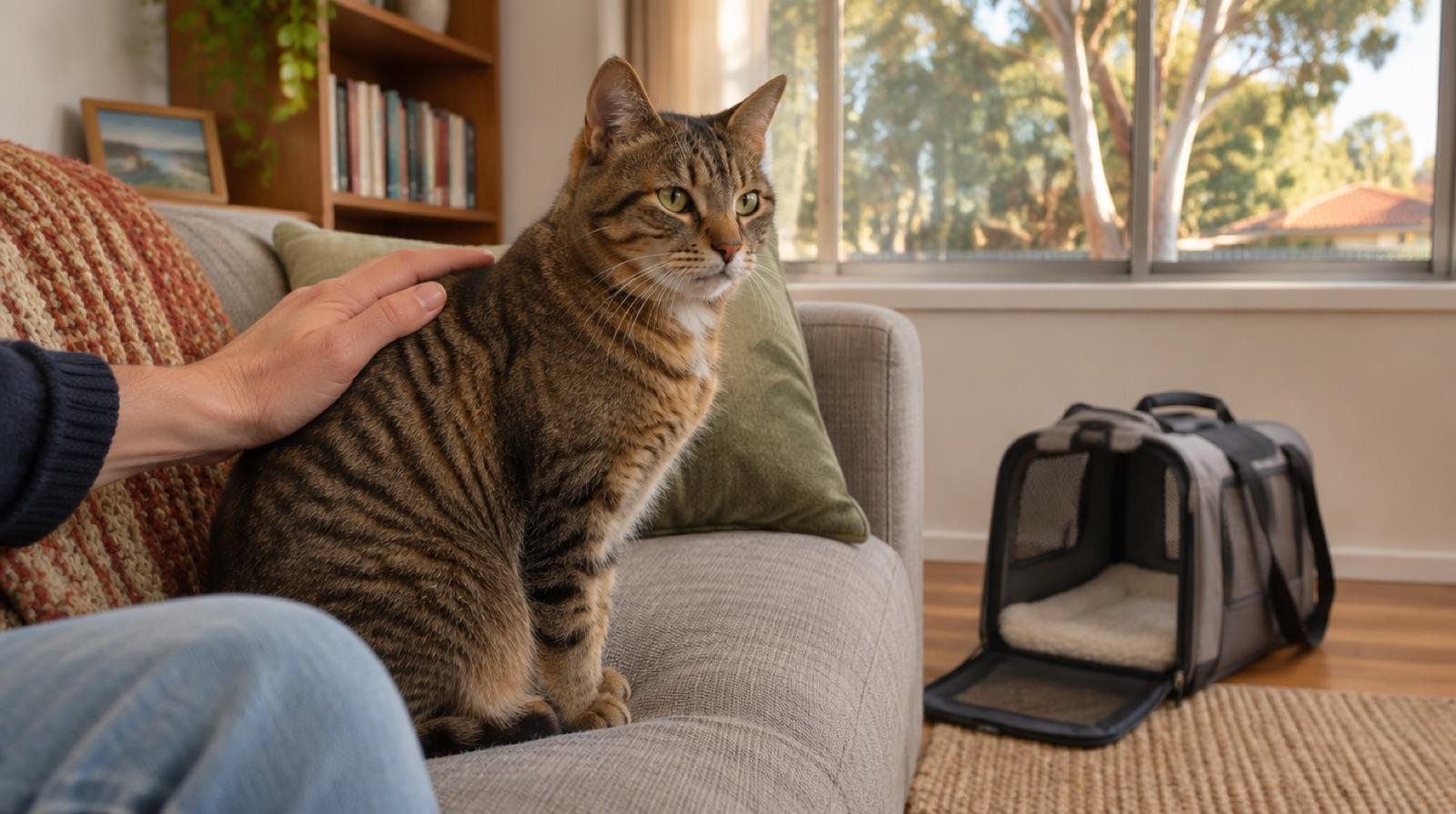
The short answer
You have three responsible options. First, if the reason is fixable, such as a litter tray problem, a money gap or a short crisis, try the alternatives below. Second, you can surrender to a shelter or cat rescue, which takes ownership and finds the new home. You apply by form or phone, wait for a place, and usually pay a fee or make a contribution. Third, you can rehome owner to owner, which is free on LocalPetFinder and keeps your cat at home until you choose the new family. Whichever you pick, the rules on microchips, desexing and registration differ by state, so find yours in the list below.
Rehome your cat on LocalPetFinder
List free, keep your cat at home until it is adopted, and choose the new family yourself. Your email stays private.
List your cat free →What surrendering a cat actually means
Surrendering a cat means signing ownership over to a shelter or rescue. From that point the organisation decides where the cat goes, and some, such as Cat Haven in Western Australia, say they cannot give you any further information about the cat once it is surrendered. It is different from rehoming the cat yourself, where you stay the owner until you hand it to a person you picked.
The process is slower than most people expect. Of the shelters we checked for this guide in November 2026, nearly all take owned cats by application or appointment only, several say a form does not guarantee a place, and several describe a waiting list. Several will only accept a cat from the person named on its microchip record, so check that your details are current before you apply.
Before you surrender: things worth trying first
Whether an alternative fits depends on why you are here. If none of these apply, surrender or owner-to-owner rehoming is a reasonable next step, and nothing below is meant to talk you into keeping a cat in a home that is not working.
If it is a behaviour problem
Toileting outside the tray, spraying and sudden aggression often have a medical cause, so start with a vet visit. Cat Haven says every cat with a behaviour problem should have a vet examination, and that many behaviour problems can be treated. Some shelters also give behaviour advice, so ask when you ring.
If it is money
Tell the shelter before you apply. RSPCA ACT, for example, says it may be able to offer advice, low-cost pet food and veterinary services to help an owner keep a pet. Ask what your local shelter or council has, because help varies a lot by area.
If it is a short-term crisis
A hospital stay, a gap between rentals or an unsafe home can sometimes be bridged without giving up the cat. RSPCA Darwin lists emergency boarding and temporary foster homes among the ways it may be able to help, and RSPCA South Australia suggests asking family or friends to mind your pet for a while.
If you simply need a new home for the cat
Shelters themselves suggest trying to rehome the cat yourself first. The Cat Protection Society of NSW lists asking friends, family and colleagues and advertising, and SPCA in New Zealand asks owners to explore all options to find a new home. That is the route the next section covers.
Our before-you-rehome checklist was written for dogs, but the questions about cost, housing and timing apply to a cat as well.
Owner-to-owner rehoming: your cat stays home and you choose
Owner-to-owner rehoming means you find the new home yourself. Your cat stays in your care the whole time, in the rooms it knows, until you hand it to the person you chose. There is no surrender fee, no waiting list and no shelter stay.
It asks more of you than a shelter does. You write the listing, answer enquiries, meet people and say no to the ones who are not right. In exchange you decide who your cat lives with, and you free up a shelter place for a cat with no owner to speak for it.
Listing a cat on LocalPetFinder is free. Your email stays private and each listing is reviewed before it goes live. Our guide to rehoming a cat for free walks through the steps, the rehoming safety guide covers meeting strangers and spotting scams, and if you have a litter rather than one cat, start with the kitten rehoming guide. The legal steps in the state list below still apply when you rehome a cat yourself.
Where can I surrender a cat, and can I do it for free?
Three kinds of organisation take owned cats, and each works a little differently:
- The RSPCA in your state or territory. Each one sets its own process. All of those listed below start with an online form or portal, then contact you if they can offer a place.
- Cat shelters and welfare leagues, such as the Cat Protection Society of NSW, Cat Haven in Western Australia and Ten Lives Cat Centre in Hobart. These book surrenders by appointment.
- Your council. RSPCA Queensland notes that many councils run a surrender and rehoming service. Whether yours does depends on where you live, so ring and ask.
On cost, most of the shelters we checked say a surrender fee applies, and they publish or confirm the amount when you book, so ask rather than rely on a figure quoted elsewhere. A few ask for a donation or a contribution you choose instead of a set fee. Owner-to-owner rehoming has no fee at all.
Surrendering a cat in your state
Who takes owned cats, and what the law asks of you when a cat changes hands, is different in every state, in both territories and in New Zealand. Each entry below was checked against the organisation's or government's own website in November 2026. Intake rules change with shelter capacity, so confirm on the linked page before you travel.
New South Wales
In NSW a cat must be microchipped before it is sold or given away, or by 12 weeks of age, and ownership is transferred to the new owner through the NSW Pet Registry. RSPCA NSW starts with its online rehoming assistance portal and asks you to consider every option first. The Cat Protection Society of NSW takes owned cats by appointment only: phone its office on a weekday, expect a surrender fee, and note that it cannot guarantee when a space will open. Animal Welfare League NSW asks you to phone or email its Kemps Creek team, then sends a surrender questionnaire. The microchip must be registered in your name, a fee applies, and your cat may go on a waitlist.
State rehoming guide for New South Wales (written for dogs) →
Victoria
In Victoria, every advertisement to sell, rehome or give away a cat must show the cat's microchip number and a source number from the Pet Exchange Register, but Agriculture Victoria says you do not need a source number to surrender an animal to a rescue organisation, shelter or pound. RSPCA Victoria asks you to complete its cat surrender form. It says intake is limited and a place is not guaranteed, it needs proof of vaccination, and it asks for a contribution of an amount you choose. Lort Smith admits surrenders by appointment only after you send its feline surrender form, and charges a surrender fee for each animal.
Queensland
In Queensland, cats must be microchipped between 8 and 12 weeks of age, according to the state government's guidance, and the Queensland Government puts that job on the person selling or giving the animal away. RSPCA Queensland takes pet surrender requests through its online surrender form. Its team replies with availability so you can book a surrender appointment, the form itself does not mean your pet has been accepted, and a fee may apply. RSPCA Queensland also notes that many councils run a surrender and rehoming service, so ring yours.
Western Australia
In Western Australia, a cat that has reached six months must be microchipped, sterilised and registered with the local government. To give away or sell a cat, the WA Government says it must be microchipped and sterilised before the transfer, or go with a prepaid sterilisation voucher if it is too young. Cat Haven takes owned cats by appointment on weekday mornings, booked by email. A surrender fee applies, and its website was quoting a wait of several weeks in November 2026. RSPCA WA uses an online pet surrender application, gives priority to the animals most in need, and says it will help you look at other options if it cannot accept your pet.
State rehoming guide for Western Australia (written for dogs) →
South Australia
In South Australia, all cats must be microchipped and registered in Dogs and Cats Online, and cats born after 1 July 2018 must be desexed before six months of age unless exempt. If your cat goes to a new home, the Dog and Cat Management Board says you must transfer the microchip registration in Dogs and Cats Online, which gives you a transfer code to pass to the new owner. RSPCA South Australia has a cat surrender request form. It says the form does not guarantee a place, that there is a lengthy wait list, and that it asks for a financial contribution. Animal Welfare League SA also rehomes owned cats, but its website said in November 2026 that new rehoming requests were paused, so check there before you plan around it.
State rehoming guide for South Australia (written for dogs) →
The ACT
The ACT Government says you must microchip, register and desex your cat, and registration is compulsory for cats over 8 weeks old. When your cat has a new owner, you cancel your registration through the Pet Registration Portal. Cats born after 1 July 2022 must be contained on the owner's property, and so must every cat in a declared cat containment suburb, so tell anyone taking your cat. RSPCA ACT asks for an Animal Surrender Application Form for each animal. It says there is a waiting list for all surrenders, staff contact you when a space is free, a surrender fee applies, and ACT animals take priority over animals from NSW.
Tasmania
Under Tasmania's Cat Management Act 2009, “to sell” includes giving a cat away. NRE Tasmania says a cat you sell or give away must be at least eight weeks old, microchipped, desexed, wormed, vaccinated and free of external parasites. A vet's certificate can exempt a cat from microchipping or desexing, and desexing is not required when the cat goes to a registered breeder or a Cat Breeding Permit holder. Those requirements do not apply when you surrender an unwanted cat to a cat management facility. RSPCA Tasmania says it is not a cat management facility, so ask each organisation what your cat needs before you bring it in. Ten Lives Cat Centre in Hobart takes cats strictly by appointment, 10am to 2pm on weekdays. Phone first, and bring photo ID and your cat's microchip and vet records. It lists no set fee and says a donation is appreciated. RSPCA Tasmania runs a managed intake: you fill in the cat surrender form on its website, and cats are surrendered to its Animal Care Centre at Spreyton.
The Northern Territory
In the Northern Territory, check your own council's pet rules. In the City of Darwin, a cat older than three months must be registered, so give the new owner the microchip number and ask your own council what it needs from you. RSPCA Darwin first talks through help that may let you keep your cat, such as trainer referrals, emergency boarding and temporary foster care. If you go ahead, you apply with its cats and kittens surrender form and staff contact you to arrange an appointment. A surrender fee applies, which it discusses once your application is approved.
State rehoming guide for the Northern Territory (written for dogs) →
New Zealand
No national law requires a cat to be microchipped in New Zealand, although some councils have cat bylaws, so check with yours. SPCA says it does not usually accept owned animals into its care and does not have the resources to run a rehoming service for them. For most owners that makes rehoming the cat yourself the main path, and SPCA's advice is to start early. If your cat is on the NZ Companion Animal Register, the register has an instructional video on rehoming a pet to a new guardian, so update the record at handover.
Shelter surrender vs owner-to-owner rehoming
Both are responsible choices. This side-by-side is here so you can pick the one that fits your situation. For a longer look that also covers rescues, see our surrender, rehome or rescue comparison.
| Factor | Shelter surrender | Owner-to-owner rehoming |
|---|---|---|
| Cost to you | Often a surrender fee or a requested contribution | Free on LocalPetFinder |
| Where the cat waits | At home until a place opens, then in the shelter | In your home until the handover |
| Who picks the new home | Shelter staff | You do |
| How it starts | A form or phone call, then an appointment | A free listing you write yourself |
| Waiting list | Common, and a place is not guaranteed | None |
| Your effort | Low once the cat is accepted | Higher: you screen and meet people |
What to have ready, whichever route you take
The same paperwork helps a shelter and a private adopter. Shelters we checked ask for some or all of these:
- Photo ID, and a microchip record that is in your name.
- Vaccination, desexing and vet records. RSPCA Victoria says it needs proof of vaccination.
- A secure carrier. Animal Welfare League NSW asks that cats arrive in a secure, safe carry cage.
- A written note on the cat's routine, food, litter, and how it is with children, dogs and other cats.
- An honest account of any health or behaviour problem. RSPCA ACT says all known medical or behavioural issues must be stated before surrender.
A note on open classifieds: an ad on a general marketplace puts your cat and your contact details in front of everyone, with no review. If you rehome privately, screen every enquiry, meet in person, and never send money or a cat ahead of a meeting. Scamwatch publishes current warnings about online scams. Our safety guide has the full checklist.
Want your cat to stay home until it is adopted?
Owner-to-owner rehoming on LocalPetFinder is free. Your cat stays with you, you read the enquiries, and you choose the family. No surrender fee, no waiting list.
List your cat for free →Related guides
The owner-to-owner steps: records, listing, screening, handover and the microchip update.
Desexing the mother first, when kittens can leave, and the advertising rules for a litter.
The three routes side by side, with who each one suits.
Written for dogs, but the cost, housing and timing questions fit a cat too.
Meeting strangers, protecting your details, and spotting a scam before the handover.
The same guide for dogs, with the dog shelters and dog law in each state.
Frequently asked questions
Where can I surrender my cat for free?+
It depends on the organisation, so check its website or ring ahead before you go. Most of the shelters we checked in November 2026 say a surrender fee applies, including the Cat Protection Society of NSW, Animal Welfare League NSW, Lort Smith, Cat Haven, RSPCA ACT and RSPCA Darwin. Two work differently: Ten Lives Cat Centre in Hobart lists no set fee and says a donation is appreciated, and RSPCA Victoria asks for a contribution of an amount you choose, which it says does not affect the offer of a place. If cost is the barrier, ask about hardship help, and consider owner-to-owner rehoming, which is free on LocalPetFinder and keeps your cat at home until you choose the new family.
Can I surrender my cat to the RSPCA?+
In most of Australia yes, but you apply first and wait for a place. You cannot walk in with the cat. RSPCA Victoria, RSPCA South Australia, RSPCA ACT, RSPCA Tasmania and RSPCA Darwin each start with a surrender form on their website, and RSPCA NSW starts with its online rehoming assistance portal. RSPCA Queensland and RSPCA WA take pet surrender applications through an online form, so ask whether they have space for a cat. Several say plainly that filling in the form does not guarantee a place, and waiting lists are common. In New Zealand, SPCA says it does not usually accept owned animals.
How do I surrender a cat to a shelter?+
Contact the shelter first, because almost all of them take owned cats by application or appointment only. Fill in the surrender form or phone, then wait for staff to offer a time. Shelters commonly ask for photo ID, the cat's microchip details, and vet, vaccination and desexing records. Several will only accept a cat from the person named on the microchip record. Bring the cat in a secure carrier, with a written note about its health, habits and temperament.
Is there a cat surrender near me?+
Probably, but which organisation depends on your state, and most serve a set region. Use the state list on this page to find who takes owned cats where you live and how each one wants you to start. RSPCA Queensland also notes that many councils run a surrender and rehoming service, so your council is worth a phone call wherever you are. If nobody nearby has space, owner-to-owner rehoming has no waiting list, because your cat stays with you.
How long is the wait to surrender a cat?+
Expect to wait, because most shelters manage their intake. RSPCA ACT says there is a waiting list for all surrenders, RSPCA South Australia describes a lengthy wait list, and Cat Haven in Western Australia was quoting a wait of several weeks on its website in November 2026. The Cat Protection Society of NSW says it cannot guarantee when a space will open. Apply early, and ask the shelter what help it can offer while you wait.
Is surrendering a cat the same as rehoming it?+
Not quite. Surrendering means signing your cat over to a shelter or rescue, which takes ownership and finds the new home through its own process. Rehoming usually means finding the new home yourself, owner to owner, with the cat staying in your care until the handover. Both are legitimate. Surrender hands the screening to shelter staff. Rehoming takes more of your time but keeps the cat out of a shelter and lets you choose the family.
Do I need to update the microchip when my cat changes hands?+
Yes, wherever a register holds your details, and the step depends on where you live. In NSW, ownership is transferred through the NSW Pet Registry. In South Australia, you transfer the microchip registration in Dogs and Cats Online and pass a transfer code to the new owner. In the ACT, you cancel your registration when the cat has a new owner. If you surrender to a shelter, you sign the cat over to the shelter when you hand it in, and several shelters ask that the microchip is in your name first.
I found a stray cat. Can I surrender it to a shelter?+
A found cat follows a different route from an owner surrender, because it may have a home. Start by having a vet scan it for a microchip, then contact your council or the local shelter before you take it anywhere. In the ACT, the government says found cats are housed at RSPCA facilities and RSPCA ACT helps return them. In Tasmania, RSPCA Tasmania's advice on trapped and stray cats is to contact a cat management facility before taking a cat there.
Will my cat be put down if I surrender it?+
Ask the shelter directly, because each one sets its own policy and the honest answer depends on the cat's health and behaviour. A good shelter will tell you how it assesses cats and what happens to a cat it cannot place. If this worry is the main thing holding you back, owner-to-owner rehoming lets you decide the outcome yourself, since your cat never enters a shelter.
Am I a bad person for surrendering my cat?+
No. Owners give up cats for real reasons: a rental that will not allow pets, an allergy, a new baby, money, illness, or cats that will not live together. Looking up how to do it properly is a sign that you care about what happens next. What matters is being honest about the cat and choosing a route that puts it in safe hands.
What should I try before surrendering my cat?+
It depends on the reason. For litter tray trouble, spraying or sudden aggression, see a vet first, because the cause is often medical. For money trouble, ask the shelter what help it has, since RSPCA ACT says it may be able to offer advice, low-cost pet food and veterinary services. For a short crisis, ask about emergency boarding or temporary foster care, which RSPCA Darwin lists among the ways it may be able to help. If none of that fits, surrender or owner-to-owner rehoming is a reasonable next step.
How is owner-to-owner rehoming different from surrendering?+
With owner-to-owner rehoming, your cat stays in your home until the handover. You write the listing, read the enquiries, choose the person you trust and hand the cat over yourself with its records. There is no surrender fee and no waiting list. The trade-off is your time, because you do the screening that shelter staff would otherwise do. Listing a cat on LocalPetFinder is free.
Sources
Each page below was read in November 2026. Shelter intake rules and fees change, so treat this guide as a starting point and confirm with the organisation.
- NSW Office of Local Government: microchipping and selling or giving away a pet (NSW)
- RSPCA NSW: rehoming assistance portal (NSW)
- Cat Protection Society of NSW: surrendering an owned cat (NSW)
- Animal Welfare League NSW: surrender steps (NSW)
- Agriculture Victoria: Pet Exchange Register questions and answers (Victoria)
- RSPCA Victoria: surrendering and rehoming pets (Victoria)
- Lort Smith: surrender process (Victoria)
- Business Queensland: microchipping laws for the sale of cats and dogs (Queensland)
- RSPCA Queensland: rehoming and surrendering your pet (Queensland)
- WA Government: laws for responsible cat owners, Cat Act 2011 (Western Australia)
- Cat Haven: surrendering your cat (Western Australia)
- RSPCA WA: pet surrender application (Western Australia)
- Dog and Cat Management Board: cat microchipping, desexing, registration and transfers (South Australia)
- RSPCA South Australia: pet surrender requests (South Australia)
- Animal Welfare League SA: rehome your cat (South Australia)
- ACT City Services: cat registration, microchipping, desexing and containment (ACT)
- RSPCA ACT: rehome your pet (ACT)
- NRE Tasmania: selling or giving away a cat under the Cat Management Act 2009 (Tasmania)
- Ten Lives Cat Centre: surrendering a cat (Tasmania)
- RSPCA Tasmania: cat and kitten surrender (Tasmania)
- RSPCA Tasmania: advice on trapped and stray cats (Tasmania)
- City of Darwin: pet registration (Northern Territory)
- RSPCA Darwin: surrendering an animal (Northern Territory)
- SPCA New Zealand: what to do if you need to rehome your pet (New Zealand)
- NZ Companion Animal Register: microchip register and guardian transfers (New Zealand)
- Scamwatch: avoiding scams in online pet ads
Rehoming guides for your state
Surrender options, the local law and the help that lets you keep your pet are different in every state, territory and in New Zealand. Each guide covers the shelters, the rules and the owner-to-owner route where you live.