The short answer
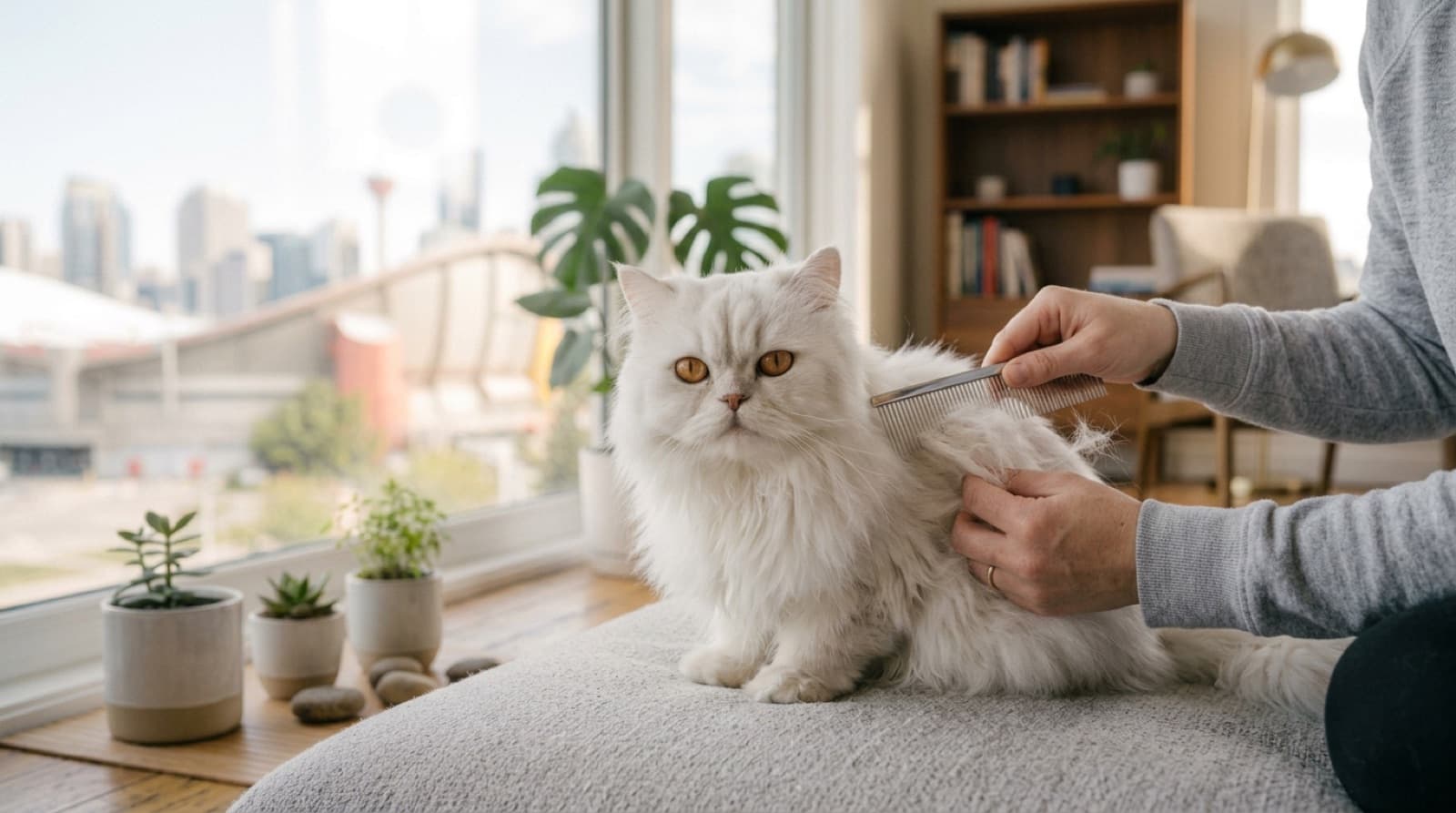
The Persian coat is the highest-maintenance of any cat, so daily brushing plus daily face and eye care are non-negotiable, or the coat mats to the skin. Comb the whole coat every day with a steel comb and slicker, paying special attention to behind the ears, the armpits, the belly, the britches and the tail. Wipe the watery, staining eye folds daily. Never cut a mat out with scissors, and many owners keep a Persian in a shorter clip for easier care and to help it stay cool. Keep the back end trimmed and clean, bathe occasionally, and protect this flat-faced, long-haired cat from Brisbane's hot, humid summers.
The Persian coat, and why it mats so fast
A Persian carries the most demanding coat in the cat world. It is long, it is very fine, and it is extremely dense, with a thick undercoat packed beneath the outer hairs. That combination looks glorious, but it works against the cat. In a shorthaired cat, loose hairs drop away or come out when the cat washes itself. In a Persian, those loose hairs have nowhere to go. They stay trapped in the dense coat and start to twist together, and within a day or two a small tangle has formed.
Left alone, a tangle felts into a mat: a hard, matted lump of hair pressed against the skin. Mats form fastest in the high-friction areas where the cat moves and the coat rubs. The reliable hot-spots are behind the ears, under the front legs in the armpits, across the belly, around the britches on the back legs, in the groin, and along the underside of the tail. These are exactly the spots owners skip, because the cat likes them least.
A neglected coat does not just look untidy. A tight mat pulls constantly on the skin, which hurts, and it traps moisture and dirt against the skin so sores and infections can develop underneath where you cannot see them, a particular worry in Brisbane's warm, humid air. In bad cases the coat mats into a solid sheet and the cat needs a professional groomer to clip it all off, or veterinary attention if the skin is already damaged. The RSPCA Australia Knowledgebase is clear that long-haired cats need regular grooming to prevent this, and a Persian sits at the very top of that scale. None of it is hard, but it does have to happen every day.
The daily grooming routine
The good news is that a daily session is short once the coat is in good condition, often five to ten minutes. The point is consistency, not marathon sessions. A little every day beats a long, stressful detangle once a week, which is uncomfortable for the cat and where mats build up in the meantime. Here is the routine:
- Use the right tools. A wide-tooth stainless-steel comb is the main tool, plus a slicker brush to lift the coat and remove loose hair. A metal comb reaches the undercoat where mats start. A soft brush alone glides over the top and misses them.
- Work in sections. Part the coat and comb small areas at a time, right down to the skin, rather than skimming the surface. Do the back, sides, chest, belly, legs, britches and tail so nothing gets missed.
- Hit the hot-spots on purpose. Behind the ears, the armpits, the belly, the groin, the britches and under the tail mat first and fastest. Comb these every single day, even when the cat objects.
- Comb, do not just brush. Finish each area with the steel comb. If the comb runs cleanly from skin to tip with no snag, that area is mat-free. A snag is a tangle to tease out now, while it is small.
- Go gently, especially with a rescue Persian. A cat that was surrendered with a matted coat may associate grooming with pain. Keep sessions short and calm, reward with treats, and build up slowly. Patience and desensitisation matter more than doing the whole cat on day one.
Introduce grooming early and gently if you can, so it becomes a normal daily habit the cat tolerates or even enjoys. A Persian that has learned to lie on your lap for a comb is far easier to keep healthy for the next fifteen years.
Dealing with mats
If you find a mat, how you handle it depends on how bad it is. For a small, loose tangle, hold the hair at its base near the skin so you are not tugging on the cat, then work the mat apart from the outer edge with your fingers and the tip of the comb. A pinch of cornflour worked in helps the fibres slide. Take your time and stop if the cat is distressed.
The one rule that prevents injuries: never cut a mat out with scissors. Cat skin is thin and loose, and it tents up into the base of a mat, so it is frighteningly easy to slice the skin while you think you are cutting hair. This is one of the most common grooming injuries vets treat, and it can mean stitches. If a mat is tight, felted close to the skin, or you find several, do not fight it at home. Book a professional groomer who can clip it out safely with electric clippers that sit flat against the skin.
When a coat is badly matted overall, the kindest fix is a full clip, sometimes called a lion cut, done by a groomer. It is not a failure. It resets the coat, removes the discomfort, and gives you a clean slate to keep on top of with daily combing as the coat grows back. Plenty of Persian owners in a warm climate choose a shorter clip permanently for exactly this reason, which brings us to the next point.
Should you keep a Persian clipped?
Keeping a Persian in a shorter clip is a legitimate welfare choice, not just a look, and in Brisbane it has an extra benefit: a lighter coat helps a heat-sensitive cat stay comfortable through summer. A shorter coat mats far less, stays cleaner, and is much easier to manage day to day. It suits an older cat that finds long grooming sessions tiring, a cat that genuinely hates being combed, or an owner who is honest that they cannot do daily coat care. A groomer trims or clips the coat with proper clippers every four to six weeks, and you keep the rest of the routine going in between.
A few things stay true even with a clipped cat. You still wipe the face and eyes daily, still comb whatever length is left, and still trim and check the back end. A clipped cat also has less natural protection, so keep it out of direct sun and heat, which matters through a hot Brisbane summer, and comfortable in the cooler months. Leave the actual clipping to a groomer. A full body clip attempted at home with scissors is how skin gets cut.
Daily face and eye care
The flat Persian face is the second half of the daily job. Because of the shortened muzzle and the shape of the tear ducts, a Persian's eyes water almost constantly, and that moisture runs down into the folds of skin below the eyes. Left there, it stains the pale fur a rusty brown and keeps the skin folds damp, which can lead to irritation and skin infection.
The fix is a gentle daily wipe. Use a soft, damp cloth or a cotton pad with plain warm water, and clean the folds under and around each eye, using a fresh section of cloth for each eye so you never carry anything from one to the other. Keep the area clean and dry. It takes under a minute and prevents most staining and skin trouble.
Know where grooming stops and a vet begins. Routine watering and light staining is a care task. Redness, swelling, squinting, a thick or coloured discharge, cloudiness, or the cat rubbing and pawing at an eye are not. Flat-faced breeds are prone to eye problems including ulcers, and these need prompt veterinary care. Route any eye problem to a vet and never medicate a cat's eye yourself. The Australian Veterinary Association can help you find a local clinic if you do not have one.
Hygiene at the back end
This is the unglamorous part nobody mentions before you adopt a Persian. A long, dense coat around the britches and under the tail, combined with a litter tray, means faeces and litter can catch in the fur. It is uncomfortable for the cat, it smells, and it mats quickly in an area the cat cannot clean well itself.
The simple answer is to keep the britches and the area under the tail trimmed short. Many owners have a groomer do a sanitary trim as part of a regular visit, or learn to keep it neat at home. Check the back end daily when you groom, clean it gently if anything has caught, and keep the litter tray scrupulously clean so there is less to catch in the first place. A cat kept short and clean at the rear is a much happier cat.
Bathing a Persian
Most cats never need a bath, but Persians are an exception, and an occasional bath does more good than it does for a shorthaired cat. The dense coat holds grease, dander and litter dust that brushing alone cannot fully lift, so a wash every few weeks to a couple of months keeps the coat fresh and the skin healthy. Use a cat-specific shampoo. Never a human product or a dog product, as both can upset a cat's skin.
Comb the coat out fully before the bath, because water shrinks and tightens any existing tangle into a solid knot that is then very hard to remove. Introduce bathing slowly and calmly, especially with a rescue cat that may never have been bathed and finds it alarming. Getting the coat fully dry, right down to the skin, matters as much as the wash, since a damp undercoat mats and can chafe the skin in humid weather. If bathing is a battle, a professional groomer can bathe and blow-dry the coat properly and safely.
Shedding, and the hypoallergenic myth
Persians shed steadily all year, and because the hairs are long, the shed coat shows up everywhere: on the couch, on your clothes, on the bed. Daily combing is your best defence, because every loose hair you catch on the comb is one that does not land on the furniture or twist into a mat.
Persians are not hypoallergenic. No cat truly is. The allergen that triggers most people is a protein in cat saliva and skin dander, not the hair itself, and a Persian's heavy coat spreads that dander widely. If anyone in the household has a cat allergy, spend real time with a Persian before you commit, because the thick coat can make reactions worse rather than better. Adopt with your eyes open on this one.
The rest of daily and weekly care
Coat and face care dominate, but a Persian needs the same basics as any cat. Trim the nails every couple of weeks so they do not overgrow or snag in the coat. Look after dental health, since dental disease is common and painful in cats, and ask your vet about tooth brushing or dental checks. Check the ears when you groom and clean them only if your vet advises how. And in a Brisbane home, run your fingers through the coat as a tick check after any time near the garden or bushland, because the paralysis tick is present year-round across South East Queensland and a dense coat can hide one. If you feel anything unfamiliar or the cat seems unwell, see a vet the same day.
Browse adoptable Persian cats in Brisbane
Purebred and Persian-cross cats do come up in Brisbane rescue, often surrendered with coats that need a fresh start. Browse the live listings and find one whose care you can commit to.
See Available Persians →Temperament and living with a Persian in Brisbane
For all the grooming, the Persian is one of the easiest cats to live with in personality. They are calm, quiet, placid and low-activity, the classic lap cat that would rather doze on a shaded chair than tear around the house. They suit a peaceful home, an apartment, and owners who want a gentle companion rather than an athlete. That placid nature is also why the daily grooming works: a Persian will usually settle for a comb far more readily than a busy, high-energy breed.
An indoor or contained life suits a Persian and protects it. This is a slow, flat-faced, long-haired cat that is poorly built for coping outdoors, and Brisbane's hot, humid summers are a real risk for a brachycephalic cat with a heavy coat. Add traffic, year-round paralysis ticks, cane toads that are toxic if mouthed, snakes, and cat fights that spread disease, and a Persian is far safer indoors with vertical space, scratching posts and window perches. Our indoor versus outdoor cats guide covers how to set up an indoor home and transition a cat that has lived outside.
Is a Persian right for you?
Be honest with yourself before you adopt, because the grooming is the whole deal. A Persian is a good fit only if you will genuinely commit to daily coat combing and daily face and eye care, or you will budget for a professional groomer every four to six weeks and keep the cat in a manageable clip. This is not a wash-and-go cat, and a Persian whose coat is neglected ends up in pain, matted to the skin, and sometimes back in rescue for exactly that reason.
If that daily routine sounds fine, and a calm lap cat is what you want, a Persian rewards the effort many times over. If you know the grooming will not happen, choose a shorthaired cat and everyone is better off. If you are weighing it up, read the Persian adoption guide for where to find one and what it costs, the Persian health guide for the breed's known issues, and the general cat adoption guide for how adoption works in Brisbane.
When a coat, skin or eye problem means a vet
Grooming handles the coat, but some signs are medical and need a professional, not a comb. See a vet or a professional groomer, not just a home fix, if you notice any of these:
- Mats felted tight against the skin, or a coat matted over a large area. A groomer can clip it out safely, and a vet if the skin underneath is sore.
- Red, weeping or smelly skin under a mat, or any sore or scab you find while grooming.
- Bald patches, or a cat overgrooming and pulling its own hair out, which can signal stress, allergy, parasites or pain.
- Eye redness, swelling, squinting, cloudiness, thick or coloured discharge, or the cat pawing at an eye.
- A tick, or anything unfamiliar in the coat, plus any wobbliness, breathing change or lethargy, which need same-day veterinary care.
For the legal side of owning a cat in Brisbane, including microchipping under the Animal Management (Cats and Dogs) Act 2008, check the current rules with your own council and the Brisbane City Council. A rescue Persian arrives already microchipped, and most rescues start the ownership transfer for you.
Frequently Asked Questions
How often should I groom a Persian cat?
Every day. The Persian has the longest, densest coat of any common cat, and it tangles within a day or two if you leave it. A short daily session with a steel comb and a slicker brush keeps the coat mat-free and lets you catch a knot while it is still small. Pair the coat grooming with a quick daily wipe of the eye area, because the flat face means the eyes water and stain. Weekly grooming is enough for a shorthaired cat, but for a Persian it is nowhere near enough. If you cannot commit to daily coat and face care yourself, budget for a professional groomer every four to six weeks and keep the cat in a shorter clip between visits.
Do Persian cats mat easily?
Yes, more than any other common cat. The coat is long, fine and very dense, which means loose hairs cannot fall away. They stay trapped in the coat and twist into felted mats, fastest in the high-friction spots: behind the ears, under the armpits, on the belly, around the britches at the back legs, and along the tail. A mat that is left tightens and pulls on the skin, which is genuinely painful and can hide sores underneath. Daily combing is the only reliable way to stop mats forming. Once you skip a few days, small tangles become tight mats that are hard to remove without a groomer.
How do I get a mat out of a Persian's coat?
For a small, loose tangle, hold the fur at the base near the skin so you are not pulling, then gently tease the mat apart with your fingers and a wide-tooth steel comb, working from the outer edge inwards. A little cornflour worked in can help it slide apart. Never cut a mat out with scissors. Cat skin is thin and lifts into the mat, so it is very easy to cut the skin, and this is one of the most common home-grooming injuries vets see. If a mat is tight, close to the skin, or matted in several places, stop and book a professional groomer, who can clip it out safely with clippers.
Should I clip my Persian cat?
Many Persian owners choose to keep their cat in a shorter clip, and in a warm Brisbane climate it is a reasonable welfare decision rather than a cosmetic one. A shorter coat, or a full body clip often called a lion cut, mats far less, is much easier to keep clean, and can help a cat stay cooler through a hot summer, which suits an older cat, a cat that dislikes long grooming sessions, or an owner who cannot manage daily combing. A groomer does the clip with proper clippers. Do not attempt a full body clip at home with scissors. You still need to comb the areas that are left long, wipe the face daily, and keep the cat out of direct sun, since a clipped cat has less protection.
How do I clean a Persian cat's eyes?
Wipe the folds under and around the eyes gently every day with a soft, damp cloth or a cotton pad, using a separate clean section for each eye so you do not move any infection across. Plain warm water is fine. The flat Persian face means the eyes water constantly, and that moisture stains the fur a rusty brown and can irritate the skin in the folds if it sits there. Daily wiping keeps the area clean and dry. If you see redness, swelling, squinting, a thick or coloured discharge, or the cat pawing at an eye, that is not a grooming issue. Book a vet, and never put any human eye product in a cat's eye.
Do Persian cats need baths?
Persians benefit from the occasional bath more than most cats, because the long, dense coat holds grease, litter and dander that brushing alone cannot fully clear. Every few weeks to a couple of months is a common rhythm, using a cat-specific shampoo and never a human or dog product. Comb the coat out first, because water tightens any existing mats into a solid mass. Introduce bathing slowly and gently, especially with a rescue cat that may never have been bathed. If your cat finds it very distressing, a professional groomer can bathe and dry the coat properly, which also gets it fully dry down to the skin.
Are Persian cats high maintenance?
Yes, for grooming they are the most demanding common cat, and that is the honest headline before you adopt one. The coat needs daily brushing and combing, the face and eyes need daily wiping, and the back end needs to be kept trimmed and clean. On top of that come the usual nail trims, dental care and vet checks. In personality Persians are famously low-maintenance: calm, quiet, placid lap cats that do not demand much activity. So the effort is almost all in the coat and face care. If you can commit to that daily routine, or pay a groomer regularly, a Persian is a wonderful companion. If you want a wash-and-go cat, this is not the breed.
Do Persian cats shed a lot?
Yes. Persians shed steadily all year, and the long hairs are very visible on furniture and clothing. Persians are not hypoallergenic. No cat truly is, since the allergen is in saliva and skin dander rather than hair length, but the Persian's heavy coat spreads dander and loose hair widely. Daily combing is the best defence, because it removes loose hair before it lands on your couch and before it can twist into a mat. If someone in the home has a cat allergy, spend real time with a Persian before adopting, since the heavy coat can make reactions worse rather than better.
Keep reading
Adoptable Persian Cats in Brisbane
Live listings of Persian and Persian-cross cats from rescues across Brisbane and Queensland.
Persian Adoption in Brisbane
Where to find a Persian in Brisbane rescue, what adoption costs, and why they are surrendered.
Persian Health Issues in Brisbane
The flat face, the eyes, kidney disease and the heat risk to know before you adopt a Persian.
All Cat Adoption Resources
Every LocalPetFinder guide to adopting and caring for a rescue cat in Brisbane and Queensland.