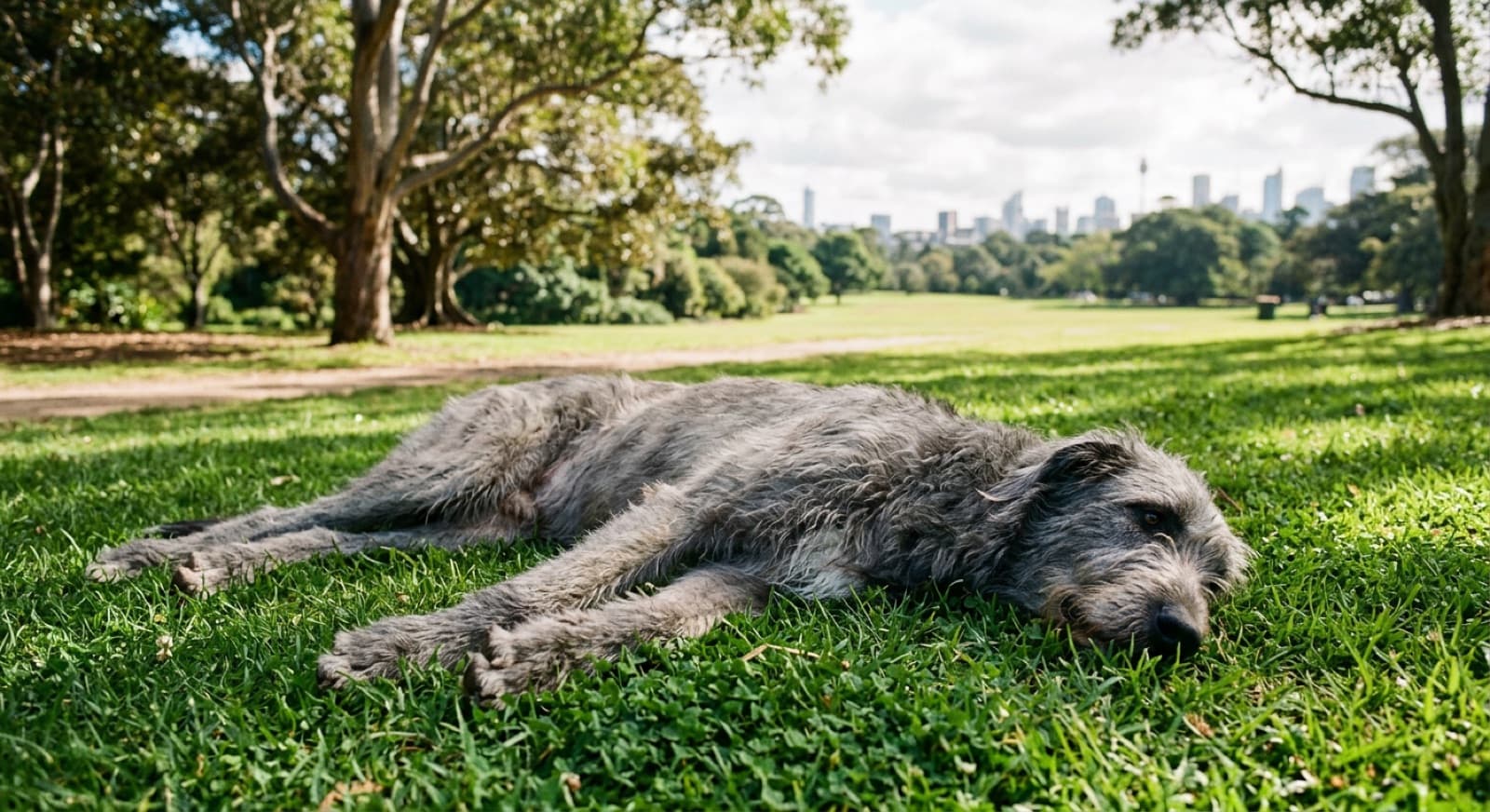
The short answer
An Irish Wolfhound is one of the gentlest, most dignified dogs you can adopt, and it is also the tallest breed and a giant that takes real planning to own well in Sydney. Everything is bigger: the food, the bedding, the boarding, and the vet bills, since much of veterinary care is dosed and priced by weight. It needs room to sprawl and a high, secure yard, because a Wolfhound is a sighthound with a strong chase instinct and should not be off-lead in open ground near roads. The rough coat needs regular brushing and must never be shaved. Manage the Sydney heat with shade, water and cool-hour walks. And the hardest truth of the breed is the short life of around 6 to 8 years. Get all of that right and you have a magnificent, devoted companion.
Everything is bigger, including the bills
The first thing to understand about an Irish Wolfhound is scale. This is the tallest dog breed and a genuine giant, commonly 50 to 70 kg, and almost every cost of ownership grows with the dog. A dog that size eats a lot, so food is a real ongoing expense, not a rounding error. The bed, the crate, the car you need to fit a very tall dog into, the harness and lead, and the boarding kennel that can house a giant all cost more than the mid-sized equivalents. Grooming is a bigger job on a coat this size and is priced to match.
The cost that catches people out most is veterinary care. Many medications, anaesthetics and some treatments are dosed and priced by body weight, which means a routine procedure on a 60 kg dog can cost far more than the same procedure on a Labrador. That is not a hidden fee. It is simple biology, and it applies across the dog's whole life. Because of that, pet insurance is worth considering for a giant breed to spread the risk of a large, unexpected bill. Australian insurers such as Bow Wow Meow and Petplan Australia offer dog cover, but read the fine print, because some insurers price giant breeds higher or apply breed caveats. Compare options rather than assuming you can absorb a giant-breed emergency out of pocket.
None of this is a reason to avoid the breed. It is a reason to budget honestly. Adopting through a rescue keeps the up-front adoption fee modest compared with a breeder, but the day-to-day and lifetime costs of a giant dog are what they are. Go in planning for them and you will enjoy the dog far more than someone who is constantly surprised by the size of the bills. The Irish Wolfhound breed page is clear that this is a big commitment, and cost is a large part of why.
Space, strength and a very tall dog in your kitchen
An Irish Wolfhound needs room. Not a mansion, but genuine space to stretch out, a home where a very large, very tall dog can move around comfortably, and ideally a big, securely fenced yard. A Wolfhound sprawls when it rests and takes up a surprising amount of floor, and a small apartment is a poor fit for a dog of this height, especially in a warm climate where it also needs to stay cool.
Height brings its own quirks. A standing Wolfhound can reach a kitchen bench, sweep a coffee table clear with a single happy wag of its tail, and knock over a small child or an older person by accident just by turning around. It is a lot of dog, and it is also enormously strong. You cannot physically overpower a 60 kg sighthound, so control comes from training, not muscle. That is why calm, reward-based training and good lead manners matter so much with a giant breed. Teach loose-lead walking, a reliable settle, and basic obedience early, using reward-based methods, so that a dog you cannot out-muscle is a dog that listens. Transport is a real logistic too: fitting a dog this tall into a car takes planning.
The good news is that Irish Wolfhounds are famously gentle, calm and good-natured, and they respond well to kind, consistent handling. Start early, keep it positive, and a Wolfhound becomes a superbly mannered, dignified companion. The RSPCA Australia Knowledgebase has sound general guidance on humane, effective reward-based training, and a Sydney force-free trainer experienced with large breeds can help you build the manners a giant dog needs from puppyhood or from the day a rescued adult comes home.
The short years are the hardest part
This is the part that belongs in any honest guide to the breed, even though it is the hardest to talk about. The very tallest breeds live the shortest lives, and an Irish Wolfhound typically lives only around 6 to 8 years. That is simply the trade-off that comes with a dog at the extreme end of the size scale. Owners are almost unanimous that it is the single most difficult thing about loving a Wolfhound, and it is worth knowing before you adopt, not to put you off, but because it shapes the commitment you are making.
Going in with your eyes open means being ready for the greater health care an ageing giant needs, and being clear that your time together will be precious and shorter than with a smaller dog. It also reframes something important. Adopting an adult or even a senior Wolfhound, and giving a gentle giant a wonderful home for the time it has left, is a genuinely meaningful choice rather than a sad one. Almost everyone who has loved a Wolfhound says the years, however short, were more than worth it, and many go on to adopt another. The point is to choose the breed knowing this, so it is never a shock, and so you can give a Wolfhound the comfortable, well-supported life it deserves for as long as you have it.
Prey drive, fencing and staying on-lead
An Irish Wolfhound is a sighthound, bred over centuries to spot, chase and course game at speed, and that history lives on as a strong prey drive. It is calm and gentle in the house, but once it locks onto a cat, a rabbit or a bird, a switch flips. A Wolfhound is fast, powerful and single-minded in a chase, and a recall that works perfectly in the yard can fail completely the instant something bolts across a park. That combination is a genuine safety risk near roads.
The practical answer is not to fight the instinct but to manage it. Give a Wolfhound a high, secure yard fence that a large, driven dog cannot clear or push through. For free running, use a fully fenced off-leash area or a large private paddock where a chase cannot end in traffic. Everywhere else, keep the dog on a lead or a long-line, so it can stretch out and sniff without being able to disappear after something. You can and should work on recall using a long-line, but treat genuine off-lead reliability in open, unfenced ground as something most Wolfhounds never fully earn. Be cautious around cats and small animals too, and assess each dog as an individual, which we cover in the FAQs below.
The coat: brush it, tidy it, never shave it
The Irish Wolfhound wears a rough, wiry double coat, harsh to the touch and weatherproof by design. It is lower-maintenance than a soft, heavy coat, but it is not no-maintenance. Regular brushing, roughly a couple of times a week, keeps it clean and free of mats, and the breed benefits from occasional hand-stripping or tidying to keep the harsh texture in good condition rather than clipping it soft. Wolfhounds shed moderately. Keep the ears, nails and teeth on a routine too, since dental and nail care matter as much on a giant as on any dog.
Here is the rule that matters most in a warm climate, and the one giant-breed owners most often get wrong: never shave an Irish Wolfhound, even in a Sydney summer. It is tempting to think a coat must make the dog hotter and that shaving it would help. It does the opposite. The double coat shields the skin from the sun and helps the dog cope with heat, so shaving can leave the dog hotter, expose it to sunburn, and damage the coat so that it never grows back correctly. The right way to keep a Wolfhound comfortable is to manage the environment and keep the coat clean and brushed so it can do its job. If you are ever unsure how to care for the coat in summer, ask your vet or a groomer experienced with rough-coated breeds. We cover coat-related skin and heat health in more detail in the Irish Wolfhound health issues guide.
Sydney heat and a big rough-coated dog
A large, rough-coated dog can overheat, and Sydney summers, with daily maximums averaging around 26C and hot days pushing past 35C, ask real care of a giant breed. Heat management here is not a nice-to-have. It is part of keeping a Wolfhound safe and well through the warmer months.
The practical rules for a Sydney Wolfhound are straightforward:
- Exercise only in the cool. Walk in the early morning and the evening. Never exercise a Wolfhound in the middle of a hot day.
- Shade and water, always. The dog needs constant access to deep shade and fresh, cool water whenever it is outside.
- Cool the house. Use air-conditioning and cooling mats on hot days. A giant dog in an un-airconditioned home through a Sydney heatwave is a genuine welfare risk.
- Never leave it in a car. Not for a minute. A hot car is lethal to any dog, and more so to a large one.
- Do not shave the coat. Manage the environment, not the coat. Keep it clean and brushed so it can insulate against heat and shield the skin.
Watch for the warning signs of overheating and treat any suspected heatstroke as the emergency it is. The RSPCA Australia Knowledgebase and the Australian Veterinary Association both stress heat safety for dogs in the Australian climate. The detail on recognising and responding to heat-related illness lives in the health guide, so if you suspect your dog is in trouble, get to a vet straight away rather than waiting.
Paralysis tick and a hairy giant
The paralysis tick is native to the NSW coast and bushland and is a year-round risk in Sydney. It is dangerous for every dog, and a rough-coated giant needs particular care, because a tick is easy to miss in a thick, wiry coat. Keep your Wolfhound on a vet-recommended year-round tick prevention product, and after any bushwalk run your hands slowly through the coat and over the skin to feel for anything the size of a small lump, paying attention to the head, neck, ears and between the toes.
Ask your vet which prevention suits your dog, since the right product depends on the individual. If you ever find a tick, or your dog shows a wobbly gait, a changed bark, breathing trouble or vomiting, treat it as an emergency and go straight to a vet. The health guide goes into tick prevention and the warning signs in more depth.
Sensible exercise for a sprinter, not a jogger
For such a tall dog, an adult Irish Wolfhound has surprisingly modest exercise needs. This is a calm, low to moderate energy breed that is happy to lounge for much of the day. A couple of steady daily walks, plus the chance to open up and gallop safely in a securely fenced space, suit an adult well. Remember what a sighthound is: a sprinter built for a short burst of speed, not an endurance athlete, so a Wolfhound wants a quick run rather than a long jog. Do not expect it to keep pace with you on a marathon training session.
Giant-breed puppies need special care, because their joints and growth plates are still developing well into the second year. Keep young Wolfhounds to gentle, controlled activity, and avoid forced running, long hikes and repetitive jumping while they are growing, so you protect the joints they will rely on for their whole, and sadly short, life. For an adult Wolfhound, cool timing and safe, fenced galloping beat distance every time.
Browse adoptable Irish Wolfhounds in Sydney
A Wolfhound rewards an owner who plans for the size, the secure fencing, the coat and the short years. Browse live NSW listings and set an alert so you hear when a gentle giant comes into rescue.
See Available Irish Wolfhounds →Is an Irish Wolfhound right for your Sydney home?
Put it together and the honest picture is clear. An Irish Wolfhound is a gentle, dignified, wonderful giant, and living with the tallest breed in Sydney is a serious commitment. It costs more across the board, from food to weight-dosed vet care. It needs room to stretch out and a high, secure yard, calm reward-based training because you cannot out-muscle it, and awareness that even a friendly giant can knock someone over by accident. As a sighthound it needs secure fencing and long-line management rather than open off-lead freedom. Its rough coat needs regular brushing and must never be shaved. And above all, it lives a short giant-breed life of around 6 to 8 years.
If you can provide the space, the budget, the secure fencing, the cool summer routine and the grooming, an Irish Wolfhound gives back one of the calmest, most devoted temperaments in the dog world. If any of those needs is a stretch for your home, it is far kinder to both of you to choose a breed that fits your life better. Adopting a giant is a big yes or an honest no, not a maybe. And if the short lifespan gives you pause, remember that an adult or senior Wolfhound in rescue offers a beautiful way to give a gentle giant a loving home for the time it has.
Sydney and NSW rescues such as RSPCA NSW, AWL NSW, Sydney Dogs and Cats Home, Monika's Doggie Rescue and Maggie's Rescue assess their dogs in foster and shelter care. Irish Wolfhounds and Wolfhound crosses come into rescue far less often than smaller breeds, so setting an alert is the best way to hear when one is available, and a good rescue will tell you honestly whether a particular dog suits your home, your yard and your Sydney climate. For where to adopt and what it costs, read the Irish Wolfhound adoption guide.
Frequently Asked Questions
How much does it cost to own an Irish Wolfhound?
Far more than a mid-sized dog like a Labrador, because almost everything scales with the dog. A 50 to 70 kg Irish Wolfhound eats a lot, so food bills are large. Bedding, a giant crate, and a car big enough for a very tall dog all cost more up front. Boarding and grooming are priced as big-dog jobs. The cost that surprises people most is veterinary care, because many medications, anaesthetics and some treatments are dosed and priced by body weight, so a routine procedure on a giant costs considerably more than the same procedure on a small dog. Pet insurance is worth considering to spread the risk of a large unexpected bill, though some insurers price giant breeds higher or apply breed caveats, so read the policy closely. There is no way to make a giant breed cheap, so budget generously and go in with your eyes open.
Do Irish Wolfhounds need a big house or yard?
Yes, they need genuine space and a large, securely fenced yard, though not a mansion. An Irish Wolfhound is the tallest dog breed, and a dog this size sprawls when it sleeps, so it needs room to stretch right out. A standing Wolfhound can reach a kitchen bench, clear a coffee table with a wag of its tail, and knock over a small child or an elderly person by accident just by turning around. A small apartment is a poor fit. Beyond the size, a Wolfhound is a sighthound with a chase instinct, so the yard fencing has to be high and secure enough to hold a fast, powerful dog that may bolt after a cat or bird. Room to move plus secure containment are the two things a Wolfhound home really needs.
Can I let an Irish Wolfhound off-lead?
Only inside a securely fenced area, never in an open, unfenced space near roads. An Irish Wolfhound is a sighthound bred to chase and course game, so it has a strong, hardwired prey drive. Once it locks onto a cat, a rabbit or a bird, it is astonishingly fast and very hard to recall, and a recall that works in the backyard can fail completely the instant something bolts. That is a real safety risk near traffic. For free running, use a fully fenced off-leash area or a large private paddock, and for everywhere else keep the dog on a lead or a long-line so it can stretch out safely without being able to disappear after something. Work on recall on a long-line, but treat reliable off-lead freedom in open ground as something most Wolfhounds never earn.
How much exercise does an Irish Wolfhound need?
Less than most people expect, because an adult Wolfhound is a calm, low to moderate energy dog. A couple of steady daily walks plus the chance to stretch out and gallop safely in a securely fenced space usually suits an adult well. A Wolfhound is a sprinter, not an endurance jogger, so it wants a short burst of speed rather than a long run, and it is happy to spend most of the day lounging. In Sydney, timing matters more than distance: walk in the cool of the morning and evening in warm weather. Giant-breed puppies are a special case and must not be over-exercised while their joints and growth plates are still developing, so keep young dogs to gentle, controlled activity and avoid forced running and repetitive jumping until they mature.
Why do Irish Wolfhounds have such a short lifespan?
Because the very tallest and largest breeds simply do not live as long as smaller dogs, and Irish Wolfhounds typically live only around 6 to 8 years. Giant size carries a heavier health burden as a dog ages, and Wolfhounds sit at the extreme end of the size scale. Most owners will tell you the short lifespan is the single hardest part of loving the breed. It is worth knowing before you adopt, not to put you off, but because it shapes the whole commitment. You are choosing to love a dog completely for a shorter time than you would a small dog, and to be ready for the greater care an ageing giant needs. Many people who have loved a Wolfhound say the years were more than worth it.
Are Irish Wolfhounds good with cats and small animals?
It depends entirely on the individual dog, and you should be cautious, because the breed carries a sighthound prey drive. Some Wolfhounds live peacefully with a cat they have grown up alongside, while others cannot be trusted around cats or small pets at all, and there is no guarantee either way from the breed alone. A good rescue assesses each dog in foster care and will tell you honestly whether a particular Wolfhound has shown a strong chase instinct or has settled calmly around cats. If you have a cat or small animals, be upfront about it, ask the rescue directly, and manage early introductions carefully with barriers and supervision. Never assume a big, gentle-natured Wolfhound is automatically safe with a cat, especially one that runs.
Should I shave an Irish Wolfhound in summer?
No, you should never shave an Irish Wolfhound, even in a hot Sydney summer. The rough, wiry double coat is not just insulation against cold. It also shields the skin from the sun and helps the dog cope with heat, so shaving it can leave the dog hotter, expose it to sunburn, and damage the coat so it does not grow back correctly. The right approach is to keep the coat clean, well brushed and free of mats, with occasional hand-stripping or tidying to keep it in good condition. To keep a Wolfhound comfortable in the heat you manage the environment, not the coat: exercise in the cool hours, provide shade and water, and use air-conditioning on hot days. If you are unsure how to care for the coat, ask your vet or a groomer experienced with rough-coated breeds.
Is adopting an older Irish Wolfhound a good idea?
Yes, adopting an adult or senior Irish Wolfhound can be one of the most meaningful choices you make, given the breed's short life. Because Wolfhounds only live around 6 to 8 years, some people hesitate to take on an older one, but giving a gentle giant a wonderful, comfortable home for the time it has is a genuinely kind and rewarding thing to do. An adult Wolfhound is usually calmer and past the demanding giant-puppy stage, its temperament is already clear, and a good rescue can tell you how it behaves around cats, children and other dogs. Yes, the years may be short, but they can be very good ones for both of you. Talk to the rescue about what an older Wolfhound needs, and read the health guide so you know what senior giant-breed care involves.
Keep reading
Adoptable Irish Wolfhounds in Sydney
Live listings of Irish Wolfhounds and Wolfhound crosses across Sydney and NSW rescues.
Irish Wolfhound Adoption in Sydney
Where to adopt, why Wolfhounds end up in rescue, and what adoption costs against a breeder.
Irish Wolfhound Health Issues in Sydney
Giant-breed heart, bone and bloat risks, the short lifespan, heatstroke signs, and year-round tick prevention.
All Sydney Adoption Guides
Browse every breed and how-to guide for adopting a rescue dog in Sydney.