The short answer
A Chow Chow is aloof, dignified, independent and cat-like. It is deeply loyal to its own family, reserved with strangers, and not a demonstrative, eager-to-please dog. It gives its loyalty selectively and it has guarding and territorial instincts plus a prey drive, so early, kind, positive socialisation is the single biggest predictor of a well-adjusted adult Chow. This is not a beginner's breed. On the coat, the dense double coat needs brushing and line-combing several times a week to prevent matting, blows heavily once or twice a year, and must never be shaved. Keep it well brushed so air can circulate, manage Sydney's heat with cool-hour exercise and shade, and use year-round paralysis tick prevention because ticks hide in the thick coat.
The temperament: aloof, dignified, and its own dog
To live well with a Chow Chow you have to start by accepting what the breed is, rather than wishing it were something friendlier. A Chow is an ancient, dignified, independent dog, and the personality people most often reach for to describe it is cat-like. It is composed, self-contained, clean in its habits, and content to be near its people without needing constant fuss or reassurance. It is loyal, but it is not a dog that lives to please you, and it will not shower every visitor with affection.
With its own family a well-raised Chow tends to be calm, devoted and quietly affectionate on its own terms. With strangers it is naturally reserved, aloof and slow to warm up, and it typically gives its loyalty selectively rather than freely. Many Chows attach most strongly to one person or one household and remain politely indifferent to everyone else. That selective devotion is exactly what Chow people love, but it means you should set honest expectations. If you want a bouncy, waggy, everyone-is-my-best-friend dog, this is not your breed.
The Chow Chow breed page is blunt that this is not an easy first dog, and the temperament is exactly why. A Chow is strong-willed, proud and sensitive, and it does not forgive careless handling the way a more biddable breed might. Respect its independence and it is a superb companion. Try to steamroll it and you will lose.
Guarding instincts, and why socialisation is everything
Alongside the aloofness sits a guarding, territorial streak. A Chow is watchful over its home and its people, can be same-sex intolerant with other dogs, and carries a prey drive that means caution around cats and small animals. None of that makes it a bad dog. It makes it a serious one, and it puts socialisation at the very centre of raising a good Chow.
Early, respectful, positive socialisation is the single biggest predictor of a well-adjusted adult Chow. That means calm, controlled, rewarding exposure to lots of different people, dogs, places, sounds and everyday situations from as young an age as possible, so the dog learns the world is normal and it does not need to guard against all of it. A Chow that gets that grounding tends to be a mannerly, confident, dignified adult. A Chow that is left unsocialised, or is handled harshly, can become wary, defensive and quick to guard, and in a powerful, strong-willed breed that is a real problem.
One breed-specific safety point that matters here. A Chow's deep-set eyes, framed by that heavy facial coat, give it limited peripheral vision. Always approach a Chow where it can see you coming, and teach children and visitors to do the same, because a startled guarding breed is a bite risk. This is not a reason to be afraid of the breed. It is a reason to socialise, manage and handle it thoughtfully.
- Start young and never stop. Socialisation is a lifelong habit for this breed, not a puppy-class box to tick.
- Plan around dog tolerance. Many Chows do best as the only dog, or with one carefully matched dog of the opposite sex.
- Skip the busy dog park. A crowded, high-arousal, off-lead free-for-all plays straight to a reserved, same-sex-intolerant breed's weakest point.
- Secure fencing and careful lead handling. Keep space from unknown dogs and stay calm so your Chow takes the cue from you.
Training: reward-based only, and keep it short
Here is a hard rule for the breed: reward-based, force-free methods only. Chows are intelligent and perfectly capable of good manners, but they are independent and famously stubborn, and they do not respond to being bullied. Harsh, confrontational or dominance-style training backfires badly with a proud, sensitive dog. Instead of obedience it produces defensiveness, and in a breed with guarding instincts that is the last thing you want.
What works is calm, clear, motivating training that the dog wants to take part in, kept in short sessions that respect its dignity. Build solid basic manners and a reliable recall, and put real effort into handling tolerance early. A Chow that happily accepts being brushed, having its nails trimmed, its ears cleaned and its face and eyes checked is far easier and safer to care for, and given how much grooming and eye care the breed needs, that handling work pays off every single week. For any reactivity or guarding, choose a Sydney force-free trainer or a qualified behaviourist with genuine experience of independent, guarding breeds. The Australian Veterinary Association supports reward-based training, and the RSPCA Australia Knowledgebase has sound guidance on humane, effective methods.
Chow Chows with children and other pets
A Chow raised with a respectful family can be good with the children it lives with, but it is not an easygoing, rough-and-tumble family dog. Most Chows dislike being hugged, grabbed or pestered, so they suit calm, older, dog-savvy children better than boisterous toddlers. Supervision is essential, and it is not optional with any powerful breed. Teach children to respect the dog's space, to leave it in peace when it is eating or resting, and never to corner it. Take extra care around visiting children and unfamiliar dogs, because the reserved, guarding nature that makes a Chow watchful at home can misfire with people and animals it has no relationship with.
With other pets, plan cautiously. Chows can be intolerant of other dogs, sometimes aggressive towards dogs of the same sex, and their prey drive can make them a risk around cats and small animals. Some Chows learn to live happily with a specific dog or cat they were raised with, but many are happiest as the only pet. This is where adopting through a rescue is a genuine advantage. A dog assessed in foster care comes with a real read on how it behaves around children, strangers and other animals, which matters enormously for a breed where individual temperament varies this much. Be honest with the rescue about your household, and never leave a young child and a dog together unsupervised.
The coat: the other half of owning a Chow
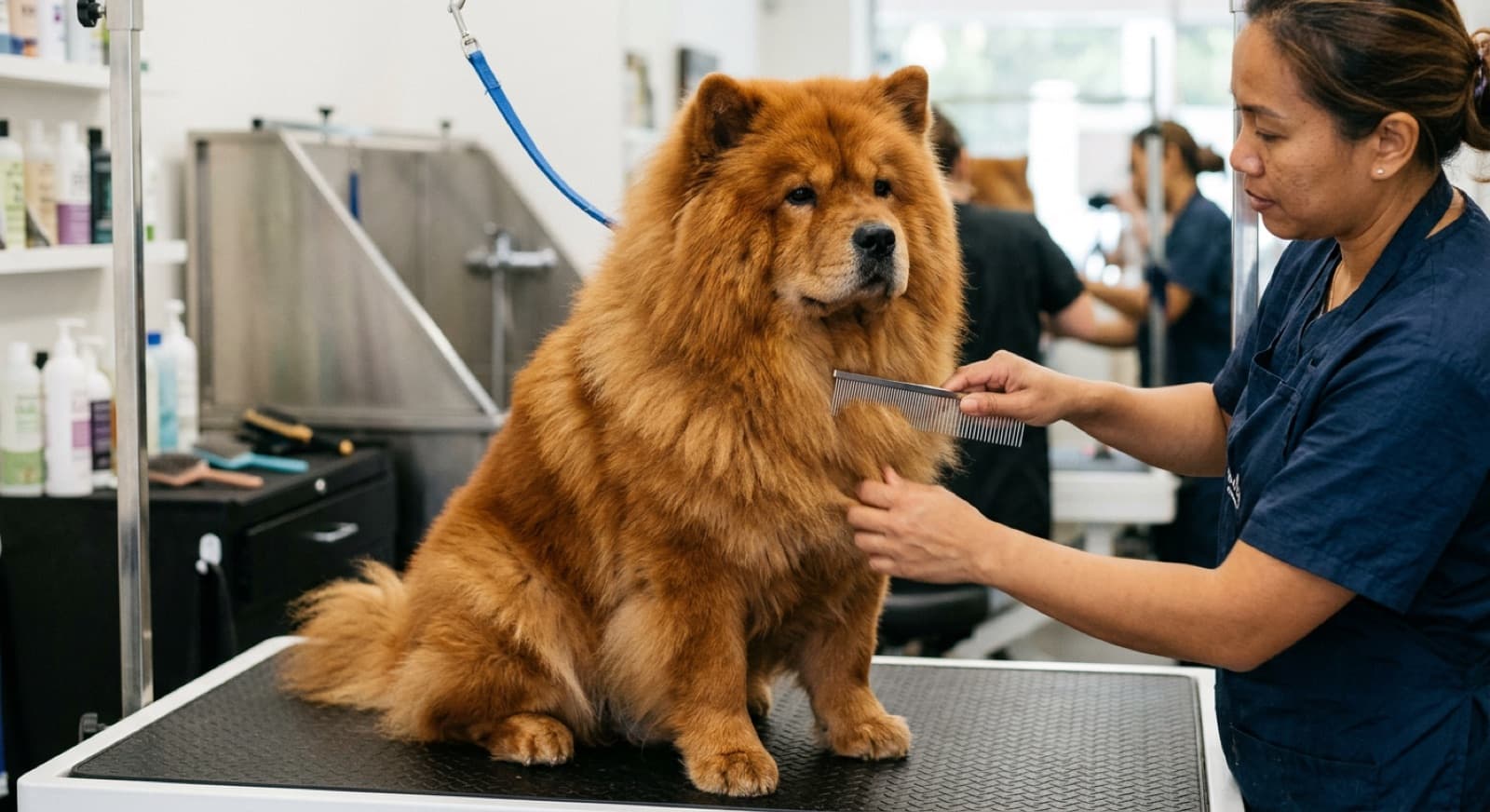
The Chow's coat is as much a part of the commitment as its temperament, and it is where a lot of well-meaning owners underestimate the breed. There are two coat types. The rough coat is the classic one, the profuse, standoff lion mane that gives the breed its look. The smooth coat is shorter and less dramatic but is still a genuine double coat with a dense undercoat. Either way, this is a heavily coated dog that needs regular, thorough grooming for its whole life.
A Chow is brushed and de-shedded, never clipped into a shape. The routine is a proper brush-out and line-comb (working in layers down to the skin) several times a week, not a quick once-over. Matting is the enemy, and it forms fastest in a few predictable places:
- The mane around the neck and shoulders, the densest part of the coat.
- Behind the ears, where fine coat tangles quickly.
- The trousers on the back legs and the britches.
- The tail, which carries a full plume of coat.
Skip the routine for a week or two and matts form close to the skin, which is uncomfortable, traps moisture, and can lead to skin problems that need a vet. Matts cannot always be brushed out once they are set, and a badly matted Chow sometimes has to be clipped down, which is exactly what you are trying to avoid. Staying ahead of it with regular brushing is far kinder and far easier than trying to fix it after the fact.
The seasonal coat blow
On top of the regular routine, a Chow blows its undercoat heavily once or twice a year. During those weeks the shedding is dramatic, and you will need to de-shed daily to keep the loose undercoat out and prevent it from felting into matts as it comes away. A good undercoat rake and a slicker brush, plus patience, get you through it. Outside of the big blows, a Chow still sheds year-round at a lower level, so this is not a low-shedding breed by any measure. If a hair-free house is important to you, a Chow is not the right choice.
Never shave a Chow Chow
In a Sydney summer the temptation to shave a heavily coated dog is understandable, and it is the wrong move. Do not shave a Chow. The double coat is not just insulation against cold. It also insulates against heat and shades the dog's pale skin, so it is part of how the dog stays comfortable. Shaving removes that protection, leaves the skin exposed to sunburn, can raise the risk of heatstroke rather than lower it, and frequently damages the coat so it grows back patchy or with a changed texture.
The right approach is the opposite of shaving. Keep the coat well brushed and free of matts so air can circulate through it, which is how a double coat is designed to work. A tidy sanitary trim and a neaten-up around the feet are perfectly fine. Beyond that, leave the coat on and manage the heat itself, which we cover below.
Bathing, ears, nails, teeth and the eye area
Bathing a Chow is a bigger job than it looks, because a dense double coat holds water. The key is to dry it thoroughly, right down to the skin. A damp undercoat left to its own devices will mat, so a proper dry (and a good brush-out as it dries) is as important as the wash itself. Most owners bathe every few weeks or as needed, not constantly, and brush far more often than they bathe.
Round out the routine with the basics every dog needs and a Chow needs consistently: check and gently clean the ears, keep the nails trimmed, and look after the teeth with regular brushing. Pay particular attention to the eye area and the facial folds. A Chow's deep-set eyes and heavy facial coat mean the folds and the area around the eyes should be kept clean and dry to stay comfortable. If you notice persistent tearing, rubbing, squinting, redness, or any sign the eyes are irritated or the eyelids are turning inward, that is a vet conversation, not a grooming one. We cover the breed's specific eye and health concerns in the Chow Chow health issues guide.
All of this is far easier if you have done the handling work described earlier. A Chow that tolerates being brushed, dried, trimmed and having its face checked is a pleasure to care for. A Chow that fights every session is a weekly battle, so invest in that handling tolerance from day one.
Managing the coat and the heat in Sydney
Sydney's summers run warm and humid, with average January maximums around 26°C and occasional heatwave days above 35°C. A heavily coated dog like a Chow needs sensible heat management, and the answer is never to shave it. Instead, keep the coat well brushed so it can do its job, exercise in the cool of early morning or evening rather than the middle of a hot day, always provide shade and fresh water, and never leave the dog in a car or out in the midday sun. Watch for signs of overheating (heavy panting, drooling, weakness, distress) and treat heat as the real seasonal risk for a Chow in Sydney.
The thick coat also creates a hidden hazard: paralysis ticks. Ticks are a year-round danger across coastal and bushland NSW, and a Chow's dense coat is a perfect place for one to hide unnoticed. Year-round tick prevention is essential, so ask your vet for the right product for your dog, and get into the habit of checking your Chow by hand after any walk near bush or long grass, working your fingers right down to the skin because you will not spot a tick through that coat by looking. The RSPCA Australia Knowledgebase has good general guidance on paralysis tick risk and prevention, and your vet is the right source for the specific product.
On the legal side, a Chow is not a restricted breed in NSW, so it can be legally owned and adopted normally. Like any dog it must be microchipped and registered for life through the NSW Pet Registry, and any dog of any breed can be declared menacing or dangerous by a council based on its behaviour, which is one more reason to socialise, train and manage a guarding breed well. We cover council registration and the rest of responsible ownership in the Chow Chow adoption guide.
Browse adoptable Chow Chows in Sydney
A Chow rewards an owner who respects the aloof, dignified temperament and commits to the coat. Browse live NSW listings and set an alert so you hear when one comes into rescue.
See Available Chow Chows →Is a Chow Chow's temperament and coat right for you?
Put it together and the honest picture is clear. A Chow Chow is aloof, dignified, independent and cat-like, deeply loyal to its own family but reserved with strangers, with guarding instincts, a prey drive, and a coat that demands brushing several times a week for the life of the dog. It needs an experienced owner who respects its independence, commits to early and ongoing positive socialisation, trains with reward-based methods, and is genuinely prepared for the grooming workload. It is generally not a dog-park dog, and it is not an easy first dog.
Meet all of that and you get a strikingly beautiful, loyal, low-drama companion, a dog that will bond to you completely and carry itself with real dignity. Fall short on either the socialisation or the coat and you get a wary, poorly adjusted dog with a matted, uncomfortable coat, and, all too often, another Chow needing to be rehomed. So the real question is not whether you love how a Chow looks in that lion mane. It is whether your experience, your patience, and your willingness to groom genuinely suit the breed.
Sydney and NSW rescues such as RSPCA NSW, AWL NSW, Sydney Dogs and Cats Home, Monika's Doggie Rescue and Maggie's Rescue assess their dogs in foster and shelter care, and can tell you honestly how a particular Chow or Chow cross behaves around people, dogs and other animals, and what its coat needs. Adopting an assessed adult takes a lot of the guesswork out of a breed where temperament and grooming matter this much.
Frequently Asked Questions
Are Chow Chows aggressive?
Chow Chows are not mindlessly aggressive, but they are an aloof, dignified guardian breed that is naturally reserved with strangers and can be territorial, which people sometimes read as aggression. With their own family a well-raised Chow is loyal, calm and quietly affectionate, though not demonstrative or fussy. The behaviour that gets them a reputation usually comes down to the breed being what it is: independent, standoffish with people it does not know, protective of its home, and unwilling to tolerate rough or pushy handling. A Chow that has been well socialised from a young age and handled kindly is typically a mannerly, dignified dog. A Chow that was never socialised, or was handled harshly, can become wary and defensive, and in a powerful, strong-willed breed that matters. This is not a beginner's easy dog. It needs an owner who respects its independent nature, commits to early positive socialisation, and uses reward-based training. One more practical point: the deep-set eyes give a Chow limited peripheral vision, so always approach where the dog can see you, because startling one is a genuine bite risk.
Are Chow Chows good with children?
A Chow Chow raised with a respectful family can be good with the children it lives with, but it is not an easygoing, anything-goes family dog and it needs sensible supervision. Chows are dignified and independent, and most of them dislike rough handling, hugging and being pestered, so they suit calm, older, dog-savvy children better than boisterous toddlers. Teach children to respect the dog's space, to leave it alone when it is resting or eating, and never to grab or corner it. Extra care is needed around visiting children and other people's dogs, because the same reserved, guarding nature that makes a Chow watchful at home can misfire with unfamiliar kids. Because so much depends on the individual dog, lean on a rescue's foster assessment rather than the breed label alone, and never leave any dog and a young child together unsupervised.
How much grooming does a Chow Chow need?
A lot. A Chow Chow has a dense double coat that needs thorough brushing and line-combing several times a week to prevent painful matting, and that is a permanent, non-negotiable commitment for the life of the dog. Pay special attention to the mane, behind the ears, the trousers on the back legs, and the tail, which mat fastest. On top of the regular routine, the coat has a heavy seasonal blow once or twice a year when the undercoat sheds in earnest, and during those weeks you will need to de-shed daily to stay on top of it. Chows also shed year-round. The coat is brushed and de-shedded, never clipped into a shape. Add regular bathing (dried thoroughly right down to the skin, or the damp undercoat mats), plus routine ears, nails, teeth, and gentle cleaning of the eye area and facial folds. If you are not prepared for that workload, or the cost of professional grooming to help, a Chow is not the right breed for you.
Should I shave my Chow Chow in summer?
No. Do not shave a Chow Chow, even in a Sydney summer. It feels intuitive to strip the coat off a heavily coated dog in the heat, but a Chow's double coat actually insulates against heat as well as cold and shades the skin, and shaving it works against the dog. Shaving removes that protection, exposes pale skin to sunburn, can raise the risk of heatstroke rather than lower it, and often damages the coat so it grows back patchy or with a changed texture. The right approach is the opposite: keep the coat well brushed and free of matts so air can circulate through it, which is how it is designed to keep the dog comfortable. A tidy sanitary trim and a neaten-up of the feet are fine. Manage the heat itself by exercising in the cool of early morning or evening, providing shade and fresh water, and never leaving the dog in a car or out in the midday sun.
Are Chow Chows one-person or one-family dogs?
Largely yes. A Chow Chow tends to give its loyalty selectively, bonding deeply with its own person or family while remaining aloof, reserved and unbothered with everyone else. This is one of the breed's defining traits and a big part of why it is often compared to a cat. A Chow is not the sort of dog that loves the whole world and greets every visitor like a long-lost friend. It is devoted, dignified and undemonstrative, and it decides for itself who it trusts. That selective, cat-like loyalty is exactly what Chow people love about the breed, but it does mean you should not expect a waggy, eager-to-please people-pleaser. Good early socialisation helps a Chow be relaxed and polite with people beyond its family, even if it never becomes gushingly friendly with them.
Do Chow Chows need an experienced owner?
Yes. A Chow Chow is not a good first dog for most people, and a good rescue will say so honestly. This is a proud, independent, strong-willed and sensitive breed that does not live to please you the way a Labrador or a working gundog does, and it will not simply forgive beginner handling mistakes. It needs an owner who respects its dignity and independence, commits to early and ongoing positive socialisation, uses calm reward-based training, and can build the handling tolerance a Chow needs for grooming, vet visits and eye care. Harsh or dominance-style methods backfire badly with this breed and create defensiveness. In the right, patient, experienced hands a Chow is a wonderful, loyal, dignified companion. Underestimated, its aloofness and guarding can become a problem, and that is a common reason Chows end up needing to be rehomed.
Are Chow Chows good with other dogs and cats?
It varies, and you should plan cautiously. Chow Chows can be intolerant of other dogs, are sometimes aggressive towards dogs of the same sex, and can have a prey drive that makes them a risk around cats and small animals. Some Chows raised alongside another pet learn to live with that specific animal, but many are happiest as the only pet or with one carefully matched dog of the opposite sex. This means secure fencing, careful handling on lead in public, and being honest that busy off-lead dog parks are generally not the right environment for a reserved, same-sex-intolerant breed. If you already have a dog or a cat, tell the rescue upfront so they can match you with a Chow that has been assessed as safe to live with other animals, and never leave a Chow unsupervised with an unfamiliar pet.
What is the best way to train a Chow Chow?
Reward-based, force-free training only, in short sessions that respect the dog's dignity. Chows are intelligent but independent and famously stubborn, so they respond to being motivated and made a willing partner, not to being pushed around. Harsh, confrontational or dominance-style handling backfires with this proud, sensitive breed and tends to produce defensiveness rather than cooperation. Keep training sessions short and positive, build solid basic manners and a reliable recall, and put real effort into handling tolerance early, because a Chow that accepts brushing, nail trims, ear cleaning and having its face and eyes checked is far easier and safer to care for. Start socialisation and handling as young as possible, and for any reactivity or guarding, work with a Sydney force-free trainer or behaviourist experienced with independent, guarding breeds rather than trying to muscle through it.
Keep reading
Adoptable Chow Chows in Sydney
Live listings of Chow Chows and Chow crosses across Sydney and NSW rescues.
Chow Chow Adoption in Sydney
Where to adopt, why Chows end up in rescue, the legal side, and what adoption costs against a breeder.
Chow Chow Health Issues in Sydney
Eye conditions, hip and joint concerns, the double coat in Sydney's heat, and year-round tick prevention.
All Sydney Adoption Guides
Browse every breed and how-to guide for adopting a rescue dog in Sydney.