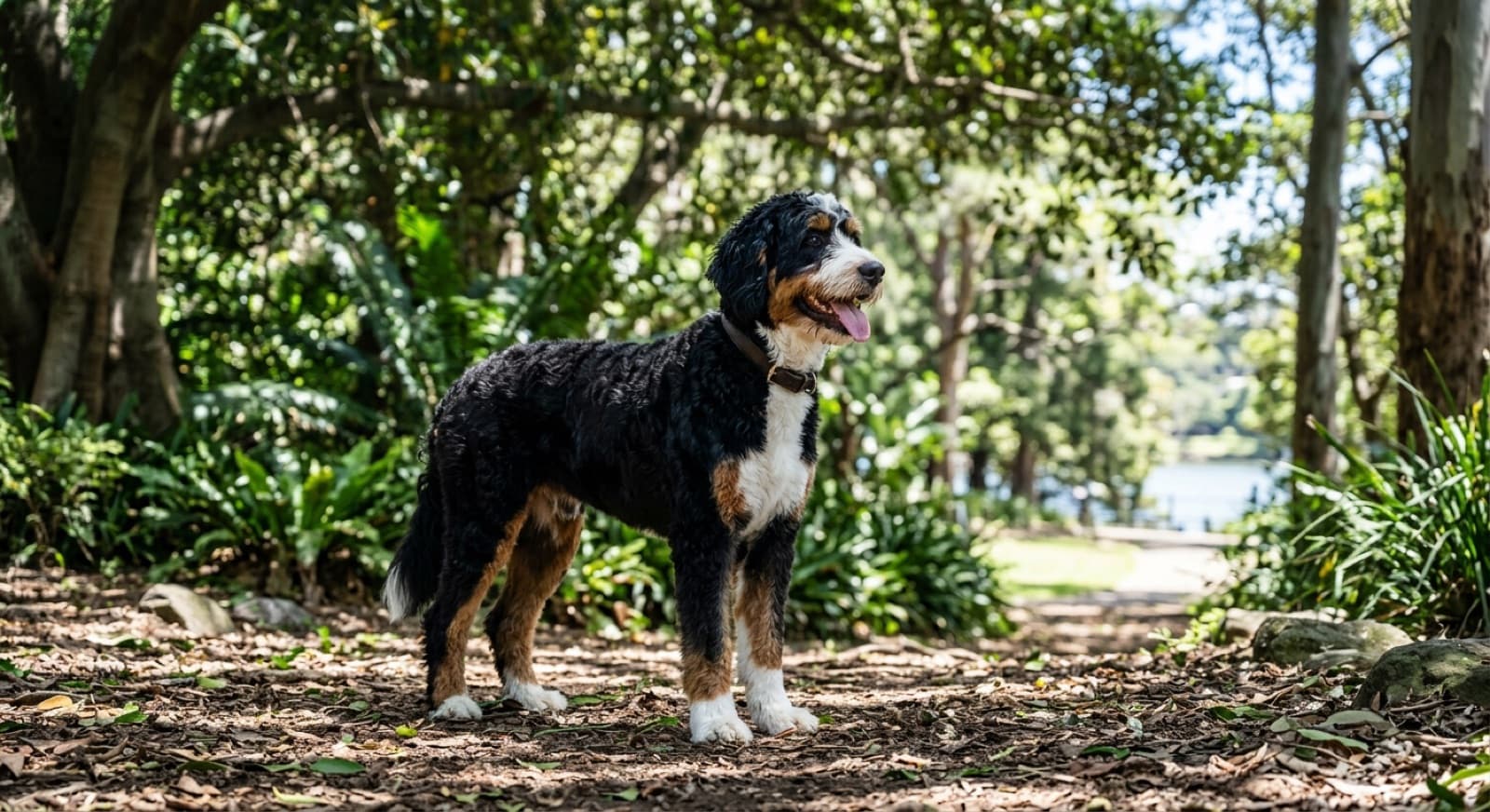
The short answer
A Bernedoodle inherits health risks from both parent breeds, so hip and elbow dysplasia, the Bernese Mountain Dog's elevated cancer risk, and heat sensitivity are the main things to watch. Crossbreeding widens the gene pool and can reduce some inherited disease, but it does not remove it. From the Bernese side you watch the joints, the lumps and the summer heat, and from the Poodle side conditions like ear infections, a slipping kneecap and, less often, Addisons disease or epilepsy. Keep the dog lean, keep it cool, care for the ears, check for lumps, and learn the signs of bloat and heatstroke, which are both genuine emergencies in a large, thickly coated dog.
The crossbreed reality: it inherits from both parents
If you understand one thing about Bernedoodle health, make it this. A Bernedoodle is a cross of a Bernese Mountain Dog and a Poodle, so it can inherit the health risks of both parent breeds, not just one. People often assume a crossbreed is automatically healthier than a purebred, and there is a grain of truth in it, but it is easy to overstate.
Crossing two breeds widens the gene pool, an effect often called hybrid vigour, and that can lower the odds of some inherited diseases that come from a narrow purebred line. The Bernese Mountain Dog is a good example, because it is a breed with real health challenges, and adding Poodle genes can help. What crossbreeding does not do is guarantee a healthy dog. If both parents carry the genes for a condition, the puppy can still get it, and a Bernedoodle bred from parents who were never health-tested carries the same risks as any poorly bred dog.
That is why the single best question to ask a Bernedoodle breeder is what health testing both parents had. A responsible breeder health-tests both the Bernese and the Poodle parent for hips, elbows, eyes and known DNA conditions, and is happy to show you the results. If you are adopting rather than buying, the equivalent reassurance is the vet check a rescue dog gets before it is listed, and the fact that with an adult you can see the coat, the movement and the general condition for yourself. The RSPCA Australia Knowledgebase has helpful general guidance on inherited disease and choosing a healthy dog.
Hip and elbow dysplasia: the large-dog joints
Hip dysplasia is one of the main things to watch in a Bernedoodle, because it is common in large breeds and in the Bernese side of the cross. It is a malformation of the hip joint where the ball and socket do not fit together smoothly. Over time the loose, poorly fitting joint wears, which causes pain and arthritis. Elbow dysplasia is the same idea in the front leg, a joint that has not formed properly and grows sore with use. Both matter more in a big dog, because there is more weight going through the joint.
The signs to know. Watch for stiffness, especially after rest, a limp, a bunny-hopping run, reluctance to exercise or jump, and trouble rising or climbing stairs. These often creep in slowly, so a dog that is simply slowing down is worth a vet check rather than being written off as lazy or old.
What helps. Two things sit in your hands. First, keep your Bernedoodle lean, because extra weight adds strain to a joint that already does not fit well, and it is one of the most useful things you can do for a large breed. Second, manage a puppy's growth so it does not grow too fast or exercise too hard on developing joints, which matters a great deal in a big dog that grows quickly. Ask your vet about the right food and exercise for a growing Bernedoodle. If your dog is showing signs, a vet can assess the joints and talk through management, from weight and exercise to pain relief and, in some cases, surgery. The Australian Veterinary Association and your own vet are the right first calls.
The Bernese cancer risk: know your dog, act early
This is the one that worries Bernese and Bernedoodle owners most, and it is worth being honest about. The Bernese Mountain Dog is one of the breeds most strongly associated with cancer, and a Bernedoodle can carry an elevated risk from that side of the cross. Crossing with a Poodle widens the gene pool and may lower the odds compared with a purebred Bernese, but it does not remove the risk, and no crossbreed comes with a guarantee.
The useful thing to know is that worrying about it does nothing, but knowing your dog does a lot. Get into the habit of running your hands over your Bernedoodle every week or so, feeling for any new lump, swelling or bump under the skin, and note anything you find. Watch too for the vaguer signs that something is wrong, such as unexplained weight loss, tiredness that is out of character, a poor appetite, or a lameness that will not settle. None of these means cancer on its own, but all of them mean a vet visit.
The single rule is do not try to diagnose a lump at home. Most lumps in dogs are harmless, but only a vet can tell which is which, often with a simple in-clinic test. Early assessment gives the best options, so a new or growing lump is worth a prompt appointment rather than a wait-and-see. This is also the strongest argument for keeping up regular vet checks through your Bernedoodle's whole life, and moving to twice-yearly visits once it is a senior.
Heart and eye conditions
Heart conditions. The Bernese side can pass on some inherited heart problems, so the heart is worth watching in a Bernedoodle. You cannot see these at home in the early stages, which is exactly why the yearly vet check matters, because a vet can hear a heart murmur or an irregular rhythm long before you would notice anything. At home, watch for a cough that will not settle, tiring quickly on a walk, faster or laboured breathing at rest, or any fainting or collapse, and treat those as reasons to see a vet.
Eye conditions. Both parent breeds carry a couple of inherited eye conditions, so the eyes are worth watching too. Progressive retinal atrophy, an inherited disease where the retina slowly degenerates and vision fades, occurs in both lines, as do cataracts, where the lens clouds and the pupil looks milky. Neither is painful and both come on gradually, so the first sign owners notice is often a dog that becomes hesitant in dim light or bumps into things. These are conditions responsible breeders DNA-test or eye-test the parents for. The general rule with eyes is simple: any red, painful, cloudy or squinting eye should be seen by a vet, and a red painful eye should be treated as an emergency.
Ear infections: from the Poodle side
Ear infections are one of the most common everyday health problems in Bernedoodles, and for many owners they are a routine management job rather than a one-off. The good news is that they are also among the most preventable, so a bit of regular care goes a long way.
Why the ears. It comes down to shape. Many Bernedoodles have floppy ears that hang down and sit like a lid over the ear canal, and they often inherit the hairy Poodle-type ear canal on top of that. The flap stops air from circulating, and the hair traps warmth and moisture in the dark space underneath. Warm, damp and dark is exactly what bacteria and yeast thrive in, so infections take hold easily, and a bath or a swim makes it worse. None of this means you have done anything wrong. It is simply how many Bernedoodles are built.
The signs to know. Watch for head shaking, scratching or pawing at the ears, a noticeable odour, redness or discharge inside the ear, and pain or flinching when you touch the ear. Catch these early, because a grumbly ear is far easier to settle than a full, established infection.
Routine care that prevents it. Make ear care a habit, not a reaction. Lift the ear flap and look inside every few days, and clean the ears with a vet-recommended ear cleaner as often as your vet advises. Dry the ears carefully after every bath or swim so water is not left to sit in the canal. Keep the hair around the opening tidy so air can move, and ask your groomer or vet about the right approach for the coat. When an infection does take hold, see your vet promptly rather than trying to ride it out. Our Bernedoodle grooming and care guide covers the coat and ear routine in more detail.
Other conditions worth knowing
Luxating patella. This is a kneecap that slips out of its groove, and it comes largely from the Poodle side. You might see a sudden skip or hop in the back leg, or the dog holding a hind leg up for a stride or two before carrying on as normal. Mild cases are managed conservatively and more severe ones may need a vet's attention, so it is worth having a skippy back leg checked.
Addisons disease and epilepsy. From the Poodle side, a Bernedoodle can less commonly develop Addisons disease, a hormone disorder where the adrenal glands do not make enough of certain hormones, which can cause vague signs like weakness, poor appetite and vomiting that come and go. Epilepsy, a seizure disorder, can also occur. Neither is common, but both are worth knowing about, and a dog that has a seizure, or that is repeatedly and unexplainably off-colour, needs a vet.
Obesity. A Bernedoodle gains weight easily, and extra kilos are hard on a large-breed frame. It is one of the most common and most preventable problems in the cross. Extra weight strains the joints, worsens hip and knee issues, and adds to the load on the heart and the whole body. Feed to a visible waist, measure meals rather than guessing, and go easy on treats. A lean Bernedoodle is a healthier, more comfortable dog.
Bloat. A Bernedoodle, particularly a larger, deeper-chested one, can be at risk of bloat. It is not the most common problem in the cross, but it is the most urgent, so the note below explains why it cannot wait.
Emergency: bloat (a swollen, hard belly and retching)
Bloat, also called gastric dilatation-volvulus or GDV, is when the stomach fills with gas and can twist, cutting off the blood supply. It is life-threatening within hours, so it is a genuine emergency. Get to a vet immediately, day or night, if your Bernedoodle has a swollen, hard or distended belly, is retching without bringing anything up, is drooling, pacing, or is obviously restless and distressed. Do not wait to see if it settles, because bloat kills fast without surgery. Phone ahead so the team is ready. Sydney has 24/7 emergency and specialty hospitals such as SASH, which offers round-the-clock emergency and surgical care.
Sydney heat: the risk a thick-coated dog carries
This section matters more for a Bernedoodle in Sydney than almost any other. The Bernese Mountain Dog was bred to work in the cold Swiss mountains, and it carries a thick, heavy coat to match. A Bernedoodle often inherits that dense, heat-trapping coat, and a large body holds heat, so the Sydney summer is a genuine health risk, not just a discomfort. Average January days sit around 26 degrees, but heatwaves push well past 35, and the humidity makes it harder for a dog to cool itself.
How to keep a Bernedoodle safe in the heat. Walk in the cool of the early morning or the evening, and skip the walk altogether on very hot days rather than pushing through. Test the footpath with your hand, because hot pavement burns paws. Give constant access to shade and fresh water, indoors and out. Never leave a dog in a parked car, even for a couple of minutes with the window down, because the temperature inside climbs fast and turns lethal. Do not clip or shave the coat right down to cool the dog without your groomer's advice, because the coat also insulates against heat and a bad clip can make sunburn and overheating worse.
Emergency: heatstroke (heavy panting, drooling, red gums, collapse)
Heatstroke is a life-threatening emergency. The signs are heavy, frantic panting, thick drooling, bright red gums, weakness or wobbliness, vomiting, distress and collapse. If you see them, move your Bernedoodle to shade or air conditioning at once, offer cool (not icy) water, wet the coat and belly with cool water, and get to a vet immediately, phoning ahead. Do not wait to see if the dog recovers on its own. Sydney 24/7 hospitals such as SASH can treat heatstroke, but minutes matter, so a thickly coated dog that overheats on a hot day needs care fast.
Why adopting a Bernedoodle is not a health disadvantage
People sometimes worry that a rescue dog is a health gamble compared with a breeder puppy. For a Bernedoodle the picture is more balanced than that. A Bernedoodle adopted through a reputable Sydney rescue arrives desexed, vaccinated, microchipped, treated for parasites and vet-checked, with all of that included in the fee, and any known health issue is noted on the listing. You are not taking on an unassessed animal.
Adopting an adult also lets you see the things that a puppy keeps hidden. With a Bernedoodle that matters, because coat type varies enormously in the cross, and so do size, joint condition and how the dog copes with warmth. You can ask whether the dog has had ear infections, whether anything is known about its joints, heart or any lumps, and how it moves. Better still, you can see the coat, the size and the movement for yourself rather than guessing how a puppy will turn out. A foster carer who has lived with the dog can tell you how it handles a warm day, which is real information a puppy cannot offer. If you are weighing it up, our Bernedoodle adoption guide for Sydney covers where to look and what it costs. Sydney rescues worth watching include RSPCA NSW, AWL NSW, Sydney Dogs and Cats Home, Monika's Doggie Rescue and Maggie's Rescue.
Keeping a Bernedoodle healthy: the checklist
Most of what keeps a Bernedoodle well is routine and proactive. The habits below do the heavy lifting.
- Keep the dog lean. Feed to a visible waist, measure meals, and go easy on treats. Extra weight strains a large-breed frame and worsens hip and knee issues.
- Keep it cool in summer. Walk in the cooler hours, give shade and water, never leave the dog in a car, and treat any sign of heatstroke as an emergency.
- Check for lumps weekly. Run your hands over the whole dog, feel for anything new, and have any lump checked by your vet, given the Bernese cancer risk.
- Check and clean the ears. Look inside every few days, clean with a vet-recommended cleaner as advised, and dry carefully after every bath or swim.
- Groom the dense coat. Regular brushing and clipping keep the coat comfortable and stop painful mats, especially around the ears, legs and under the body.
- Book regular vet checks. Annually while the dog is adult, then twice yearly once it is a senior, so joint, heart, lump and other issues get caught early.
- Stay on year-round tick and parasite prevention. Use a vet-recommended product every month without a gap, because the paralysis tick on the NSW coast is a fatal risk.
The Sydney paralysis tick point
One health risk has nothing to do with the cross and everything to do with where you live. The paralysis tick is native to the east coast of Australia, including the coastal and bushland areas around Sydney, and its bite releases a toxin that causes an ascending paralysis which is fatal without veterinary treatment. It is a year-round risk here, worst in the warmer months but never truly gone.
The response is straightforward. Keep your Bernedoodle on a vet-recommended tick prevention product every single month with no gaps, and after any walk through bush or long grass run your hands slowly over the whole dog, feeling for a lump. A Bernedoodle's thick, wavy coat gives ticks plenty of cover and hides them well, so check carefully, under and inside the ear flaps, around the face, under the collar, in the armpits and between the toes. If your dog develops a wobbly back end, a changed or weak bark, gagging or heavy breathing, treat it as an emergency and get to a vet at once. Your own vet can advise on the right prevention product for your dog.
Browse adoptable Bernedoodles in Sydney
Adopting an adult lets you see the coat and size and ask about the dog's history directly, with a vet check already done and known issues on the listing. Browse live NSW listings and set an alert so you hear the moment a Bernedoodle or Bernedoodle cross comes in.
See Available Bernedoodles →When to see the vet urgently
Most Bernedoodle health issues are managed at a normal appointment. A few need a faster response. Get to a vet immediately, including out of hours, if you see any of these:
- A swollen, hard belly with unproductive retching, drooling and restlessness (possible bloat, which can kill within hours).
- Heavy panting, drooling, bright red gums, weakness or collapse on a hot day (possible heatstroke, which is life-threatening).
- A red, painful or cloudy eye, or squinting and holding an eye shut (some eye problems can cost the eye quickly).
- A wobbly back end together with a changed or weak bark, gagging or heavy breathing (possible paralysis tick).
- A seizure, fainting or collapse, or sudden repeated weakness and vomiting (possible epilepsy, a heart problem, an Addisons crisis or another serious issue).
For the everyday things, such as a smelly or itchy ear, a new lump, a slowly cloudy eye, a skippy back leg, stiffness, or steady weight gain, book a normal vet visit soon rather than waiting. Catching those early gives your Bernedoodle the best outcome and saves it discomfort. When in doubt, phone your vet or a 24/7 hospital and describe what you are seeing. They would far rather you called and it was nothing than the other way around. For a broader look at the cross before you commit, browse the full Sydney adoption resources hub.
Frequently Asked Questions
What health problems do Bernedoodles have?
A Bernedoodle can inherit the health risks of both its parent breeds, so the main things to watch are hip and elbow dysplasia (a large-dog joint issue from the Bernese side), the Bernese Mountain Dog's elevated cancer risk, and ear infections from the hairy, floppy Poodle-type ears. The Bernese side can also pass on some heart and inherited eye conditions. From the Poodle side, a Bernedoodle can develop a luxating patella (a slipping kneecap), and less commonly Addisons disease or epilepsy. As a large, often deep-chested dog it can be at risk of bloat, which is a genuine emergency. The thick coat also means heat is a real risk in the Sydney summer. Most of this is manageable with a lean weight, routine ear care, sun and heat sense, and regular vet checks.
How long do Bernedoodles live?
Bernedoodles often live around 12 to 15 years, which is longer than a purebred Bernese Mountain Dog usually manages. The Poodle side tends to bring a longer lifespan into the cross, so a Bernedoodle commonly outlives a straight Bernese. That said, the Bernese influence can pull some individuals toward the shorter end, and the breed's elevated cancer risk is the main reason. A lot of the outcome sits in your hands. A Bernedoodle kept lean, kept cool in summer, with lumps checked promptly and regular vet visits, has every chance of a long, comfortable life. Ask about the dog's health history when you adopt and stay on top of the annual and senior checks.
Are Bernedoodles at higher risk of cancer?
The Bernese Mountain Dog is one of the breeds most associated with cancer, so a Bernedoodle can carry an elevated risk from that side of the cross. Crossing with a Poodle widens the gene pool and may lower the odds compared with a purebred Bernese, but it does not remove the risk, and there is no guarantee either way. The practical response is not to worry constantly, it is to know your dog and act early. Check your Bernedoodle over regularly for new lumps, swellings or bumps, and watch for vague signs like unexplained weight loss, tiredness, poor appetite or lameness that will not settle. Anything new or persistent is worth a vet visit, because early assessment gives the best options. Do not try to diagnose a lump at home, have your vet look at it.
Do Bernedoodles cope with Sydney heat?
Bernedoodles can struggle in the heat, so Sydney summers need real care. The Bernese Mountain Dog was bred for cold Swiss mountains and carries a thick coat, and a Bernedoodle often inherits that dense, heat-trapping coat. Heat builds up fast in a large, thickly coated dog. Walk your Bernedoodle in the cool of early morning or evening, never in the middle of a hot day, and never leave a dog in a parked car even for a few minutes. Give constant access to shade and fresh water. The signs of heatstroke are heavy panting, drooling, bright red gums, weakness, distress and collapse, and it is a life-threatening emergency. If you see them, move the dog to shade, offer cool water and get to a vet immediately. Do not shave the coat to cool the dog without your groomer's advice, because the coat also helps regulate temperature.
Are Bernedoodles prone to hip dysplasia?
Yes, hip dysplasia is one of the main things to watch, because it is common in large breeds and in the Bernese side of the cross. Hip dysplasia is a malformation of the hip joint where the ball and socket do not fit together smoothly, which leads to wear, pain and arthritis over time. Elbow dysplasia works the same way in the front leg. Signs include stiffness, limping, a reluctance to exercise or climb stairs, and trouble rising after rest. Keeping your Bernedoodle lean is one of the most useful things you can do, because extra weight adds strain to a poorly fitting joint, and managing a puppy's growth so it does not grow too fast or over-exercise on developing joints also helps. A vet can assess the joints and talk through management. Responsible breeders hip-score both parents, which is worth asking about.
Can Bernedoodles get bloat?
Yes, a Bernedoodle can be at risk of bloat, especially the larger, deeper-chested individuals, because a deep chest is the main risk factor. Bloat, also called gastric dilatation-volvulus or GDV, is when the stomach fills with gas and can twist, which cuts off the blood supply and becomes life-threatening within hours. It is a genuine emergency. The signs are a swollen, hard belly, unproductive retching where the dog tries to vomit but nothing comes up, drooling, pacing and obvious restlessness or distress. If you see these signs, get to a vet immediately, day or night, because bloat kills fast without surgery. It is not the most common Bernedoodle problem, but it is the most urgent, so it is worth knowing the signs.
Do rescue Bernedoodles come health checked?
Yes. A Bernedoodle adopted through a reputable Sydney rescue is desexed, vaccinated, microchipped, treated for worms and fleas, and given a vet check before it is listed, and the fee covers all of that. Any health issue the rescue is aware of is noted on the listing, so you are not taking on an unknown. Adopting an adult also lets you see and ask about the things that matter most in this cross. You can ask whether the dog has had ear infections, whether anything is known about its joints, heart or any lumps, and how it copes with warm days. Better still, with an adult you can see the coat type and how the dog moves for yourself, rather than guessing how a puppy will turn out. A foster carer who has lived with the dog can tell you what they have seen day to day.
How do I keep my Bernedoodle healthy?
Keep the dog lean, keep it cool in summer, care for the ears, check for lumps, and stay on top of vet care. Feed to a visible waist and measure meals, because extra weight strains large-breed joints. Walk in the cool of the day, give shade and water, and treat any sign of heatstroke as an emergency. Check inside the ears every few days, clean them with a vet-recommended cleaner as advised, and dry them after every bath or swim. Run your hands over the dog weekly to catch new lumps early, given the Bernese cancer risk, and have anything new checked by your vet. Groom the dense coat regularly so it does not mat, book annual vet checks that become twice-yearly for a senior, and keep up year-round paralysis tick prevention with a vet-recommended product.
Keep reading
Adoptable Bernedoodles in Sydney
Live listings of Bernedoodles and Bernedoodle crosses across Sydney and NSW rescues.
Bernedoodle Adoption in Sydney
Where to adopt a Bernedoodle, why they end up in rescue, and what adoption costs against a breeder.
Bernedoodle Grooming & Care
The coat, ear and grooming routine that keeps a Bernedoodle comfortable and cool in the Sydney climate.
All Sydney Adoption Guides
Browse every breed and how-to guide for adopting a rescue dog in Sydney.